pioneer
Adenium
Adenium obesum
- punjab plains
- sindh coast
International hardiness
- USDA 10-12
- RHS H1b
- AU: Tropical, Subtropical, Arid / semi-arid
Where it grows — regional guide
| Zones / rating | Regional notes |
|---|---|
USDA 10-12 | Hardy outdoors in frost-free parts of South Florida and southern California (Zones 10 to 12); keep away from pets and overwinter indoors in cooler climates. |
| Zones / rating | Regional notes |
|---|---|
H1b (10 to 15C) | No region-specific data yet |
| Zones / rating | Regional notes |
|---|---|
Tropical, Subtropical, Arid / semi-arid | Grown outdoors in tropical and subtropical regions of Queensland, the Northern Territory, and Western Australia in free-draining sandy loam. |
| Zones / rating | Regional notes |
|---|---|
USDA 10-12 (USDA scale) Canada uses its own zone system; Canadian zones run roughly one lower than USDA. | No region-specific data yet |
| Zones / rating | Regional notes |
|---|---|
Punjab plains, Sindh coast | Pakistan:Flourishes outdoors year-round across the Punjab plains and Sindh coast; requires complete shelter from monsoon waterlogging to protect the swollen caudex from rot. India:Extremely popular across India as an ornamental caudex bonsai; thrives in tropical heat with gritty media, but handle with gloves due to toxic, blister-causing sap. |
Adenium (Adenium obesum), widely known as the desert rose, is a pachycaul succulent shrub in the dogbane family (Apocynaceae). Native to the arid and semi-arid landscapes of tropical Africa—stretching across the Sahel from Senegal east to Sudan and Kenya—as well as the southern Arabian Peninsula in Oman, Yemen, and Saudi Arabia, adenium is known for its drought endurance and heavy flowering. The plant belongs to the same botanical family as oleander, sharing both its striking trumpet-like flowers and its dangerous concentration of toxic cardiac glycosides.
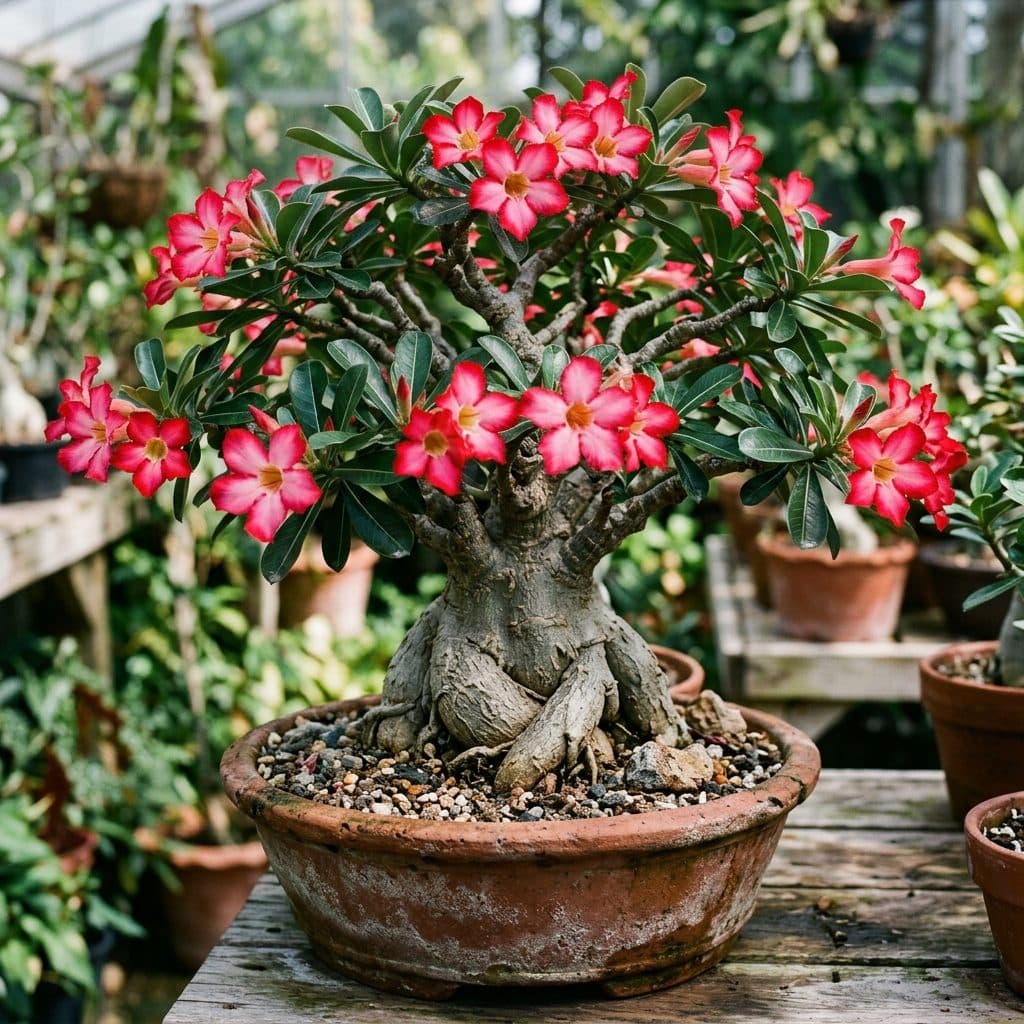
The most iconic morphological feature of Adenium obesum is its massive, swollen basal stem and root structure, known botanically as a caudex. In its native dry rocky habitats, this swollen reservoir stores water and nutrients, enabling the plant to endure months of extreme drought and intense solar radiation. When monsoon rains arrive, the shrub awakens, producing terminal rosettes of glossy, deep green leaves and covering itself in clusters of vivid scarlet, crimson, or pink blossoms.
Across South Asia, Southeast Asia, and arid subtropical regions worldwide, adenium has achieved status as a prized container specimen and living sculpture. Horticultural enthusiasts and bonsai artisans train the plant through selective pruning, root manipulation, and progressive repotting to expose the convoluted, sculptural caudex above the soil line. Because of its compact architecture, tolerance of dry indoor air, and long flowering season, it is a structural accent in xeriscape gardens, arid homestead patios, and greenhouse collections alongside other succulents such as aloe vera.
Growing adenium
Adenium is a tropical xerophyte that requires intense warmth and full sun to develop a compact, thick-stemmed growth habit and set flower buds. The plant is winter-hardy only in USDA Zones 10 to 12, suffering physiological chilling injury if temperatures drop below 10 °C (50 °F). Exposure to light frost causes immediate foliage collapse, stem necrosis, and fatal rotting of the swollen caudex. In temperate regions, adenium must be grown in containers that are moved outdoors during hot summer months and overwintered indoors in a warm, sunny room or heated greenhouse.
Light is the primary driver of growth and flowering. Site outdoor plants where they receive at least six hours of direct, unfiltered sunlight daily. Plants grown in partial shade or dim indoor positions produce elongated, weak, spindly branches, pale foliage, and few or no flowers, while the caudex fails to swell properly.
Soil management is the single most critical factor in cultivating adenium successfully. The plant cannot tolerate dense, moisture-retentive, or clay-heavy soils. The growing substrate must be hyper-porous and free-draining to prevent waterlogging. A standard potting mix for container cultivation consists of equal parts coarse river sand, pumice or perlite, volcanic scoria or gravel, and well-rotted leaf compost or coconut coir chips. Terracotta pots with large drainage holes are strongly preferred over glazed ceramic or plastic containers, as porous clay walls allow moisture to evaporate from the root zone.
Watering follows a strict "soak-and-dry" cycle during the active summer growing season. Water the container thoroughly until moisture drains freely from the base, then allow the potting substrate to dry out almost completely before watering again. During prolonged summer heatwaves with active growth, watering every two to three days may be required. In contrast, during cool winter dormancy, reduce watering drastically: moisten the soil only once every three to four weeks, or withhold water entirely if the plant drops its leaves and enters deep rest.
To develop an impressive, sculptural caudex, repot mature container plants every one to two years in early spring. During repotting, lift the plant slightly so that 2 to 5 cm (1 to 2 in) of the previously buried caudex and upper roots sits exposed above the new soil line. Over successive repottings, this technique exposes dramatic, swollen root architecture. Prune leggy branches back by one-third to one-half in late winter to encourage branching and dense flower clusters.
Harvest and uses
In contemporary horticulture, adenium is cultivated strictly as an ornamental specimen plant and structural landscape feature. Homesteaders and collectors harvest vegetative tip cuttings in early summer to propagate named flower cultivars, or practice wedge-grafting to attach double-flowered scions onto sturdy seedling rootstocks.
Historically, Adenium obesum possessed a dark ethnobotanical utility across sub-Saharan Africa. Indigenous hunters harvested and boiled the roots and thick stem bark to extract a concentrated, pitch-like decoction used to coat the tips of hunting arrows. This arrow poison was potent enough to fell large African game, including antelopes, elephants, and lions, within hours by inducing acute heart failure. In traditional veterinary medicine, highly diluted leaf preparations were applied externally as cattle washes to eliminate ticks and lice, often formulated alongside neem leaves.
Identifying adenium
Adenium obesum is easily identified by its unique succulent architecture:
- Caudex and habit: A pachycaul deciduous to semi-evergreen shrub reaching 1 to 3 m (3.3 to 10 ft) in height, featuring a massive, twisted, greyish-green to pale brown swollen basal caudex that can exceed 1 m (3.3 ft) in diameter with age.
- Branches: Thick, succulent, smooth grey branches containing clear to watery-milky sap when wounded.
- Foliage: Simple, spirally arranged, glossy dark green leaves measuring 5 to 15 cm (2 to 6 in) long and 1 to 4 cm (0.4 to 1.6 in) broad, with an obovate to oblanceolate shape and smooth margins, crowded in tight rosettes at branch tips.
- Flowers: Striking, terminal corymbs of showy, five-lobed trumpet-shaped flowers measuring 4 to 6 cm (1.5 to 2.4 in) across, with colours ranging from bright crimson and deep scarlet to pink and pure white, often featuring a paler or yellow throat.
- Fruit: Paired, cylindrical, pod-like follicles measuring 10 to 20 cm (4 to 8 in) long, splitting along one side to release numerous seeds tipped with long, silky plumose hairs that disperse on the wind.
Cautions
Anyone cultivating or handling Adenium obesum must exercise extreme caution regarding its systemic toxicity, irritating sap, and cultural vulnerabilities:
- Lethal cardiac glycoside toxicity: Every part of Adenium obesum—especially the clear-to-milky sap, root bark, and seeds—contains deadly cardiotoxic glycosides, including ouabain, digitalinum, odoroside H, and somalin. Ingestion causes acute cardiac disruption, severe heart arrhythmias, violent vomiting, profuse diarrhea, dizziness, lethargy, cardiac arrest, and fatal collapse. Keep plants completely out of reach of curious young children, dogs, cats, and livestock. If ingestion is suspected, seek emergency medical or veterinary intervention immediately.
- Severe sap contact irritation: The sap contains caustic chemical compounds that cause severe contact dermatitis, skin blistering, burning, and intense inflammation. If sap splashes into the eyes, it causes extreme pain, corneal irritation, and temporary vision impairment. Always wear impervious gloves and safety goggles when pruning, repotting, or taking cuttings. Thoroughly scrub shears and pruning knives with rubbing alcohol immediately after use.
- Fatal fungal caudex rot: The primary killer of cultivated adenium is root and caudex rot caused by soil-borne fungal pathogens (Phytophthora, Fusarium, and Pythium) triggered by overwatering or poorly draining soil. Fungal infection causes the firm, woody caudex to turn soft, spongy, and collapsed. If the base feels mushy to the touch, unpot the plant immediately, slice away all rotten tissue with a sterile blade until clean white flesh is reached, dust the wound with powdered sulphur or systemic fungicide, and allow the plant to callous dry in the shade for ten days before repotting in dry, gritty substrate.
- Chilling injury and winter rot: When exposed to cold, damp conditions below 10 °C (50 °F), adenium roots lose the ability to take up moisture and rot rapidly. Never water an adenium when temperatures are low.
Sources
- Royal Botanic Gardens, Kew. Adenium obesum (Forssk.) Roem. & Schult. Plants of the World Online.
- Plants For A Future. Adenium obesum - (Forssk.) Roem. & Schult.
- NC State Extension Plant Toolbox. Adenium obesum
- Missouri Botanical Garden. Adenium obesum