pioneer
African moringa
Moringa stenopetala
International hardiness
- USDA 10-11
- RHS H1b
- AU: Tropical, Subtropical, Arid / semi-arid
Where it grows — regional guide
| Zones / rating | Regional notes |
|---|---|
USDA 10-11 | Grown in frost-free regions of southern Florida, Hawaii, and the desert Southwest (Zones 10 to 11); intolerant of freezing cold and wet winter soils. |
| Zones / rating | Regional notes |
|---|---|
H1b (10 to 15C) | Suitable outdoors only in the Canary Islands and southernmost Mediterranean microclimates; killed outright by sub-zero winter frosts. |
| Zones / rating | Regional notes |
|---|---|
Tropical, Subtropical, Arid / semi-arid | Exceptional drought-hardy fodder and shade tree for tropical and arid zones of Western Australia and Queensland; highly susceptible to waterlogged root rot. |
| Zones / rating | Regional notes |
|---|---|
USDA 10-11 (USDA scale) Canada uses its own zone system; Canadian zones run roughly one lower than USDA. | No region-specific data yet |
| Zones / rating | Regional notes |
|---|---|
No region-specific data yet | No region-specific data yet |
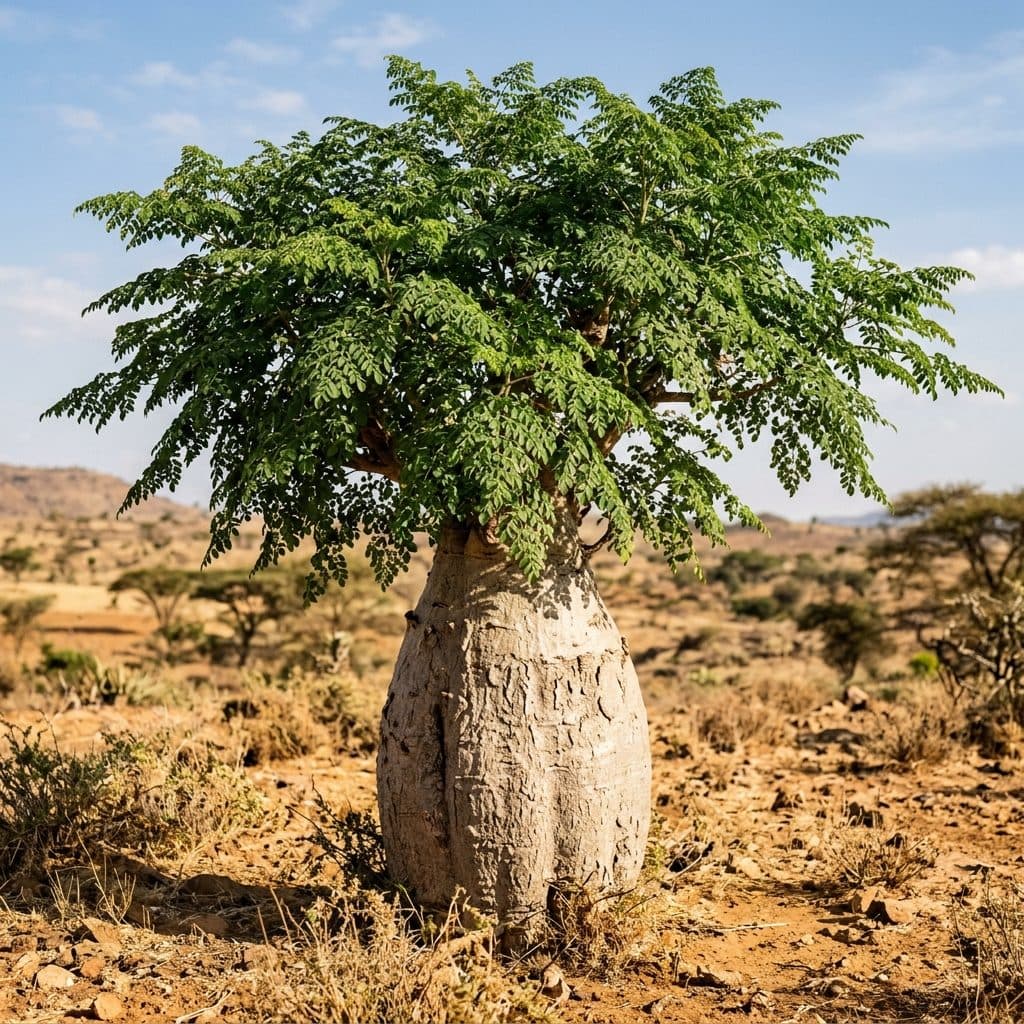
African moringa (Moringa stenopetala), widely known as the cabbage tree, African cabbage tree, or southern moringa, is an impressive, fast-growing pachycaul deciduous tree in the ben-oil tree family (Moringaceae). Endemic to the semi-arid lowlands, rocky Rift Valley terraces, and dry lake basins of southern Ethiopia and northern Kenya (chiefly surrounding Lake Turkana and Lake Baringo), the species has served for centuries as a vital indigenous agroforestry tree. Cultivated in terraced mountain home gardens by the Konso people of southwestern Ethiopia, Moringa stenopetala is a celebrated famine-buffer tree whose massive leaves furnish fresh, protein-rich vegetables during prolonged droughts when cereal crops wither. For warm-climate permaculture homesteaders and arid-zone food-forest practitioners, African moringa offers a larger-leafed, more drought-resilient counterpart to the familiar Indian drumstick tree.
Within multi-strata dryland agroforestry systems, Moringa stenopetala is an exceptional pioneer-to-secondary multipurpose canopy tree. Its swollen, water-storing bottle-like trunk and wide canopy provide essential light-filtering shade in sun-scorched environments. It integrates effectively into guild systems alongside regional relatives like moringa and Konkan moringa, creating an outstanding protein bank and living hedge. It also pairs harmoniously with tough dryland companions like pomegranate. In spring and early summer, mature trees produce panicles of sweetly scented cream flowers that draw dense gatherings of bees and beneficial insects, while periodic pollarding yields nutrient-rich leafy mulch to cool parched topsoils.
Growing African moringa
Moringa stenopetala is adapted to semi-arid tropical and subtropical climates characterised by high temperatures, intense sunshine, and distinct seasonal rainfall, performing reliably outdoors in USDA Hardiness Zones 10 through 11 and rated RHS H1b. The tree possesses minimal cold hardiness: foliage drops when temperatures fall below 5 °C (41 °F), and young branches are killed to the trunk by light frosts at 0 °C (32 °F). Mature trees survive brief, non-freezing cold snaps if the soil remains dry, but severe frost kills the tree outright. African moringa thrives under heat exceeding 40 °C (104 °F). Annual rainfall between 300 and 800 mm (12 and 31 in) is ideal; the swollen trunk stores vast volumes of moisture, allowing established specimens to flourish through six to eight months of continuous arid drought. Full sun exposure receiving at least six to eight hours of direct sunlight daily is mandatory.
Soil drainage is the absolute governing factor in successfully establishing Moringa stenopetala. The tree demands coarse, highly permeable, rocky, sandy, or gravelly soils with rapid water percolation. It thrives across a broad pH spectrum between 6.0 and 8.5, exhibiting notable tolerance to alkaline limestone, calcareous clays, and mildly saline soils. The species has zero tolerance for waterlogging: planting in heavy, unamended, compacted clays or poorly drained hollows leads inevitably to catastrophic collar rot and lethal Phytophthora root rot within days of heavy rainfall. On flat ground prone to standing water, always construct raised mounds or stony planting berms to safeguard the root collar.
Propagation is accomplished using fresh seeds or hardwood trimmings. Unlike Moringa oleifera, which bears winged seeds, the seeds of Moringa stenopetala are large, triangular, and enveloped in a soft, white, spongy papery coat. Seeds germinate rapidly within 7 to 14 days when planted 2 to 3 cm (0.8 to 1.2 in) deep in warm, well-draining sandy loam without prior soaking. Growth is phenomenal: seedlings frequently reach 2 to 3 m (6.6 to 10 ft) in height during their first year, developing a basal swelling within months. Large branch cuttings measuring 1 to 2 m (3.3 to 6.6 ft) in length can also be planted directly into garden soil at the onset of rains. Space trees 3 to 4 m (10 to 13 ft) apart in agroforestry alleys, or 1 to 1.5 m (3.3 to 5 ft) apart in edible hedges. Regular pollarding at 1.5 to 2 m (5 to 6.6 ft) stimulates dense, bushy leaf production and keeps foliage accessible.
Harvest and uses
African moringa is celebrated primarily for its bountiful, nutrient-dense edible foliage. In contrast to the delicate, tiny leaflets of Moringa oleifera, the leaves of Moringa stenopetala are significantly larger, thicker, and fleshier, remaining on the branch longer into dry spells before falling.
Leaves and tender branch tips are harvested by hand throughout the year, stripping fresh green leaflets from woody central rachises. In traditional Konso cooking, the leaves are boiled for 15 to 25 minutes—often with a pinch of wood ash or salt to soften the texture—and served as a savoury, spinach-like vegetable dressed with oil and chillies. The cooked leaves possess a mild, pleasant flavour resembling collard greens or cabbage, lacking the pungent mustard-radish bite typical of M. oleifera. Fresh leaves are also dried in the shade and ground into a shelf-stable, high-protein green powder utilised to enrich homesteader porridges, soups, and breads.
Mature dried seeds are pressed to extract ben oil—a clear, sweet, non-drying edible oil rich in oleic acid that resists rancidity. A mature, well-pollarded tree yields 15 to 30 kg (33 to 66 lb) of fresh edible leaves annually.
Identifying African moringa
Moringa stenopetala is readily distinguished from other moringa species by several prominent morphological traits:
- Habit and trunk: A small to medium-sized pachycaul deciduous tree growing 6 to 12 m (20 to 40 ft) in height with an expansive crown. The most iconic field feature is the swollen, bottle-shaped, smooth trunk, which often reaches 60 to 100 cm (2 to 3.3 ft) in diameter at breast height. The bark is smooth, pale greyish-silver to yellowish-green, exuding a translucent gum when slashed.
- Leaves: Alternate, bipinnately to tripinnately compound leaves measuring 30 to 60 cm (12 to 24 in) in length. Individual leaflets are broadly elliptic to ovate, measuring 2.5 to 5 cm (1 to 2 in) long and 1.5 to 3 cm (0.6 to 1.2 in) wide—substantially larger than the leaflets of M. oleifera (which rarely exceed 2 cm [0.8 in]). Leaflets have entire margins, obtuse tips, and a smooth, dark green surface.
- Flowers: Borne in dense, spreading, axillary panicles up to 60 cm (24 in) long. The blossoms measure about 1.5 cm (0.6 in) across, with five narrow, reflexed, creamy-white or pale yellow petals and prominent white filaments, releasing a sweet floral scent.
- Fruit: Elongated, grooved, cylindrical three-valved capsules (pods) measuring 20 to 50 cm (8 to 20 in) long and 2 to 3 cm (0.8 to 1.2 in) wide, drying to woody brown and splitting lengthwise to release triangular seeds enclosed in spongy white coats.
African moringa is easily distinguished from Indian moringa (Moringa oleifera) by its dramatically swollen bottle trunk, substantially larger and broader leaflets, and seeds wrapped in a thick spongy casing rather than thin membranous wings.
Cautions
Cultivators and foragers of Moringa stenopetala must heed several critical toxicological, reproductive, and cultural cautions:
- Severe root and bark toxicity (spirochin alkaloids): The root system, root bark, and trunk bark of Moringa stenopetala contain dangerous concentrations of toxic alkaloids, predominantly spirochin and pterygospermin. Ingestion of roots or root decoctions induces acute central nervous system depression, profound hypotension, bradycardia, paralysis of the vagus nerve, and fatal cardiac arrest. Unlike the roots of M. oleifera (which were historically used in tiny culinary doses as a horseradish substitute), the roots and bark of M. stenopetala are dangerously toxic and must never be ingested under any circumstances.
- Uterotonic and abortifacient hazards: Chemical constituents within the roots, inner bark, and excessive unripe seeds provoke violent uterine contractions. Traditional medicine utilises these extracts as abortifacients; therefore, consumption of root or bark products is strictly contraindicated during pregnancy, as it presents a severe risk of inducing miscarriage.
- Waterlogging and root rot fatality: Moringa stenopetala is exquisitely susceptible to root asphyxiation and collar rot in poorly drained soils. Planting in heavy clay or exposing trees to continuous seasonal flooding causes rapid fungal infection, structural trunk softening, and total plant mortality within a matter of days.
- Brittle wood hazard: The rapid-growing, water-filled, soft spongy wood of African moringa possesses low shear strength. Heavy canopy branches snap easily under severe gale-force winds. Practice regular pollarding and avoid planting trees close to buildings, animal shelters, or overhead utility lines.
Sources
- Royal Botanic Gardens, Kew. Moringa stenopetala (Baker f.) Cufod. Plants of the World Online.
- USDA PLANTS Database. Moringa stenopetala (Baker f.) Cufod.
- Plants For A Future. Moringa stenopetala - (Baker f.)Cufod.
- Feedipedia. Moringa stenopetala