secondary
Cape gooseberry
Physalis peruviana
International hardiness
- USDA 9-11
- RHS H2
- AU: Subtropical, Warm temperate, Tropical
Where it grows — regional guide
| Zones / rating | Regional notes |
|---|---|
USDA 9-11 | Treated as a summer annual across USDA Zones 4 to 8, or perennial in Zones 9 to 11; do not plant near wild riparian areas in Hawaii and California where it naturalises. |
| Zones / rating | Regional notes |
|---|---|
H2 (1 to 5C) | Start seeds indoors under heat in early spring and transplant after all frost risk has passed; best grown against a warm south-facing wall or in a greenhouse. |
| Zones / rating | Regional notes |
|---|---|
Subtropical, Warm temperate, Tropical | Performs reliably in subtropical and warm-temperate regions; monitor plants in wet coastal areas where self-sown seeds can establish in disturbed pastures. |
| Zones / rating | Regional notes |
|---|---|
USDA 9-11 (USDA scale) Canada uses its own zone system; Canadian zones run roughly one lower than USDA. | Cultivate as a fast-maturing container annual in sheltered sunny microclimates, starting seeds indoors eight weeks before the last spring frost date. |
| Zones / rating | Regional notes |
|---|---|
No region-specific data yet | No region-specific data yet |
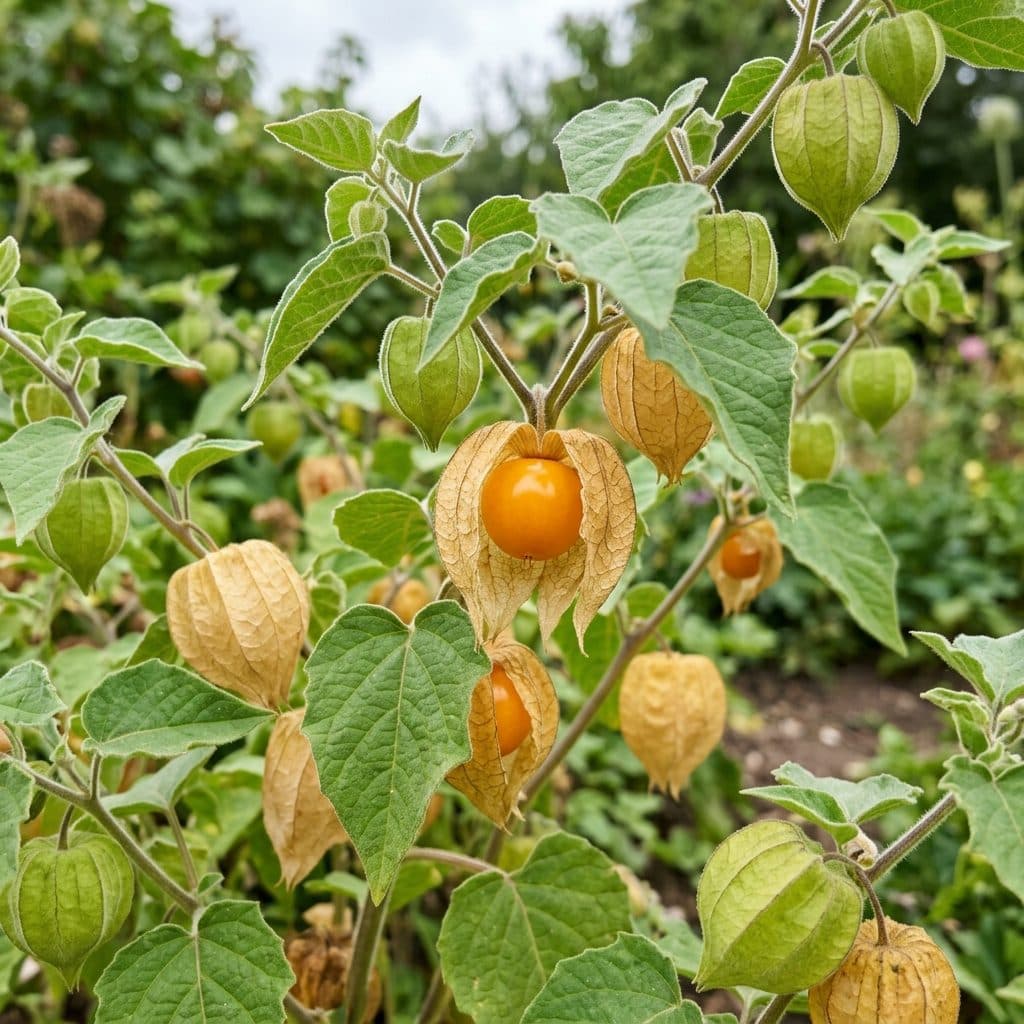
Cape gooseberry (Physalis peruviana), also known as goldenberry, Peruvian groundcherry, and poha berry, is a tender perennial nightshade shrub (Solanaceae). Native to high-altitude Andean valleys in Colombia, Ecuador, and Peru, this productive species spread globally via nineteenth-century trade routes. The plant produces round, golden-orange berries encased in papery, lantern-like calyx husks.
In homestead gardens and edible food forests, Physalis peruviana is a versatile secondary-stratum fruiting shrub or productive summer annual. Growing 1 to 1.8 m (3.3 to 6 ft) high, it integrates well alongside companion crops like the garden tomato, pungent chili pepper bushes, and sprawling groundcovers like sweet potato. The inflated husks protect developing fruit from adverse weather, pest insects, and premature bird damage, conferring superior post-harvest shelf life.
The berries deliver a sweet-tart flavour blending apricot, mango, and passionfruit with bright citrus acidity. Rich in dietary fibre, vitamins A and C, and antioxidant polyphenols, they yield dependable autumn nutrition.
Growing Cape gooseberry
Physalis peruviana is frost-sensitive, growing as a perennial across USDA Hardiness Zones 9 through 11 with an RHS hardiness rating of H2. Temperatures below -1 °C (30 °F) destroy succulent foliage and stems. In temperate zones (USDA Zones 4 through 8), growers cultivate it as a summer annual matching standard tomato schedules.
The crop requires full sun for abundant flowering and sugar development. It thrives across diverse well-drained soils, including sandy loams, gravels, and poor rocky ground with a pH of 5.5 to 7.0. Overly fertile or nitrogen-heavy soils cause excessive vegetative foliage at the expense of fruit set. Avoid heavy manure or high-nitrogen fertilisers.
Good soil drainage is essential; saturated ground promotes crown and root rot. Consistent moderate moisture prevents fruit cracking, though established plants withstand short dry spells. Mulch beds with 5 to 7.5 cm (2 to 3 in) of clean straw to retain uniform moisture.
Sow seeds indoors six to eight weeks before the last spring frost, planting 5 mm (0.2 in) deep at 20 to 24 °C (68 to 75 °F) for emergence within ten to fourteen days. Alternatively, root semi-ripe cuttings in late summer to overwinter stock indoors. Transplant outdoors once night temperatures consistently exceed 10 °C (50 °F).
Space plants 0.9 to 1.5 m (3 to 5 ft) apart in rows spaced 1.5 to 1.8 m (5 to 6 ft) apart. As hollow stems become top-heavy under heavy crops, provide bamboo stakes or wire cages. Pinch growing tips at 30 cm (12 in) to encourage lateral branching.
Harvest and uses
Cape gooseberry plants commence cropping roughly 90 to 120 days after transplanting, yielding 1 to 3 kg (2.2 to 6.6 lb) of fruit per bush throughout the harvesting window. Fruiting occurs continuously from mid-summer until the first autumn frost in temperate climates, and year-round in frost-free subtropical districts.
The fruit is a spherical, smooth-skinned berry measuring 1.2 to 2 cm (0.5 to 0.8 in) in diameter, enclosed within a ten-ribbed, five-angled accrescent calyx measuring 3 to 5 cm (1.2 to 2 in) long. Berries must be harvested strictly when fully mature. Immature green berries contain bitter alkaloids and are unsafe to consume. Harvest commences when the surrounding papery husks turn pale straw-yellow, dry, and brittle, and the internal fruit shifts from green to a rich, uniform golden-orange hue.
Ripe fruit naturally drops to the ground in its papery shell. Pick fallen husked berries from dry mulch or gently detach dry lanterns by cutting the pedicel with shears. Keep the papery calyx intact during post-harvest handling; intact husks protect the fruit from physical bruising and fungal decay, allowing sound berries to store at 10 to 15 °C (50 to 59 °F) in dry, well-ventilated crates for four to eight weeks, or under refrigeration at 2 to 4 °C (36 to 39 °F) for up to three months.
Culinary applications are varied:
- Fresh consumption: Peel back or twist off the dry papery calyx to enjoy the raw golden berry out of hand, skin and tiny edible seeds included.
- Preserves and sauces: The high natural pectin and balanced acidity make Cape gooseberries outstanding for cooking into piquant jams, jellies, savoury chutneys, and glazes for roasted meats.
- Desserts: Dipped in dark chocolate with the calyx folded back as a decorative handle, fresh berries make an elegant dessert garnish.
- Dehydrated fruit: Dried gently in a dehydrator at 45 to 50 °C (113 to 122 °F), the berries shrink into tangy, chewable Inca berries, prized in trail mixes and granola.
Identifying Cape gooseberry
Physalis peruviana displays several characteristic taxonomic hallmarks:
- Habit: An erect, sprawling, multi-branched perennial subshrub growing 1 to 1.8 m (3.3 to 6 ft) high and 1 to 1.5 m (3.3 to 5 ft) wide, with ribbed, herbaceous, softly pubescent stems that become woody at the base.
- Foliage: Alternate, heart-shaped (cordate) to ovate leaves measuring 6 to 15 cm (2.4 to 6 in) long and 4 to 10 cm (1.6 to 4 in) wide. The blade surfaces and petioles are densely clothed in soft, velvety trichomes, giving the plant a distinctive greyish-green cast.
- Flowers: Solitary, nodding, bell-shaped blossoms borne in leaf axils, measuring 1.5 to 2 cm (0.6 to 0.8 in) across. The corolla is pale yellow to creamy-amber, accented by five prominent brownish-purple blotches at the throat, surrounded by a pubescent calyx with five pointed teeth.
- Fruit: An accrescent, inflated papery calyx (bladder) 3 to 5 cm (1.2 to 2 in) long, encasing a single round, succulent, two-celled berry 1.2 to 2 cm (0.5 to 0.8 in) across that ripens to luminous golden-orange, packed with dozens of minute, flat, straw-coloured seeds.
Cape gooseberry is distinguished from tomatillo (Physalis philadelphica) by its smaller, sweet golden fruit, densely velvety foliage (tomatillos possess glabrous or sparsely hairy leaves), and distinctly perennial nature. It differs from Chinese lantern (Alkekengi officinale, formerly Physalis alkekengi) by producing edible yellow-orange fruit rather than unpalatable scarlet berries encased in brilliant bright-orange ornamental husks.
Cautions
Growers should observe several essential health, ecological, and horticultural cautions before cultivating Physalis peruviana:
- Solanine and alkaloid toxicity in green plant parts: As a solanaceous species, all vegetative components of Physalis peruviana—including leaves, stems, roots, and unripened green fruit—contain toxic glycoalkaloids (primarily solanine) and bitter withanolides. Ingesting unripe berries or foliage causes gastrointestinal irritation, vomiting, diarrhoea, abdominal cramping, and headaches in humans and domestic pets. Only fully ripe, golden-orange berries harvested from dry, straw-coloured calyxes are safe for consumption.
- Ecological weed potential and invasive spread: In frost-free subtropical and tropical zones, Physalis peruviana readily escapes domestic cultivation. Frugivorous birds and mammals feed on fallen fruit and disperse seeds across disturbed pastures, riparian riverbanks, and native bushland. The species has become naturalised and classified as an environmental or agricultural weed in parts of Hawaii, coastal California, eastern Australia, and New Zealand. Contain plantings in suburban beds and promptly harvest ripe fruit to prevent bird dispersal into natural ecosystems.
- Soil-borne pathogen vulnerability: Physalis peruviana is susceptible to common solanaceous soil pathogens, including Verticillium wilt, Fusarium oxysporum, bacterial wilt (Ralstonia solanacearum), and tomato spotted wilt virus (TSWV). Practice a strict four-year crop rotation, avoiding garden plots previously planted with tomatoes, potatoes, aubergines, or capsicums.
- Physical brittleness: Stems are hollow and brittle, snapping readily under heavy fruit loads or turbulent thunderstorm winds without external staking.
Sources
- Royal Botanic Gardens, Kew. Physalis peruviana L. Plants of the World Online.
- USDA PLANTS Database. Physalis peruviana L., Peruvian groundcherry
- Plants For A Future. Physalis peruviana - L.
- Royal Horticultural Society. Physalis peruviana (Cape gooseberry)
- Purdue University Center for New Crops & Plant Products. Cape Gooseberry (Physalis peruviana) Fruits of Warm Climates.