pioneer
Pongamia karanja
sukh chain (سکھ چین) / karanj (کرنج)
Pongamia pinnata
- punjab plains
- sindh coast
- pothohar
International hardiness
- USDA 10-12
- RHS H1c
- AU: Tropical, Subtropical, Warm temperate
Where it grows — regional guide
| Zones / rating | Regional notes |
|---|---|
USDA 10-12 | Restricted to frost-free microclimates in southern Florida and Hawaii; keep away from drainage canals to prevent naturalised thickets. |
| Zones / rating | Regional notes |
|---|---|
H1c (5 to 10C) | No region-specific data yet |
| Zones / rating | Regional notes |
|---|---|
Tropical, Subtropical, Warm temperate | Native to northern tropical estuaries; valued for coastal windbreaks and salinity control, but monitor seed spread in wetland nature reserves. |
| Zones / rating | Regional notes |
|---|---|
USDA 10-12 (USDA scale) Canada uses its own zone system; Canadian zones run roughly one lower than USDA. | No region-specific data yet |
| Zones / rating | Regional notes |
|---|---|
Punjab plains, Sindh coast, Pothohar | Pakistan:Commonly cultivated as sukh chain along roads in Lahore and Karachi; withstands extreme heat and salinity, but plant away from sewer lines and watch for toxic fallen seeds. India:Extensively planted for karanja oil extraction, bio-pesticides, and green leaf manuring; avoid planting in pastures where livestock could browse fallen seeds. |
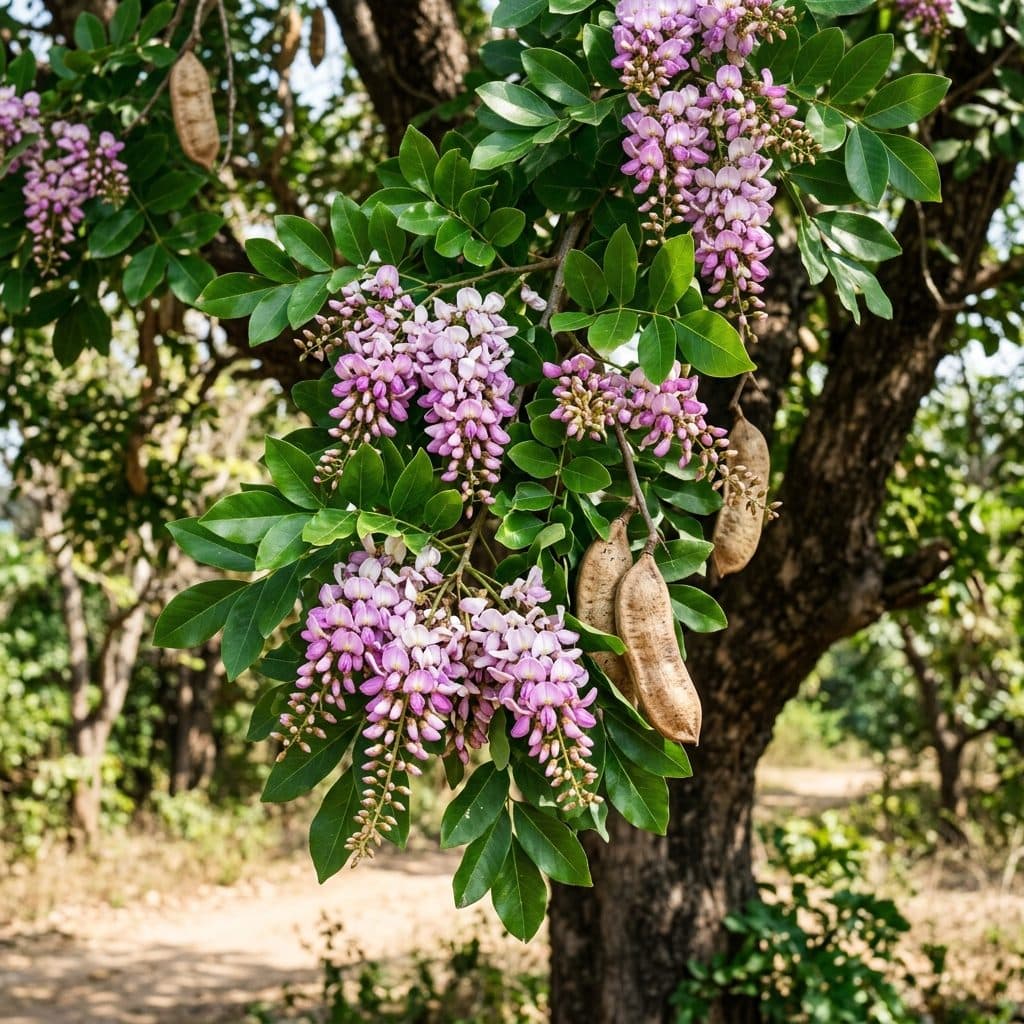
Pongamia karanja (Pongamia pinnata), widely classified in modern botanical literature under its accepted synonym Millettia pinnata, is a resilient, medium-sized legume tree in the family Fabaceae. Known in South Asia by its vernacular names karanj and sukh chain, the species is native to tropical and subtropical Asia, northern Australia, and the Pacific Islands. Characterised by a dense canopy of lustrous green foliage, fragrant pea-like pink and white flowers, and thick woody pods, it has gained international prominence as a multipurpose agroforestry species, coastal buffer tree, and sustainable biofuel feedstock.
In ecological restoration and homestead design, Pongamia pinnata excels as a durable nitrogen-fixing pioneer. Its root architecture associates with efficient rhizobial strains, contributing substantial atmospheric nitrogen to surrounding topsoil. The tree possesses exceptional tolerance to soil salinity, waterlogging, and extended drought, allowing it to stabilise coastal sands, tidal riverbanks, and saline-sodic wasteland soils where companion trees like neem or jamun struggle. Its heavy leaf drop creates rich humus that improves organic soil structure. However, all vegetative and reproductive parts contain toxic defensive compounds that demand disciplined livestock management.
Growing pongamia karanja
Pongamia thrives in humid to sub-humid tropical and subtropical climates, hardy within USDA Zones 10 through 12 and rated RHS H1c. It tolerates brief seasonal temperature drops to 0 °C (32 °F) once established, but prolonged freezing temperatures cause severe stem dieback or death. The tree flourishes in regions with annual precipitation ranging from 500 to 2,500 mm (20 to 100 in), surviving harsh seasonal dry periods of five to six months by drawing moisture through deep lateral roots.
Soil adaptability is outstanding. The species prospers in deep alluvial loams, heavy river clays, loose coastal sands, and saline estuaries across pH levels from 5.0 to 8.6. It survives seasonal inundation with fresh or brackish water for several weeks, making it ideal for drainage ditches, pond borders, and stormwater catchment basins. Maximum performance occurs in full sun; saplings tolerate light understorey shade during early establishment but quickly require open overhead light to develop heavy floral racemes and straight central leaders.
Trees grow moderately to rapidly, reaching heights of 12 to 20 m (40 to 65 ft) with an umbrella-like canopy spreading 10 to 15 m (33 to 50 ft). Propagation is straightforward from seed. Mature woody pods are cracked to extract the single oily seed, which germinates in 10 to 20 days when sown directly into warm nursery beds or deep containers without pre-treatment. Fresh seeds exhibit germination rates exceeding 80%. Semi-hardwood cuttings and branch air layering also establish readily for clonal replication of high-yielding biofuel mother trees. For orchard or agroforestry plantation spacing, plant trees at 6 by 6 m (20 by 20 ft) to facilitate mechanical seed harvesting.
Harvest and uses
The principal commercial and homestead harvest consists of the mature woody pods. Individual mature trees yield 20 to 50 kg (44 to 110 lb) of seed pods annually. The thick, leathery pods turn greyish-brown upon ripening and fall to the ground, where they are gathered by hand. Air-dried seeds yield 30 to 40 percent of a thick, bitter, pungent, reddish-brown oil known commercially as karanja oil or pongam oil.
Karanja oil contains high concentrations of triglycerides and oleic acid, making it a valuable raw material for biodiesel production that meets international diesel fuel standards without diverting food crops. Traditionally, the oil is extracted via cold expeller pressing for lighting lamps, lubricating rustic machinery, and formulating organic horticultural sprays. The oil displays potent insecticidal, acaricidal, and antifungal properties against aphids, whiteflies, and powdery mildew.
The timber of Pongamia pinnata is moderately hard, fine-grained, and yellowish-white, weighing approximately 650 to 750 kg per cubic metre (40 to 47 lb per cubic foot). While non-durable in direct soil contact due to beetle susceptibility, the wood seasons well and serves for cabinetwork, cart yokes, tool handles, and packing cases. Pruned branches provide dense, high-heat firewood and quality charcoal. The press cake remaining after oil extraction is rich in nitrogen and phosphorus, acting as an exceptional organic fertiliser when incorporated into soil, though its bitter compounds make it unsafe as animal fodder unless chemically detoxified.
Identifying pongamia karanja
Pongamia pinnata can be identified reliably in the field by these morphological characteristics:
- Bark and trunk: The trunk is covered with smooth to shallowly fissured greyish-brown bark, often exhibiting horizontal lenticular ridges. Older trees produce an attractive, gnarled basal trunk with thick, spreading buttress roots.
- Leaves: Alternate, odd-pinnately compound leaves measuring 15 to 30 cm (6 to 12 in) long, comprising 5 to 7 (rarely 9) leaflets. Leaflets are ovate to elliptic, 5 to 12 cm (2 to 5 in) long, with an acute tip and rounded base. The leaf surface is hairless, glossy emerald green above, and slightly paler beneath.
- Flowers: Short, pendant axillary racemes 8 to 20 cm (3 to 8 in) long, carrying clusters of fragrant, pea-like flowers measuring 1.2 to 1.5 cm (0.5 to 0.6 in) across. Petals range from pinkish-white to pale lilac with a greenish-white calyx tube. Flowering peaks in late spring and early summer.
- Fruit: Elliptic to oblong, compressed, woody pods measuring 4 to 7 cm (1.6 to 2.8 in) long, 2 to 3 cm (0.8 to 1.2 in) wide, and 1 cm (0.4 in) thick, tipped with a short curved beak. The indehiscent pods contain one (rarely two) kidney-shaped, oily, wrinkled brown seed.
The species differs from Derris indica primarily in its solitary, indehiscent woody pods that do not split open upon drying, and its larger, glossy leaflets.
Cautions
Growers intending to plant Pongamia pinnata must account for several critical safety, ecological, and structural factors:
- Toxicity of seeds and oil: The seeds, crude oil, roots, and bark contain toxic furanoflavonoids, including karanjin, pongapin, and pinnatin. Ingestion by humans, cattle, horses, or pets causes severe gastrointestinal irritation, vomiting, abdominal colic, and central nervous depression. The raw seed cake must never be fed to livestock without rigorous chemical debittering. Furthermore, crushed seeds and root extracts act as powerful piscicides (fish poisons); avoid washing seed-processing equipment near aquaculture ponds, natural streams, or farm reservoirs.
- Invasive spread in riparian corridors: The buoyant, woody pods float on fresh and marine waters, dispersing over long distances along rivers and ocean currents. In northern Australia and South Florida, the species has naturalised along wetland margins and mangrove edges, occasionally outcompeting native coastal vegetation. Do not plant near pristine natural waterways. Verify local municipal and conservation regulations before introducing the tree.
- Surface root damage: The tree produces aggressive, shallow lateral roots that break asphalt, lift concrete pavements, and invade underground sewer lines. Plant at least 8 m (26 ft) away from domestic foundations, driveways, and septic drain fields.
- Leaf and pod litter: The heavy annual shedding of dense foliage and woody pods generates substantial ground litter that requires periodic clearing on managed lawns and driveways.
Sources
- Royal Botanic Gardens, Kew. Pongamia pinnata (L.) Pierre Plants of the World Online.
- USDA PLANTS Database. Pongamia pinnata (L.) Pierre - Pongam oiltree
- Plants For A Future. Pongamia pinnata - (L.)Pierre.
- University of Florida IFAS Assessment. Pongamia pinnata
- University of Florida IFAS Extension. Pongamia pinnata - Pongam