Key takeaways

Solar battery storage transforms a daytime solar array into a 24-hour power supply, offering resilience and independence from the grid.
- A solar-plus-storage system is a battery charged by your panels — the U.S. Department of Energy frames it as DC from the panels, stored as DC, then inverted to the AC your house runs on.
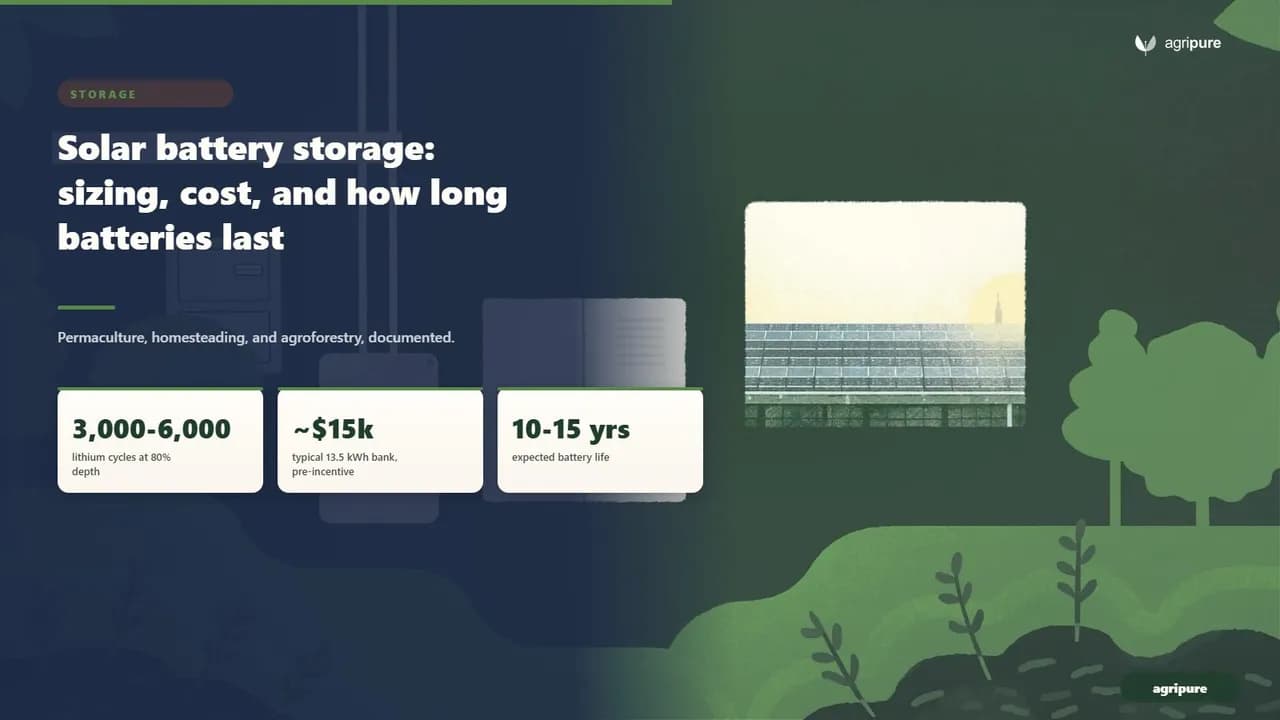
- Lithium iron phosphate (LiFePO4) is now the default home chemistry: roughly 3,000 to 6,000 cycles at 80% depth of discharge and over 95% efficiency, against 300 to 500 cycles and a 50% discharge limit for lead-acid.
- Size the bank by arithmetic: bank kWh = daily load × days of autonomy ÷ usable depth of discharge. A 10 kWh/day home needs about 12.6 kWh of lithium or 24 kWh of lead-acid per day of autonomy.
- Most lithium solar batteries are warrantied to hold 70% of their capacity for 10 to 12 years, with a real-world life of 10 to 15 years.
- Storage is not cheap: EnergySage pegs a typical 13.5 kWh home battery near $15,228 before incentives, and payback runs longer than solar alone — about 5 years at best where state incentives are strong.
- If you have full net metering and a reliable grid, you may not need a battery at all. Storage earns its keep on backup, time-of-use rates, and going off-grid.
A homestead at the end of a long line learns the value of stored power the first time an ice storm drops the grid for 3 days. Panels alone go dark the moment the sun does: a grid-tied array without storage shuts off in an outage by design. Solar battery storage is what turns a daytime generator into a 24-hour power supply, and it is also the single most expensive box in most home solar projects. This guide covers how a solar panel battery works, how lithium and lead-acid compare, how to size a battery bank in kWh, how long batteries last, and what storage costs against what it pays back. The honest answer to “do I need it?” is sometimes no, and we will say so where the numbers say so.
How solar battery storage works
Strip away the brand names and the idea is simple. The Department of Energy defines a solar-plus-storage system as “a battery system that is charged by a connected solar system, such as a photovoltaic (PV) one.” The panels make more power at noon than a house uses; the battery banks the surplus and hands it back after dark. That is the whole job of a solar energy battery — move midday sunshine to evening load.
Current flow is worth getting right because it decides what hardware you buy. As the DOE puts it, “DC, or direct current, is what batteries use to store energy and how PV panels generate electricity. AC, or alternating current, is what the grid and appliances use.” So a battery for solar panel storage lives on the DC side, and somewhere between the panels and your outlets, an inverter has to translate roughly 48 V of stored DC into the 120/240 V AC a house runs on. The underlying physics of that DC generation is covered in our explainer on how a solar panel actually works.
AC-coupled vs DC-coupled
There are two ways to wire storage into a system, and the difference is where the inverter sits. The DOE describes a DC-coupled system as one that “needs a bidirectional inverter to connect battery storage directly to the PV array,” while an AC-coupled system “needs a bidirectional inverter and a PV inverter.” In plain terms: DC-coupled keeps the power in DC from panel to battery and converts once, which is marginally more efficient and the usual choice for a new off-grid build. AC-coupled converts panel power to AC, then back to DC to charge — a small double-conversion penalty, but it is the simplest way to bolt a battery onto an existing grid-tied array.
Cost tracks that layout too. The DOE notes that “the cost of the co-located, DC-coupled system is 8% lower than the cost of the system with PV and storage sited separately, and the cost of the co-located, AC-coupled system is 7% lower.” The lesson for a homeowner adding a solar panel battery bank: integrating storage with the array beats bolting on a separate system later, and if you are building fresh, DC-coupled is the tidier path.
Quick rule: building new and off-grid, go DC-coupled for the efficiency edge. Adding storage to an array you already own, go AC-coupled — it is the lower-friction retrofit, and the DOE’s own figures put the cost penalty at roughly one percentage point.
Lithium vs lead-acid: the chemistry that decides everything
Every other number in this article bends around one choice — which chemistry sits in the box. For decades off-grid homes ran flooded lead-acid; today lithium solar batteries, specifically lithium iron phosphate (LiFePO4 or LFP), have taken over, and the spec sheet shows why.

Cycle life and depth of discharge
A battery’s life is measured in cycles, not years, and the two chemistries are not close. SolaX Power reports that “a LiFePO4 solar battery typically offers 3,000 to 6,000 cycles at 80% Depth of Discharge (DoD),” while “a lead acid battery usually provides only 300 to 500 cycles.” That is roughly a tenfold gap before the battery is worn out.
Depth of discharge (how much of the battery you can use) widens the gap further. Lead-acid, per SolaX, “should generally not be discharged beyond 50%,” so half its nameplate is off-limits if you want it to last. LiFePO4 batteries can be safely discharged up to 80-100%. A nominal 10 kWh lead-acid bank gives you 5 usable kWh; a 10 kWh lithium bank gives you 8 or more. You are buying usable energy, not nameplate, and that is where lithium wins on a per-dollar basis despite the higher sticker.
Efficiency and lifespan
Round-trip efficiency is the energy you get back out divided by what you put in, and it is money lost as heat. SolaX puts LiFePO4 energy efficiency at “over 95%” against lead-acid’s “around 50-95%” — a real lithium-ion solar battery typically lands near 90% round-trip in practice, while a tired lead-acid bank can waste a fifth of every charge. Over a decade of daily cycling, that efficiency gap alone pays for a chunk of the chemistry upgrade.
Calendar life follows. SolaX lists a LiFePO4 battery at 10 to 15 years versus 3 to 5 years for lead-acid, and Solar.com agrees that “the lithium-ion solar batteries being made today have an expected operational lifespan of 10 to 15 years.” For most homeowners the verdict is settled: unless the budget is brutally tight, lithium iron phosphate is the chemistry to buy. The table below lays the two side by side.
Spec | Lithium (LiFePO4) | Lead-acid (deep cycle) |
|---|---|---|
Cycle life | 3,000-6,000 (at 80% DoD) | 300-500 |
Usable depth of discharge | 80-100% | ~50% |
Round-trip efficiency | Over 95% (≈90% real-world) | ~50-95% |
Calendar life | 10-15 years | 3-5 years |
Usable kWh per 10 kWh nameplate | 8+ kWh | ~5 kWh |
How to size a battery bank
Sizing is the question every off-grid builder gets wrong first — usually by guessing high and overspending, or guessing low and sitting in the dark. It is not mysticism; it is one equation. Bank kWh = daily load (kWh) × days of autonomy ÷ usable depth of discharge, with a small efficiency fudge factor on top.
A worked 10 kWh/day example
AltE Store publishes the cleanest worked numbers, and they show the chemistry gap directly. For a home using 10 kWh a day, lead-acid sizing runs “10 kWh × 2 (for 50% depth of discharge) × 1.2 (inefficiency factor) = 24 kWh,” while lithium sizing runs “10 kWh × 1.2 (for 80% depth of discharge) × 1.05 (inefficiency factor) = 12.6 kWh.” Same house, same load — and the lithium bank is barely half the nameplate kWh because you can actually use more of it.
To turn kWh into the amp-hours a battery is rated in, divide by system voltage. AltE gives the clean conversion: “24 kWh = 500 amp hours at 48 volts.” Higher system voltage (48 V over 12 V) means thinner wire and less loss, which is why whole-home banks have largely moved to 48 V while a 12v solar battery charger and a small 12 V bank still rule for an RV, a van, or a single shed.
Step | Lead-acid (50% DoD) | Lithium (80% DoD) |
|---|---|---|
Daily load | 10 kWh | 10 kWh |
Sizing factor | × 2.0 × 1.2 | × 1.2 × 1.05 |
Nameplate bank (1 day) | 24 kWh | 12.6 kWh |
At 48 V | ~500 Ah | ~260 Ah |
Off-grid (3 days) | ~72 kWh | ~38 kWh |
Days of autonomy: backup vs off-grid
The lever that swings bank size most is days of autonomy — how long the bank must carry the house with no sun. The two use cases pull in opposite directions:
- Backup / time-of-use (grid present): one evening to one day is plenty. The grid covers the rare deep-cloud stretch, so a single Powerwall-class unit near 13.5 kWh handles essentials for most homes.
- Full off-grid (no grid): AltE notes “most off-grid systems aim for 2-3 days of autonomy (storage for cloudy days).” Triple the bank, and budget accordingly — this is where storage costs balloon.
That single number (1 day versus 3) can triple your battery spend, so be honest about which case you are in. If you are sizing the panels that feed this bank, our guide to sizing the array for off-grid living covers the generation side; this piece owns the storage side.
How long solar batteries last
“How long do solar batteries last” is really two questions: how many cycles, and how many warranty years. Both matter, and manufacturers hedge their bets across both.
Cycles, warranties, and capacity fade
By cycle count, lithium iron phosphate is in a class of its own. Solar.com lists LFP at 1,000 to 10,000 cycles versus 500 to 1,000 for older non-LFP lithium chemistries, and the SolaX figure of 3,000 to 6,000 cycles at 80% DoD sits comfortably inside that band. At one cycle a day, even the low end clears 8 years.
Warranties translate cycles into a promise you can hold a vendor to. Solar.com reports that “modern solar battery warranties typically guarantee 70% of nameplate capacity after 10-12 years or a certain number of cycles or throughput.” A 10 kWh battery is expected to fade to about 7 kWh of usable capacity by the end of its warranty without failing completely. Batteries degrade gradually; they rarely fail outright. When you compare two solar panel batteries, compare the guaranteed end-of-warranty capacity and the cycle cap, not just the headline year count.
What a 10-year warranty means: the maker guarantees the battery will still hold about 70% of its rated kWh at year 10. A well-treated lithium bank often keeps working at reduced capacity for years past the warranty; plan the swap for year 12 to 15.
The practical takeaway: a quality lithium bank installed today should run 10 to 15 years, hold most of its capacity for the first decade, and then keep working at reduced capacity for years after. Plan the replacement at year 12 to 15, not year 5.
What solar battery storage costs
This is where enthusiasm meets the invoice. Storage is the priciest single component in most home solar projects, and the per-kWh solar battery cost is the number to anchor on.

Cost per kWh and total system
EnergySage data puts a typical home battery (about 13.5 kWh, the size of a Tesla Powerwall 3) at “$15,228 before any available incentives.” Per kWh of capacity, installed prices range widely by brand: EnergySage notes the most affordable units run “about $706/kWh” while the priciest land near “$1,437/kWh,” with state-by-state averages spanning roughly $777 to $1,730 per kWh. A solar power battery storage system is rarely a small line item.
Whole-system numbers from the DOE frame it bluntly: “a solar-plus-storage system costs about $25,000-$35,000, depending on the size of the battery and other factors,” and bolting a battery onto an existing array “will cost anywhere from $12,000 to $22,000.” However you slice it, solar battery installation is a five-figure decision. The federal residential clean-energy credit and state or utility rebates can take a real bite out of that, and they are the difference between a marginal and a sensible payback.
What you’re buying | Ballpark cost (before incentives) | Source basis |
|---|---|---|
Per kWh of storage (cheapest brand) | ~$706/kWh | EnergySage |
Per kWh of storage (priciest brand) | ~$1,437/kWh | EnergySage |
Typical 13.5 kWh home battery | ~$15,228 | EnergySage |
Battery added to existing solar | $12,000-$22,000 | U.S. DOE |
Full solar-plus-storage system | $25,000-$35,000 | U.S. DOE |
Payback and when storage does not pay
EnergySage notes that “on the low end, you can expect storage to pay for itself in five years if robust state-level incentives are available,” but without those incentives, payback stretches well past a decade. Storage “can add $13,000-$17,000 to the cost of a solar panel system,” and adding it “may only change your overall payback period by a year or two in either direction.” A battery rarely pays for itself on energy arbitrage alone.
What does make storage pay is narrower than the sales pitch suggests:
- Time-of-use rates, where you charge cheap and discharge during expensive peak hours.
- Frequent or long outages, where backup power has real value the spreadsheet can’t fully price.
- Strong incentives — federal, state, and utility rebates are, per EnergySage, “the most significant economic benefits for energy storage.”
- Off-grid, where there is no grid to lean on and storage isn’t optional.
Spend on the highest-return upgrades first. Our overview of what moves the needle on home energy makes the case that sealing, insulation, and load reduction often beat a battery on dollars-per-outcome, which is worth reading before you commit five figures to storage.
Do you even need a battery?
For a grid-tied home with full retail net metering, the honest answer is often no. The grid already acts as a near-perfect, free battery: you export at noon, import at night, and the meter nets it out. As the DOE notes, “most people rely on electricity from the power grid to supplement their solar-generated power,” and where net metering pays full retail, a battery mostly buys resilience, not savings.
Storage changes that math in three situations:
- Backup — a grid-tied array without storage goes dark in an outage, so if you lose power often, a solar house battery means “your house will be the one with the lights on,” in the DOE’s words.
- Net-metering rollback — as utilities cut export rates below retail, self-consumption from solar panels with battery storage gets more valuable each year.
- Off-grid: no grid, no choice, and a solar battery bank for home use is mandatory.
If you are weighing a full off-grid build, our walkthrough of what is in an off-grid solar kit covers the charge controller and inverter that pair with the bank, and our look at powering a tiny home off the grid runs the smallest-scale version of all this math.
Safety, placement, and getting it installed
Lithium iron phosphate is among the safer lithium chemistries (it resists thermal runaway far better than the lithium-cobalt cells in laptops), but a wall of stored energy still demands respect. Mount the bank in a dry, ventilated space within its rated temperature band; lithium tolerates cold storage poorly and loses capacity in heat, while lead-acid vents hydrogen and must never sit in sealed living space. Keep the bank off the floor in flood-prone areas, give the inverter the clearance its manual specifies, and fuse every battery circuit.
This is also the part of a build where do-it-yourself meets a hard line. Low-voltage 12 V and 24 V wiring on a small home solar battery is within reach of a careful owner; a 48 V whole-home bank tied into your main panel is grid-interactive work that, in most of North America, must be permitted and signed off — often by a licensed electrician. A battery storage for solar install also needs a battery management system (BMS) doing its job and a rapid-shutdown path for first responders. When in doubt, the integration is the wrong place to save money.
Three placement non-negotiables: keep a lithium bank between roughly 0 and 40 °C and out of direct sun; never seal a venting lead-acid bank in living space; and fuse every battery circuit close to the terminal. A 13.5 kWh wall of stored energy is safe when wired right and dangerous when it isn’t.
The takeaway
Solar battery storage collapses to a few honest numbers. Buy lithium iron phosphate for its 3,000-to-6,000-cycle life, 80%-plus usable depth, and 10-to-15-year span. Size the bank with kWh = daily load × days of autonomy ÷ depth of discharge, giving about 12.6 kWh of lithium per day of autonomy for a 10 kWh/day home, tripled if you are off-grid. Expect to pay around $15,000 for a typical 13.5 kWh battery before incentives, and expect payback to lag solar-only unless you have time-of-use rates, frequent outages, or strong rebates. And if you have a reliable grid and full net metering, take the quiet win: the grid is the cheapest battery you will ever not buy. Storage is worth it when the grid cannot do the job for you, such as for backup, for arbitrage, and for a remote homestead.
@media (prefers-reduced-motion: reduce) { .box, .text, .line, .decision-box, .decision-text, .result-box, .result-text { animation: none; opacity: 1; transform: none; stroke-dashoffset: 0; } }
Frequently asked questions
How long do solar batteries last?
A modern lithium iron phosphate (LiFePO4) solar battery is expected to last 10 to 15 years, and is typically warrantied to retain about 70% of its capacity for the first 10 to 12 years. Measured in cycles, LiFePO4 delivers roughly 3,000 to 6,000 cycles at 80% depth of discharge, versus only 300 to 500 cycles for a lead-acid battery. Batteries usually fade gradually instead of failing outright.
How much do solar batteries cost?
EnergySage puts a typical 13.5 kWh home battery at about $15,228 before incentives, with per-kWh prices ranging from roughly $706 to $1,437 depending on brand. The U.S. Department of Energy estimates $12,000 to $22,000 to add a battery to existing solar, or $25,000 to $35,000 for a full solar-plus-storage system. Federal, state, and utility incentives can reduce these figures substantially.
How do I size a solar battery bank?
Use bank kWh = daily load × days of autonomy ÷ usable depth of discharge, with a small efficiency factor. For a 10 kWh/day home, AltE Store’s worked numbers give about 12.6 kWh of lithium (at 80% depth of discharge) or 24 kWh of lead-acid (at 50%) for one day of autonomy. Off-grid homes usually target 2 to 3 days, so multiply the bank accordingly.
What is the difference between lithium and lead-acid solar batteries?
Lithium iron phosphate batteries offer far more cycles (3,000-6,000 vs 300-500), deeper usable discharge (80-100% vs 50%), higher round-trip efficiency (over 95% vs around 50-95%), and a longer life (10-15 years vs 3-5). Lead-acid is cheaper upfront, but lithium delivers more usable energy per dollar over its life, which is why it has become the default home chemistry.
Do I need a battery with grid-tied solar?
Often no. If you have full retail net metering and a reliable grid, the grid acts as a free, near-perfect battery — you export surplus by day and draw it back at night. A battery becomes worthwhile when you face frequent outages and want backup, when you are on time-of-use rates, when export credits are being cut, or when you are going fully off-grid.
What is the difference between AC-coupled and DC-coupled storage?
In a DC-coupled system, a single bidirectional inverter connects the battery directly to the PV array, converting power once — slightly more efficient and common in new off-grid builds. An AC-coupled system uses a separate PV inverter plus a bidirectional battery inverter, which adds a small conversion penalty but is the simplest way to add a battery to an existing grid-tied array.
References
- U.S. Department of Energy. “Solar-Plus-Storage 101.” energy.gov
- U.S. Department of Energy (Energy Saver). “Should I Get Battery Storage for My Solar Energy System?” energy.gov
- EnergySage. “Solar Battery Cost: Are They Actually Worth It?” energysage.com
- EnergySage. “Payback With a Home Battery: What to Expect.” energysage.com
- SolaX Power. “LiFePO4 vs Lead Acid Battery: Complete Comparison Guide.” solaxpower.com
- Solar.com. “How Long Does a Solar Battery Last?” solar.com
- AltE Store. “Off Grid Solar System Sizing Calculator.” altestore.com