Key takeaways
- Understand the primary biosecurity hazard: Blackhead disease (Histomoniasis), a protozoan parasite carried asymptomatically by chickens that is fatal to turkeys.
- Recognize that cecal worm eggs (Heterakis gallinarum) carrying the blackhead organism can survive in wet soil for three to four years.
- Brood turkey poults and chicken chicks completely separately; poults demand high-protein starter feed (26 to 28 percent) compared to chick starter (18 to 20 percent).
- Prevent disease transmission by pasturing turkeys on fresh ground that has not housed chickens within the preceding three years.
- Reinforce roosts and feeders if co-ranging mature birds, as heavy adult tom turkeys (25 to 35 lbs) easily damage standard chicken roost perches.
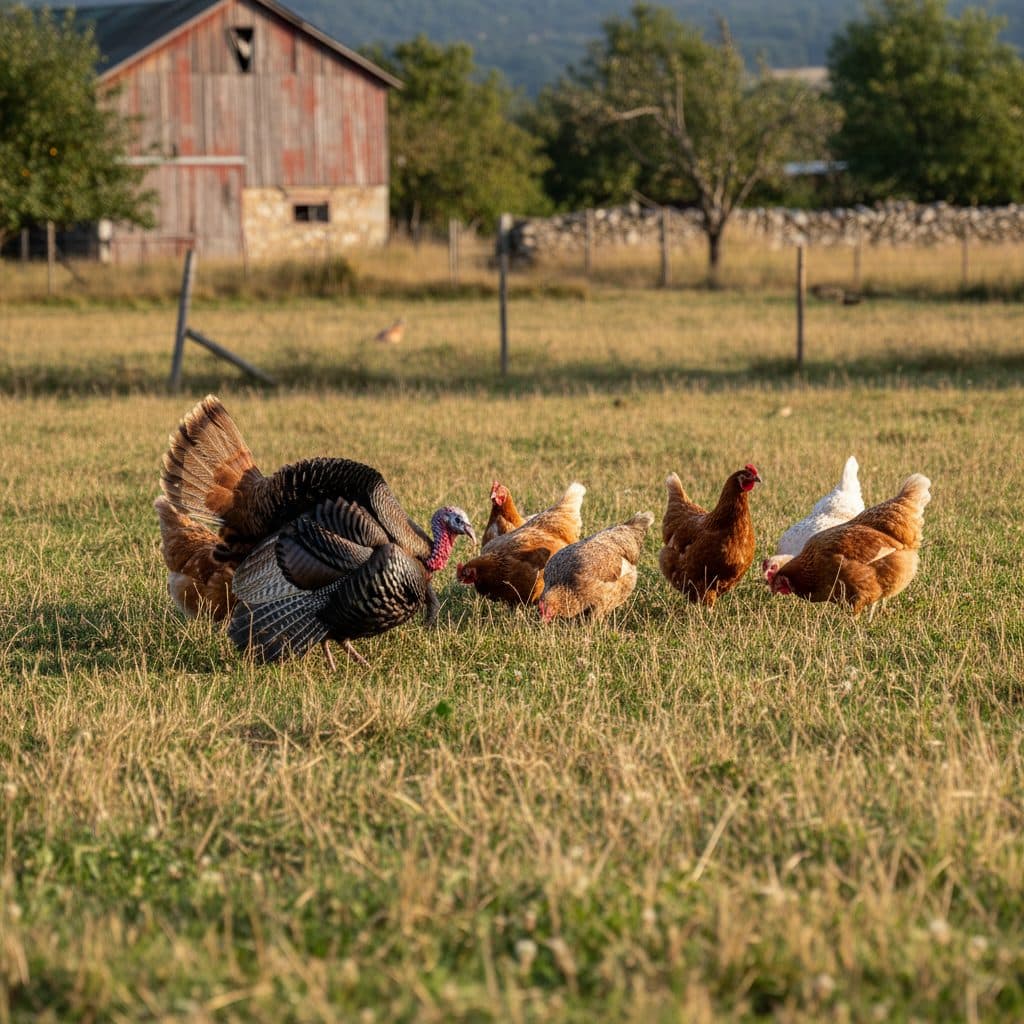
Quick answer: Raising turkeys with chickens is possible on homesteads with ample dry pasture, but carries significant biosecurity risks due to Blackhead disease (Histomonas meleagridis). Chickens are asymptomatic carriers of cecal worms that harbor the lethal blackhead protozoan, which causes up to 90 percent mortality in young turkeys. Homesteaders must brood poults separately, provide high-protein turkey feed, and practice strict pasture rotation.
Homesteaders looking to diversify their barnyard meat and egg production often consider running turkeys and chickens in the same coop and run. The idea of a single mixed flock sharing feeders, waterers, and grazing paddocks seems efficient and practical.
However, poultry pathologists and experienced livestock farmers consider co-housing chickens and turkeys one of the riskiest practices in small-scale animal husbandry.
Chickens harbor microscopic parasites without showing any external symptoms, but passing those same parasites to vulnerable young turkeys can wipe out an entire flock within days.
Understanding disease transmission biology, distinct nutritional demands, physical flock dynamics, and safe co-ranging protocols allows you to manage both species on the homestead with confidence.
Blackhead disease: the core biosecurity hazard
The single greatest obstacle to co-housing turkeys and chickens is Histomoniasis, commonly known as Blackhead disease, caused by the microscopic protozoan parasite Histomonas meleagridis.
+-------------------------------------------------------------------+
|               BLACKHEAD TRANSMISSION VECTOR DYNAMICS              |
|                                                                   |
|   [CHICKEN: Asymptomatic Carrier]                                 |
|   - Harbors Cecal Worms (*Heterakis gallinarum*) in gut           |
|   - Sheds thousands of microscopic worm eggs into soil & litter   |
|                 |                                                 |
|                 v                                                 |
|   [SOIL & EARTHWORMS: Reservoir]                                  |
|   - Cecal worm eggs survive in damp soil for 3 to 4 years         |
|   - Earthworms ingest eggs; act as transport hosts                |
|                 |                                                 |
|                 v                                                 |
|   [TURKEY POULT: Fatal Host]                                      |
|   - Ingests infected worm egg or earthworm                        |
|   - Protozoa attack cecal lining and migrate to liver             |
|   - 70% to 100% mortality within 10 to 14 days                    |
+-------------------------------------------------------------------+
+------------------------+-----------------------------------+-------------------------+
| Host Species | Susceptibility Level | Clinical Outcome |
+------------------------+-----------------------------------+-------------------------+
| Chickens (Layer/Broiler)| Highly Resistant | Asymptomatic carrier |
| Young Turkey Poults | Extremely Susceptible (<6 months) | 70% to 100% Mortality |
| Mature Adult Turkeys | Moderate Susceptibility | Severe chronic illness |
| Gamebirds (Peafowl) | Highly Susceptible | High mortality |
+------------------------+-----------------------------------+-------------------------+Because veterinary pharmaceuticals historically used to treat Blackhead (such as dimetridazole) have been banned from poultry use in the United States, prevention through biosecurity and physical separation is the only effective defense.
Clinical symptoms of Histomoniasis in turkeys
Recognizing early warning signs of blackhead is critical to saving unaffected birds.
+-------------------------------------------------------------------+
|               DIAGNOSTIC SIGNS OF BLACKHEAD DISEASE               |
+-------------------------------------------------------------------+
| 1. Sulfur-Yellow Droppings: The hallmark clinical symptom         |
| 2. Severe Lethargy & Drooping: Wings held low, ruffled feathers   |
| 3. Head Cyanosis: Dark blue or purple facial skin (occasional)    |
| 4. Extreme Weight Loss: Rapid emaciation and refusal to feed      |
| 5. Post-Mortem Lesions: Sunken "bullseye" necrotic liver craters  |
+-------------------------------------------------------------------+
Despite the common name "blackhead," the head of an infected turkey does not always turn black. The most reliable diagnostic sign is bright sulfur-yellow, watery diarrhea caused by acute liver necrosis.
Nutritional divergence: protein and medication
Chickens and turkeys possess fundamentally different metabolic growth curves and nutritional requirements, particularly during the first twelve weeks of life.
+------------------------+-------------------+-------------------+-------------------------+
| Poultry Life Stage     | Starter Protein % | Calcium Needs     | Feed Type Required      |
+------------------------+-------------------+-------------------+-------------------------+
| Day-Old Chickens       | 18% to 20% Crude  | 1.0% Balanced     | Standard Chick Starter  |
| Day-Old Turkey Poults  | 26% to 28% Crude  | 1.2% High P       | Turkey / Gamebird Starter|
| Growing Poults (8 wks) | 20% to 22% Crude  | 1.0% Balanced     | Turkey Grower           |
| Laying Hens (Adult)    | 16% Crude Protein | 3.5% to 4.0% High | Layer Pellets           |
| Mature Turkeys (Adult) | 14% to 16% Crude  | 1.2% Moderate     | Turkey Maintenance / Grn|
+------------------------+-------------------+-------------------+-------------------------+
Feeding turkey poults a standard chicken starter feed (18% protein) results in stunted growth, weak leg bone development (perosis / slipped tendon), and poor feathering. Poults require gamebird or turkey starter containing 26% to 28% protein for their rapid skeletal development.
Medicated Feed Caution: Never feed poults medicated chick starter unless the medication (such as amprolium) is explicitly labeled and dosed for turkeys. Certain coccidiostats and chemical additives formulated for chickens can be toxic or fatal to turkeys.
Conversely, adult turkeys should never be fed high-calcium layer feed (4% calcium) intended for laying hens, as excess calcium causes irreversible kidney damage and visceral gout in non-laying turkeys.
Compare baseline poultry diets in what to feed chickens and ingredient formulation in what is in chicken feed.
Physical and behavioral cohabitation dynamics
Beyond disease risks, physical differences between turkeys and chickens create coop management challenges.
+-------------------------------------------------------------------+
|                 PHYSICAL DISPARITIES AND HAZARDS                  |
|                                                                   |
| [Adult Tom Turkey: 25 - 35 lbs]     [Standard Laying Hen: 4 - 6 lbs]
| - Easily crushes light perches       - Roosts on 2x2 inch lumber  |
| - Can injure hens if mating attempted- Traumatized by large toms  |
| - Dominates central feed troughs     - Pushed away from feed pans |
+-------------------------------------------------------------------+
Adult heritage tom turkeys weigh five to seven times more than a standard laying hen. If an aggressive tom attempts to tread or mate with a chicken hen, the weight difference can cause severe spinal trauma, broken ribs, and death.
Build heavy-duty roosts from 2x4 timber laid flat (4-inch side facing up) mounted low (12 to 18 inches off the ground) with heavy support brackets. High perches force heavy turkeys to jump down with massive impact force, causing bumblefoot, foot abscesses, and keel bone fractures.
Watering hygiene and coccidiosis management
Waterers in mixed poultry runs are major vectors for parasite transmission. Open water pans quickly become fouled with fecal dust and litter kicked up by scratching hens.
+------------------------+-----------------------------------+-------------------------+
| Management Factor      | Recommended Protocol              | Health Protection       |
+------------------------+-----------------------------------+-------------------------+
| Water Delivery         | Nipple drinkers or cup systems    | Blocks fecal water soiling|
| Drinker Height         | Adjust to shoulder height of bird | Prevents bottom dipping |
| Coccidiosis Control    | Keep bedding completely bone-dry  | Stops oocyst sporulation|
| Litter Additives       | Hydrated lime or biochar in litter| Absorbs ammonia/moisture|
+------------------------+-----------------------------------+-------------------------+
Installing enclosed horizontal nipple watering buckets prevents turkeys and chickens from defecating into their drinking supply, cutting off the fecal-oral route for coccidial oocysts and cecal worm eggs.
Protocols for running both species on the same homestead
If you choose to raise both chickens and turkeys on your property, implement strict biosecurity protocols to eliminate disease transmission.
+-------------------------------------------------------------------+
|               BIOSECURE HOMESTEAD MANAGEMENT PROTOCOL             |
|                                                                   |
| 1. Separate Brooders: Brood turkey poults in a dedicated, clean   |
|                       facility with zero chicken dust or dander.  |
|                                                                   |
| 2. Virgin Ground:     Pasture turkeys only on ground that has not |
|                       housed chickens for at least 3 years.       |
|                                                                   |
| 3. Dry Pasture System: Maintain well-drained pastures; wet, muddy |
|                       ground dramatically increases worm ingestion|
|                                                                   |
| 4. Clean Equipment:   Never use the same shovel, boots, or water  |
|                       buckets between chicken and turkey pens.    |
|                                                                   |
| 5. Mature Multi-Ranging: If grazing mature birds together, ensure |
|                       wide acreage (minimum 50 sq ft per bird).   |
+-------------------------------------------------------------------+
Homesteaders operating on limited acreage with shared, muddy chicken runs should avoid adding turkeys. On expansive multi-acre homesteads with dedicated rotational paddocks, raising both species is practical and rewarding.
Explore foundational self-reliance frameworks in what is homesteading, urban flock planning in urban homesteading, apartment food strategies in apartment homesteading, and whole-property livestock planning in self-sufficient-living.