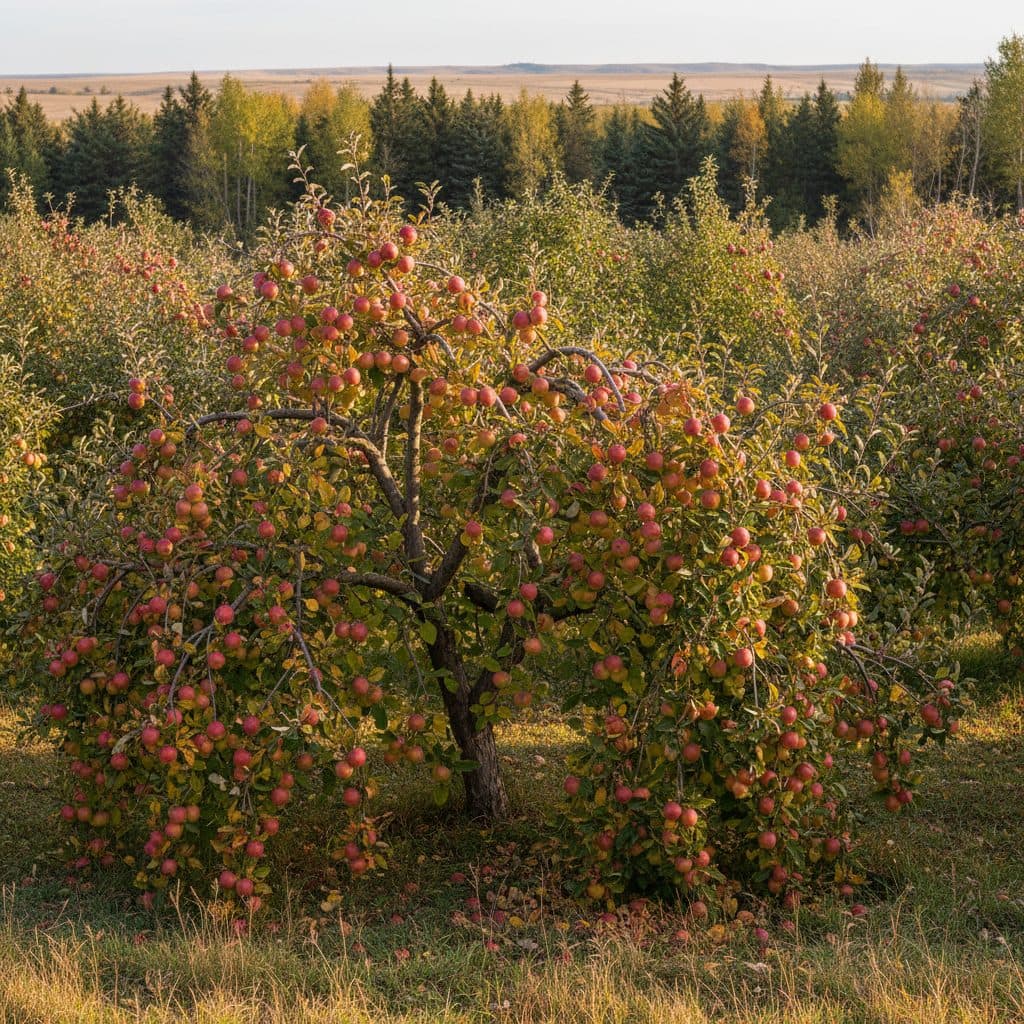
Key takeaways
- Select cold-hardy apple cultivars grafted onto Antonovka or Siberian Crab (Malus baccata) rootstocks.
- Plant University of Saskatchewan Romance series sour cherries that thrive down to -40°C on their own roots.
- Choose hybrid prairie plum varieties like Pembina and Brookred, and make sure a compatible wild plum pollinator is nearby.
- Establish multi-row windbreaks to protect orchards from desiccating winter winds and late spring blizzards.
- Install spiral white tree guards to protect lower trunks from winter sunscald and rodent bark girdling.
- Incorporate super-hardy native berries including haskaps (honeyberries) and saskatoon serviceberries.
Quick answer: The best fruit trees for Zone 3 in Canada include cold-hardy apple varieties (Goodland, Norland, Battleford) grafted onto Antonovka rootstock, University of Saskatchewan dwarf sour cherries (Carmine Jewel, Romeo, Juliet), hardy hybrid plums (Pembina, Brookred), and cold-tolerant pears (Early Gold, Ure).
Growing a productive home fruit orchard in the Canadian prairies, northern Ontario, or high-altitude mountain valleys is often considered an intimidating challenge. In USDA Zone 3 (and cold microclimates dipping into Zone 2), winter temperatures routinely drop between -35°C and -40°C (-30°F to -40°F), and short 100 to 110-day growing seasons test plant resilience. Zone numbers here are USDA zones. Canada's own hardiness map uses a different formula and often rates the same site a zone higher — check which map a nursery is quoting.
However, decades of horticultural breeding at Canadian agricultural research stations have produced an extraordinary selection of fruit trees for Zone 3. Cultivars bred specifically to withstand sub-zero prairie cold, late spring frosts, and drying winter winds produce heavy crops of crisp eating apples, rich sour cherries, sweet hybrid plums, and hardy pears.
By matching hardy cultivars to cold-tolerant rootstocks, designing protective shelterbelts, and safeguarding trunks from winter sunscald, you can harvest baskets of fresh orchard fruit even in Canada's coldest growing regions.
+--------------------------------------------------------------------------+
|                  ZONE 3 COLD-HARDY FRUIT CULTIVARS (CANADA)              |
+-------------------+-----------------------------+------------------------+
| Fruit Category    | Proven Hardy Cultivars      | Key Characteristics    |
+-------------------+-----------------------------+------------------------+
| Prairie Apples    | Goodland, Norland,          | Sweet, crisp, excellent|
|                   | Battleford, Parkland        | storage, Antonovka root|
+-------------------+-----------------------------+------------------------+
| Dwarf Sour Cherry | Carmine Jewel (1999);       | Own-root bushes, hardy |
| (U of S)          | Romance Series: Romeo,      | to about -40°C         |
|                   | Juliet, Crimson Passion,    |                        |
|                   | Valentine, Cupid            |                        |
+-------------------+-----------------------------+------------------------+
| Alberta Sour      | Evans (Bali)                | Small tree form;       |
| Cherry            |                             | Alberta Prunus cerasus |
+-------------------+-----------------------------+------------------------+
| Hybrid Plums      | Pembina, Brookred,          | Sweet dessert quality, |
|                   | Patterson Pride, Brookgold  | needs wild pollinator  |
+-------------------+-----------------------------+------------------------+
| Cold-Hardy Pears  | Early Gold, Ure,            | Ussurian parentage;    |
|                   | Golden Spice                | crisp, cold-resilient  |
+-------------------+-----------------------------+------------------------+
| Super-Hardy Berry | Haskap (Borealis, Aurora),  | Zone 2 hardy (-45°C);  |
| Companions        | Saskatoon Berry (Thiessen)  | antioxidant-dense      |
+-------------------+-----------------------------+------------------------+
Prairie-hardy apple cultivars and rootstock selection
Apples are the backbone of the cold-climate northern orchard. However, hardiness in an apple tree depends as much on the underlying rootstock as it does on the fruiting scion variety.
Proven Zone 3 apple cultivars:
- Goodland: Developed at the Morden Research Station in Manitoba, Goodland is widely considered the finest eating apple for cold climates. It produces large, crisp, aromatic yellow-green apples with a soft red blush that keep for roughly two months in a cool cellar.
- Norland: An early-ripening, highly productive apple with red-striped skin. Crisp, juicy, and semi-sweet, perfect for fresh eating and applesauce in August.
- Battleford: An exceptionally rugged Saskatchewan heirloom producing large, striped cooking and eating apples. Survives severe prairie winters with zero tip dieback.
- Parkland: Extremely cold-tolerant, producing medium-sized, crisp, slightly tart apples in late summer.
- September Ruby: Bred in Alberta, this late-season apple features deep ruby-red skin, crisp white flesh, and exceptional winter hardiness.
Essential cold-hardy rootstocks:
Standard commercial dwarf rootstocks (such as M9 or M26) lack the root cold-hardiness needed for Zone 3 and will freeze and die at soil temperatures below -12°C. Always ensure your apple trees are grafted onto:
- Antonovka: Standard seedling rootstock offering extreme root cold-hardiness down to -40°C.
- Siberian Crab (Malus baccata): Exceptional root hardiness; produces a slightly more compact tree with deep anchorage.
- Beautiful Arcade or Ranetka seedling stocks: Hardy seedling rootstocks that give some size reduction against Antonovka while keeping prairie root hardiness. Ottawa 3 is hardier than M9 but is an M9-class dwarfing stock and is generally recommended only for Zone 4 and warmer.
For broader orchard systems in moderately cold regions, compare varieties in our guide to cold-hardy-fruit-and-nut-trees-zones-4-6.
University of Saskatchewan Romance series sour cherries
One of the greatest achievements in northern pomology is the development of the dwarf sour cherry series by the University of Saskatchewan breeding program.
Unlike sweet cherries (Prunus avium), which cannot survive northern prairie winters, these dwarf sour cherries (Prunus cerasus x Prunus fruticosa) are hardy to -40°C and grown on their own roots:
- Carmine Jewel: The earliest ripening selection, producing dark purple-black cherries with deep red flesh and high sugar content (brix up to 17%). Ripens in late July.
- Romeo and Juliet: Later-ripening selections producing heavy clusters of plump, sweet-tart dessert cherries ideal for fresh eating, baking, and wine-making.
- Evans Cherry (Bali): A legendary Alberta discovery that forms a small 4-metre tree, bearing enormous crops of bright red sour cherries every August.
Because Romance series cherries grow as compact 2 to 2.5-metre multi-stemmed bushes on their own roots, even if an extreme winter kills top growth, the bush will naturally regenerate true to type from root suckers.
+--------------------------------------------------------------------------+
|                  COLD-CLIMATE ORCHARD MICROCLIMATE DESIGN                |
+--------------------------------------------------------------------------+
|  [ Prevailing North/West Winter Winds ]                                  |
|         |                                                                |
|         v                                                                |
|  [ Multi-Row Evergreen Shelterbelt (Spruce, Willow, Buffaloberry) ]     |
|                                                                          |
|  [ Protected Microclimate Zone: Apple, Cherry, Plum Trees ]              |
|  [ Thick Straw Mulch & Snowpack (Insulates Root Zones from Deep Freeze) ]|
+--------------------------------------------------------------------------+
Cold-hardy plums and pears
Stone fruits and pears require specific cross-pollination planning in Zone 3:
Prairie-hardy hybrid plums:
Northern plums are hybrids between Japanese plums (Prunus salicina) and native American wild plums (Prunus americana or Prunus nigra):
- Pembina: Large, pointed red plums with sweet, juicy yellow flesh and thick skin.
- Brookred and Patterson Pride: Highly productive, sweet dessert plums that ripen in late August.
- Pollination rule: Hybrid plums are self-sterile. You must plant at least two different varieties, or include a wild native plum — American plum (Prunus americana) or Canada plum (Prunus nigra) — nearby to ensure effective cross-pollination.
Cold-hardy pears:
Zone 3 pears derive their extreme cold-hardiness from the Siberian Ussurian pear (Pyrus ussuriensis):
- Early Gold and Ure: Produce medium-sized, crisp greenish-yellow pears with sweet, juicy flesh that ripen in early autumn.
- Plant both varieties together to achieve dependable cross-pollination.
To complement tree crops with nitrogen-fixing companion species, explore our resource on cold-hardy-nitrogen-fixers-zones-2-6.
Orchard microclimate design and windbreak protection
In cold northern landscapes, the physical environment surrounding your orchard is just as critical as cultivar selection.
- Shelterbelts and windbreaks: The greatest threat to northern fruit trees is desiccating winter winds that suck moisture from dormant buds and snap brittle branches, not just freezing temperatures. Plant a dense, multi-row shelterbelt led by native white spruce (Picea glauca), with native shrubs such as chokecherry (Prunus virginiana), buffaloberry (Shepherdia argentea) and willow on the north and west perimeters. Caragana and Scots pine are the traditional prairie shelterbelt fillers, but both are introduced and both self-seed into native grassland and bush — check your provincial invasive-species list before planting either.
- Slope and aspect: Choose a site with a gentle slope so cold air drains away from the trees on frost nights — any aspect does this. On the prairies a north or northeast aspect is often the safer choice: it holds bloom back past the worst late frosts and cuts the winter sun on trunks that causes sunscald. A south aspect buys heat units but costs you on both counts.
- Snow trapping: Snow is the premier natural insulator for tree root systems. A 30 cm layer of uncompacted snow keeps soil temperatures near 0°C even when air temperatures plunge to -35°C.
For comprehensive seasonal protection and winterization protocols, see our guide on how-to-winterize-your-garden.
Preventing winter sunscald and rodent damage
Protecting young fruit trees through a prairie winter requires two vital physical defenses:
- Sunscald prevention: In February and March, bright prairie sunshine reflecting off white snow heats the dark bark on the south side of tree trunks, causing cambium cells to break dormancy. When temperatures drop below freezing at night, the active cells freeze and burst, creating long vertical cracks (sunscald) that invite fungal cankers. Wrap lower trunks with rigid white spiral tree guards to reflect sunlight.
- Vole and mouse protection: Voles and field mice tunnel beneath deep snow drifts and feed on the sweet inner bark of young fruit trees. Ensure rigid plastic tree guards or 1/4-inch hardware cloth cylinders extend from 5 cm below the soil line to at least 60 to 90 cm above ground — above the depth snow normally drifts on your site — so voles tunnelling under the snow and hares standing on it are both excluded.
If you are managing container-grown cold-climate plants, review our guidelines in overwintering-container-gardens-northern-us.
For integrating perennial living mulches around orchard tree rings, read our selection guide in edible-ground-cover.