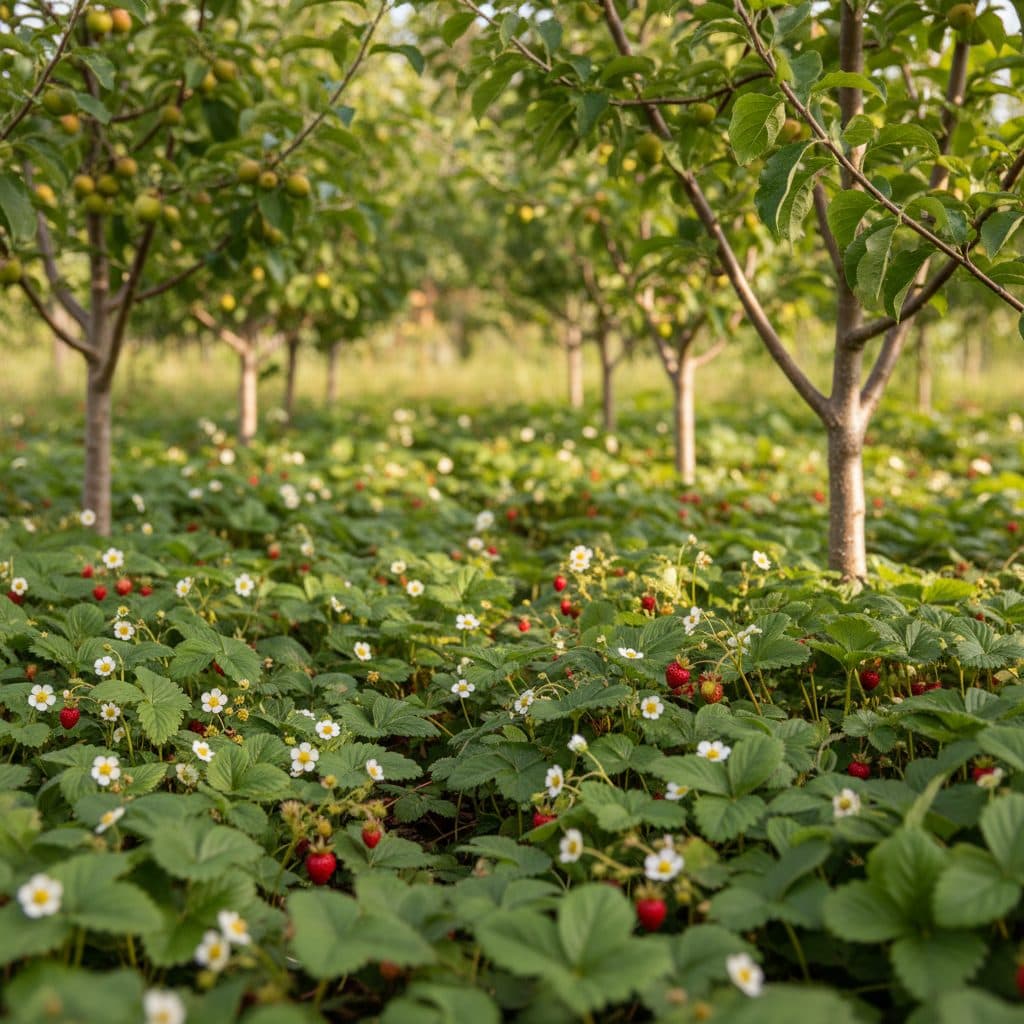
Key takeaways
- Edible living mulches suppress weed emergence, protect soil from erosion, and conserve root-zone moisture.
- Alpine strawberries and creeping thyme thrive in fruit tree guilds, offering harvests while shading topsoil.
- Sweet potato vines are a rapid warm-season living mulch that yields both edible greens and nutrient-dense storage roots.
- Select ground covers that match the root architecture and light requirements of your canopy fruit trees.
- Avoid aggressive invasive species like bishop's weed, and confine vigorous spreaders like culinary mint to submerged containers.
Quick answer: Edible ground cover plants form a living mulch layer that covers bare soil, blocks weed germination, conserves moisture, and yields edible fruits, greens, or culinary herbs. Excellent options for temperate gardens include alpine strawberries, creeping thyme, nasturtiums, miner's lettuce, French sorrel, and sweet potato vines.
In conventional gardening and commercial orchards, the ground beneath fruit trees is frequently sprayed with herbicides, scraped bare with tillers, or smothered with imported wood chips year after year. Establishing an edible ground cover replaces this high-maintenance cycle with an intentional, productive carpet of low-growing perennial crops.
In natural forest ecosystems, bare soil is treated as an emergency wound. Nature immediately covers exposed earth with opportunistic weeds to prevent erosion and shield soil microbes from solar ultraviolet radiation. By intentionally planting low-growing, non-invasive edible species, you satisfy nature's need for soil cover while harvesting berries, salad greens, and aromatic herbs from spaces that would otherwise require weeding.
Whether you are designing the ground layer of a multi-tiered fruit guild or filling borders between raised beds, choosing the right living mulch plants transforms your understory into a resilient, self-mulching ecosystem.
Why establish an edible living mulch in your garden?
Replacing bare soil or inert wood chips with living ground covers delivers multiple ecological and practical benefits:
- Moisture retention and soil cooling: A dense vegetative canopy shades the soil surface, reducing moisture evaporation during hot summer months and keeping soil microbial life active near the surface.
- Weed suppression: Dense foliage intercepts sunlight, preventing airborne weed seeds from reaching bare earth and germinating.
- Erosion control: Fibrous, spreading root networks bind loose topsoil against heavy downpours and surface runoff on sloped land.
- Nutrient cycling: Perennial ground covers capture falling tree leaves, trapping organic matter and converting it into rich humus right in the root zone.
- Pollinator and beneficial insect forage: Low-growing flowering herbs provide continuous nectar and habitat for ground beetles, predatory wasps, and spiders that prey on orchard pests.
Reviewing food forest design principles and what a food forest is illustrates how the ground cover layer is the protective floor of a multi-story agroforestry system.
+-----------------------------------------------------------------------------------+
|                         EDIBLE LIVING MULCH CANOPY PROFILE                        |
|                                                                                   |
|                      Fruit Tree Trunk (Shade Provider)                            |
|                                    ||                                             |
|                                    ||                                             |
|      +-----------------------------++-----------------------------+               |
|      |               DENSE LIVING GROUND COVER LAYER              | (5-15 cm)     |
|      |             (Alpine Strawberry, Thyme, Nasturt)            |               |
|  ====+============================================================+==== Topsoil   |
|      |               Fibrous Shallow Root Zone                    |               |
|      |               (Intercepts Weeds & Retains H2O)             | (0-10 cm)     |
|      +------------------------------------------------------------+               |
|      | Fruit Tree Feeder Roots (mostly 0-45 cm, overlapping the ground-cover zone)|
|      +----------------------------------------------------------------------------+
+-----------------------------------------------------------------------------------+
Top edible ground cover plants for fruit tree guilds and beds
Selecting the right species depends on sun exposure, moisture levels, and climatic zone:
1. Alpine and woodland strawberries (Fragaria vesca)
Alpine strawberries are exceptional ground covers for partial shade beneath fruit trees. Unlike standard June-bearing garden strawberries that produce long runners, many alpine cultivars form dense, clumping mounds that spread gradually via side crowns and seed. They produce small, intensely fragrant berries continuously from late spring until autumn frost. They thrive in USDA zones 3 through 9 and tolerate filtered shade.
2. Creeping thyme (Thymus serpyllum) and dwarf oregano (Origanum vulgare 'Humile', syn. 'Compactum')
For sunny perimeters, south-facing tree borders, and well-drained slopes, aromatic herbs provide drought-hardy ground cover. Creeping thyme forms a tight, evergreen carpet just 2 to 5 inches tall that tolerates moderate foot traffic and produces tiny edible leaves and pollinator-attracting purple blossoms. Low-growing oregano cultivars spread via shallow creeping rhizomes, suppressing weeds while offering culinary herbs.
3. Garden nasturtium (Tropaeolum majus)
Nasturtiums function as a rapid annual living mulch in temperate zones and a perennial ground cover in frost-free regions. In frost-free coastal California and in Hawaii, note that nasturtium naturalises readily and is listed as an invasive plant — deadhead before seed set, or grow it as an annual only. A single plant can spread 3 to 6 feet across the soil surface in a single season. Every part of the plant is edible: peppery leaves, colorful edible flowers, and tender seed pods that can be pickled like capers. Nasturtiums are also a sacrificial trap crop for aphids and caterpillars.
4. Miner's lettuce (Claytonia perfoliata)
Miner's lettuce is a cold-hardy, shade-loving annual salad green native to western North America. It self-sows prolifically in cool, moist, shaded soil beneath deciduous tree canopies. It provides crisp, mild, vitamin-rich salad leaves throughout winter and early spring when other crops are dormant, dying back naturally as summer heat arrives.
5. Sweet potato (Ipomoea batatas)
In USDA zones 7 through 11, sweet potatoes are a fast-growing, weed-choking living mulch for warm summer months. Their trailing vines root lightly at nodes, forming a lush, unbroken green carpet that shades the soil completely. The tender young leaf tips and shoots are harvested throughout the summer as a cooked green, followed by a harvest of edible storage roots in late autumn before the first frost.
6. French sorrel (Rumex scutatus)
French sorrel is a hardy perennial herb with creeping rootstocks that forms low clumps of shield-shaped leaves (scutatus means shield), broader and blunter than the arrow-shaped leaves of common sorrel, Rumex acetosa. Its bright, lemony-tart foliage adds flavor to salads and soups. It returns reliably each spring in USDA zones 4 through 9, tolerating dry shade once established.
7. Wintergreen (Gaultheria procumbens)
Wintergreen is a slow-spreading, evergreen, acid-loving ground cover reaching 4 to 6 inches in height. It thrives in the shaded, acidic soil beneath blueberries, lingonberries, and pines in USDA zones 3 through 8. It produces glossy leaves that can be steeped into tea and aromatic red winter berries with a distinct wintergreen flavor. Wintergreen leaves contain methyl salicylate, a natural salicylate. Occasional weak leaf tea is traditional, but avoid it if you are sensitive to aspirin, take anticoagulants, or are pregnant, and do not give it to children. Never substitute wintergreen essential oil for the leaves — the oil is toxic in very small amounts.
+-------------------------------------------------------------+
|           EDIBLE GROUND COVER SPECIES COMPARISON            |
|                                                             |
| Plant Species         Sun / Shade      Hardiness   Harvest  |
| -------------         -----------      ---------   -------  |
| Alpine Strawberry     Partial Shade    Zones 3-9   Berries  |
| Creeping Thyme        Full Sun         Zones 4-9   Herbs    |
| Garden Nasturtium     Sun to Part Sun  Annual/10+  Leaves   |
| Miner's Lettuce       Full/Part Shade  Zones 5-9   Greens   |
| Sweet Potato Vine     Full Sun to Part Zones 7-11  Greens   |
| French Sorrel         Sun to Part Sun  Zones 4-9   Leaves   |
| Wintergreen           Part/Full Shade  Zones 3-8   Berries  |
+-------------------------------------------------------------+
Designing the food forest ground cover layer
Integrating ground covers beneath established trees requires balancing light, root space, and pedestrian access:
- Matching light requirements: Place sun-demanding herbs (thyme, oregano, nasturtium) along the southern and western drip lines of tree guilds. Position shade-tolerant species (alpine strawberries, miner's lettuce, wintergreen) directly beneath dense interior canopies.
- Avoiding root competition: Use ground covers with shallow, fibrous roots, but do not assume they avoid the tree. Most fruit-tree feeder roots sit in the top 30-45 cm (12-18 in) and spread past the drip line, so living mulch does compete for water and nitrogen — keep it 45-60 cm (18-24 in) clear of the trunk and expect to water and feed more during the tree's first three or four years.
- Creating harvest pathways: Do not carpet an entire orchard floor without leaving dedicated walking corridors. Lay flagstones, stepping logs, or coarse wood chip paths so you can harvest fruit and prune branches without stepping on tender ground cover plants.
Techniques from companion planting strategies help you position complementary species that support tree health while suppressing pests.
Planting density, establishment, and weed management
A successful living mulch requires careful preparation during its establishment year. If you plant small plugs into weed-infested soil, aggressive perennial grasses will choke out the young ground covers before they can knit together.
- Prepare a clean planting bed: Use sheet mulching with cardboard for weed control to eliminate existing turf and perennial weeds without disturbing soil biology.
- Plant at appropriate density: Space strawberry and herb plugs 8 to 12 inches apart to achieve complete canopy closure within one growing season. Wider spacing leaves bare gaps where opportunistic weeds can establish.
- Top-dress with clean organic mulch: Apply a 1-inch to 2-inch layer of clean straw, shredded leaves, or wood shavings around new transplants. As detailed in organic mulches for garden beds, temporary mulch conserves moisture while young plants spread their foliage.
- Hand-weed during year one: Inspect beds monthly during the first growing season to remove stubborn weeds before they set seed. Once the living mulch forms an unbroken canopy, maintenance drops significantly.
Plants to avoid or contain in ground cover plantings
Not all spreading edible plants belong in an open garden bed. Certain vigorous perennials can quickly overrun small garden spaces:
- Culinary mints (Mentha spp.): Spearmint and peppermint spread aggressively through underground stolons, choking out slower-growing herbs and strawberry patches. Always sink mint into buried 5-gallon buckets or bottomless containers to restrict root spread.
- Bishop's weed / Goutweed (Aegopodium podagraria): While historically eaten as a pot herb, this plant is an aggressive, invasive weed across much of North America that is nearly impossible to eradicate once established in garden soil. Avoid planting it under any circumstances.
- Horseradish (Armoracia rusticana): Horseradish possesses deep, brittle taproots that spread laterally. Any root fragment left in the soil will sprout a new plant, making it better suited for dedicated barrels rather than open fruit tree guilds.
Selecting well-behaved, non-invasive edible ground covers ensures a productive, low-maintenance living carpet that builds soil fertility and provides seasonal food for years to come.