Fruit flies are the most destructive insect threat to home orchards, citrus groves, and backyard vegetable patches across Australia. Unlike tiny vinegar flies that feed on already decaying kitchen produce, true tephritid fruit flies attack unripe and ripening fruit directly on the tree, ruining stone fruit, pome fruit, citrus, berries, and fruiting vegetables. Because Australia hosts two distinct pest species distributed across different geographical zones, successful fruit production requires an integrated approach based on early monitoring, physical exclusion, and rigorous orchard hygiene.
For regional pest management guides across the country, see the Australian growing hub.
The two species: Queensland vs Mediterranean fruit fly
Australian home growers contend with two primary economic pest species:
- Queensland Fruit Fly (Bactrocera tryoni): Commonly referred to as Qfly, this native species originated in the coastal rainforests of eastern Australia. It has a reddish-brown body with distinctive bright yellow patches on the thorax and clear wings. Historically confined to tropical and subtropical eastern regions, Qfly populations have expanded across New South Wales, Victoria, and parts of the Murray-Darling basin due to changing weather patterns and domestic fruit transit.
- Mediterranean Fruit Fly (Ceratitis capitata): Commonly called Medfly, this exotic species was introduced from overseas over a century ago. It is slightly smaller than Qfly, exhibiting a mottled brownish-grey body, banded wings, and large iridescent eyes. Medfly is established primarily in Western Australia, including the Perth metropolitan area and surrounding horticultural districts.
Geographic distribution varies widely by region. While northern and eastern areas experience persistent Qfly pressure throughout the warm months, south-western Australia manages Medfly, and commercial production districts in South Australia and Tasmania enforce strict biosecurity surveillance to detect and suppress sporadic incursions. Recognizing which species threatens your locality helps ensure you select the appropriate pheromone lures, as male attractants are highly species-specific.
Life cycle and timing of damage
Both Qfly and Medfly share a similar life cycle that enables populations to multiply rapidly during warm weather:
- Stinging and oviposition: Adult females seek out ripening fruit as skin softens and sugar levels begin to rise. Using a sharp needle-like ovipositor, the female pierces the outer skin and deposits clusters of eggs directly beneath the surface into the fleshy pulp. This puncture wound, known as a "sting," introduces bacterial and fungal decay organisms into the flesh.
- Larval development: Within several days, microscopic maggots hatch and tunnel toward the seed core, consuming the fruit pulp. The infested tissue breaks down into a watery, foul-smelling brown rot, causing premature fruit drop.
- Pupation in soil: Once fully fed, mature larvae chew their way out of fallen fruit and burrow several centimetres into the surrounding topsoil, forming hard brown pupae. In warm summer conditions, adult flies emerge from the ground within weeks, ready to mate and infest subsequent fruit crops.
Because larvae feed entirely inside the fruit tissue, chemical contact sprays cannot reach them once eggs are laid. Control must focus on preventing adult females from accessing the fruit in the first place.
Physical exclusion: netting and bagging
Physical barriers provide the most dependable non-chemical protection against both fruit fly species:
Canopy netting
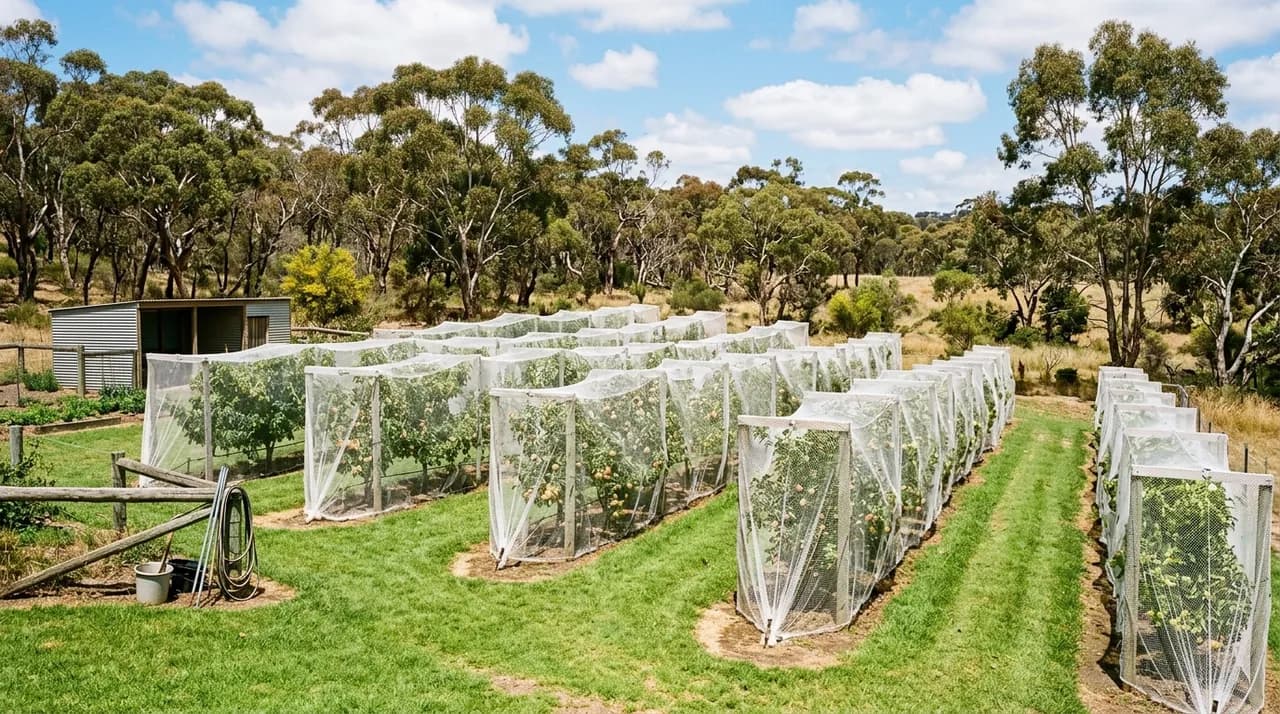
Covering entire tree canopies with UV-stabilized insect exclusion netting is the most reliable method for home orchards:
- Mesh aperture: Standard bird netting will not exclude fruit flies. You must use specialized fruit fly netting with an aperture of two millimetres or smaller to prevent adult flies from squeezing through the weave.
- Timing: Install netting immediately after fruit set and natural flower drop, well before the fruit begins to show color or soften. Installing nets too late leaves fruit unprotected during its most vulnerable window.
- Frame support: Ensure the netting is supported on a timber, polypipe, or steel conduit frame so that the mesh does not rest directly against ripening fruit. If the net touches the fruit skin, female flies can insert their ovipositors through the mesh openings.
- Base securing: Fasten the net securely around the trunk base or weight the perimeter edges flush to the soil surface with bricks or timber battens to prevent flies from walking in underneath.
Maintaining compact tree height through seasonal canopy shaping makes netting manageable; see our guide on when to prune fruit trees in Australia to keep trees at reachable heights.
Fruit bagging and sleeves
For large trees or gardens where full netting is impractical, individual exclusion bags or sleeves made of breathable spunbond fabric, wax paper, or micro-mesh can be tied over individual fruit clusters. This targeted technique is particularly well-suited for heavy stone fruits like peaches, nectarines, and heirloom apples.
Monitoring traps and protein baits
Traps play two distinct roles in fruit fly management: monitoring presence and mass attraction:
- Male pheromone traps: Traps containing chemical pheromones (such as cuelure for Qfly or trimedlure for Medfly) attract male flies from considerable distances. While male trapping rarely achieves total population suppression on its own, daily inspection indicates when active flies have entered your area, signaling that exclusion nets must be immediately deployed.
- Female protein lures and food baits: Because newly emerged female fruit flies require protein feeds to develop mature eggs, yeast- or protein-based traps attract mated females before oviposition. Positioning protein traps in sheltered, shady inner canopy branches provides targeted lure-and-kill protection.
- Bait spraying: Spot-spraying small patches of inner canopy foliage with a mixture of protein hydrolysate and an approved organic insecticide (such as spinosad) attracts and kills foraging flies without requiring whole-tree chemical coverage.
Detailed trapping methods for this species are covered in Queensland fruit fly management.
Orchard hygiene and fallen fruit disposal
Strict sanitation is essential to break the breeding cycle across the neighborhood. Allowing stung fruit to rot on the ground provides an uninterrupted supply of emerging flies that will infest adjacent trees throughout the season:
- Daily windfall collection: Collect all fallen and damaged fruit from beneath orchard canopies every day.
- Solarization destruction: Never discard infested fruit into open compost heaps or standard council green-waste bins, where larvae will successfully pupate. Instead, place stung fruit inside sealed, heavy black plastic bags and leave them in full direct sun on hot ground for at least three to five days. The intense internal heat kills all eggs and larvae.
- Boiling or freezing alternatives: Small batches of infested fruit can be submerged in boiling water for several minutes or frozen solid in domestic freezers before being safely added to closed compost systems or fed to enclosed poultry.
Special vigilance is needed when cultivating backyard lemons, limes, and oranges, which can harbor over-wintering fly populations; learn more about preventive care in our guide to growing citrus in Australia.
By combining early physical exclusion netting, regular trap monitoring, and rigorous fallen fruit sanitation, Australian gardeners can harvest clean, worm-free fruit without heavy dependence on broad-spectrum chemical sprays.