Key takeaways
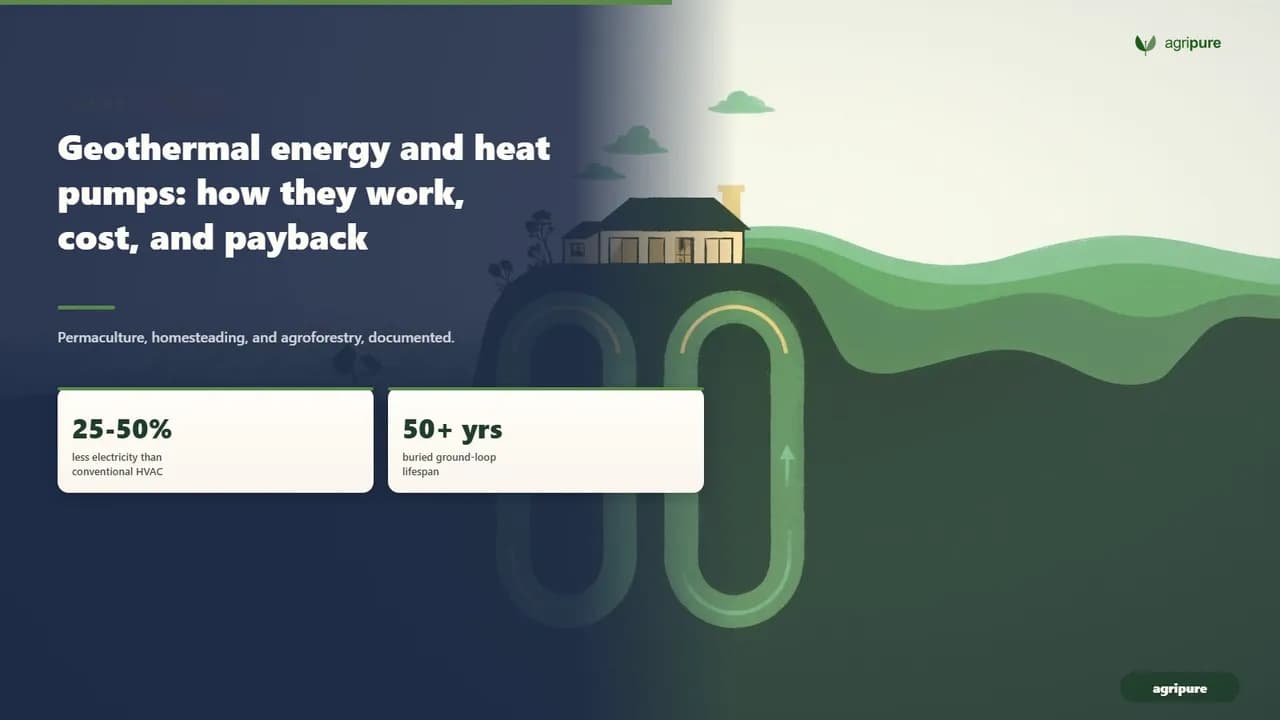
- A geothermal heat pump moves heat, it doesn’t burn fuel. It uses the steady 40 to 70 degree Fahrenheit temperature a few feet down to heat your house in winter and cool it in summer, and the U.S. Department of Energy reports these systems use 25% to 50% less electricity than conventional heating or cooling equipment.
- The efficiency is real and measurable. Ground-source units are up to 65% more efficient than traditional HVAC, and the best ENERGY STAR certified models reach a coefficient of performance near 4.8, meaning close to five units of heat moved per unit of electricity drawn.
- Upfront cost is the hard part. A residential install commonly runs $15,000 to $40,000 (some quotes reach $45,000), with deep vertical loops costing more than horizontal trenches. The ground loop itself lasts 50-plus years; the indoor heat pump about 24.
- Payback is now longer than it was. The Department of Energy puts savings-based payback at 5 to 10 years, but the 30% federal tax credit that made that math work ended for systems placed in service after December 31, 2025, so run your own numbers on state and utility incentives instead.
- Geothermal is renewable, and it both heats and cools. The heat flowing from Earth’s interior is continually replenished by radioactive decay, and one ground loop handles space heating, air conditioning, and often water heating from the same buried pipe.
Why a homeowner cares about the ground temperature
Start with the number that makes the whole technology work: a few feet below your lawn, the ground holds a nearly constant temperature year-round, somewhere in the 40 to 70 degree Fahrenheit band depending on your latitude. The U.S. Department of Energy frames it plainly: many parts of the country swing from scorching summers to sub-zero winters, but the shallow earth barely moves. That stability is the entire premise of geothermal energy used for home heating and cooling.
Power-plant geothermal versus the heat pump in your basement
Most people first meet the phrase “geothermal energy” through power plants (steam rising off a field in Iceland, or the geysers at Yellowstone). That is the deep, high-temperature resource used to spin turbines and make electricity. What sits under a typical North American homestead is different and far more accessible: low-grade heat in the soil and bedrock, tapped not to generate power but to move it. The device that does the moving is a geothermal heat pump, also called a ground-source heat pump or GSHP. This guide leads with that residential system because it is the version a homeowner in USDA zone 5 can buy, then widens out to what geothermal energy is, how it works, what it costs, and whether it earns its keep on your property.
Why moving heat beats making heat
Heat pumps are not exotic. Your refrigerator and your window air conditioner are both heat pumps: they move heat from one place to another using electricity rather than making heat by burning something. A geothermal heat pump does the same trick, except its outdoor “coil” is a loop of pipe buried in the ground, exchanging heat with that stable 50-something-degree earth instead of with bitterly cold or blazing-hot outdoor air. That single design choice is why the efficiency numbers are so good, and it is worth understanding before you weigh the price tag. A conventional furnace tops out near 95% efficiency; a ground-source heat pump effectively delivers 300% to 500% by moving heat rather than burning fuel.
Quick definition. “Geothermal heating” for a home means a ground-source heat pump (not a power plant). It taps the steady 40 to 70 degree Fahrenheit ground a few feet down and uses roughly one unit of electricity to move three or more units of heat indoors.
How a geothermal heat pump works
A geothermal system has three parts: the ground loop (buried pipe carrying water or a water-antifreeze mix), the heat pump unit indoors, and a distribution system (usually ductwork, sometimes radiant floors). In winter, fluid circulating through the loop absorbs warmth from the roughly 50-degree soil and carries it inside, where the heat pump concentrates that low-grade heat and delivers it as warm air. In summer the cycle reverses: the system pulls heat out of your house and dumps it back into the cooler ground. The Department of Energy describes the earth here as a kind of seasonal battery: a heat sink in summer, a heat source in winter.
That reversal is the answer to a question buyers ask constantly: does geothermal do air conditioning too? Yes: geothermal cooling is built into the same equipment. One buried loop and one indoor unit cover all 3 jobs (heating, cooling, and frequently domestic hot water as a bonus) because the system can route waste heat to your water tank instead of rejecting it to the ground. You are not buying a furnace and a separate air conditioner; you are buying one machine that runs both directions.
One buried loop, one indoor unit: heat is absorbed from the ground in winter and rejected to it in summer.
What “moving heat” buys you in electricity
Here is the part that sounds too good until you see the mechanism. A furnace is at best roughly 95% efficient; it can never deliver more energy than the fuel holds. A heat pump is not bound by that ceiling because it isn’t creating heat, only relocating it. The Department of Energy’s consumer guidance puts the practical result at 25% to 50% less electricity than conventional systems, and frames it as one unit of electricity moving three or more units of heat from the earth. The Environmental Protection Agency, through its ENERGY STAR program, lists geothermal heat pumps among the most efficient and cost-effective space-conditioning systems available.
Engineers call this the coefficient of performance, or COP, a unitless ratio of heating energy out to electrical energy in. Cooling efficiency is rated by the energy efficiency ratio, or EER. Federal procurement data from the Department of Energy shows the most efficient certified closed-loop units reaching an EER/COP as high as 26.1/4.8. A COP of 4.8 means nearly five units of heat delivered per unit of electricity consumed. Field studies temper the brochure figures (Oak Ridge National Laboratory measured ten real residential ground-source systems and found seasonal performance lands in the practical 3-to-5 range once you account for pumps, weather, and how the house is run), but even the conservative end of that range beats any combustion appliance.
The four loop types, and which fits your land
The single biggest variable in a geothermal install is the ground loop, because that is what gets dug or drilled. Most residential systems are closed loops (sealed pipe with fluid circulating in a continuous circuit) and they come in three layouts. A fourth type, open-loop, uses groundwater directly. Which one fits comes down to your site, not your preference.
Closed loops: horizontal, vertical, and pond
- Closed horizontal loop. Pipe is laid in trenches, typically with one pipe buried at six feet and another at four feet, or two pipes side by side at five feet. It is the cheapest option when you have the land (such as a homestead with open pasture or a large yard), but it needs a lot of trench length.
- Closed vertical loop. Where space is tight, holes about four inches in diameter are drilled roughly 20 feet apart and 100 to 400 feet deep, then fitted with U-shaped pipe. Drilling is what makes vertical loops more expensive, but they have a small footprint and tap more stable deep-ground temperatures, so they suit suburban lots.
- Pond or lake loop. If you have a suitable body of water on the property, coils of pipe are sunk and anchored (in cold climates at least eight feet under the surface to stay below the freeze line). When it’s available, this is often the lowest-cost loop because there’s no excavation.
- Open-loop system. Instead of a sealed circuit, the system pumps groundwater from a well, runs it through the heat pump, and discharges it to another well or surface water. It works beautifully where there’s abundant clean water and the right geology, but water quality and local regulations decide whether it’s viable.
Match the loop to your acreage
A reputable installer will assess soil conductivity, available area, and water resources before quoting, and that site assessment is worth paying for, because a loop sized wrong underperforms for 50 years. Acreage favors horizontal trenching; a small lot pushes you to vertical drilling, where boreholes run 100 to 400 feet deep; a clean pond or strong aquifer can change the economics entirely.
The indoor unit is compact and quiet; there is no outdoor compressor exposed to the weather.
What geothermal costs to install and the payback timeline
This is the question with the most commercial weight, so here are sourced ranges rather than a single tidy figure. A residential ground-source heat pump typically costs $15,000 to $40,000 or more to install, according to the energy-marketplace firm EnergySage’s 2025 pricing; the manufacturer Carrier puts its range at roughly $12,000 to $45,000 including installation. The two independent sources land in the same neighborhood, which is about as much certainty as exists in this market. The spread is wide because so much of the cost is the loop: labor and excavation or drilling, not the box on the wall, drive the bill, and a vertical-loop job on a rocky lot sits at the top of the range while a horizontal trench on open ground sits near the bottom.
Against that upfront number you set the running savings. Because the system uses 25% to 50% less electricity and ENERGY STAR certified units use 61% less energy than a standard model (a saving the EPA pegs at nearly $830 a year and more than $9,500 over the product’s 15-year rated life), the monthly bills fall hard. The Department of Energy’s own guidance says the additional cost of going geothermal may be returned in energy savings in 5 to 10 years, depending on local energy prices and incentives, and elsewhere notes payback typically arrives within about 10 years. Two things stretch that life out: the buried ground loop is rated for 50-plus years, and the indoor heat pump for around 24 years, so the loop you pay for once keeps working through two or three indoor units.
The case for geothermal in three numbers: deep efficiency, a high COP, and a loop that outlasts the house.
The federal tax credit update
For most of the past decade, the math above leaned on a generous federal incentive, and it’s the single most misreported fact about geothermal right now. The federal Residential Clean Energy Credit, Section 25D of the tax code, equaled 30% of the cost of a qualifying geothermal heat pump, and the IRS is explicit that it applied to property installed from 2022 through December 31, 2025. ENERGY STAR’s official schedule says the same thing in different words: 30% for property placed in service after December 31, 2021, and before January 1, 2026.
The part the older articles miss: that credit is no longer available for systems placed in service after December 31, 2025. If you completed an install in 2025, you can still claim 30% on that year’s return; a homeowner breaking ground in 2026 should not budget around the federal credit, because it has lapsed. What remains are state and utility incentives, which vary enormously by location and can still take a meaningful bite out of the upfront cost. The practical move in 2026 is to price the system, find out exactly which local rebates apply to your address, and build the payback on those, not on a federal credit that no longer exists.
Is geothermal energy renewable? And what are the real tradeoffs
Why geothermal counts as renewable
Yes, geothermal is renewable, and the reason is geological rather than promotional. The U.S. Department of Energy states that the heat flowing from Earth’s interior is continually replenished by the decay of naturally occurring radioactive elements and will remain available for billions of years. A residential heat pump barely scratches that resource (it only borrows and returns shallow ground heat on a seasonal cycle), so for any human timescale the supply is effectively inexhaustible. A March 2026 Department of Energy fact sheet lists geothermal heat pumps as using renewable geothermal energy, suitable for all areas of the United States, with long lifespan and very low electricity use. So the answer to “is geothermal renewable or nonrenewable” is unambiguous: it is renewable.
The honest pros and cons
That said, agripure’s job is to name the failure modes alongside the wins, so here are the pros and cons of geothermal energy for a home, without the gloss. The advantages are concrete: low operating cost and high efficiency, a long-lived system that heats and cools and helps with hot water, and quiet, even comfort with no roaring outdoor condenser. The disadvantages are just as real, and they are mostly about money and site: a $15,000-to-$45,000 bill and a yard that can take a loop.
Advantages | Disadvantages |
|---|---|
Uses 25% to 50% less electricity; up to 65% more efficient than conventional HVAC | High upfront cost of $15,000 to $45,000, now harder to offset since the 30% federal credit lapsed |
50-plus-year ground loop and ~24-year indoor unit; little maintenance, no combustion to vent | Site-dependent: needs land to trench or budget to drill, plus suitable soil or water |
One system heats, cools, and often makes hot water; quiet, steady comfort | Installation disrupts the yard; it still uses electricity, so carbon tracks your grid |
Set against the broader menu of home upgrades, geothermal is a high-cost, high-durability play rather than a quick win: a 50-year decision, not a weekend project. Our overview of where heat pumps rank among home energy upgrades puts it in context: air sealing and insulation usually come first because they’re cheaper per unit of comfort, and a heat pump (air-source or ground-source) is the next big lever once the envelope is tight.
Does your property suit geothermal?
Run a quick honest screen before you call an installer. Land or drilling access is first: a horizontal loop wants open ground (a homestead, a large rural lot), while a tight suburban parcel pushes you toward more expensive vertical boreholes 100 to 400 feet deep. Soil and geology matter because conductivity affects loop length and cost, and dense rock raises drilling bills. Your time horizon is the deciding factor: geothermal rewards people who plan to stay 10-plus years, because the payback runs years and the value lives in decades of low bills, not a fast flip.
Two situations make geothermal especially compelling. The first is new construction, where you can trench or drill before landscaping and size ductwork for the system from the start, avoiding retrofit headaches. The second is whole-home electrification: if you’re already moving off fossil fuels, a ground-source heat pump is the most efficient electric heating you can install (up to 65% more efficient than conventional HVAC) and it pairs naturally with on-site generation. Many homesteaders who pair geothermal with rooftop solar share the same goal: the heat pump cuts the load, and the panels supply the electricity that’s left. If your ambitions run all the way to cutting the cord, our guide to building an off-grid energy plan walks through how heating, power, and water fit together when there’s no utility to fall back on.
Conclusion
Geothermal energy, in the form a homeowner can install, is one of the most efficient heating and cooling technologies on the market: it moves heat instead of burning fuel, uses 25% to 50% less electricity than conventional systems, and runs on a renewable resource that outlasts the house by decades. The catch is the upfront cost and the site work, and the calculus shifted at the end of 2025 when the 30% federal tax credit lapsed for new installs. None of that makes geothermal a bad bet; it makes it a deliberate one. Price it for your specific lot, chase down the state and utility incentives that still apply, weigh the 50-year loop against the 10-to-15-year payback, and the decision will rest on real numbers instead of a brochure promise. For the right property and the right owner, the ground under your feet is the cheapest fuel you’ll ever not buy.
Frequently asked questions
How does geothermal energy work for home heating and cooling?
A geothermal heat pump circulates fluid through pipe buried in the ground, which holds a steady 40 to 70 degree Fahrenheit temperature year-round. In winter the fluid absorbs ground heat and the heat pump concentrates it to warm your home; in summer the cycle reverses and the system moves heat out of the house into the cooler earth. One loop and one unit handle heating, cooling, and often water heating.
How much does it cost to install a geothermal heat pump?
A residential geothermal (ground-source) heat pump typically costs $15,000 to $40,000 to install, with some quotes reaching $45,000. Horizontal trench loops are usually cheaper than deep vertical boreholes because most of the cost is excavation or drilling rather than the heat pump itself. Site conditions and system size drive the final figure.
What is the payback period for geothermal heating and cooling?
The U.S. Department of Energy estimates the extra upfront cost is returned through energy savings in 5 to 10 years, depending on energy prices and incentives, with payback often landing within about 10 years. Because the federal 30% tax credit ended for systems installed after December 31, 2025, homeowners in 2026 should base payback on state and utility incentives, which can push the real figure toward 10 to 15 years.
Is geothermal energy renewable?
Yes. The Department of Energy states that the heat flowing from Earth’s interior is continually replenished by the decay of naturally occurring radioactive elements and will remain available for billions of years. A home heat pump only borrows shallow ground heat on a seasonal cycle, so the resource is effectively inexhaustible.
How efficient is a geothermal heat pump compared with a furnace?
Geothermal heat pumps use 25% to 50% less electricity than conventional systems and are up to 65% more efficient than traditional HVAC. Because they move heat rather than burning fuel, the best ENERGY STAR certified units reach a coefficient of performance near 4.8 (close to five units of heat delivered per unit of electricity), which no combustion furnace can match.
What are the main disadvantages of geothermal energy?
The biggest drawback is the high upfront cost, made harder by the lapse of the federal tax credit at the end of 2025. Geothermal also depends on your site: you need land to trench or budget to drill, plus suitable soil or water, and installation disrupts the yard. It still uses electricity, so its carbon footprint depends on your grid.
References
- U.S. Department of Energy, Energy Saver. Geothermal Heat Pumps.
- U.S. Department of Energy, Energy Saver. Choosing and Installing a Geothermal Heat Pump System.
- U.S. Department of Energy. 5 Things You Should Know about Geothermal Heat Pumps.
- U.S. Department of Energy, Federal Energy Management Program. Purchasing Energy-Efficient Geothermal Heat Pumps.
- U.S. Environmental Protection Agency, ENERGY STAR. Geothermal Heat Pumps.
- U.S. Environmental Protection Agency, ENERGY STAR. Geothermal Heat Pumps Federal Tax Credit.
- Internal Revenue Service. Residential Clean Energy Credit.
- U.S. Department of Energy, Geothermal Technologies Office. Geothermal Basics.
- U.S. Department of Energy. Geothermal Heat Pump Fact Sheet (DOE/EE-2679, March 2026).
- EnergySage. Ground Source Heat Pump Cost: How Much Will You Pay in 2025?
- Liu, X. & Munk, J. Summary of Measured Performance of Ten Residential Ground Source Heat Pump Systems. Oak Ridge National Laboratory (U.S. DOE).