Key takeaways
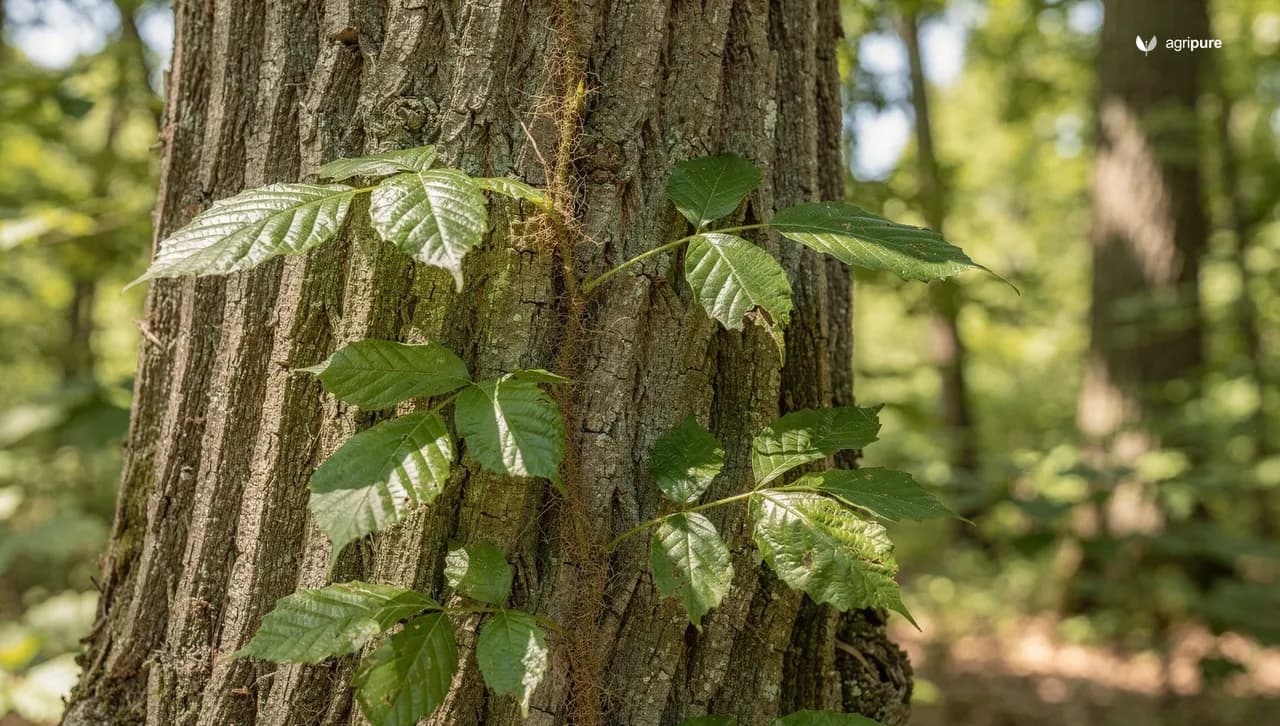
A detailed close-up, photorealistic image of a poison ivy plant. The foreground prominently displays a cluster of bright green leaves, each composed of three leaflets, with the central leaflet noticeably extending from a longer stalk. The leaves have a subtle, healthy sheen. In the softly blurred background, a poison ivy vine with distinct hairy aerial roots can be seen clinging to a tree trunk, alongside a faint cluster of small, white, waxy berries. The natural woodland setting is captured with gentle, natural lighting.
Learn to distinguish poison ivy by its signature ‘leaflets of three’ with a longer-stalked middle leaflet, its variable growth habit (vine, shrub, or groundcover), and its characteristic white berries in late summer or fall.
- Poison ivy carries 3 leaflets per leaf, arranged alternately on the stem, with the middle leaflet on a longer stalk — the basis of “leaves of three, let it be.”
- The same plant grows as a climbing vine, a low shrub, or a groundcover; a mature vine clings with hairy aerial roots, not the sucker discs of Virginia creeper.
- Virginia creeper has 5 leaflets, box elder seedlings have opposite leaves, and fragrant sumac’s center leaflet has no stalk — the 3 most common false alarms.
- Clusters of white, waxy berries in late summer confirm the call, since true poison ivy fruit is whitish, not the blue of creeper or the red of sumac.
- All parts hold urushiol; less than a grain of salt rashes 80 to 90% of adults, so wash skin, gear, and pets within minutes of contact.
Walk any woodland edge in July and you will pass poison ivy within the first 50 yards, usually without noticing it. The plant is a quiet shape-shifter: a glossy groundcover one season, a 30-foot vine up an oak the next, and a knee-high shrub in an old fence line. Learning to read it on sight is the single most useful field skill a forager or new landowner can carry.
Roughly 10 to 50 million Americans react to poison ivy and its relatives every year, which makes it the most common cause of allergic skin rash in the country. The good news is that confident identification comes down to about 5 checks — leaflet count, leaf arrangement, stalk length, growth form, and fruit color. Here is how each one works, and how to separate the real thing from the handful of plants that mimic it.
The leaves of three rule and what it misses
The old rhyme, “leaves of three, let it be,” is the right starting point and the wrong stopping point. Poison ivy (Toxicodendron radicans) carries compound leaves in threes, what botanists call trifoliate: one leaf is built from 3 separate leaflets. Dozens of harmless plants also show 3 leaflets, though, so the count alone narrows the field without closing the case.
Two details push the call from “maybe” to “yes.” Its middle leaflet sits on a noticeably longer stalk than the two side leaflets, which attach almost directly to the stem. Each leaf is also arranged alternately along the stem — stepping up one side then the other, never sitting in matched pairs. A weed that climbs like poison ivy is worth a second look the way a deep-rooted vine such as field bindweed earns one in a bed.
Five checks before you touch anything
Run the list below before deciding a plant is safe. Any single trait can mislead, but 3 or 4 of them together rarely do, and the whole sequence takes under 30 seconds once it is habit.
- Leaflet count: exactly 3 leaflets per leaf — not 5, not a single blade.
- Stalk length: the terminal leaflet stands on a visibly longer stalk than its two neighbors.
- Arrangement: leaves alternate up the stem rather than sitting opposite each other.
- Edges and surface: margins range from smooth to coarsely toothed; the surface may be glossy or dull.
- Growth form: vine, shrub, or groundcover, often with a hairy, ropelike main stem.
Vine, shrub, or groundcover in one plant
One species wears 3 different silhouettes, which is why people who know the leaf still get fooled by the form. Eastern poison ivy is a woody, perennial vine or small shrub, and in open ground it spreads as a low mat barely 6 inches high. Its leaf stays trifoliate in every form, so when the shape confuses you, drop your eyes back to the 3 leaflets.
The climbing form is the one worth memorizing. A mature poison ivy vine can run 30 feet or more up a trunk, gripping bark with hairy aerial roots that give the stem a fuzzy, ropelike look — the detail that separates it from nearly every other woodland climber. People exploring a new patch of land for permaculture planning or clearing an overgrown urban homestead meet this stem constantly along old fences and tree trunks.
Bare-stem warning: a leafless poison ivy vine in winter still carries urushiol in its wood and roots. A fuzzy, ropelike vine on a trunk deserves the same caution in January as it does in July.
A thick, fuzzy poison ivy vine covered in fine hairy aerial roots climbing the bark of a mature tree in a shaded forest.
Telling poison ivy from its lookalikes
Most false alarms come from 3 plants, and each one fails a single decisive test. Virginia creeper has 5 leaflets instead of 3, so it never passes the count. Box elder seedlings do carry 3 leaflets, but their leaves sit opposite each other on the stem rather than alternating. Fragrant sumac also shows 3 leaflets, but its center leaflet has almost no stalk, the reverse of poison ivy’s long-stalked terminal leaflet.
Plant | Leaflets | Tell-tale trait | Berry color |
|---|---|---|---|
Poison ivy | 3, alternate | Long-stalked middle leaflet, hairy vine | White, waxy |
Virginia creeper | 5, palmate | Climbs with adhesive sucker discs | Dark blue |
Box elder seedling | 3 to 5, opposite | Leaves paired opposite, not alternate | Winged keys |
Fragrant sumac | 3, alternate | Center leaflet has no stalk; citrus scent | Fuzzy red |
Across all 4 plants, the leaflet count screens out Virginia creeper instantly, the opposite-versus-alternate test removes box elder, and the stalk and berry color settle fragrant sumac. No memory of the rash is worth as much as 10 seconds spent on these 3 questions.
Seasonal color, flowers, and white berries
Poison ivy changes its look across all 4 seasons, and the color shifts trip up anyone who learned only the summer leaf. New spring growth often emerges reddish or bronze, hardens to a glossy green through summer, then turns vivid red, orange, and yellow in fall — frequently the brightest color on a woodland edge in October. A trifoliate structure holds through every one of these 4 stages.
Flowers and fruit add the final confirmation. In late spring loose clusters of small greenish-white flowers appear where leaf meets stem, and by late summer they ripen into clusters of white, waxy berries that birds spread widely. That whitish fruit is diagnostic: Virginia creeper carries dark blue berries and fragrant sumac carries fuzzy red ones, so a white cluster on a 3-leaflet plant is poison ivy until proven otherwise.
Why the fall color is a trap
The autumn display is the most dangerous moment to misjudge, because a scarlet 3-leaflet vine looks ornamental and invites a closer touch. Urushiol stays fully active in colored and even fallen leaves, so a handful of pretty fall foliage carries the same risk as the summer plant. Treat any bright trifoliate climber in October as poison ivy, not decoration.
Never burn it: burning poison ivy lofts urushiol on smoke particles, and inhaling that smoke can cause a serious reaction in the lungs and airway. Bag and dispose of cleared vines instead of adding them to a brush fire.
Urushiol and what to do after skin contact
Every part of the plant (leaves, stems, roots, and berries) holds urushiol, the oil behind the rash. The dose needed is tiny: less than a grain of salt triggers a reaction in 80 to 90% of adults, and the oil does not need a fresh wound to spread, only a bruised or broken plant surface. That is why brushing past a mowed or trampled patch is enough to coat your skin.
Speed matters most after contact. Washing the skin within about 10 minutes using warm soapy water, dish soap, or rubbing alcohol removes some oil before it bonds, and those first few minutes count for more than anything you do later. A sturdy hand tool and stout gloves let you grub out roots without skin contact, which beats pulling a urushiol-coated vine bare-handed.
- Wash skin fast: soap and water or rubbing alcohol within the first 10 minutes lifts oil that has not yet bonded to the skin.
- Decontaminate gear: urushiol clings to tools, leashes, boots, and clothing and can rash you days later, so wash everything that touched the plant.
- Bathe the dog: a pet’s fur carries the oil without reacting; wear gloves and wash the animal before it transfers urushiol to you.
Gloved hands using a hand weeder to dig out a poison ivy root from dark garden soil, with cleared green leaflets set aside on the ground.
Conclusion
Identifying poison ivy is less about a single rhyme and more about stacking a few quick checks: 3 leaflets, a long-stalked middle leaflet, alternate spacing, a hairy climbing stem, and white berries in late summer. Run those 5 against any suspect plant, and the lookalikes (5-leaflet creeper, opposite-leaved box elder, stalkless fragrant sumac) fall away in seconds. Spot it early, keep your skin and gear off it, and a patch you once feared becomes one you simply route around.
Frequently asked questions
Does poison ivy always have three leaves?
Poison ivy reliably shows 3 leaflets making up each compound leaf, so “leaves of three” is a sound first screen. The count alone is not proof, because Virginia creeper has 5 leaflets and box elder seedlings and fragrant sumac also carry 3, so confirm with leaflet stalk length, alternate arrangement, and berry color.
How do you tell poison ivy from Virginia creeper?
Count the leaflets. Virginia creeper has 5 leaflets per leaf and poison ivy has 3, which settles most cases immediately. Virginia creeper also climbs with adhesive sucker discs and ripens dark blue berries, while poison ivy climbs with hairy aerial roots and produces white, waxy berries.
Can you get a rash from poison ivy in winter?
Yes. All 3 of the bare stems, vine, and roots still contain urushiol after the leaves drop, so a leafless plant can rash you in January. A fuzzy, ropelike vine clinging to a tree trunk deserves the same caution across all 4 seasons as the leafy plant does in summer.
What does poison ivy fruit look like?
Mature poison ivy produces clusters of small, white, waxy berries about 5 to 6 mm (1/4 inch) across in late summer that often persist into winter. The whitish color is diagnostic, since Virginia creeper carries dark blue berries and fragrant sumac carries fuzzy red ones on the 2 most common lookalikes.
What should you do right after touching poison ivy?
Wash the exposed skin as soon as possible with soap and water, dish soap, or rubbing alcohol, ideally within the first 10 minutes before the oil bonds. Then clean all 3 of any tools, clothing, and pet fur that touched the plant, because urushiol can linger on those surfaces and cause a rash days later.
References
- CDC NIOSH — Poisonous Plants and Work
- CDC NIOSH Science Bulletin (2022) — Outdoor Workers and Poisonous Plant Exposures
- Clemson Cooperative Extension — How to Identify and Control Poison Ivy
- Penn State Extension — Virginia Creeper and Poison Ivy Identification
- Alabama Cooperative Extension System — Touch-Me-Nots: Poison Ivy, Poison Oak, and Poison Sumac
- American Academy of Dermatology — Poison Ivy, Oak, and Sumac: How to Treat the Rash
- Missouri Department of Conservation — Poison Ivy Field Guide