Key takeaways

A simple snap of the stem reveals the difference that matters: clear sap identifies edible purslane, while milky white sap indicates the irritating prostrate spurge. Always perform this quick test before consuming any wild plant.
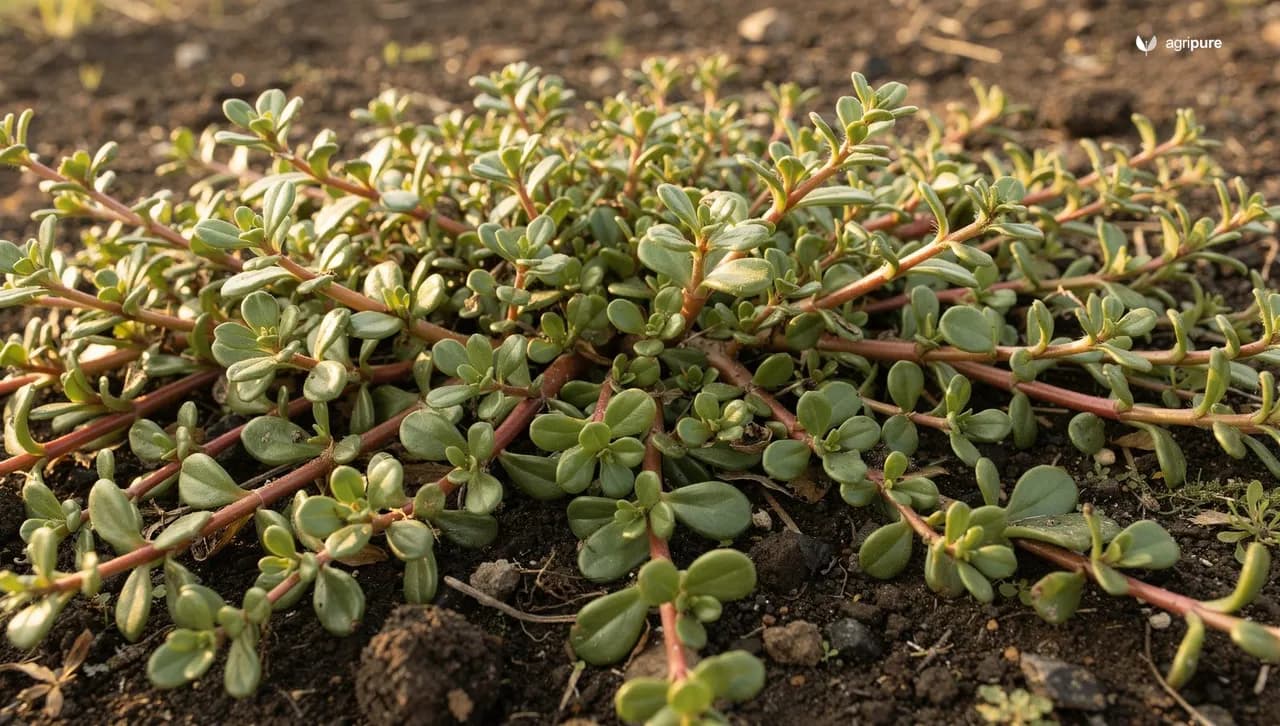
- Common purslane has fat, smooth, reddish stems, glossy paddle-shaped leaves, and yellow flowers — the stems hold so much water the plant is about 94% water.
- Its one dangerous lookalike is prostrate spurge: snap a stem, and milky white sap means spurge (a skin irritant), while clear sap means purslane.
- Purslane is the richest leafy source of omega-3 ALA, with 300 to 400 mg per 100 g serving — about five times the omega-3 of spinach.
- One plant can set up to 240,000 seeds that stay viable 5 to 40 years, so pulled stems must leave the garden, not sit on the soil.
- You can eat what you weed: harvest the young tips raw, and starve the rest out with a 3 inch mulch layer.
Common purslane (Portulaca oleracea) is the fleshy mat-forming plant filling the gaps between your tomatoes right now, and it carries more omega-3 than any other leafy vegetable. It is also one of the few backyard weeds with a genuinely toxic twin, so positive identification comes before anything reaches a salad bowl.
Get the ID wrong and you can end up chewing prostrate spurge, a different plant whose milky sap is a skin and gut irritant. The good news is that telling the two apart takes about 5 seconds and one snapped stem. Here is how to be certain, why this 94%-water weed is worth eating, and how to manage a plant that can drop 240,000 seeds in a season.
How to identify common purslane with certainty
Purslane reads as a succulent because it is one. Cornell weed scientists describe it as a succulent, prostrate, taprooted summer annual with round, fleshy, highly branched stems that turn maroon with age and club-shaped, round-tipped leaves. The whole plant is roughly 94% water, which is why the stems feel plump and snap with a clean, juicy break rather than a dry one.
Three features lock in the ID together — no single one is enough on its own, but the combination is unmistakable. The reddish stems radiate from a central rooting point like spokes of a wheel, the leaves are smooth and shiny, and any flowers that open are small and yellow, opening for only a few hours around midday. Mature plants typically span 12 inches or more and lie flat against the soil. The full purslane plant profile covers its growth habit and range in more detail.
The three-point field check
Run all 3 before you trust a patch, because lookalikes can match 1 or 2 features but never all 3 at once.
- Stems: fat, smooth, and hairless, reddish to maroon, holding obvious water when you press them.
- Leaves: thick paddle or teardrop shapes, glossy, arranged in loose rosettes at the stem tips, usually under 1.5 inches long.
- Sap: snap a stem and the juice runs clear — this is the single test that rules out the toxic lookalike below.
The one non-negotiable rule: never eat a foraged plant on shape alone. With purslane, the clear-sap snap test takes 5 seconds and is the difference between a salad green and a stomach-ache.

The lookalike that can hurt you: prostrate spurge
Prostrate or spotted spurge (Euphorbia maculata) grows in the same hot, compacted, sunny spots as purslane and forms a similar low mat up to 3 feet wide, which is exactly why the two get confused. The University of Wisconsin notes that spurge stems secrete a milky sap when broken, a trait of the entire euphorbia family, and that this sap is a skin irritant to susceptible people and toxic to grazing animals. That 1 milky sap test is the whole story: purslane never has it.
The plants diverge on 4 checkable points. Spurge leaves are thin, dull, and slightly hairy, growing in opposite pairs along pink-to-maroon hairy stems, sometimes with a small red spot on the leaf. Purslane leaves, by contrast, are thick, glossy, and hairless on smooth stems. Spurge carries whitish-pink flowers while purslane flowers are yellow, and in any doubt the 5-second snap test settles it instantly.
Feature | Common purslane (edible) | Prostrate spurge (toxic) |
|---|---|---|
Broken-stem sap | Clear and juicy | Milky white (irritant) |
Stems | Fat, smooth, hairless | Thin, often hairy |
Leaves | Thick, glossy, paddle-shaped | Thin, dull, red-spotted |
Flower color | Yellow | Whitish pink |
Texture | Succulent, ~94% water | Dry, wiry |
If the sap is milky, walk away. Wash any spurge sap off your skin, and never put a plant in your mouth to “taste-test” an ID — with spurge, the sap alone is the warning.
The omega-3 case for eating purslane
Once you have ruled out spurge, purslane earns its place at the table on nutrition alone. A peer-reviewed review in The Scientific World Journal calls it the richest vegetable source of alpha-linolenic acid, the plant-based omega-3 (ALA). One 100 g serving of fresh leaves carries 300 to 400 mg of ALA — and the same review reports purslane holds about five times more omega-3 than spinach.
The mineral side is just as strong. The same analysis measured 494 mg of potassium and 68 mg of magnesium per 100 g, and found purslane leaves beat spinach on alpha-linolenic acid, vitamin E, and vitamin C. For a plant most gardeners spray, that is an unusual return — roughly a third of a gram of a hard-to-get omega-3 in a single handful you would otherwise throw on the compost.
What the omega-3 actually buys you
ALA is the omega-3 your body converts, slowly, into the EPA and DHA found in fish. Purslane will not replace oily fish, but as a free, fast-growing green it tops up a fatty acid most plant-heavy diets run short on. A daily salad-sized portion of about 50 to 100 g adds a meaningful 150 to 400 mg of ALA at no cost beyond bending down.
From the garden to the plate
Purslane is one of the easiest of the wild greens to cook because it behaves like a vegetable, not a foraged oddity. Mississippi State Extension notes it is served raw in salads, sauteed in oils, or cooked in soups and breads. That 94% water content gives raw leaves a crisp, slightly lemony snap, while 2 to 3 minutes of heat softens them into something close to spinach with a mild mucilaginous body that thickens a soup.
Harvest the top 2 to 3 inches of each stem with scissors and the plant regrows for weeks, so a single patch feeds you repeatedly through summer. Rinse well — these mats sit on soil and collect grit — and eat the stems too, since they hold much of the omega-3. Foragers who let some plants stay treat purslane as a productive ground layer in a food forest, where a self-seeding green that needs zero care has obvious appeal.
Worth knowing: purslane is naturally high in oxalates, like spinach and chard. If you are prone to kidney stones, treat it as an occasional green rather than a daily staple, and cooking lowers the oxalate load.

Managing purslane versus harvesting it
The same trait that makes purslane a generous green makes it a stubborn weed: it is built to come back. UC IPM warns that a single plant may produce 240,000 seeds that stay viable in the soil for 5 to 40 years, and that the fleshy stems stay alive for days after pulling and re-root once the bed is watered. Cornell puts a foot-wide plant at about 7,000 seeds, with large plants topping 100,000.
That biology dictates the tactics. Whether you are clearing it or cropping it, the 1 rule is the same: never let it set seed, and never leave pulled stems lying on moist ground for the 3 to 4 days they stay viable. A sharp hand weeder and cultivator lifts the central taproot cleanly so the plant cannot resprout from a fragment.
Three ways to keep it in check
- Pull early, before flowers: uprooting kills small seedlings within the first 3 weeks; after about 4 weeks it sets seed and gets far harder to stop.
- Remove what you pull: bag pulled plants or eat them — left on the soil, stems re-root and seeds keep ripening a week later.
- Mulch the rest out: a 3 inch layer of organic mulch screens out the light purslane seed needs to sprout.
If you would rather farm it than fight it, the same principles used in no-dig permaculture beds apply: leave a managed patch, harvest the tips, and pull any plant that starts to flower. A few minutes a week keeps a 4 by 8 foot bed both productive and under control.
Conclusion
Purslane is the rare weed that pays you back, but only after you have proven it is purslane. Snap a stem first: clear sap, smooth fat stem, glossy paddle leaves, and yellow flowers mean a green carrying 300 to 400 mg of omega-3 per serving. Milky sap on a hairy stem means spurge — leave it. Then decide plant by plant whether to harvest the tips or pull the crown before its 240,000 seeds settle in for the next decade.
Frequently asked questions
How do I know a plant is purslane and not its toxic lookalike?
Break 1 stem. Common purslane runs clear, juicy sap and has fat smooth reddish stems with glossy paddle leaves and yellow flowers. Prostrate spurge leaks milky white sap from thin hairy stems and has whitish-pink flowers, and that milky sap is a skin and gut irritant, so the 5-second snap test is the only check you fully trust.
Is the whole purslane plant edible?
Yes — leaves, stems, flowers, and seeds of common purslane are all edible, and the stems hold much of the omega-3. It is naturally high in oxalates, so people prone to kidney stones should eat it occasionally rather than daily, and cooking lowers the oxalate content.
How much omega-3 does purslane actually contain?
A 100 g serving of fresh purslane carries about 300 to 400 mg of alpha-linolenic acid, the plant form of omega-3. Peer-reviewed analysis calls it the richest leafy vegetable source of ALA, with roughly five times the omega-3 of spinach.
How do you eat purslane?
Eat the young top 2 to 3 inches raw in salads for a crisp, lemony bite, or saute and add them to soups, stir-fries, and breads where they soften like spinach. Rinse well first, since the low mats collect grit from sitting on the soil.
How do I control purslane without losing the harvest?
Pull or harvest plants before they flower, within about the first 3 weeks, and always remove pulled stems because they re-root and keep ripening seed for a week. A 3 inch organic mulch layer blocks the light the seed needs to sprout.
References
- Mississippi State University Extension — Forgotten Foods: Common Purslane
- University of Wisconsin-Madison Extension — Spotted Spurge (Euphorbia maculata)
- Uddin et al., The Scientific World Journal — Purslane: Nutrition, Omega-3, and Antioxidant Attributes
- Cornell University CALS Weed Science — Common Purslane
- UC Statewide IPM Program — Common Purslane