Key takeaways
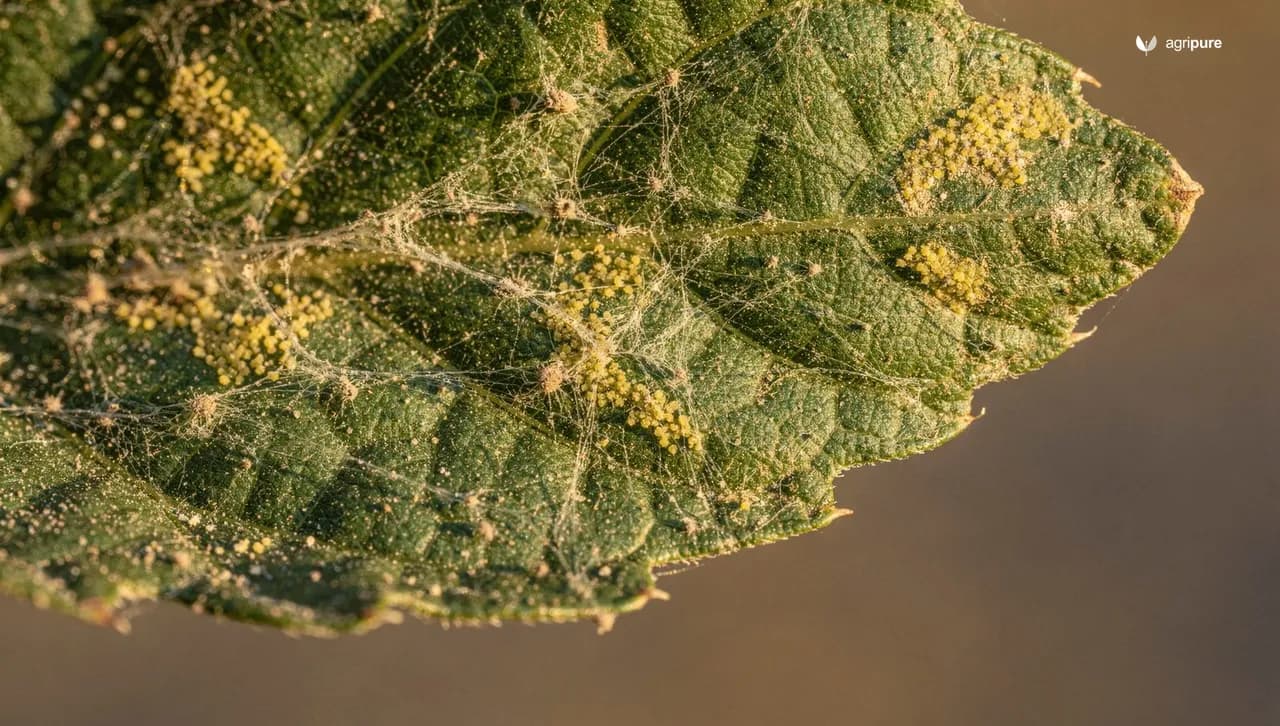
A close-up photograph of a green plant leaf affected by spider mites, showing fine, almost imperceptible webbing on the underside and tiny pale stippling dots on the upper surface, indicative of early infestation.
Early detection of spider mites matters: look for subtle stippling on leaf surfaces and fine webbing, especially on the undersides, before the infestation becomes severe and challenging to manage.
- Spider mites are roughly 1/50 inch long; the first sign is usually fine webbing and a pale stippling of dots, not the mites themselves.
- Dry conditions favor them, and a female can lay about a dozen eggs a day, so a colony explodes in under 2 weeks above 90°F.
- A forceful spray of water knocks down populations and washes off the dust that shields them from predators.
- Insecticidal soap, horticultural oil, and neem all work on contact; rotate and hit the leaf undersides.
- Outdoors, predatory mites like Phytoseiulus persimilis do the heavy lifting once you stop the dust and raise humidity.
You rarely see the mites first. You see the leaf — a faint sandblasted look across the top, a few thousand pale dots where the green used to be, and on the underside a fine silk webbing that catches the afternoon light. By the time the webbing is obvious, a single plant can be carrying tens of thousands of mites, each one about 1/50 inch long.
Spider mites are a dryness problem before they are a pest problem. They breed fastest in hot, dusty, low-humidity air, while the predatory mites that would eat them need it humid: Phytoseiulus, the key one, requires above 60% relative humidity to survive. Here is how to read the damage, knock the population down with water, soap, and neem in 3 rounds, and then change the conditions so they do not come back, indoors on houseplants and outdoors in the garden.
How to spot the webbing and stippling early
Catching mites early is mostly about knowing what their feeding looks like, because the animal itself is barely visible. UC Integrated Pest Management notes that damage first appears as a stippling of light dots on the leaves, and that when numbers are high, dense webbing can cover leaves, twigs, and fruit. By the webbing stage you are already 2 or 3 generations behind.
Run 2 quick field tests before you treat anything. The first costs nothing and the second takes about 10 seconds.
- The paper test: hold a sheet of white paper under a suspect leaf and tap it sharply — moving specks the size of ground pepper that smear green-brown when wiped are spider mites.
- The hand-lens check: at 1/50 inch they are right at the edge of unaided sight, so a 10x loupe on the leaf underside confirms the two dark body spots of the twospotted species.
- The webbing read: fine silk strands spanning a leaf notch or the gap between leaf and stem mean a heavy, established colony, not a first arrival.
Mites versus look-alikes
Stippling can be confused with the damage of lace bugs, thrips, or early nutrient burn. The tell is the underside: mite stippling comes with webbing and live specks, while thrips leave silvery scars flecked with tiny black dots of frass and no silk. On a stressed tomato crop, check the lowest 2 or 3 leaves first, since mites almost always start on the oldest growth.
Scout the undersides weekly during any hot, dry stretch. A 10x hand lens and 2 minutes per plant catches an infestation while a single water blast can still end it.
Underside of a bean leaf held up to the light showing pale yellow stippling and a thin patch of spider mite webbing along the midrib.
Why dry, dusty air is their best friend
Spider mites are not a sign of dirty growing so much as a sign of dry growing, and 9 times out of 10 an outbreak traces back to heat and low humidity. Colorado State University Extension explains that dry conditions greatly favor all spider mites because the lower humidity lets them evaporate the excess water they excrete, so they feed more. UC IPM adds that mites prefer hot, dusty conditions and turn up first on plants beside dusty roads or at garden margins, and that water-stressed plants are highly susceptible.
The reproduction math is what makes a dry spell dangerous. A mature female may lay about a dozen eggs daily for roughly 2 weeks, and the young become full-grown in as little as a week after hatching. University of Minnesota Extension reports that above 90°F a colony can reach high numbers in under 2 weeks, which is why an overlooked plant in July goes from a few specks to a webbed-over ruin almost overnight.
Dust is not cosmetic: the layer that settles on roadside or shelf-top foliage shelters mites from their predators, so hosing it off is part of the control, not just cleanup.
A field comparison of spider mite controls
Each method has a job it does well and a limit worth knowing before you reach for it. This table sorts the common options by how fast they work, whether they spare the predators, and where each one fits.
Method | Speed | Spares predators? | Best use |
|---|---|---|---|
Forceful water spray | Immediate, partial | Yes | First response, dust removal |
Insecticidal soap | 1-2 days, contact | Mostly | Houseplants, light outbreaks |
Horticultural oil | 1-2 days, contact | Mostly | Heavier coverage, eggs |
Neem oil | Several days | Partly | Repeat sprays, suppression |
Predatory mites | 1-3 weeks | They are the predator | Greenhouses, larger gardens |
Raising humidity | Preventive, slow | Yes | Indoor plants, long-term |
Across all 6 options, water is the only instant and predator-safe first move, oils and soaps do the cleanup, and humidity plus predators is what actually keeps mites from rebuilding.
Water, soap, and neem: the contact knockdown
The fastest, cheapest control is plain water. UC IPM is direct that on small fruit trees and in gardens, regular, forceful spraying with water often reduces mite numbers adequately, and the Missouri Botanical Garden notes a strong stream aimed at the leaf undersides gives real control. Hit the undersides every 2 to 3 days for a couple of weeks, since that is where the colony and the eggs sit.
When water alone is not enough, move to contact sprays within 1 to 2 days. UC IPM recommends insecticidal soap or insecticidal oil as the preferred selective materials, and the Missouri Botanical Garden lists horticultural oils and neem among effective options. A pump sprayer in a greenhouse or on a patio lets you coat the undersides evenly rather than misting the tops and missing most of the mites.
How to spray so it works
Contact sprays only kill what they wet, so technique matters more than the brand on the bottle. These 3 habits separate a spray that clears mites from one that just stresses the plant.
- Coat the undersides: aim up into the canopy so soap or oil reaches the underside, where most of the colony feeds.
- Repeat on a 5 to 7 day cycle: sprays miss eggs, so plan 3 passes to catch each new generation as it hatches.
- Spray cool and shaded: apply in early morning or evening below about 90°F, because oils and soaps can scorch leaves in midday heat.
Predatory mites and raising the humidity
Sprays buy time, but the durable fix is biology and climate. UC IPM and Colorado State Extension agree that spider mites have many natural enemies, the most important being the predatory mites, and that those predators need it humid, so arid conditions stress them while favoring the pest. Cornell’s biological control program reports that Phytoseiulus persimilis, a specialist on web-spinning mites, eats 5 to 20 prey a day and underpins roughly 75% of European greenhouse vegetable production.
That predator has one firm requirement worth designing around: Cornell notes it needs relative humidity above 60% to survive, especially through the egg stage. Raising humidity does two jobs at once. It slows the mites, which thrive when dry, and it keeps their predators alive — so on a greenhouse tomato, releasing Phytoseiulus at roughly a 1-to-10 predator-to-prey ratio can clear a light infestation in 2 to 3 weeks.
Hold off on broad insecticides: carbaryl and some pyrethroids wipe out the predatory mites and routinely trigger a worse mite outbreak within days, especially in hot weather. Selective soaps and oils protect the biology you are trying to recruit.
A cluster of leafy houseplants grouped on a pebble-and-water humidity tray near a bright window, leaves misted with fine droplets.
Indoor houseplants versus the outdoor garden
The same mite plays out differently in a living room and a vegetable bed. Indoors, the air is dry, predators are absent, and 1 infested plant seeds the whole shelf, so the lever is humidity plus isolation. Group plants on a pebble-and-water tray, run a humidifier toward 50% or higher, mist on hot days, and quarantine any new plant for 2 weeks before it joins the others.
Outdoors the playbook flips toward biology and water. Dust suppression matters most along driveways and bed margins, a 1-minute hose-down restores the predators’ footing, and resident populations of Phytoseiulus and lady beetles usually hold mites below damage if you avoid broad sprays. Keeping plants from drought stress — the same reason a deep, well-watered raised bed resists mites — removes the trigger that starts most outbreaks.
Conclusion
Getting rid of spider mites is less about a single spray and more about reversing the dryness that let them win. Knock the population down with a forceful water blast, follow with 3 rounds of soap, oil, or neem on the undersides, and then push humidity above 50% and protect the predators so a 1/50 inch pest cannot rebuild faster than you can scout it.
Frequently asked questions
What is the fastest way to get rid of spider mites?
A forceful spray of water on the leaf undersides is the quickest first move and reduces numbers immediately. Follow it within a day with insecticidal soap or horticultural oil, then repeat both every 5 to 7 days for 2 to 3 weeks to catch newly hatched mites.
Does neem oil kill spider mites?
Yes, neem is an effective contact material against mites, but it works over several days rather than instantly. Coat the undersides thoroughly and reapply on a 7-day cycle, since a single pass misses the eggs that hatch a few days later.
Why do my houseplants keep getting spider mites?
Indoor air is usually dry, and dry conditions greatly favor mites while starving their predators. Raising humidity above 50% with a pebble tray, humidifier, or misting, plus quarantining new plants for 2 weeks, removes the conditions that let them keep returning.
Do predatory mites really work against spider mites?
They do, and outdoors they are the main reason most gardens never see an outbreak. Phytoseiulus persimilis eats 5 to 20 spider mites a day but needs humidity above 60%, so it performs best in greenhouses or humid gardens where broad insecticides are avoided.
What conditions cause spider mite outbreaks?
Hot, dry, dusty weather is the trigger. Above 90°F a colony can reach high numbers in under 2 weeks, and water-stressed or dust-covered plants are the most susceptible, which is why irrigation and humidity are the core of prevention.