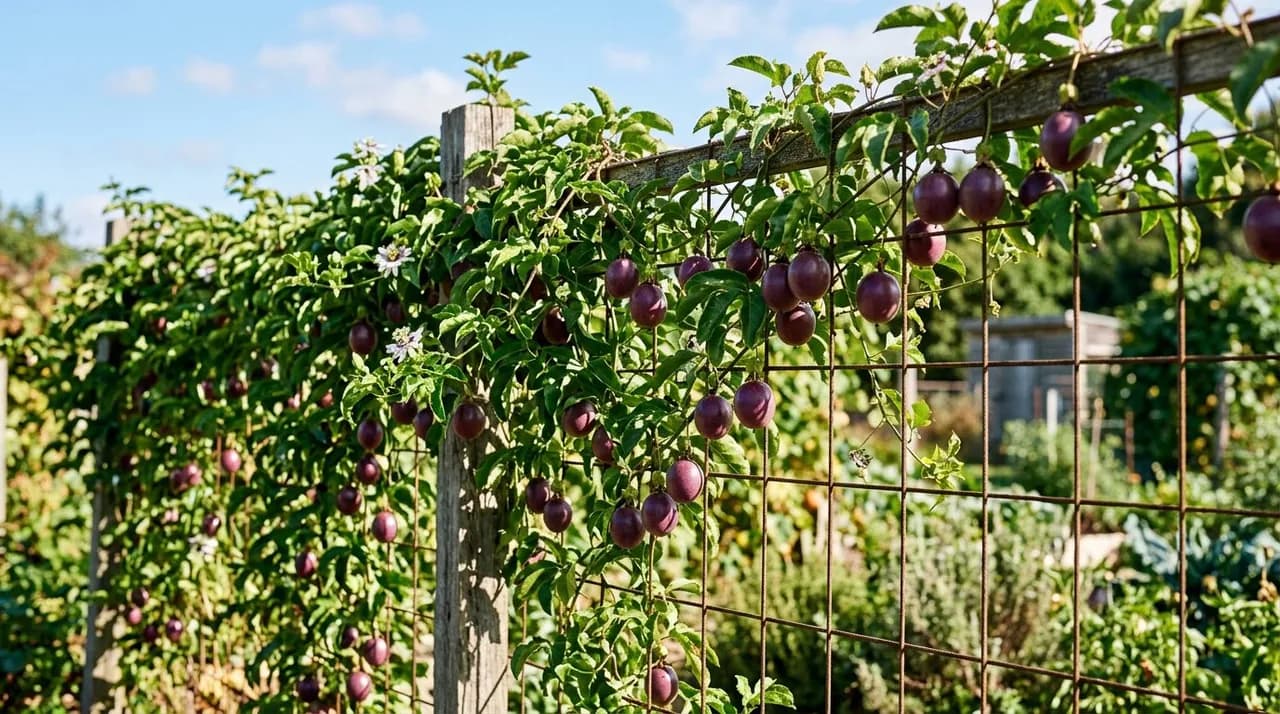
Key takeaways
- Select purple passion fruit (Passiflora edulis) for cooler subtropical climates and self-fertile fruiting, or yellow varieties for warm tropical lowlands.
- Construct a heavy-duty post-and-wire trellis (2 metres / 6.5 feet tall) capable of supporting mature vine weight.
- Provide full sunlight and freely draining, compost-enriched soil with a neutral pH (6.5 to 7.5).
- Resolve unpollinated flowers by hand-pollinating blooms with a soft paintbrush and avoiding high-nitrogen fertilisers.
- Harvest fruit only when skins turn fully purple or yellow and detach easily, or collect fallen fruit from clean mulch.
Quick answer: To grow passion fruit successfully, plant vines in full sun in rich, freely draining soil against a heavy post-and-wire trellis. Feed with potassium-rich organic fertiliser, keep roots evenly moist under thick mulch, and hand-pollinate blossoms if local bee activity is low.
Passion fruit (Passiflora edulis) produces heavy crops of aromatic fruit in a compact footprint when trained vertically.
A healthy vine can grow 5 to 10 metres (16 to 33 feet) in a single season, with a productive lifespan of 5 to 7 years. Because these climbers need sturdy support and reliable pollination, trellising and variety selection determine the yield.
Vines can be trained along a boundary fence or grown in a large container in a sheltered courtyard, provided the structure can bear the weight of mature vines.
Choosing varieties: purple vs. yellow passion fruit
The two main types of Passiflora edulis have different climate and pollination requirements:
+--------------------+-----------------------+--------------------+-------------------+
| Feature            | Purple Passion Fruit  | Yellow Passion Fruit| Cultivation Note  |
|                    | (Passiflora edulis)   | (var. flavicarpa)  |                   |
+--------------------+-----------------------+--------------------+-------------------+
| Climate Preference | Subtropical & high-   | Strict tropical    | Purple tolerates  |
|                    | altitude tropics      | lowland warmth     | light winter cold |
+--------------------+-----------------------+--------------------+-------------------+
| Pollination        | Self-fertile; sets    | Self-incompatible; | Yellow requires a |
| Biology            | fruit easily          | needs cross-pollen | second clone vine |
+--------------------+-----------------------+--------------------+-------------------+
| Fruit Flavor       | Intensely sweet-tart, | Highly aromatic,   | Purple preferred  |
|                    | rich aroma            | higher acidity     | for fresh eating  |
+--------------------+-----------------------+--------------------+-------------------+
| Frost Tolerance    | Light frost (-1°C /   | No frost tolerance;| Protect purple    |
|                    | 30°F) kills foliage   | stalls <10°C (50°F)| from ground freeze|
|                    |                       | killed at 0°C (32F)|                   |
+--------------------+-----------------------+--------------------+-------------------+
1. Purple passion fruit (Passiflora edulis f. edulis)
Purple passion fruit is suited to home gardens outside the equatorial tropics. It features dark green leaves and produces round, egg-sized fruit that turns deep purple when ripe.
2. Yellow passion fruit (Passiflora edulis f. flavicarpa)
Also known as maracuyá or lilikoi, yellow passion fruit produces larger, glossy yellow fruits with acidic juice. Yellow vines are vigorous in tropical soils, but require cross-pollination from a separate seedling vine to set fruit.
Propagation: growing passion fruit from seed vs. cuttings
Propagating passion fruit is straightforward using either seeds or vegetative cuttings:
+---------------------------------------------------------+
|                  [Seed vs. Cutting Propagation]         |
|                                                         |
|    [Fresh Ripe Fruit Seeds]       [Semi-Hardwood Cutting|
|      (Wash Off Mucilage)            (15 cm Stem + Node) |
|               |                              |          |
|    (Sow 1 cm / 0.5 in Deep)       (Dip Node in Rooting) |
|               |                              |          |
|    Sprouts in 2 - 4 Weeks         Roots in 3 - 4 Weeks  |
+---------------------------------------------------------+
1. Growing passion fruit from seed
- Extract seeds from a fully ripe fruit and wash off the surrounding pulp aril in a fine sieve.
- Plant seeds immediately 1 cm (0.5 in) deep in warm, moist seed-starting mix. Fresh seeds germinate in 14 to 28 days at 22°C to 28°C (72°F to 82°F).
2. Semi-hardwood cuttings
- Take 15 cm (6 in) cuttings from healthy lateral vines during spring or early summer.
- Make a 45-degree cut below a node, strip lower leaves, and insert the cutting into a 50/50 mix of perlite and coco coir under high humidity; roots form in 3 to 4 weeks.
For trellising ideas in tight footprints, see our guide on vertical vegetable gardening in small spaces.
Constructing a sturdy passion fruit trellis
Avoid planting vines against flimsy plastic netting. A mature vine develops heavy woody stems and a dense canopy that requires sturdy support.
+---------------------------------------------------------+
|                  [T-Post Wire Trellis Design]           |
|                                                         |
|     (T-Bar) ========================= (T-Bar)           |
|        ||   |--- Top Wire (2.0 m)---|   ||              |
|        ||   |-- Lower Wire (1.4 m)--|   ||              |
|   =====||===|=======================|===||===== (Ground)|
|      [Treated Wooden Post]    [Treated Wooden Post]     |
|      (60 cm Concrete Base)    (60 cm Concrete Base)     |
+---------------------------------------------------------+
1. The post-and-wire cordon trellis
- Trellis height: Install treated timber or steel posts extending 1.8 to 2.0 metres (6 to 6.5 feet) above ground, set 60 cm (2 feet) into the soil.
- Wire tension: String two galvanised steel wires (2.5 mm gauge) horizontally: the top wire at 2.0 metres (6.5 feet) and a lower wire at 1.4 metres (4.5 feet).
- Orientation: Orient north-to-south so both sides receive equal daily sunlight.
2. Training the vine
- Train a single central stem upward to the top wire by tying it to a stake, pinching off low side shoots.
- At the top wire, pinch the tip to force two horizontal leaders (cordons), training one left and one right.
- Allow lateral fruiting branches to hang downward from the top cordon like a green curtain.
Soil, feeding, and water: passion fruit vine care
Delivering proper root nutrition and moisture ensures healthy flowering:
1. Soil and drainage
Passion fruit roots occupy the top 30 cm (12 in) of soil and rot quickly in saturated clay:
- Plant in rich, freely draining loam amended with compost.
- Build a 15 cm (6 in) raised mound before planting to guarantee drainage away from the stem base.
2. Fertiliser: potassium vs. nitrogen
- Avoid excess nitrogen: High nitrogen stimulates runaway foliage at the expense of flowers.
- Focus on potassium: Apply organic rock phosphate and sulfate of potash in early spring. Top-dress every 8 weeks with balanced organic amendments; see organic gardening fertilizer.
- Supplement with micronutrient drenches in DIY fish and seaweed fertilizer.
3. Mulching and watering
- Mulch the root zone with a 10 cm (4 in) layer of wood chips or straw, keeping it 10 cm (4 in) clear of the main trunk.
- Water deeply twice weekly during hot dry weather to prevent fruit shrivelling.
Troubleshooting: why passion fruit flowers but no fruit sets
The most common issue is flowers failing to set fruit:
+-------------------+--------------------+--------------------------------------------+
| Problem           | Root Cause         | Corrective Solution                        |
+-------------------+--------------------+--------------------------------------------+
| Flowers drop off  | Lack of pollinating| Hand-pollinate blossoms when open; purple  |
| without swelling  | insects            | late morning, yellow early-mid afternoon   |
+-------------------+--------------------+--------------------------------------------+
| Dense foliage,    | Excessive nitrogen | Stop nitrogen feeds; top-dress with potash |
| zero flower buds  | in soil            | and bone meal                              |
+-------------------+--------------------+--------------------------------------------+
| Shrivelled fruit  | Inconsistent soil  | Water deeply twice weekly; apply 10 cm     |
|                   | moisture           | organic mulch over root zone               |
+-------------------+--------------------+--------------------------------------------+
Hand-pollination technique
Passion fruit pollen is large, heavy, and sticky, so honeybees often fail to transfer it to the central stigma, especially on yellow varieties. Carpenter bees (Xylocopa species) are the primary natural pollinators, but hand pollination guarantees fruit set:
- Use a soft artist's paintbrush or cotton swab to dab golden pollen from downward-facing anthers and transfer it to the three sticky stigmas at the blossom centre.
- Hand-pollination takes seconds and significantly improves fruit set rates.
For general pest control methods, see our guide on integrated pest management for beginners.
Regional climate calendars and harvesting ripe passion fruit
Adjusting management by climate ensures ongoing productivity:
Regional planting schedules
In subtropical and tropical climates: Plant vines outdoors in spring or early autumn to establish root systems during warm rains.
In cool temperate climates: Plant against a sunny, heat-radiating masonry wall. In frosty areas, grow purple varieties in large 50-litre (13-gallon) containers, moving them into an unheated greenhouse over winter.
Harvesting ripe passion fruit
- Never pick hard green fruit: Passion fruit does not sweeten once picked green.
- Harvest indicators: Fruit is ripe when skins turn fully purple or yellow and detach with a gentle touch or drop naturally.
- Wrinkling for sweetness: Allowing freshly fallen fruit to sit at room temperature for 3 to 5 days until the skin wrinkles concentrates sugars and reduces acidity.
For another fast-growing subtropical perennial, see our guide on how to grow moringa from seed.