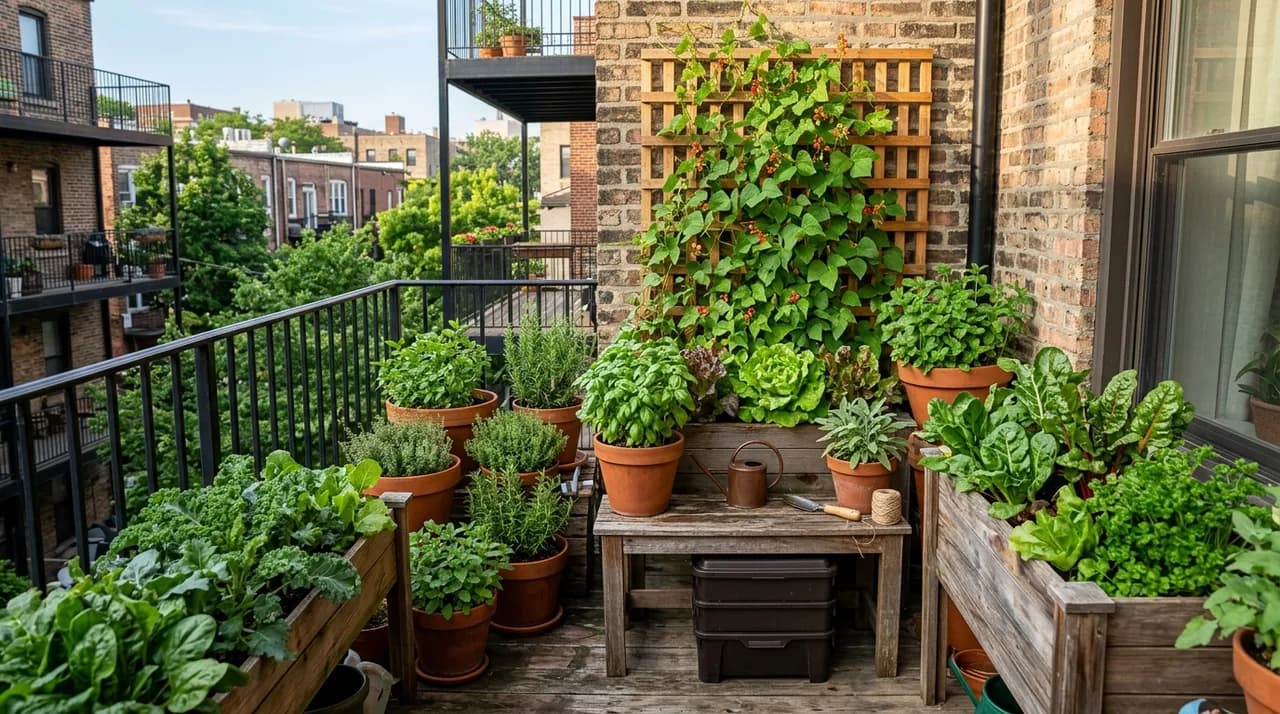
Permaculture principles can be effectively applied to urban balconies, courtyard patios, and compact residential plots, but the spatial frameworks developed for broadscale rural acreages cannot be transferred without significant modification. Techniques that capitalize on biological density, such as vertical trellising, multi-species container guilds, microclimate capture, and closed-loop vermicomposting, scale down successfully to tight quarters. Conversely, broadscale planning methods such as multi-zone concentric layouts and contour earthworks fail in small spaces; stretching rural models onto an urban balcony distorts the framework rather than improving practical food production.
What genuinely scales down: density, stacking, and closed loops
The primary advantage of small-space permaculture is accessibility. When an edible system sits three steps from the kitchen door, daily observation is continuous, allowing the grower to notice moisture stress, beneficial insects, and pest pressure before serious damage occurs.
Several core ecological techniques adapt well to small spaces:
- Vertical stacking: Using structural walls, railing planters, and overhead wires to train climbing crops upward. Indeterminate vining tomatoes, pole beans, Malabar spinach, and climbing squash take up minimal floor space while intercepting abundant vertical light.
- Container guilds: Designing large planters as polycultures rather than isolated monocultures. Instead of filling a large pot with a single dwarf fruit tree or shrub, growers build a compact fruit tree guild containing a perennial fruit bush, shallow-rooted loose-leaf greens, flowering sweet alyssum to attract beneficial hoverflies, and chives to deter aphids.
- Microclimate utilization: Urban environments are dense with thermal mass. Brick masonry, concrete pavers, and stucco walls absorb solar radiation during the day and release heat slowly overnight. Situating heat-demanding crops like peppers, eggplants, and Mediterranean herbs against warm south-facing masonry creates a sheltered microclimate that buffers against unseasonal cold snaps.
- Small-scale nutrient recycling: Vermicomposting and Bokashi fermentation convert household vegetable scraps into rich biological fertility within confined footprints. A stackable worm bin tucked beneath a bench processes kitchen waste without unpleasant odors, generating nutrient-rich worm castings and liquid extracts that replenish potting media.
What does not scale down: where rural frameworks break
Attempting to treat an urban balcony or a tiny courtyard as a miniature five-acre homestead creates confusion. Recognizing what does not work in compact spaces prevents wasted effort:
The most common error is attempting to apply traditional zone planning to tiny plots. On a broad rural property, zones separate intensive daily tasks from distant, low-frequency land uses like woodlots and pastures. On an eight-square-meter balcony or a narrow rowhouse yard, the entire site is functionally Zone 1 (or an extension of Zone 0). There is no remote Zone 3 field crop, no Zone 4 managed firewood coppice, and no authentic Zone 5 unmanaged wilderness. Claiming that an untended pot of weeds in the corner functions as "Zone 5 wilderness" misinterprets the purpose of an ecological reference ecosystem. In small spaces, layout is dictated by sun exposure, physical walking paths, water access, and container weight limits, not travel-frequency rings.
Similarly, contour earthworks have no place in urban courtyards or balconies. Digging swales or retention trenches directly beside a residential foundation risks directing subsurface water against basement walls, causing structural dampness and foundation settling. In small spaces, water management relies on rainwater barrels connected to downspouts, overflow diversion pipes, and self-watering planters.
Finally, urban growers must be realistic regarding caloric yield. Attempting to grow staple calorie crops, such as corn, field potatoes, or dry beans, in a handful of containers yields negligible nutritional return while monopolizing limited growing room. Compact spaces are far better suited to high-turnaround, perishable, nutrient-dense crops: fresh culinary herbs, continuous-harvest salad greens, cherry tomatoes, and specialty berries that provide culinary quality and freshness that grocery store distribution cannot match.
Container permaculture: cultivating living soil in pots
Unlike open-ground gardens where roots explore deep subsoil for moisture and minerals, container plants depend entirely on the confined root zone within the pot. Maintaining biological health in potting media requires specific practices:
First, avoid sterile synthetic fertilizers that provide rapid chemical salt spikes while degrading microbial life. Instead, blend potting media rich in mature compost, worm castings, and aged leaf mold. Adding small quantities of mycorrhizal inoculants and compost extract introduces the fungal and bacterial populations necessary to break down organic amendments into plant-available nutrients.
Second, moisture management is critical. Small containers dry out rapidly under summer sun and drying winds, especially on elevated balconies. Using sub-irrigated planters, commonly called wicking beds, creates a lower water reservoir beneath a perforated divider, allowing soil to draw moisture upward through capillary action. This reduces surface evaporation losses, prevents water staining on patio surfaces, and delivers a consistent water supply without washing essential nutrients out the drainage holes.
Third, monitor structural weight. Wet potting soil, saturated compost, and mature fruit trees carry significant weight. On balconies and rooftop terraces, growers must check structural load ratings before installing heavy ceramic containers or deep raised beds, opting instead for lightweight fabric aeration containers or cedar planters positioned above supporting building beams.
Micro-elements for small yards and community allotments
Growers with compact backyards (fifty to two hundred square meters) or community garden plots can integrate specialized permaculture elements that maximize multi-functional space:
A well-known small-space element is the herb spiral. Built from salvaged stones, bricks, or timber, an herb spiral ascends to a height of roughly one meter within a two-meter diameter footprint. The elevated, free-draining sandy top creates a hot, dry environment ideal for Mediterranean species like rosemary and thyme, while the lower, shaded, and moister northern base supports moisture-loving herbs like mint and sorrel. The winding structure maximizes planting surface area while consolidating diverse moisture regimes into a single compact feature.
For yards with slightly more space, planting a compact perennial system based on a backyard food forest provides steady harvests across seasons. Rather than planting standard-sized fruit trees that cast dense shade across the entire yard, select dwarf or genetic semi-dwarf rootstocks. Pruning trees using summer-pruning techniques controls vigor while maintaining open light corridors for understory berry shrubs, rhubarb, and perennial ground covers.
In community garden allotments, permaculture principles apply socially as well as biologically. Coordinating crop rotations with neighboring plot holders, establishing a collective seed library, and maintaining a shared multi-bin composting bay ensures that materials like autumn leaves, chipped wood, and kitchen scraps circulate locally without leaving the site.
Guiding small-space design with permaculture principles
Applying the broader permaculture principles ensures that small urban growing spaces function as cohesive biological systems rather than collections of disconnected pots:
- Catch and store energy: Paint northern walls white to bounce solar radiation into shaded growing beds, and catch rooftop rainwater during wet seasons for summer container irrigation.
- Produce no waste: Use kitchen greywater from rinsing vegetables to water non-edible landscape plants, and direct trimmed balcony foliage into the worm bin.
- Integrate rather than segregate: Interplant aromatic herbs with brassicas and nightshades to confuse insect pests, combining beauty, fragrance, and pest deterrence in a single planter.
- Use edges and value the marginal: Utilize balcony railings for hanging planters, vertical walls for lightweight trellises, and narrow breezeways for shade-tolerant crops like winter cress and mushrooms.
By respecting the realistic constraints of small spaces while focusing on biological density, urban gardeners transform modest patios and balconies into productive, low-waste growing sanctuaries.