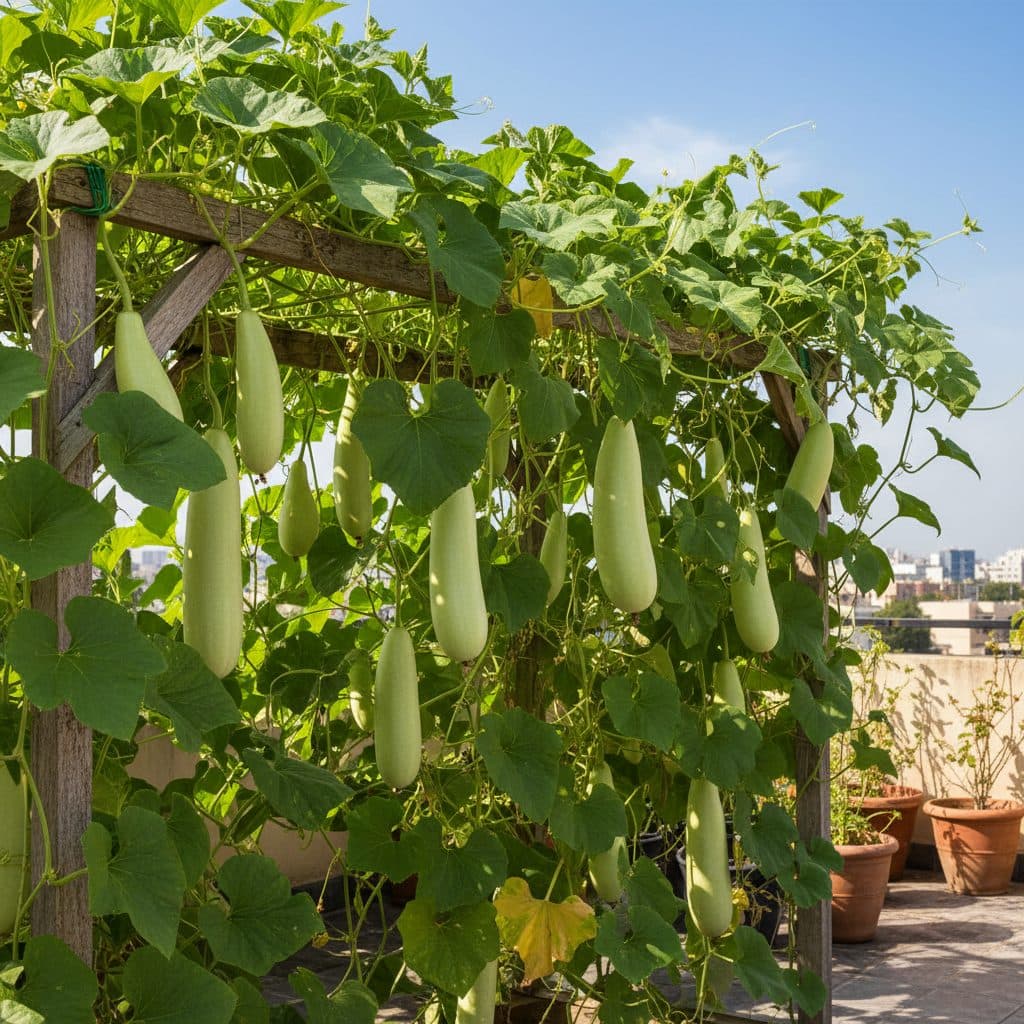
Key takeaways
- Sow bottle gourd seeds across two primary Indian growing windows: February to March for summer crops, and June to July for monsoon crops.
- Pre-soak hard-shelled seeds in clean water for 12 to 24 hours to soften the seed coat and accelerate germination.
- Grow vines in large containers: use a minimum 45x45 cm (18x18 inch) or 60x60 cm HDPE grow bag filled with a rich coco peat and compost blend.
- Build a sturdy vertical bamboo trellis or horizontal overhead net (machan) to support heavy, fast-growing vines and hanging fruits.
- Apply the 1G, 2G, and 3G apical pruning technique to trigger lateral tertiary branches that carry most of the vine's female flowers.
- Hand pollinate evening-opening white blossoms if natural insect pollination is low, preventing young baby gourds from turning yellow and rotting.
Quick answer: To grow bottle gourd (lauki) at home in India, sow pre-soaked seeds 2 cm deep in large 45x45 cm grow bags during February–March (summer) or June–July (monsoon). Provide full sun, train vines up a sturdy trellis, pinch main stems using 3G pruning to stimulate female flower branches, and hand pollinate white blooms to ensure steady fruit set.
Bottle gourd (Lagenaria siceraria), widely known across India as lauki, doodhi, ghia, or sorakaya, is one of the most productive and cooling summer cucurbits you can grow in a home kitchen garden or rooftop terrace. A single well-tended vine produces dozens of tender, pale green gourds throughout the season.
However, understanding how to grow bottle gourd in urban container setups requires addressing specific horticultural challenges. Many container gardeners face vigorous, leafy vines that produce hundreds of flowers but drop every embryonic fruit, or struggle with vines that outgrow balcony railings without setting crop.
Whether you cultivate large grow bags on an open terrace or plant directly into fertile ground beds, this guide explains seed germination, container soil mixes, trellis construction, 3G pruning, and hand pollination.
+-------------------------------------------------------------+
|              INDIAN BOTTLE GOURD CROP TIMELINE              |
|                                                             |
|   STAGE                  TIMING (DAYS)   KEY ACTION         |
|   -----                  -------------   ----------         |
|   1. Seed Soaking        Day 0           Soak 12-24 hours   |
|   2. Germination         Days 5 - 8      Warm, moist mix    |
|   3. Trellis Training    Days 20 - 35    Guide single leader|
|   4. 3G Pruning Stage    Days 35 - 50    Pinch tips (branch)|
|   5. Flowering & Set     Days 45 - 65    Hand pollinate     |
|   6. Continuous Harvest  Days 55 - 100   Pick tender gourds |
+-------------------------------------------------------------+
When should you sow bottle gourd seeds in India?
Bottle gourd is a warm-season annual that thrives in temperatures between 25°C and 35°C. Sowing schedules follow regional monsoon and summer seasons:
+-------------------------------------------------------------+
|                 REGIONAL SOWING WINDOWS (INDIA)             |
|                                                             |
|   SEASON         SOWING MONTHS       CLIMATIC REGION        |
|   ------         -------------       ---------------        |
|   Summer (Zaid)  February - March    North & Central Plains |
|   Monsoon (Kharif)June - July        All India (Monsoon)    |
|   Year-Round     Any warm month      South & Coastal India  |
+-------------------------------------------------------------+
Pre-soaking and germination technique
Bottle gourd seeds have thick, woody outer coats that can delay germination by two to three weeks if sown dry.
- Water soaking: Immerse seeds in a bowl of room-temperature water for 12 to 24 hours before sowing. Soaking softens the hard seed coat and activates internal enzymes.
- Potting depth: Sow seeds 2 cm deep into small seedling cups filled with 50% coco peat and 50% vermicompost, or direct sow into final grow bags.
- Moisture: Keep the mix damp but not soggy. Seeds emerge vigorously within 5 to 8 days in warm weather.
To coordinate your vine sowings with companion terrace greens, read how to grow methi in pots.
What container size and potting mix does lauki require?
Bottle gourd produces massive leaf area and an aggressive, wide-spreading root system. Small pots restrict root respiration and cause premature blossom drop.
+-------------------------------------------------------------+
|                 CONTAINER & POTTING SPECIFICATIONS          |
|                                                             |
|   PARAMETER             SPECIFICATION                       |
|   ---------             -------------                       |
|   Minimum Grow Bag Size 45 x 45 cm (18x18") / ~60 Litres    |
|   Ideal Grow Bag Size   60 x 60 cm (24x24") / ~150 Litres   |
|   Coco Peat (Washed)    40% by volume (Moisture buffer)     |
|   Aged Gobar Khad       30% by volume (Organic nutrition)   |
|   Garden Soil / Loam    28-29% by volume (Mineral body)     |
|   Neem Cake Powder      1-2% by vol (~100 g/50 L bag)       |
+-------------------------------------------------------------+- Container sizing: Use heavy-duty, UV-stabilised green or white HDPE grow bags measuring at least 45x45 cm (approx. 60 litres of soil volume) per single plant. A 60x60 cm grow bag can support two vigorous vines.
- Nutrient-dense potting mix: Blend 40% washed coco peat, 30% aged cow dung fertilizer (gobar khad) or vermicompost, 28% to 29% local garden loam, and 1% to 2% neem cake (neem khali, about 100 g per 50 L bag).
- Drainage elevation: Place grow bags on flat bricks to allow free drainage away from bottom holes during heavy monsoon rains.
For layout integration across your rooftop, see our kitchen garden layout for Indian homes.
How do you build vertical trellises and overhead machans?
A mature bottle gourd vine can grow 5 to 8 metres in length, carrying heavy fruits that weigh 1 to 3 kg each. Supporting this weight requires sturdy infrastructure:
+-------------------------------------------------------------+
|                 TERRACE MACHAN (OVERHEAD TRELLIS)           |
|                                                             |
|   [ Bamboo / GI Pipe Frame: 2 Metres High Above Slab ]      |
|   =======================================================   |
|   # # # # #  UV Nylon Netting (15 cm Aperture)  # # # # #   |
|         \                                   /               |
|          \  (Trained 1G Main Stem Up)      /                |
|           \                               /                 |
|      [ Grow Bag 45x45 cm ]          [ Grow Bag 45x45 cm ]   |
+-------------------------------------------------------------+- Vertical bamboo trellis: Secure two vertical bamboo poles or galvanised iron pipes against a sturdy parapet wall, tying horizontal cross-members every 30 cm.
- Overhead canopy (Machan): Build a horizontal overhead frame 2 metres above the terrace floor using bamboo poles and heavy-duty nylon trellis netting (15 cm mesh). This creates an overhead green canopy where gourds hang straight and clean beneath the leaves.
- Fruit slings: As gourds lengthen, cradle heavy fruits in soft cloth slings or mesh bags tied to the overhead frame to prevent heavy winds from snapping the fruiting stalk.
For hot, exposed balconies with limited space, compare container strategies in west-facing balcony plants.
How does the 1G, 2G, and 3G pruning technique work?
The most common complaint from terrace gardeners is that their lauki vine produces dozens of flowers but zero fruits. This occurs because the main primary vine produces almost exclusively male flowers.
Applying apical pruning (known across India as 1G, 2G, 3G cutting) forces the plant to develop tertiary branches. Tertiary branches carry a far higher proportion of female flowers than the main leader, which produces mostly male flowers.
+-------------------------------------------------------------+
|                 1G, 2G, 3G PRUNING BLUEPRINT                |
|                                                             |
|   1G (Main Stem)  ---> Pinch tip at 2.5 metres (Top of net) |
|         |                                                   |
|         +---> 2G Lateral Branches emerge from leaf nodes    |
|                     |                                       |
|                     +---> Pinch 2G tips at 1.5 metres       |
|                                 |                           |
|                                 +---> 3G TERTIARY BRANCHES  |
|                                       (FEMALE FRUITING VINES|
+-------------------------------------------------------------+- 1G Stage (First Generation): Allow the single main stem to grow up the trellis without allowing side branches. When the main leader reaches 2.5 to 3 metres (reaching the overhead net), snip off the top 5 cm growing tip.
- 2G Stage (Second Generation): Cutting the 1G tip stimulates side branches (2G shoots) to emerge from leaf nodes. Allow these branches to grow 1.5 metres, then pinch out all their growing tips.
- 3G Stage (Third Generation): Tertiary branches (3G shoots) will emerge from the 2G nodes. These 3G vines produce abundant female flowers bearing small baby bottle gourds behind the petals.
To pair gourd crops with companion nightshades, review how to grow brinjal at home.
Why are flowers dropping, and how do you hand pollinate?
Bottle gourd blossoms open in the late afternoon and evening, remaining receptive overnight until the following morning.
+-------------------------------------------------------------+
|                 MALE VS FEMALE FLOWER ANATOMY               |
|                                                             |
|   MALE FLOWER                       FEMALE FLOWER           |
|                                                             |
|       \ | / (White Petals)              \ | / (White Petals)|
|        ( )  (Pollen Anther)              ( )  (Stigma)      |
|         |                                 |                 |
|         |                               ( O ) <--- Mini-Gourd|
|         |                                 |        at Base  |
|         | (Long Thin Stem)                | (Short Stalk)   |
+-------------------------------------------------------------+
Identifying male and female blooms
- Male flower: Sits on a long, slender stem and has a single central pollen-coated core (anther).
- Female flower: Sits on a shorter, thicker stalk and has a distinct miniature swollen bottle gourd directly behind the white petals.
Hand pollination technique
If night-flying moths and early morning bees are scarce on your terrace, unpollinated female flowers will turn yellow, shrivel, and drop within 48 hours. Hand pollinate at dusk:
- In the evening (around 6:30 PM to 7:30 PM), find a freshly opened male flower.
- Carefully peel back the white petals to expose the central pollen column.
- Gently dab the pollen anther onto the raised central sticky stigma of an open female flower.
- One male flower can be used to pollinate two to three female blooms.
To naturally attract daytime pollinators to your garden, integrate flowering borders as outlined in how to grow marigold from seeds.
Food safety: Cucurbitacin toxicity in bitter bottle gourd
Taste a small raw piece of every gourd before cooking. If it tastes bitter, discard the whole fruit — bitterness means cucurbitacins, which are toxic and are not destroyed by cooking. Never drink lauki juice that tastes bitter. Bitterness is more likely in heat- or drought-stressed vines and in fruit saved from home-saved seed of cross-pollinated plants.
When and how should you harvest bottle gourds?
Harvesting bottle gourds at peak tenderness ensures the best culinary texture and encourages continuous fruiting:
- Harvest window: Gourds are ready to harvest 55 to 75 days after sowing, and approximately 10 to 14 days after successful pollination.
- Tenderness test: Press your thumbnail gently into the skin near the base of the fruit. If the skin is soft and easily pierced, the gourd is tender, with soft immature seeds. If the skin is hard and woody, the fruit is over-mature and fibrous.
- Cutting technique: Cut through the fruiting stalk 2 to 3 cm above the top of the gourd using clean, sharp pruning shears. Avoid pulling or twisting the fruit, which can tear the fragile 3G vine.