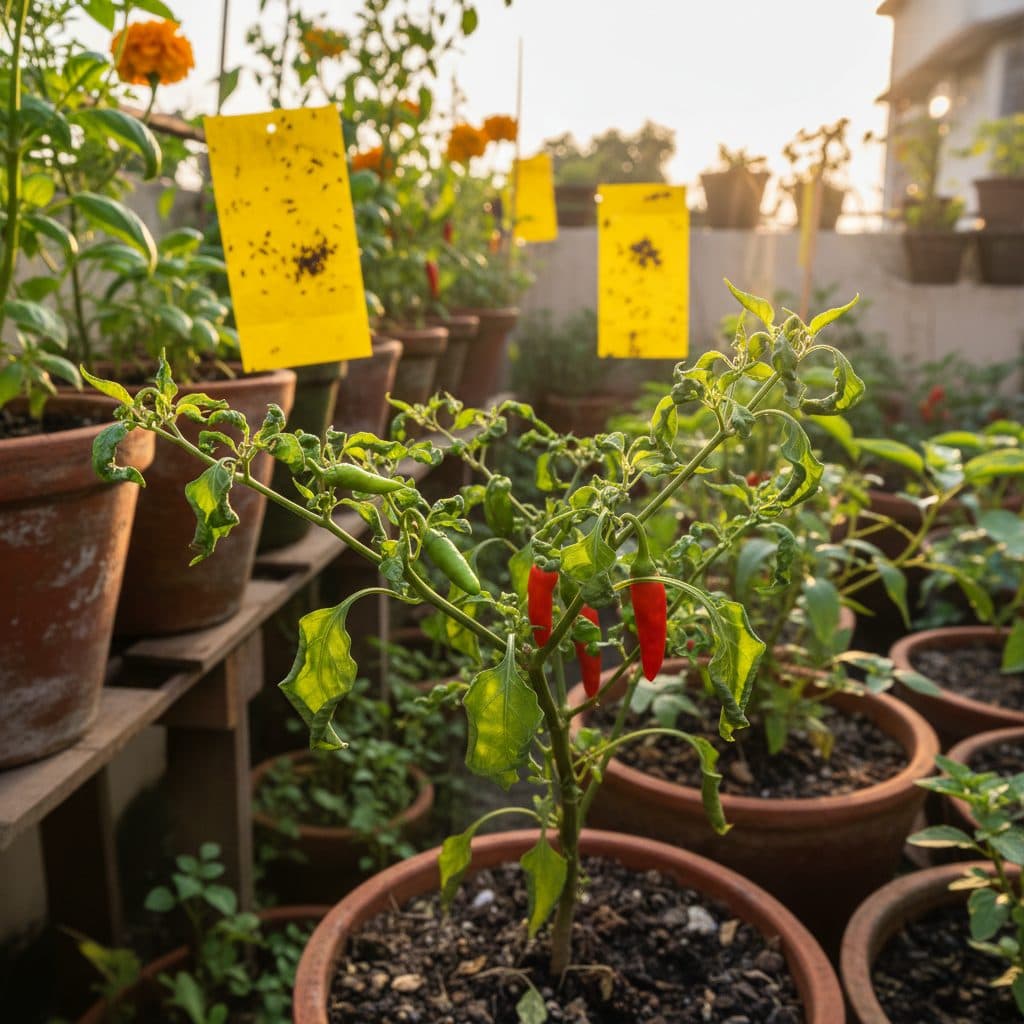
Key takeaways
- Differentiate upward leaf curling (caused by thrips or chilli leaf curl virus) from downward curling (caused by broad mites or aphids).
- Install yellow and blue sticky traps to monitor and trap winged vector insects early before viral transmission occurs.
- Spray cold-pressed neem oil (5 ml per litre with mild soap) every five to seven days during early pest activity.
- Remove and dispose of severely stunted, mosaic-mottled viral plants immediately to protect healthy neighbouring crops.
- Avoid excess synthetic nitrogen, which produces succulent shoots that attract sap-sucking thrips and mites.
Quick answer: Leaf curl disease in chilli is caused by sap-sucking pests (thrips and broad mites) or the whitefly-transmitted Chilli Leaf Curl Virus (ChiLCV). Upward boat-shaped leaf curl indicates thrips or virus, while downward inverted curling points to broad mites. Organic treatment involves neem oil sprays, yellow/blue sticky traps, and removing virus-infected plants.
Growing pungent green chillies (mirchi) is a point of pride for almost every terrace and kitchen gardener across India. However, few plant disorders cause more frustration than leaf curl. Within days, lush, vigorous chilli bushes can transform into crinkled, stunted specimens with puckered leaves, dropped flower buds, and zero fruit production.
Understanding leaf curl disease in chilli requires looking beyond the deformed foliage to identify the precise underlying cause. Leaf curl is not a single isolated pathogen; it is a complex physical response triggered either by mechanical damage from microscopic sap-sucking pests or by a systemic viral infection transmitted by insect vectors like whiteflies.
Reading the curling pattern correctly, spraying organic treatments, and controlling vectors strictly protects plant vigour and your chilli harvest across kharif, rabi, and summer seasons.
Diagnostic guide: upward vs downward chilli leaf curl
Accurate diagnosis is essential because treating thrips requires different interventions than treating broad mites or systemic viruses. Examine the curled leaves closely:
+-------------------------------------------------------------------------------+
|                       CHILLI LEAF CURL DIAGNOSTIC KEY                         |
|                                                                               |
|   LEAVES CURLING UPWARDS (Boat-Shaped):                                       |
|   --> Cause: Thrips (*Scirtothrips dorsalis*) OR Chilli Leaf Curl Virus       |
|   --> Signs: Elongated leaf margins, silvery sheen beneath, bronze streaks    |
|                                                                               |
|   LEAVES CURLING DOWNWARDS (Inverted Cup):                                    |
|   --> Cause: Broad Mites (*Polyphagotarsonemus latus*) OR Aphids              |
|   --> Signs: Thick, leathery, dark-green distorted leaves with short petioles |
+-------------------------------------------------------------------------------+
+-------------------+---------------------------+---------------------------+-----------------------------------+
| Diagnostic Symptom| Primary Culprit | Insect Appearance | Foliage & Growth Pattern |
+-------------------+---------------------------+---------------------------+-----------------------------------+
| Upward Boat Curl | Chilli Thrips | Tiny slender yellow/brown | Leaves curl up; bronzing on lower |
| | (*Scirtothrips dorsalis*) | insects (under 1 mm long) | surface; rasped veins; flower drop|
| Downward Cup Curl | Yellow Broad Mites | Microscopic translucent | Leaves curl downward; dark green; |
| | (*P. latus*) | arachnids (invisible eye) | brittle, leathery; stunted tips |
| Severe Mosaic & | Chilli Leaf Curl Virus | Transmitted by Whiteflies | Severe leaf reduction, puckering, |
| Extreme Stunting | (ChiLCV / Begomovirus) | (*Bemisia tabaci*) | yellow-green mosaic; zero fruit |
| Distorted Nodes & | Green Peach Aphids | Soft pear-shaped insects; | Clustered on young tips; sticky |
| Sticky Honeydew | (*Myzus persicae*) | visible colonies on stems | honeydew; black sooty mould |
+-------------------+---------------------------+---------------------------+-----------------------------------+For parallel diagnostics on related nightshade crops, review our guide to tomato leaf curl diagnostics.
Understanding chilli leaf curl virus (ChiLCV)
Chilli Leaf Curl Virus (ChiLCV), a begomovirus member of the Geminiviridae family, is the most destructive form of leaf curl in India. It is transmitted persistently by the whitefly Bemisia tabaci.
When an infected whitefly feeds on young chilli saplings, the virus enters the plant's vascular system. Within two to three weeks:
- Young leaves develop severe puckering, vein thickening, and yellow-green mosaic patterns.
- Internodes shorten drastically, giving the plant a crowded "witch's broom" appearance.
- Flowers abort and drop off completely; any fruit that does set remains small, deformed, and woody.
Important Botanical Reality: Once a chilli plant contracts the virus, there is no chemical or organic cure that will eliminate the virus from its vascular tissue. You must focus on preventing whitefly vectors and removing infected host plants before the disease spreads to neighbouring grow bags.
For deeper insights into managing viral vectors across vegetable gardens, consult our reference on tomato virus management.
Organic treatment protocol: sprays, traps and ratios
Managing pest-induced leaf curl and vector transmission relies on a multi-pronged organic management strategy:
1. Physical Monitoring --> Hang yellow (whiteflies/aphids) & blue (thrips) sticky traps
2. Contact Washdown    --> Spray underside of leaves with sharp jet of water at dawn
3. Botanical Spray     --> Cold-pressed neem oil (5 ml/L) or 1% EC (1-2 ml/L) + soap
4. Bio-Pesticide       --> Alternate with Lecanicillium lecanii or Beauveria bassiana
5. Rogueing            --> Uproot and bag severely stunted ChiLCV plants immediately
1. Cold-pressed neem oil emulsion
Neem oil contains azadirachtin, meliantriol, and salannin, which disrupt insect feeding, moulting, and reproduction:
- Recipe: Cold-pressed neem oil (1,500 to 3,000 ppm azadirachtin): 5 ml per litre. If you are using a 10,000 ppm (1%) azadirachtin concentrate instead, use 1 to 2 ml per litre — do not use the 5 ml rate. Add 2 ml of mild liquid soap as an emulsifier in warm water and shake vigorously until a milky emulsion forms.
- Application: Spray thoroughly in the early morning or evening only, coating the undersides of leaves and growing tips where thrips and mites shelter. Repeat every five to seven days to break the pest breeding cycle.
- Bio-Pesticide Alternation: Alternate applications with Lecanicillium lecanii (still sold in India as Verticillium lecanii) or Beauveria bassiana during humid spells.
2. Traditional fermented Agniastra / sour buttermilk spray
Traditional Indian terrace gardeners use fermented sour buttermilk (khatti chhaas) or ginger-garlic-chilli extracts (Agniastra):
- Sour Buttermilk Spray: A traditional remedy — dilute 100 ml of fermented buttermilk in 1 litre of water and spray weekly. Evidence is limited and it is best treated as a supplement to neem and trapping, not a replacement. Spray in the evening and rinse foliage if residues build up, since milk solids in Indian heat can feed sooty mould and attract ants.
3. Sticky insect traps
Hang yellow sticky traps 15 cm above the canopy to trap whiteflies and winged aphids. Hang bright blue sticky traps alongside them, as thrips are strongly attracted to the blue visual spectrum.
Cultural practices for terrace grow bags
Strong, resilient plants with thick cellular walls resist pest feeding far better than weak, stressed specimens.
- Lightweight, Aerated Growing Medium: Ensure your potting soil drains freely during the monsoon. Stagnant root zones weaken plant immunity. Formulate your containers using our proven guide on how to make potting mix at home india.
- Balanced Nutrition: Avoid heavy doses of high-nitrogen synthetic fertilisers. Rapid, soft, succulent vegetative growth attracts thrips and aphids. Top-dress with well-aged vermicompost and neem cake. Add wood ash for potassium only if your mix is acidic — it is strongly alkaline and will lock up iron and zinc in the neutral-to-alkaline mixes common in India. For silica, use rice-husk ash or a potassium silicate spray.
- Moisture Management: Over-watering and under-watering both trigger physiological stress that resembles pest damage. Check soil saturation using the methods outlined in our yellowing leaves watering flowchart.
- Shade Netting in Peak Summer: In April and May, when temperatures exceed 40°C on concrete terraces, install 50% green shade netting. Extreme solar heat and dry winds scorch tender chilli tips and favour thrips and spider mites; broad mites build up later, once the humid monsoon air arrives.
Quarantine and rogueing protocol
If a chilli plant exhibits classic viral mosaic symptoms (extreme dwarfing, brittle puckered leaves, and complete cessation of flowering) despite pest control:
- Do not hesitate or attempt to nurse the plant back to health.
- Carefully place a plastic bag over the infected plant to trap lingering whiteflies.
- Uproot the entire plant, including its root system, and dispose of it in municipal waste bins. Never add virus-infected foliage to your home compost bin.
- Spray surrounding healthy plants with neem emulsion to suppress any remaining insect vectors.