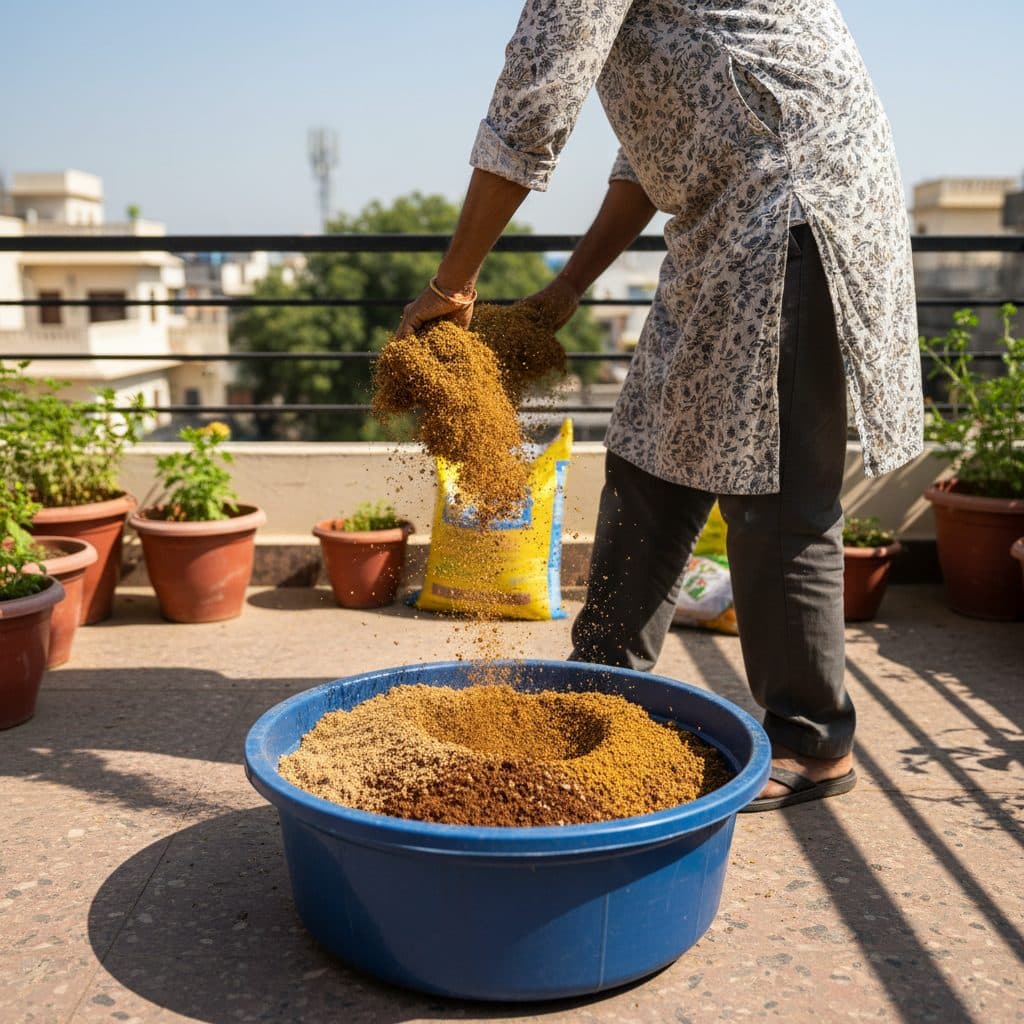
Key takeaways
- Use the classic 40-40-20 ratio (40% cocopeat, 40% compost or vermicompost, 20% garden soil) for lightweight terrace grow bags.
- Always wash and rehydrate compressed cocopeat blocks thoroughly to leach out residual salts.
- Add about 500 g to 1 kg of neem cake per 50 litres of mix (roughly 1 to 2 per cent) to suppress root-knot nematodes and soil grubs.
- Incorporate rice husk or coarse sand to prevent compaction and ensure rapid drainage during heavy monsoon rains.
- Customise the mix for heavy-feeding vegetables like brinjal and bhindi by blending in bone meal or seaweed granules.
Quick answer: Learning how to make potting mix at home in India requires blending washed cocopeat (40%), organic compost or vermicompost (40%), and garden soil or coarse sand (20%) with a handful of neem cake powder. This creates a lightweight, airy, moisture-retentive medium that protects terrace roofs from excessive weight while preventing root rot during hot summers and heavy monsoon downpours.
Setting up a productive kitchen garden or terrace garden in India begins with formulating the right growing medium, not with buying expensive plants or fancy containers. Using plain garden soil or red laterite soil directly in containers almost always leads to disaster: heavy clay compacts into a rock-hard brick under the scorching 40°C summer sun and turns into waterlogged, suffocating sludge during torrential monsoon rains.
Mastering how to make potting mix at home india enables you to tailor a porous, nutrient-dense, and lightweight medium suited to container-grown vegetables like brinjal, bhindi (ladies finger), tomatoes, chillies, methi (fenugreek), and coriander. By blending locally available organic materials—such as coir pith, vermicompost, and neem cake—you give roots the ideal balance of oxygen and moisture.
Whether you cultivate in HDPE grow bags, terracotta pots, or repurposed crates on a concrete rooftop, using a proven homemade potting soil recipe supports vigorous plant growth across kharif, rabi, and zaid seasons.
Why native garden soil fails in container grow bags
Native garden soil (such as red clay or alluvial silt) functions well in open ground because earthworms, deep subterranean drainage, and expansive root networks maintain soil porosity. When confined within the rigid walls of a pot or grow bag, however, native soil behaves entirely differently.
+-------------------------------------------------------------------------------+
|                      CONTAINER SOIL VS HOMEMADE POTTING MIX                   |
|                                                                               |
|   PLAIN GARDEN SOIL:                                                          |
|   Dense clay particles --> Compacts in sun --> High weight --> Waterlogged rot|
|                                                                               |
|   BALANCED HOMEMADE MIX (40-40-20):                                           |
|   Cocopeat + Compost   --> Spongy structure --> 60% lighter --> Fast drainage |
+-------------------------------------------------------------------------------+- Compaction and Suffocation: Frequent watering washes fine clay particles downward, forming a dense barrier at the base of the pot that blocks drainage and prevents root respiration.
- Excess Rooftop Weight: Wet garden soil weighs approximately 1.6 to 2.0 kg per litre. Placing dozens of soil-filled pots on a rooftop imposes dangerous static loads on concrete slabs. A cocopeat-based mix weighs less than half as much. To understand structural slab limits, read our guide on terrace garden waterproofing.
- Hard-Crust Formation: Under intense Indian summers, the surface of red soil bakes into a hard crust, repelling irrigation water and starving root hairs of moisture.
The standard 40-40-20 potting soil recipe India
The 40-40-20 ratio is the time-tested gold standard for container vegetable gardening across urban India. It balances water retention, biological fertility, and physical structure.
+-------------------+-------------------+---------------------------------------------------------------+
| Component         | Proportion (Vol)  | Primary Function in the Mix                                   |
+-------------------+-------------------+---------------------------------------------------------------+
| Rehydrated Coir   | 40%               | Lightweight bulk, moisture retention, root aeration           |
| Vermicompost      | 40%               | Micro-nutrients, beneficial soil biology, organic carbon      |
| Garden Soil / Sand| 20%               | Mineral anchorage, trace minerals, cation exchange capacity   |
| Neem Cake Powder  | 2 to 5 handfuls   | Bio-pesticide, nematicide, slow-release organic nitrogen      |
| Rice Husk (Opt.)  | 5% to 10% (adj.)  | Enhanced aeration for heavy monsoon drainage                  |
+-------------------+-------------------+---------------------------------------------------------------+
For organic gardeners producing their own continuous supply of rich worm castings, our step-by-step guide to vermicomposting at home worm bin guide explains how to maintain productive worm bins on Indian balconies.
Step-by-step preparation: washing, mixing and enriching
Follow this systematic method to prepare premium potting mix at home:
1. Rehydrate Coir   --> Soak compressed 5 kg cocopeat block in 25 litres water
2. Wash & Drain     --> Rinse twice with fresh water to leach out marine salts
3. Sieve Compost    --> Sift well-aged vermicompost to remove large clumps
4. Combine Bases    --> Measure 4 parts coir, 4 parts compost, 2 parts soil
5. Add Organic Bio  --> Mix in neem cake, wood ash, and bone meal or rock dust
6. Moisten & Cure   --> Water lightly; let rest covered for 48 hours before planting
1. Washing and expanding cocopeat
Compressed 5 kg cocopeat blocks expand to roughly 60 to 75 litres of fluffy fiber when soaked. Place the block in a large tub and add 20 to 25 litres of clean water. Allow the block to absorb water for thirty minutes, then break it apart with your hands.
Note: Coir processed near coastal regions often carries high levels of sodium and potassium salts. Rinse the expanded coir with clean water and squeeze out the excess moisture through a fine mesh or jute sack. This salt-leaching step prevents root scorch on sensitive vegetable seedlings.
2. Blending the mineral and organic layers
Spread the washed cocopeat onto a clean plastic tarp on your terrace. Add an equal volume of mature vermicompost or well-rotted cow dung manure (gobar khad). Add two parts of clean, sieved garden soil or coarse river sand.
Compare nutrient availability and biological vitality across different compost amendments in our detailed analysis of vermicompost vs regular compost worms win.
3. Fortifying with natural bio-amendments
To every 50 litres of blended base mix, incorporate:
- Neem Cake Powder (Neem Khali): 500 g to 1 kg. Neem cake contains azadirachtin, which protects tender root systems from parasitic root-knot nematodes and grubs while slowly releasing nitrogen.
- Wood Ash: 200 g (one small cup), only if your mix or local soil is acidic. On the neutral-to-alkaline soils and hard water common across much of India, skip it — it pushes pH higher and locks up iron and zinc. Use well-rotted banana-peel compost or sulphate of potash for potassium instead.
- Bone Meal or Steamed Rock Phosphate: 250 g. Supplies slow-release phosphorus for strong taproot establishment.
- Trichoderma viride / Pseudomonas: 50 g (optional bio-inoculant). Beneficial fungal (Trichoderma) and bacterial (Pseudomonas) inoculants that colonise the root zone and suppress root-rot pathogens (Fusarium and Pythium) during warm, humid conditions.
Tailoring recipes for specific crops and Indian seasons
Different vegetable groups benefit from slight adjustments to the base formula:
+-------------------+---------------------------+-------------------------------------------------------+
| Crop Group        | Recommended Ratio         | Modification Rationale                                |
+-------------------+---------------------------+-------------------------------------------------------+
| Leafy Greens      | 50% Coir : 40% Compost :  | High moisture and nitrogen for rapid leaf flushes in  |
| (Palak, Methi)    | 10% Soil                  | shallow 15 cm trays; loose texture for fine roots     |
| Fruiting Veg      | 35% Coir : 40% Compost :  | Stronger anchorage for heavy top growth; sustained    |
| (Brinjal, Chilli) | 20% Soil : 5% Neem/Ash    | potassium and phosphorus for heavy flowering          |
| Root Crops        | 45% Coir : 15% Compost :  | Low nitrogen and a stone-free, sandy texture prevent  |
| (Radish, Carrot)  | 40% Coarse Sand           | forked or hairy taproots in deep 30 cm grow bags      |
+-------------------+---------------------------+-------------------------------------------------------+
Adjusting for the monsoon season (Kharif)
During the monsoon season (June to September in the plains), ambient humidity remains high and heavy rains saturate containers daily. Reduce the cocopeat content to 30% and add 15% coarse sand, rice husk, or perlite to accelerate water drainage through container weep holes.
Adjusting for peak summer (Zaid)
In April and May, when rooftop temperatures exceed 40°C, containers dry out in hours. Increase the cocopeat fraction to 50% to retain moisture and apply a 5 cm top mulch of dry sugarcane bagasse, dried leaves, or coconut husk fiber over the grow bag surface.
To monitor root-zone moisture accurately through hot spells, review our practical guide on soil moisture finger test meters.
Rejuvenating old potting mix season after season
You never need to throw away used potting mix at the end of a growing season. Reconditioning spent soil is economical and builds healthy soil biology:
- Empty and Sun-Dry: Spread spent mix on a tarp in full sun for two to three days to dry it out and kill many soil insects and fungus-gnat larvae. This is not solarisation — to actually kill pathogens and weed seeds, moisten the mix, seal it under clear polythene and leave it in full sun for four to six weeks.
- Remove Old Root Clumps: Sift through the dried mix with a garden fork, removing woody root masses.
- Recharge Organic Fertility: Blend in 25% fresh vermicompost, two handfuls of neem cake, and a cup of bone meal to replenish extracted nutrients before sowing the next seasonal crop.