Key takeaways
- Permaculture design is anchored by three core ethics: Earth Care, People Care, and Fair Share (setting limits to consumption and redistributing surplus).
- Co-originator David Holmgren articulated 12 systemic design principles that translate ecological patterns into practical land management strategies.
- Applying these principles creates closed-loop homestead systems where outputs from one element become functional inputs for another.
- Design strategies prioritize passive energy capture, functional diversity, and slow, incremental solutions over high-energy industrial interventions.
- Observation and feedback loops guide adaptive site planning, reducing maintenance labor and building long-term ecological resilience.
Quick answer: The 12 permaculture principles, formulated by David Holmgren, provide a framework for designing self-sustaining human habitats and agricultural systems. Grounded in the ethics of Earth Care, People Care, and Fair Share, they guide practical decisions such as catching water on contour, stacking plant functions, producing zero waste, and building biological diversity.
Originating in Australia through the collaborative work of Bill Mollison and David Holmgren during the 1970s, permaculture (permanent agriculture and permanent culture) provides a whole-systems design framework. Permaculture treats the landscape as an interconnected living ecosystem instead of a collection of isolated components.
While Mollison focused heavily on practical agronomic techniques, Holmgren synthesized the underlying methodology into twelve universal design principles. Understanding the permaculture principles allows growers, designers, and landowners to make practical decisions that conserve energy, restore soil biology, and create abundance.
These twelve principles offer practical steps for working with natural processes on any site, from suburban backyards to larger homesteads.
+-------------------------------------------------------------+
|              THE ETHICAL FOUNDATION OF PERMACULTURE         |
|                                                             |
|   1. EARTH CARE:   Rebuild natural capital & soil biology   |
|   2. PEOPLE CARE:  Nurture self-reliance & community health |
|   3. FAIR SHARE:   Redistribute surplus & limit consumption |
+-------------------------------------------------------------+
How do the 12 permaculture principles function in practice?
The twelve principles represent a cohesive design loop. Each principle addresses a specific aspect of energy capture, resource cycling, system architecture, or ecological adaptation.
+-------------------------------------------------------------+
|              THE 12 PERMACULTURE PRINCIPLES                 |
|                                                             |
|   1. Observe and Interact      7. Design Patterns to Details|
|   2. Catch and Store Energy    8. Integrate Not Segregate   |
|   3. Obtain a Yield            9. Small and Slow Solutions  |
|   4. Apply Self-Regulation    10. Use and Value Diversity   |
|   5. Use Renewable Resources  11. Use Edges & Marginals     |
|   6. Produce No Waste         12. Creatively Respond Change |
+-------------------------------------------------------------+
Principle 1: Observe and interact
Before digging swales or planting trees, spend time observing natural patterns on your land across all four seasons. Note where winter frost settles, how water flows across slopes during heavy downpours, and which corridors prevailing winds travel. Careful observation prevents costly layout mistakes.
Principle 2: Catch and store energy
Capture transient energy while it is abundant to utilize during times of scarcity.
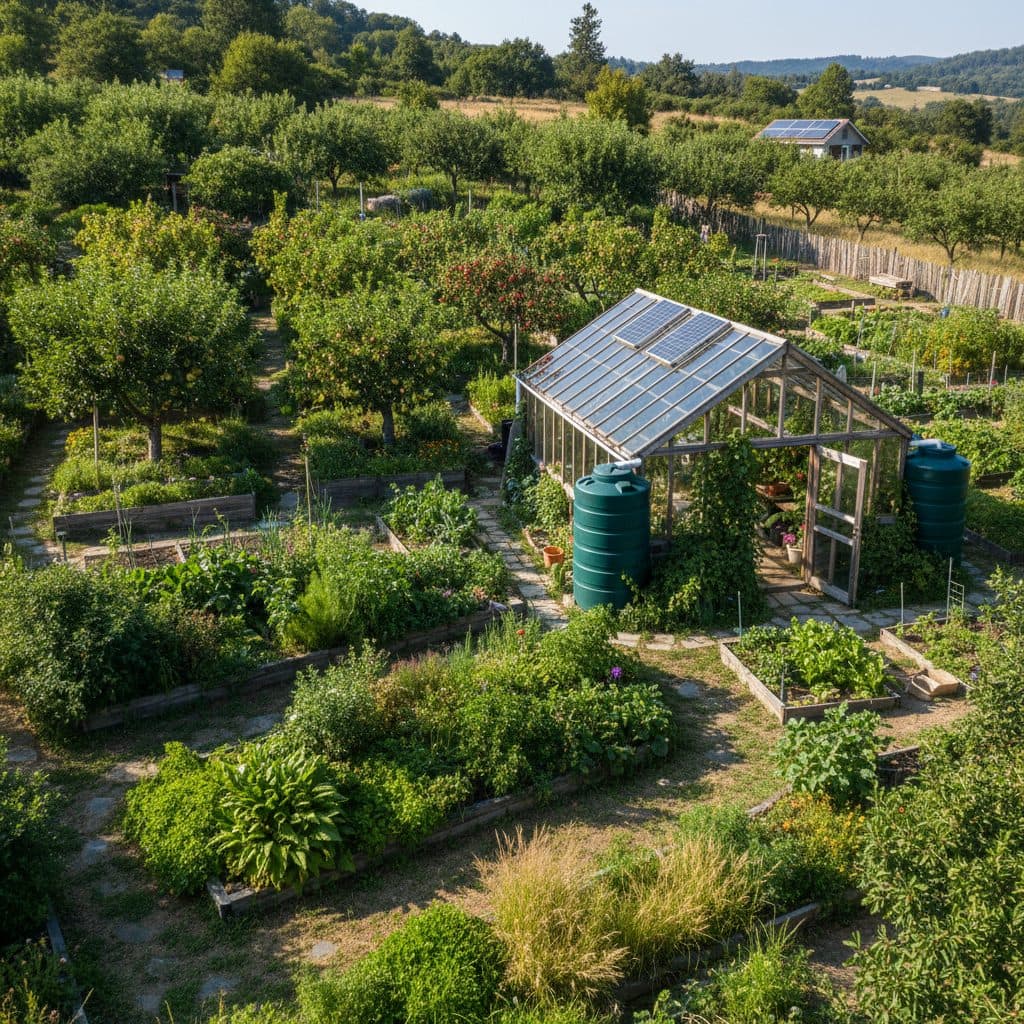
- Water storage: Direct roof runoff into cisterns or shape landscape contour swales to store rain directly in the soil mantle. To design contour earthworks, review our guide to swales, berms, and water management.
- Thermal capture: Position greenhouses and living spaces on south-facing slopes to store passive solar warmth in stone or water thermal mass.
- Biological energy: Establish fast-growing biomass species to accumulate carbon and nitrogen for future mulch.
Principle 3: Obtain a yield
Every system you design must produce tangible benefits (such as food, fuel, timber, or shelter) to remain viable. While building long-term perennial tree systems, interplant quick-yielding annual vegetables and soft berries to provide immediate returns during the establishment phase.
Principle 4: Apply self-regulation and accept feedback
Negative feedback signals an imbalance in your system. If fruit trees suffer severe aphid infestations, the outbreak indicates that the landscape lacks predatory beneficial insects. Modify the environment by planting umbelliferous flowering herbs to attract lacewings and hoverflies.
Principle 5: Use and value renewable resources and services
Reduce reliance on non-renewable, consumptive technologies by allowing biological services to perform physical work.
- Use chickens to till garden beds, consume insect pests, and deposit high-nitrogen manure.
- Plant nitrogen-fixing legumes, and deep-rooted plants such as comfrey and chicory whose leaves are traditionally cut for mulch (the 'dynamic accumulator' claim behind this is popular but poorly measured).
Principle 6: Produce no waste
In a mature forest ecosystem, the concept of waste does not exist; every output becomes an input for another organism.
- Kitchen scraps feed compost worm bins.
- Where local code allows, greywater from sinks and laundry can irrigate fruit tree guilds. Greywater rules vary by state and county and change — check your state plumbing/health code before plumbing anything, and deliver it under mulch rather than onto foliage or fruit.
- Pruned orchard branches become biochar, ramial woodchip mulch, or mushroom cultivation logs.
+-------------------------------------------------------------+
|              CLOSED-LOOP HOMESTEAD CYCLING                  |
|                                                             |
|   Kitchen Scraps ---> Chickens / Worm Bin ---> Rich Compost |
|         ^                                           |       |
|         |                                           v       |
|   Garden Harvest <--- Living Soil Biology <--- Bed Topdress |
+-------------------------------------------------------------+
Principle 7: Design from patterns to details
Step back to observe overarching patterns in nature and society before obsessing over specific plant selections. Map your property into functional zones (Zone 0 for the home, out to Zone 5 for wild unmanaged wilderness) and sector overlays (sun angles, wind vectors, fire hazards) before selecting specific nursery cultivars.
Principle 8: Integrate rather than segregate
Place elements so that relationships between them do the work: position components so the outputs of one meet the needs of another. Closely related is Bill Mollison's design maxim: every element should perform multiple useful functions, and every important function should be supported by multiple elements.
- Example: A farm pond is sited above an orchard so it gravity-feeds irrigation water, while reflecting low winter sunlight into the canopy, hosting insect-eating dragonflies, providing emergency fire suppression, and yielding edible fish.
Principle 9: Use small and slow solutions
Small, incremental changes are easier to maintain, adapt, and finance than massive, capital-intensive overhauls. Starting with a single multi-species fruit tree guild teaches you management nuances before you plant a full five-acre agroforestry canopy. For multi-layered guild design, see what is a food forest.
Principle 10: Use and value diversity
Monocultures are ecologically fragile and prone to catastrophic pest wipes. Polycultures interplant diverse species with varying root depths, flowering windows, and structural heights, creating stable biological redundancy that buffers against unpredictable weather.
Principle 11: Use edges and value the marginal
The boundary where two distinct ecological zones meet, such as the woodland edge where forest meets meadow, is often the most biologically active and diverse microclimate. Designing undulating curved beds, pond shorelines, and keyhole gardens maximizes productive edge surfaces.
Principle 12: Creatively use and respond to change
Change is an inevitable ecological reality. Permaculture designers anticipate and cooperate with natural succession instead of trying to maintain a static landscape. As pioneer shrubs build soil and cast shade, transition the understory toward shade-tolerant berries and perennial fungi.
+-------------------------------------------------------------+
|              PRINCIPLE APPLICATION CHECKLIST                |
|                                                             |
|   - Does this design capture or cycle on-site energy?       |
|   - Does every element serve multiple functions (Mollison)? |
|   - Are waste streams captured as inputs for other beds?    |
|   - Is diversity designed into root and canopy layers?      |
+-------------------------------------------------------------+
How does permaculture compare to other agroecological systems?
Permaculture is a broad design framework covering land stewardship, natural building, and community economics. In contrast, specialized methodologies like syntropic farming focus intensively on high-density process succession and heavy pruning pulses within agroforestry.
To examine the practical distinctions between these philosophies, explore our detailed comparative analysis of syntropic farming vs permaculture, and learn foundational agroforestry concepts in our primer on syntropic farming.