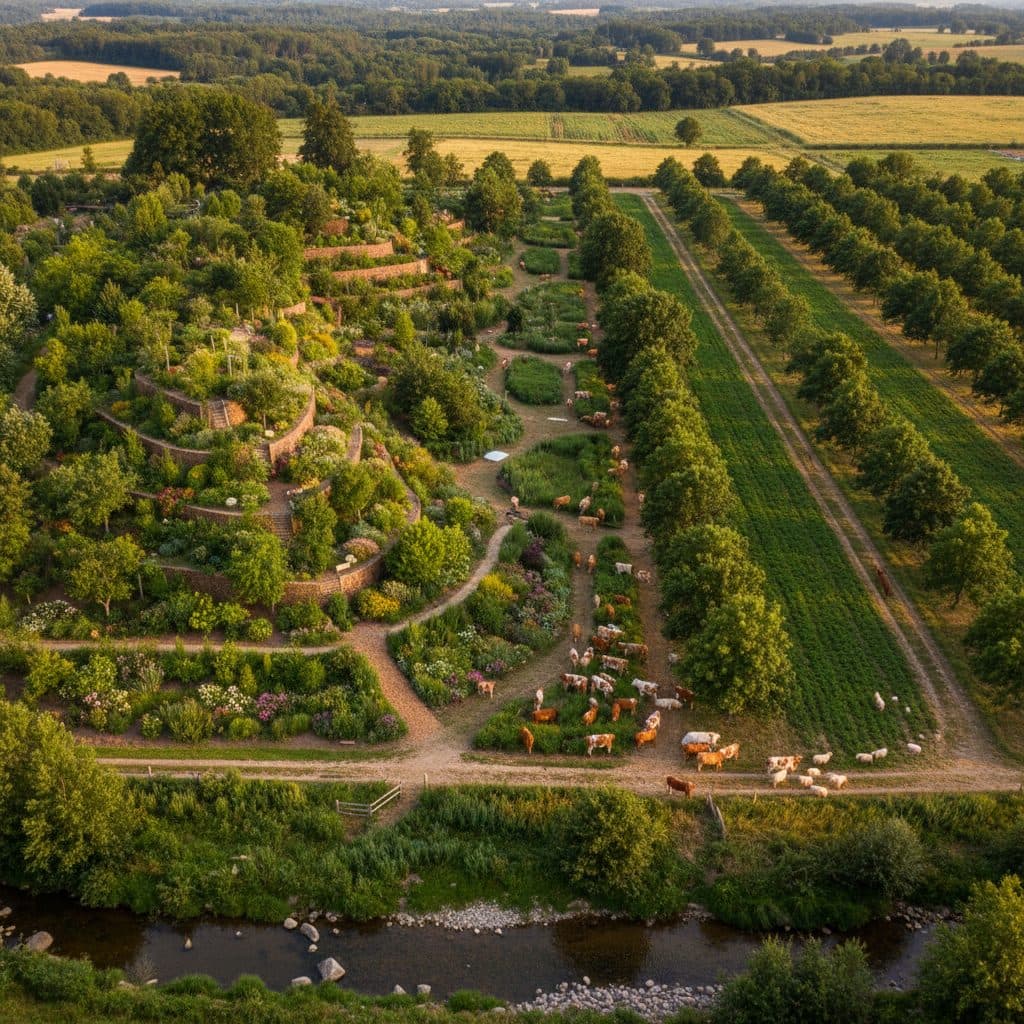
Key takeaways
- Permaculture is a broad design philosophy and ethical framework that covers human habitats, water systems, energy, and food production.
- Agroforestry is an applied agricultural and forestry science combining woody perennials with crops or livestock on working landscapes.
- Permaculture relies on three foundational ethics: Earth Care, People Care, and Fair Share.
- In North America, agroforestry is organised into five recognised practices; internationally, systems are classified by their components as agrisilvicultural, silvopastoral and agrosilvopastoral.
- Both disciplines converge in syntropic farming and multi-layered food forest design to build living soil.
Quick answer: The core difference between permaculture and agroforestry is scope and application. Permaculture is a broad design philosophy and ethical system that applies ecological principles to entire human habitats, water harvesting, buildings, and community structures. Agroforestry is a specific agricultural discipline that integrates trees and woody shrubs into productive farming and livestock systems.
As global interest in regenerative land stewardship expands, land managers and growers frequently encounter two prominent ecological approaches: permaculture and agroforestry. While both reject industrial monoculture in favor of biologically diverse, tree-centered landscapes, they originate from distinct historical traditions and operate at different scales. Understanding permaculture vs agroforestry helps land stewards choose the right framework for their land goals.
The confusion between the two fields is understandable. Both emphasize perennial polycultures, soil building, and water conservation. However, treating them as interchangeable obscures their unique strengths. Permaculture offers comprehensive design tools for whole-site self-reliance, while agroforestry provides structured, scalable agricultural models suitable for commercial farms and working timberlands.
Defining the disciplines: philosophy vs agricultural science
The fundamental distinction between permaculture and agroforestry lies in their foundational objectives and disciplinary scope.
+---------------------+-----------------------------------+---------------------------------------------------------------------+
| Comparison Aspect   | Permaculture                      | Agroforestry                                                        |
+---------------------+-----------------------------------+---------------------------------------------------------------------+
| Nature of Field     | Holistic design system & ethics   | Applied agricultural science                                        |
| Primary Scope       | Whole habitats (food, water, power)| Working farm & forestry landscapes                                  |
| Guiding Framework   | Ethics & 12 design principles     | Recognized structural component practices                           |
| Scale of Adoption   | Backyards to homesteads & villages| Smallholdings to broadacre farms                                    |
| Institutional Basis | Grassroots & community networks   | Academic forestry and agricultural research (CIFOR-ICRAF, FAO)      |
+---------------------+-----------------------------------+---------------------------------------------------------------------+
Permaculture: whole-system design
Developed in the 1970s by Bill Mollison and David Holmgren, permaculture (a blend of "permanent agriculture" and "permanent culture") is an ethical design system. It extends far beyond agriculture to include passive solar building design, rainwater harvesting earthworks, renewable energy, and community governance. Permaculture is guided by three core ethics:
- Earth Care: Rebuilding natural ecological capital and biodiversity.
- People Care: Supporting individual and community self-reliance.
- Fair Share: Setting limits to consumption and redistributing surplus.
To explore foundational layouts and sector planning, see our guide on permaculture design.
Agroforestry: combining trees, crops, and livestock
Agroforestry is the deliberate integration of woody perennials (trees and shrubs) with agricultural crops and livestock on the same land-management unit. Rooted in traditional indigenous farming systems and refined through modern forestry science, agroforestry focuses on optimizing biological interactions between trees and agricultural production.
The five practices recognised in North America
In North America, agroforestry is organized around five distinct, scientifically studied structural systems (defined by the USDA National Agroforestry Center). Internationally, systems are classified more broadly by their components: agrisilvicultural (crops + trees), silvopastoral (pasture/livestock + trees), and agrosilvopastoral (all three), which include global forms like tropical home gardens, taungya, Sahelian parkland systems, and shade-grown coffee and cacao:
+-----------------------------------------------------------------------------------+
|  [The 5 Core Agroforestry Systems (North America)]                                |
|                                                                                   |
|  1. Silvopasture      ===> Combines timber/fruit trees with managed livestock     |
|  2. Alley Cropping    ===> Agricultural crops grown between wide tree rows        |
|  3. Forest Farming    ===> Cultivating high-value shade crops beneath a canopy    |
|  4. Riparian Buffers  ===> Streamside tree/shrub strips filtering water runoff    |
|  5. Windbreaks        ===> Linear tree barriers protecting crops from wind erosion|
+-----------------------------------------------------------------------------------+- Silvopasture: Integrating trees with forage and grazing livestock. Livestock gain thermal protection from summer heat and winter winds, while trees benefit from nutrient cycling and grass competition control. Global examples range from Iberian dehesa (oak and Iberian pigs) to sheep grazed in apple orchards in the UK.
- Alley cropping: Planting agricultural crops (grains, vegetables, or berries) in wide alleys between rows of valuable trees spaced 10 m to 20 m (33 ft to 65 ft) apart. Black walnut is the classic North American alley species, but its roots exude juglone, which is toxic to tomatoes, potatoes, peppers, aubergines and lucerne; match the alley crop to that constraint. It is also listed as an invasive alien in riparian forests in parts of central and southern Europe, so check its status before planting outside its native range. In Europe, popular systems combine hybrid walnut or poplar with cereals.
- Forest farming: Cultivating high-value shade-tolerant specialty crops, such as American ginseng (Panax quinquefolius), shiitake mushrooms, goldenseal (Hydrastis canadensis), and ramps in North America, beneath a managed mature forest canopy. Note that wild ginseng and goldenseal carry strict CITES harvest and trade regulations.
- Riparian forest buffers: Planting native trees, shrubs, and perennial grasses along stream corridors to filter agricultural runoff, stabilize banks, and restore aquatic habitats.
- Windbreaks and shelterbelts: Linear plantings of trees and shrubs designed to reduce wind speed, prevent soil erosion, and reduce evaporative moisture loss from fields.
For multi-layered perennial lists that fit both frameworks, see food forest plants.
Climate-specific applications across the globe
Because climate determines tree physiology and growing seasons, both disciplines adapt their practical implementations regionally.
In cool temperate climates:
- In North America, agroforestry includes alley cropping cool-season grains between walnut or hybrid chestnut rows, and silvopasture combining sheep under timber groves; in Europe, hazel and apple silvoarable or poplar alley cropping are common.
- Permaculture designs feature cold-climate sun traps, passive solar greenhouse attachments, and multi-tier food forests utilizing haskap berries, currants, and deep-rooted Russian comfrey (use the sterile Bocking 14 cultivar, since seeding comfrey self-sows and cannot practically be removed once established, and comfrey is restricted as a food ingredient in some countries).
In subtropical and tropical climates:
- Agroforestry emphasizes shade-grown coffee and cacao beneath nitrogen-fixing canopy trees (such as Inga species), though *Gliricidia sepium* is naturalised and treated as a weed in parts of northern Australia, the Pacific and the Caribbean, and its seed and bark are toxic to horses and dogs. Check whether a nitrogen-fixing species is declared or naturalised in your region before planting it.
- Permaculture incorporates banana circles, swale-based water harvesting, and year-round perennial greens.
To see how complex layering operates in high-density tropical systems, see syntropic farming.
Economic and yield dynamics: market integration vs subsistence
A fundamental practical difference between the two systems is how yields are harvested, measured, and brought to market.
Agroforestry systems are engineered for mechanized harvesting, market timing, and standardized product streams. For example, in a timber-grain alley cropping system, tree rows are spaced exactly to accommodate standard combine harvesters and tractors. The farmer harvests cash grains annually while timber matures over a 30-year horizon, producing clear, measurable financial returns per hectare (or per acre).
In contrast, permaculture designs prioritize diverse, staggered micro-harvests spread across all twelve months. A forest garden yields culinary herbs in spring, berries in early summer, stone fruit in midsummer, nuts and apples in autumn, and root crops in winter. While this continuous multi-crop flow provides unmatched nutritional security and resilience for a homestead, it requires intensive hand-labor and does not lend itself easily to commercial wholesale distribution.
Soil carbon sequestration and hydrologic restoration
Both permaculture and agroforestry contribute significantly to long-term soil carbon sequestration and landscape rehydration. Deep-rooted perennial trees pump liquid carbon (photosynthate exudates) deep into the subsoil, feeding mycorrhizal fungi and building glomalin and stable soil aggregates.
In agroforestry, tree belts act as deep subsoil nutrient safety nets, intercepting leached agricultural nitrates before they reach waterways. In permaculture, earthworks such as swales on contour and keyline cultivation capture overland water flow, slowing and sinking overland flow into the soil profile instead of letting it run off. Swales suit gentle slopes and free-draining soils, but can destabilise steep or heavy clay ground.
Where the two fields converge: food forests and syntropic systems
Despite their distinct origins, permaculture and agroforestry converge powerfully in multi-strata food forest systems.
A permaculturalist designing a home orchard utilizes the scientific spacing, root competition research, and nitrogen-fixing data established by agroforestry scientists. Conversely, agroforestry researchers are increasingly interested in more diverse multi-strata plantings, although hard comparative data on the pest control and biodiversity claimed for permaculture guilds is still thin.
For broad principles of forest garden design, see what is a food forest.
Choosing the right approach for your landscape
- Choose permaculture when: You are designing a holistic homestead, residential property, or small community site where water catchment earthworks, off-grid energy, house orientation, and personal self-sufficiency are paramount.
- Choose agroforestry when: You manage commercial acreage, grazing pastures, or working timberland and need structured, mechanized, economically viable crop and livestock systems that satisfy agricultural grant standards and commercial markets.
By integrating the overarching ethical vision of permaculture with the structured, empirical field practices of agroforestry, land stewards can create productive and diverse landscapes.