Key takeaways

Coturnix quail offer a highly efficient and quiet option for egg and meat production in limited spaces. Their small size, rapid maturity, and prolific laying, coupled with minimal noise, make them ideal for urban homesteads or areas with strict zoning regulations.
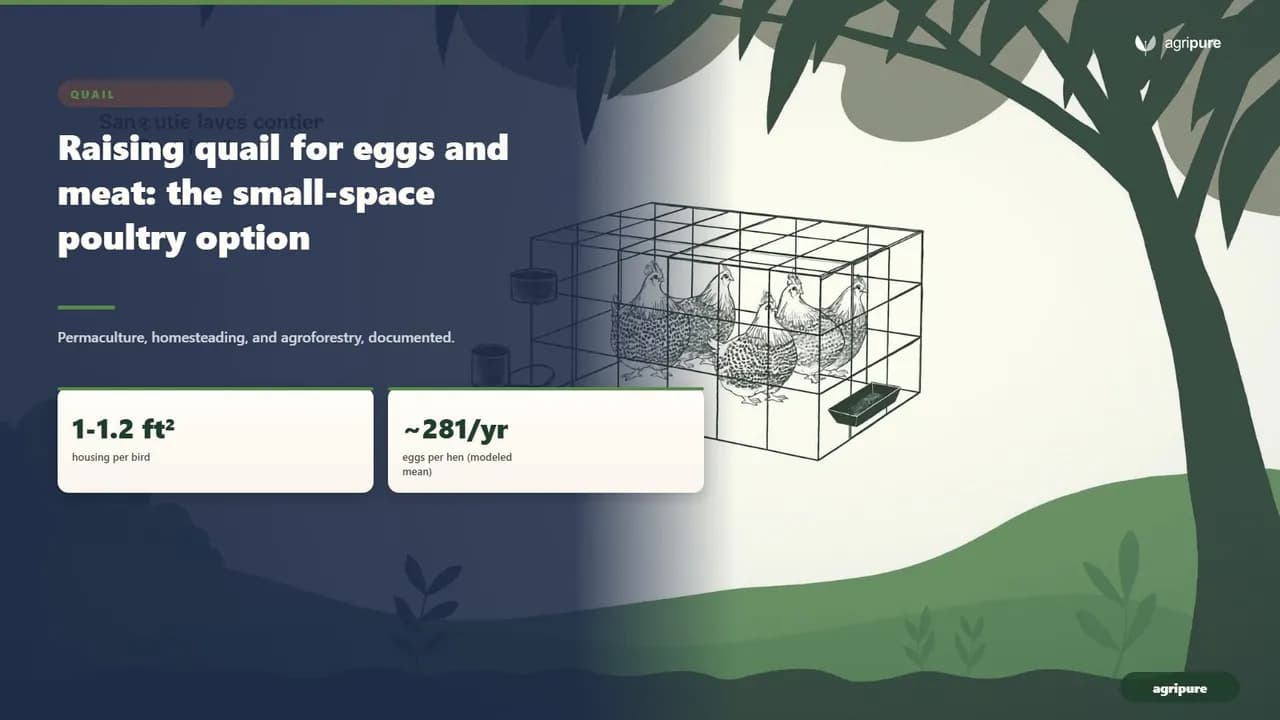
- Quail are the smallest-footprint poultry worth keeping: a financial model of small-scale enterprises put their housing need at just 1 to 1.2 ft² per bird, so a whole covey fits where a single hen would feel cramped.
- Coturnix lay absurdly young and fast. Japanese (Coturnix) quail mature in about six weeks and lay by about seven, and a well-managed hen can return more than 250 eggs in a production cycle — a mean near 281 a year in one model.
- They are quiet and often legal where chickens are not. No crow, a 100-to-160-gram body, and a cage on a balcony: quail slip under the zoning rules that ban roosters and limit hens.
- Feed is the most common beginner mistake. Quail need a high-protein game-bird or turkey starter at roughly 24 to 28% crude protein, not chicken layer feed — the protein gap stunts growth and laying.
- Broodiness is bred out, so you incubate. Coturnix eggs hatch in about 17 to 18 days, but domesticated hens rarely sit, so an incubator is standard. A low cage ceiling is a welfare must: startled quail rocket straight up and break their own necks.
A single Coturnix hen will lay you an egg most days from about 7 weeks of age, on a patch of cage floor barely larger than a sheet of paper, without ever making the noise that gets a rooster reported to the city. That is the quiet, dense case for raising quail, and it is why apartment keepers, balcony growers, and homesteaders boxed in by zoning keep landing on them when chickens will not fit or are not allowed. This guide covers the whole arc: why quail earn their tiny footprint, how Coturnix and Bobwhite differ and which to pick, how to house a covey without injuring it, what to feed and what never to feed, how the prolific early laying actually works, how incubation and butchering go, and the flightiness and cannibalism cautions that catch beginners. Every number here (footprint, laying age, egg count, protein percentage, incubation days, butcher weight) traces to a university extension program, the Merck Veterinary Manual, or peer-reviewed work. Where the homestead lore runs ahead of the evidence, this guide says so.
Why quail earn their tiny footprint
Quail make a case the louder backyard birds cannot. A laying hen wants a coop, a run, and a tolerant neighbour; a rooster for fertile eggs wants none of your goodwill by 5 a.m. A quail asks for a square of wire about the size of a dinner plate and makes almost no sound, which is why three advantages keep pulling small-space keepers toward them: footprint, speed to first egg, and the quiet legality that lets them live where chickens cannot.
Footprint, and why it matters on a balcony
The first advantage is sheer density. A 2023 financial comparison of small-scale quail and laying-hen enterprises, published in Poultry Science, put the housing requirement at only 1 to 1.2 ft² per bird. A survey of Japanese quail farms in Veterinary World reports working densities even tighter than that in cage systems. Practically, a covey of a dozen quail lives in the floor space one or two hens would need, which is the single fact that makes quail viable on a patio, in a spare-room rack, or in a corner of a garage. If space limits your ability to keep chickens, quail are an accessible alternative, and if you later add room, pastured chickens are a natural next step.
Speed to the first egg
The second advantage is how fast the investment pays back. Coturnix quail are the sprinters of poultry: eXtension’s small-flock program at the University of Kentucky states that Japanese quail mature in about six weeks and are able to produce eggs by seven weeks. Peer-reviewed work agrees from the physiology side — under long-day light, quail reach sexual maturity by 7 to 8 weeks and begin producing fertile eggs. Compared with the roughly 5 to 6 months a pullet takes to come into lay, a quail flock is feeding you eggs before a chick of the same hatch date has grown its adult feathers.
Quiet, and often legal where hens are banned
The third advantage is the one keepers discover with relief. A Coturnix hen weighs only 120 to 160 grams and does not crow; a male’s call is a soft trill, nothing like a rooster. Because many municipal codes write their poultry rules around chickens (banning roosters outright, capping hens, or setting coop setbacks), quail frequently fall outside the language entirely. That is a practical opening, not legal advice: check your own ordinance and any lease before you buy. But the combination of near-silence and a body the size of a tennis ball is exactly why quail are the bird that fits where a flock of hens never could.
Coturnix vs Bobwhite: pick your bird
That footprint and speed belong mostly to one species, so the first real decision is which quail you are raising. Two dominate North American backyards: the Coturnix (Japanese) quail and the Northern Bobwhite. They look similar in a catalogue and behave very differently in a cage, and the choice shapes everything downstream — feed, a 17-day versus 23-day incubation, and how soon you eat.
Why most keepers choose Coturnix
For eggs and for most meat birds, Coturnix is the default, and the reasons are concrete. They mature faster, lay sooner, and tolerate captivity better than Bobwhite. On the meat side, eXtension is blunt: most producers raising quail for meat prefer Japanese quail because they grow more efficiently and produce larger carcasses. Standard Coturnix males run 100 to 140 grams and females 120 to 160 grams, while selected jumbo lines reach 250 to 300 grams. Their eggs are large for the bird (about 10 grams, roughly 8% of body weight), so a clutch in the hand looks generous.
Where Bobwhite still fits
The Northern Bobwhite is a native game bird, prized for hunting-preserve release, dog training, and a firmer table bird, and it rewards a keeper who wants that. Be honest about the tradeoffs, though: Bobwhite are flightier, slower to mature, and incubate far longer. Their eggs take 23 days to hatch against the Coturnix’s 17, and they want a higher-protein starter. They are a fine bird for the right goal; they are the harder first quail.
Trait | Coturnix (Japanese) | Northern Bobwhite |
|---|---|---|
Lay / mature | Eggs by ~7 weeks | Slower; later season |
Incubation | 17 days | 23 days |
Adult weight | 100 to 160 g (jumbo 250 to 300 g) | Lighter, leaner |
Starter protein | 24 to 26% | 26 to 28% |
Temperament | Calmer in a cage | Flightier, wilder |
Best for | Eggs and meat, beginners | Game release, dog work |

Housing quail without hurting them
Whichever bird you choose, it needs housing built around two quail quirks that injure beginners’ birds: they live happily on wire at a density near 1 to 1.2 ft² per bird, and they panic upward when startled. Get those two facts right and the rest of the setup is forgiving.

Cage, density, and the wire floor
Quail are usually kept in wire cages or small aviaries, not on deep litter, because they foul bedding fast and wire keeps droppings off their feet. Penn State’s quail program specifies a 1/4-inch mesh wire floor for colony cages — fine enough to support the foot while letting waste fall through. Density follows the bird’s size: Penn State broods chicks at four birds per square foot the first week, dropping to three birds per square foot from two to six weeks, and adults settle near the 1-to-1.2-ft²-per-bird figure from the enterprise model. A covey is social, so quail are kept in groups, with enough males held back to avoid the harassment an over-cockerelled cage produces.
The low ceiling that saves necks
This is the rule that separates a thriving cage from a bloody one. When a quail is startled, it does not run — it launches vertically, hard. A 2025 welfare review in Poultry Science describes the behaviour exactly: the typical vertical take-off panic reaction may cause severe head and neck injuries, sometimes fatal, and is most common in cages. The fix is counter-intuitive but well established: keep the cage ceiling low (or padded with soft mesh), so a bird cannot build upward speed before it hits the top. The same review notes the problem eases in a tall pen or aviary only if the ceiling is high enough for a full flight and cover is provided to reduce the startle in the first place. A waist-high cage with a soft top is the simplest safe answer.
Keep the ceiling low, or make it soft. A 100-to-160-gram quail bolts straight up when spooked and can break its neck on a hard cage top. Either keep the cage short enough that the bird cannot gather speed, or pad the ceiling with soft netting. Approach the cage slowly and never let a dog or cat lunge at the wire; most fatal head injuries are a panic flight into a hard roof.
Predators and biosecurity
A cage of small birds is a magnet for rats, raccoons, cats, hawks, and snakes, and ordinary chicken wire will not stop them. Use hardware cloth on every opening, latch every door, and raise the cage off the ground. Disease control matters as much as the walls: Penn State’s biosecurity rule is to buy from disease-free sources, introduce new stock only as chicks or hatching eggs where possible, and isolate any started or adult birds for at least 1 month before they join the flock. Quail packed at cage density spread illness fast, so that 30-day quarantine is cheap insurance.
Feeding quail: high-protein game-bird feed, not layer pellets
A well-housed covey still fails on the wrong bag of feed, and this is the single most common beginner error. Quail are game birds with high protein demands (a 24-to-28% starter, against the roughly 16% in a chicken layer ration) and the wrong bag on the shelf next to the game-bird feed will stunt them.
The protein numbers that matter
Quail need a high-protein game-bird or turkey starter, well above what laying hens get. The Alabama Cooperative Extension System lists a Coturnix starter and grower at 24 to 26% crude protein, a finisher at 17 to 19%, and a breeder ration at 18 to 20%; Bobwhite starter runs higher still, at 26 to 28%. Penn State’s program lines up with this: a 28% protein starter for the first six to eight weeks, a 20% grower from eight to 14 weeks, then an 18-to-20% breeder ration before laying. By contrast, a typical chicken layer feed sits around 16%, with calcium tuned for hens, not growing quail; feed it to a quail chick and you cap the growth and laying you bought the bird for.

How much, and the starter window
Quail eat little in absolute terms (the Veterinary World survey records adult birds taking only 20 to 25 grams of feed per bird per day) but they eat it richly. Mississippi State Extension’s rule for the changeover is simple: feed the high-protein starter until the birds reach six to eight weeks of age, which is right about when Coturnix begin to lay, then move them onto a layer or breeder ration. Grit and clean water round out the diet; a quail that stops drinking stops eating, and at cage density an automatic waterer earns its keep.
Eggs, light, and prolific early laying
Feed the covey right and the payoff is a daily basket of eggs that starts almost embarrassingly soon: by 6 to 8 weeks of age. Egg production is where quail genuinely outshine their size, and a little knowledge of light and timing keeps it steady.
How many eggs, and how soon
Coturnix begin laying at six to eight weeks and rarely look back. eXtension and Mississippi State both put the onset that early, and the volume is the headline: a 2025 welfare paper in Veterinary Medicine and Science states that under proper management a female quail can produce more than 250 eggs per production cycle. The Poultry Science enterprise model is more precise, drawing egg output from a distribution with a minimum of 250, a mean of 281, and a maximum of 342 eggs per year per bird; the Bangladesh survey reports a similar roughly 300 eggs a year. A handful of hens, in other words, keeps a household in eggs. If you also run a laying flock, the contrast with our notes on raising chickens for eggs is instructive: quail trade egg size for sheer count and an earlier start.

Light is the switch
That output is driven by day length. The physiology is well documented: Coturnix come into lay under long-day conditions, reaching maturity and fertile-egg production at 7 to 8 weeks when the light is long. Practically, quail need roughly 14 to 16 hours of light a day to lay consistently, so a short winter day will slow or stop the basket unless you add a timed lamp. Keepers who want eggs year-round supplement light; those who prefer to let the birds rest over winter simply accept the seasonal dip. Either is a defensible choice; just do not blame the feed for a slowdown that is really the calendar.
Incubation and the broodiness problem
Those eggs raise a wrinkle the chicken keeper never meets: collect a clutch of fertile quail eggs and, in almost every case, no hen will sit on them through the 17 to 18 days it takes them to hatch. Generations of selection for laying have bred the brooding instinct out, so hatching quail is an incubator job from the start.
Why you will need an incubator
The 2025 Veterinary Medicine and Science review is explicit: despite their prolific laying, domesticated Japanese quail have lost the natural brooding instinct of their wild ancestors, so natural incubation is uncommon and producers rely on artificial incubators. This is not a failure of your birds; it is what the breeding did. Plan for a tabletop incubator with a turner, and treat any hen that does try to sit as a rare exception instead of a breeding strategy.
The numbers on the machine
Coturnix eggs hatch quickly. Mississippi State Extension gives the incubation period as 17 days for Coturnix (pharaoh) quail and 23 days for Bobwhite; many keepers see Coturnix pip on day 17 or 18. For the settings, the closest published quail figures come from Penn State’s Bobwhite program: set clean eggs at 99.5 to 100°F for 24 days, hold about 60% relative humidity, and turn the eggs at least three times a day; Coturnix run the same temperature and humidity on the shorter 17-to-18-day clock. Stop turning a few days before the hatch and let the humidity rise. Brood the chicks warm and on fine mesh, at Penn State’s four birds per square foot the first week.
From hatch to butcher: meat, sexing, and the cautions
Those hatchlings grow into the last set of skills that separate people who keep quail from people who do well at it: knowing when a meat bird is ready (often by 30 days), telling the sexes apart, and heading off the flightiness, cannibalism, and disease that punish a crowded cage.
Butcher age and weight
Meat quail finish almost as fast as they lay. The Veterinary World survey records broiler quail sold at 30 days with a mean live weight of 110.8 grams, and standard Coturnix top out around 140 to 160 grams as adults, with jumbo lines at 250 to 300 grams. The carcass is small, so quail are processed in batches; the work is quick once you have a rhythm, and the high feed-to-meat efficiency that eXtension cites for Coturnix is exactly why meat keepers favour the species. Learn the dispatch-and-dress technique hands-on from an experienced keeper, and do it calmly and cleanly.
Sexing the birds
Sexing Coturnix is mercifully easy in the common colour. By about 3 weeks, standard pharaoh-coloured males show a rusty, unspeckled breast, while females have a paler, black-speckled breast; mature males also produce foam from the cloacal gland when handled. Colour-mutation lines (white, tuxedo) hide the breast cue, so those are sexed later by vent or by the male’s call and foam. Sort the birds as soon as the breast colours in, holding back roughly one male per several females to keep fertility without harassment.
The cautions: flightiness, cannibalism, and disease
Three problems do most of the damage in a quail cage, and all three trace to crowding or stress. Flightiness drives the panic flights that injure heads and necks, already covered by the low-ceiling rule. Cannibalism and feather-pecking show up when birds are too crowded, too bright, or short on protein; the answers are more space, dimmer or red light, cover to hide in, and adequate dietary protein. Disease at density is the third: the Merck Veterinary Manual notes that ulcerative enteritis (literally quail disease, caused by Clostridium colinum) strikes primarily young quail, is predisposed by high population density, and can approach 100% mortality in Bobwhite within two to three days. The thread through all three is the same: density and stress are the enemy, and the husbandry that fixes one tends to fix the others.
The takeaway
Those cautions close the loop, because quail reward the keeper who respects the short list of things that actually matter. Start with Coturnix for eggs and meat: they mature in about six weeks, lay by seven, and finish for the table around 30 days. House the covey on wire at roughly 1 to 1.2 ft² per bird, with a low or padded ceiling so a startled bird cannot break its neck, and hardware cloth against every predator. Feed a 24-to-28% game-bird or turkey starter, never chicken layer feed, and switch to a breeder ration around six to eight weeks. Plan to incubate, because the broodiness is bred out, on a 17-to-18-day Coturnix clock at 99.5 to 100°F. Add light for winter eggs, keep the density honest to head off cannibalism and quail disease, and a square metre of cage will out-produce a much larger flock. When you do have the room and the zoning for the bigger, louder half of the backyard protein supply, pastured chickens are the natural next step.
Frequently asked questions
Is raising quail easier than raising chickens?
In several ways, yes. Quail need far less space (about 1 to 1.2 square feet per bird versus several for a hen); they are quiet enough to keep where roosters are banned, and Coturnix lay by about seven weeks instead of the five to six months a pullet takes. The catch is that quail will not brood their own eggs, so you need an incubator to hatch them, and they require high-protein game-bird feed instead of ordinary layer pellets.
How long do quail take to start laying eggs?
Coturnix (Japanese) quail are exceptionally fast. eXtension and Mississippi State Extension both report that they mature in about six weeks and begin laying at six to eight weeks of age, and peer-reviewed work confirms they reach sexual maturity by 7 to 8 weeks under long-day light. Expect roughly 250 to 340 eggs per hen per year, provided the birds get 14 to 16 hours of light a day; a short winter day will slow or stop laying unless you add a timed lamp.
What should you feed quail?
Quail need a high-protein game-bird or turkey starter, not chicken layer feed. The Alabama Cooperative Extension System lists Coturnix starter and grower at 24 to 26% crude protein and Bobwhite starter at 26 to 28%, while Penn State recommends a 28% starter for the first six to eight weeks. Feed the starter until the birds reach six to eight weeks, then switch to an 18-to-20% breeder ration for layers. Adult quail eat only about 20 to 25 grams of feed per bird per day.
What is the difference between Coturnix and Bobwhite quail?
Coturnix (Japanese) quail mature faster, lay sooner, tolerate cages better, and produce larger carcasses, which is why most keepers raising quail for eggs or meat choose them. Bobwhite are a native game bird favoured for hunting-preserve release and dog training; they are flightier, slower, want a higher-protein starter, and their eggs take 23 days to hatch versus 17 for Coturnix. For a first flock aimed at food, Coturnix are the simpler choice.
How long does it take to incubate quail eggs?
Mississippi State Extension gives the incubation period as 17 days for Coturnix (pharaoh) quail and 23 days for Bobwhite, with most Coturnix hatching on day 17 or 18. Because domesticated quail have lost the instinct to brood, you incubate artificially: set clean eggs at about 99.5 to 100 degrees Fahrenheit, hold near 60% relative humidity, and turn them at least three times a day, stopping a few days before the hatch.
References
- eXtension Small and Backyard Poultry. “Raising Japanese Quail in Small and Backyard Flocks” (J. Jacob, University of Kentucky). poultry.extension.org
- eXtension Small and Backyard Poultry. “Raising Bobwhite Quail in Small and Backyard Flocks” (J. Jacob, University of Kentucky). poultry.extension.org
- Penn State Extension. “Bobwhite Quail Production.” extension.psu.edu
- Mississippi State University Extension. “Quail Feeding Programs.” extension.msstate.edu
- Mississippi State University Extension. “Incubation Duration Periods.” extension.msstate.edu
- Alabama Cooperative Extension System. “Feeding Game Birds: Pheasant, Quail, and Partridge.” aces.edu
- Merck Veterinary Manual. “Ulcerative Enteritis in Poultry.” merckvetmanual.com
- Ball GF, Balthazart J. “Japanese Quail as a Model System for Studying the Neuroendocrine Control of Reproductive and Social Behaviors.” ILAR Journal (2010). ncbi.nlm.nih.gov
- “Innovations in Quail Welfare: Integrating Environmental Enrichment, Nutrition and Genetic Advances.” Veterinary Medicine and Science (2025). ncbi.nlm.nih.gov
- “A critical review on the welfare of Japanese quail in cage-free housing.” Poultry Science (2025). ncbi.nlm.nih.gov
- “A financial comparison of small-scale quail and laying hen farm enterprises.” Poultry Science (2023). ncbi.nlm.nih.gov
- “A survey of Japanese quail (Coturnix coturnix japonica) farming in selected areas of Bangladesh.” Veterinary World (2016). ncbi.nlm.nih.gov