Key takeaways
- Select compact melon varieties like ‘Sugar Baby’ watermelon or ‘Minnesota Midget’ cantaloupe for vertical gardening.
- Use sturdy containers of at least 15 gallons per plant to support root growth and fruit production.
- Install a robust trellis system capable of supporting at least 50 pounds per plant, more for larger melon varieties.
- Hand-pollinate female flowers in the early morning to ensure fruit set, as natural pollinators may be less active in urban settings.
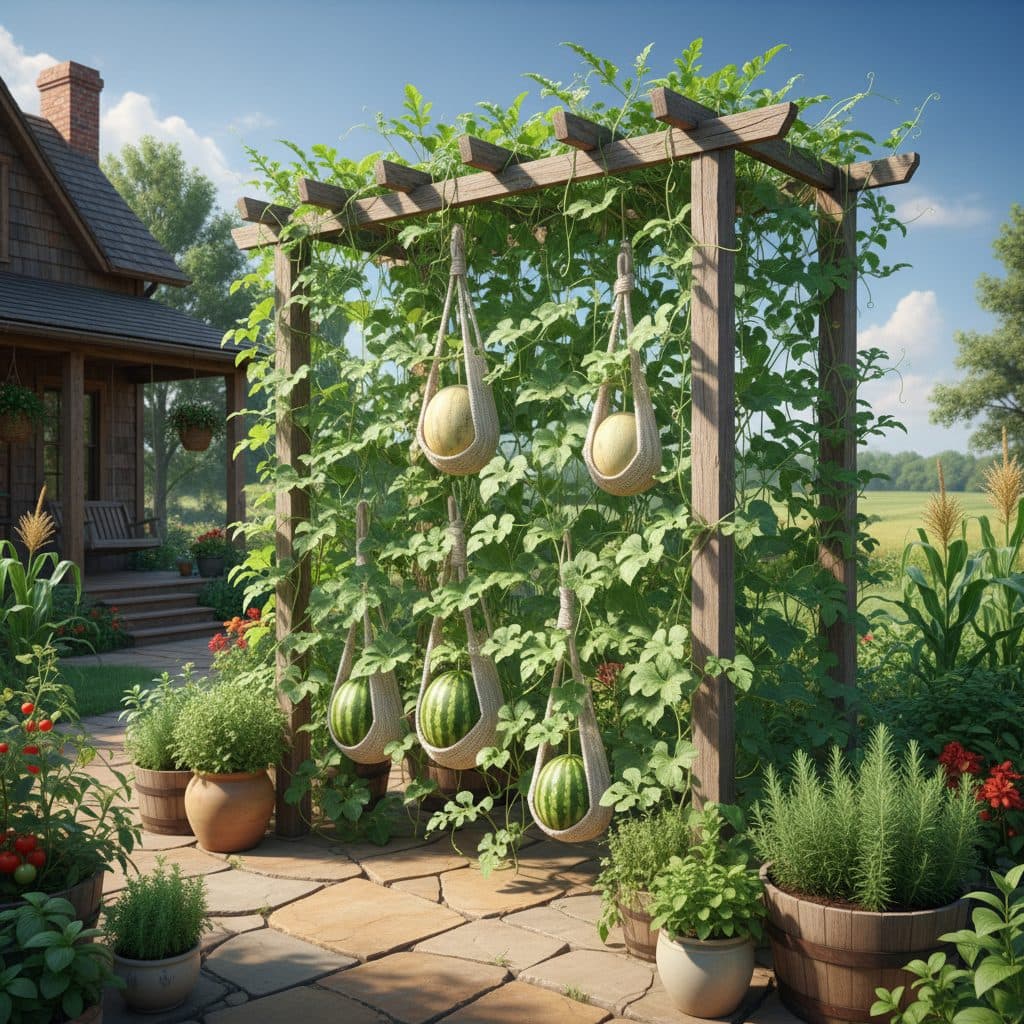
- Construct and attach fruit slings from breathable materials like old t-shirts or netting to support developing melons, preventing stem breakage.
- Water by volume rather than by rainfall inches — a fruiting melon in a 15-gallon pot can need 1-2 gallons a day in peak heat — and fertilize regularly with a complete feed.
Quick answer: To grow watermelons and cantaloupes vertically in USDA Zone 7, select compact varieties, use sturdy 15-gallon containers, and install a robust trellis system. Ensure consistent watering, regular fertilization, and hand-pollinate flowers for optimal fruit set.
In many urban areas across the United States, like the rooftops of Brooklyn, New York, or the balconies of Portland, Oregon, gardening space is often limited to a few square feet. However, a small footprint doesn’t mean you can’t enjoy fresh, homegrown watermelons and cantaloupes. Vertical gardening offers a practical solution, allowing you to cultivate these sprawling vines upwards, maximizing your yield in a constrained area. With the right techniques and a bit of planning, a single compact melon plant can produce 2-4 fruits, from 1-2 pounds for ‘Minnesota Midget’ up to 8-10 pounds for ‘Sugar Baby’, even in a small container.
This approach requires careful attention to variety selection, robust support systems, and the crucial use of fruit slings to cradle developing melons. Growing vertically not only saves space but also improves air circulation around the plants. We’ll cover everything from choosing the best seeds – many of them long-established heirlooms – to ensuring your ripening fruits are well-supported, helping you achieve a bountiful harvest of sweet, juicy melons.
Choosing the right varieties and setup for vertical melons
When planning a vertical melon patch, selecting the correct varieties is the first critical step. For container growing, look for compact or ‘bush’ types that naturally have shorter vines, typically reaching 6-8 feet rather than the 15-20 feet of traditional varieties. Popular watermelon choices include ‘Sugar Baby’ or ‘Bush Sugar Baby,’ which produce 8-10 pound fruits, and ‘New Hampshire Midget,’ yielding 3-5 pound melons. For cantaloupes, ‘Minnesota Midget’ and ‘Bush Star’ are excellent, offering 1-2 pound fruits. These smaller varieties ensure that your trellis system won’t be overwhelmed by excessive vine growth or fruit weight, which can reach 20-30 pounds per plant.
container and trellis considerations
A sturdy container is essential for healthy root development and to support the plant’s overall weight. Aim for a minimum of a 15-gallon container per plant, or a 20-gallon size for larger varieties, to provide ample soil volume. This larger volume holds moisture longer, so the pot dries out more slowly than a small one. The trellis itself must be robust, capable of supporting at least 50 pounds of combined vine and fruit weight. Heavy-duty cattle panels, strong netting with 4-6 inch squares, or a wooden A-frame structure are suitable options. On a balcony or rooftop, anchor the structure against wind before the vines leaf out — a covered trellis catches wind like a sail — and check your lease or HOA rules before fixing anything to a rail, wall or parapet. Position your trellis in a spot that receives at least 8 hours of direct sunlight daily, especially important in northern regions like USDA zone 5, to ensure proper fruit ripening. You can find general guidance on starting your garden at Vegetable gardening for beginners: your questions answered.
- ‘Sugar Baby’ watermelon (8-10 lb fruit)
- ‘New Hampshire Midget’ watermelon (3-5 lb fruit)
- ‘Minnesota Midget’ cantaloupe (1-2 lb fruit)
- ‘Bush Star’ cantaloupe (1-2 lb fruit)
- ‘Crimson Sweet’ watermelon (up to 25 lb fruit, needs extra support)
Soil, nutrients, and watering for vertical melons
The foundation of a successful vertical melon harvest lies in a rich, well-draining potting mix. For container gardening, a blend of high-quality compost (50%), perlite or vermiculite (25%), and coco coir or peat moss (25%) provides excellent drainage and nutrient retention. This mix prevents the waterlogging that leads to root rot. A 15-gallon container will require approximately 2 cubic feet of this custom soil blend. Before planting, incorporate a slow-release granular fertilizer with an NPK ratio around 5-10-10 to encourage initial growth and flowering. The USDA Natural Resources Conservation Service emphasizes the importance of healthy soil for robust plant development [3].
consistent moisture and feeding
Melons are thirsty plants, especially when grown in containers and under direct sun, common on a rooftop in USDA zone 6. They require consistent moisture, typically 1-2 inches of water per week, or enough to keep the soil evenly moist but not saturated. During peak fruiting, this might mean watering daily in hot, dry conditions, potentially requiring 1-2 gallons per plant per day. A soil moisture meter can be a valuable tool, helping you monitor levels accurately and prevent over or under-watering. Begin a liquid feeding regimen every 2-3 weeks once fruits start to set, using a liquid feed such as a 5-1-5 blend, diluted to half strength. This consistent nutrient supply supports the rapid development of large, sweet fruits.
- 50% high-quality compost
- 25% perlite or vermiculite
- 25% coco coir or peat moss
- Slow-release granular fertilizer (5-10-10 NPK)
- Liquid balanced fertilizer (5-1-5 NPK)
Pollination and fruit set on a trellis
Successful fruit set is paramount for a good melon harvest, and it largely depends on effective pollination. Melon plants produce both male and female flowers on the same vine. Male flowers typically appear first, often in clusters of 5-10, and have a slender stem. Female flowers are identifiable by a tiny, swollen base — a miniature melon — behind the petals, and usually appear individually. In a garden with ample bee activity, like a rural farm in Iowa, natural pollination is usually sufficient. However, for vertical gardens in urban settings, or on a balcony 30 feet above ground, you may need to hand-pollinate your melon flowers to ensure a good yield.
the art of hand-pollination
To hand-pollinate, wait until the early morning, between 7:00 AM and 10:00 AM, when the pollen is most viable. Gently pick a freshly opened male flower. Remove its petals to expose the stamen, which is covered in yellow pollen. Then, carefully dab the pollen onto the stigma (the central part) of a freshly opened female flower. Repeat this process for all available female flowers. A 1997 study highlighted the critical role of honey bees in pollinating cantaloupe, cucumber, and watermelon, emphasizing that effective pollination significantly boosts fruit production [2]. Aim to pollinate 2-3 female flowers per vine for optimal fruit development, preventing the plant from expending energy on too many fruits that may not fully mature. For specific details on watermelon, refer to Watermelon in our plant guide.
- Identify male flowers (slender stem, no swelling)
- Identify female flowers (swollen base, tiny melon)
- Hand-pollinate in early morning (7:00 AM – 10:00 AM)
- Use a soft brush or male flower to transfer pollen
- Pollinate 2-3 female flowers per vine for best results
Supporting your ripening fruit with slings
As your melons begin to grow, their increasing weight can put significant strain on the vine stems, leading to breakage and premature fruit drop. This is where fruit slings become indispensable for vertical gardening. A single ‘Crimson Sweet’ watermelon can reach 25 pounds, far too heavy for a slender vine to support without assistance. Slings provide the necessary support, distributing the fruit’s weight and preventing damage. You can craft slings from a variety of readily available materials, ensuring they are breathable and strong enough to hold the fruit’s full weight, which is typically 8-10 pounds for a ‘Sugar Baby’ watermelon.
crafting and attaching fruit slings
Excellent materials for fruit slings include old t-shirts cut into strips, pantyhose, mesh onion bags, or repurposed netting. Avoid using non-breathable materials like plastic bags, which can trap moisture and promote fungal diseases. Cut your chosen material into squares or strips large enough to comfortably cradle the melon as it grows. For a 10-pound melon, a 12×12 inch square of fabric is a good starting point. Attach the sling securely to the trellis system, not the vine itself, using strong twine, zip ties, or S-hooks. Position the sling so that it cups the melon from underneath, taking the weight off the vine. Check the slings weekly, especially as the fruit expands, to ensure they are still providing adequate support and not constricting growth. Slinging heavy fruit is cheap insurance against losing a melon to a snapped stem.
- Old t-shirts or pantyhose
- Mesh onion or produce bags
- Nylon netting with small holes
- Strong twine or zip ties for attachment
- S-hooks for adjustable hanging
Pest and disease management for vertical crops
This builds directly on supporting ripening fruit.
Even in a vertical garden, melons can attract common pests and diseases. Vigilance is key to managing these issues effectively and protecting your harvest. Common melon pests include aphids, squash bugs, and cucumber beetles. Aphids, tiny green insects, can quickly multiply and weaken plants by sucking sap. Squash bugs can cause significant damage, especially to young plants, leading to wilting and death within a few days if left unchecked. Regularly inspect your plants, especially the undersides of leaves, at least 2-3 times per week. Early detection allows for targeted, less intensive treatments, preserving the health of your plants and the quality of your fruit, which can be crucial for a small, intensive garden in USDA zone 7.
organic pest and disease control
For aphid infestations, a strong spray of water knocks most of them off. For more persistent pests, consider organic solutions. Neem oil, diluted to a 1% solution (e.g., 2 tablespoons per gallon of water), can be sprayed every 7-10 days to deter a wide range of insects. For squash bugs, hand-picking them off the plants and dropping them into a bucket of soapy water is an effective method, especially for small-scale vertical gardens. Disease prevention largely revolves around good cultural practices: ensure proper air circulation by pruning excess leaves, avoid overhead watering to reduce fungal issues like powdery mildew, and use clean tools like a lightweight garden hand trowel for planting. ATTRA / NCAT Sustainable Agriculture provides excellent resources on organic pest management strategies [6]. If powdery mildew appears, a spray of 1 tablespoon of baking soda mixed with 1 gallon of water and a few drops of liquid soap can help control its spread by altering the leaf surface pH.
- Aphids (sap-sucking insects)
- Squash bugs (cause wilting and plant death)
- Cucumber beetles (damage leaves and transmit diseases)
- Powdery mildew (white fungal growth on leaves)
- Downy mildew (yellow spots on leaves, purplish spores underneath)
Comparison of Melon Varieties for Vertical Growing
Variety | Type | Typical Fruit Weight | Vine Length | Days to Maturity |
|---|---|---|---|---|
Sugar Baby | Watermelon | 8-10 pounds | 6-8 feet | 75 days |
New Hampshire Midget | Watermelon | 3-5 pounds | 3-4 feet | 70 days |
Minnesota Midget | Cantaloupe | 1-2 pounds | 3-5 feet | 70 days |
Bush Star | Cantaloupe | 1-2 pounds | 4-6 feet | 80 days |
Crimson Sweet | Watermelon | 15-25 pounds | 8-10 feet | 85 days |
Container Size: A minimum 15-gallon container is recommended per melon plant to support robust root growth and fruit production, especially for varieties yielding 8-10 pound fruits.
Trellis Strength: Your trellis system must be capable of supporting at least 50 pounds of combined vine and fruit weight per plant, as a single ‘Crimson Sweet’ watermelon can weigh up to 25 pounds.
Water Needs: Melon plants in containers are watered by volume, not by rainfall inches — expect 1-2 gallons per plant daily during peak fruiting in hot weather.
Frequently asked questions
How much space do I need for vertical melon growing?
You can successfully grow 1-2 melon plants in a space as small as 2×2 feet, provided you use a 15-gallon container per plant and a strong vertical trellis system capable of supporting 50 pounds of fruit.
What kind of trellis is best for watermelons and cantaloupes?
A sturdy trellis made from cattle panels, heavy-gauge wire mesh with 4-6 inch squares, or a robust wooden A-frame is ideal. It must be able to support the collective weight of vines and fruits — at least 50 pounds per plant, and more for large-fruited varieties.
When should I start using fruit slings?
Begin supporting your melons with slings when they reach the size of a tennis ball, or approximately 2-3 inches in diameter. This prevents early strain on the vine and ensures the fruit develops properly, supporting up to 25 pounds.
How often should I water melons in containers?
Melons in containers require consistent moisture, typically 1-2 inches of water per week. During hot periods, especially in USDA zone 9, you may need to water daily, providing 1-2 gallons per plant to prevent wilting.
Can I grow large watermelon varieties vertically?
While possible, it’s more challenging. Large varieties like ‘Crimson Sweet’ can produce fruits up to 25 pounds, requiring exceptionally strong trellises and multiple, very robust slings. Compact varieties are generally recommended for easier management and higher success rates in vertical systems.
References
- Watermelon and cantaloupe seed / (1919). Watermelon and cantaloupe seed /.
- Honey Bee Pollination of Cantaloupe, Cucumber, & Watermelon (1997). Honey Bee Pollination of Cantaloupe, Cucumber, & Watermelon.
- USDA Natural Resources Conservation Service (2024). USDA Natural Resources Conservation Service.
- EPA — Soak Up the Rain (2024). EPA — Soak Up the Rain.
- SARE — Sustainable Agriculture Research & Education (2023). SARE — Sustainable Agriculture Research & Education.
- ATTRA / NCAT Sustainable Agriculture (2023). ATTRA / NCAT Sustainable Agriculture.