Key takeaways
- Black walnuts (Juglans nigra) and various hickory species (Carya spp.) are common across 30+ US states, offering a useful wild food source.
- Harvest nuts after they fall naturally, typically from late September through October so they are free from mold or insect damage.
- Hulling black walnuts immediately after harvest prevents dark hull tannins from penetrating the shell; use heavy gloves to avoid skin irritation.
- Cure nuts for 2-4 weeks in a well-ventilated, dry area with temperatures between 60-70°F and 60% humidity to ensure long-term storage and flavor development.
- Effective cracking requires specific tools like a hammer or specialized nut cracker due to the hard shells, yielding up to 20% edible kernel by weight.
- Incorporating wild nuts into your diet provides beneficial omega-3 fatty acids and antioxidants, supporting overall health.
Quick answer: Foraging black walnuts and hickory nuts involves identifying the trees, harvesting fallen nuts from late September to October, hulling them promptly, and then curing them for 2-4 weeks. These wild nuts offer a nutrient-dense food source across over 30 US states.
Across the eastern and central United States, from USDA zone 4 through zone 9, black walnuts (Juglans nigra) and native hickories (Carya spp.) yield a substantial autumn harvest. Growing across more than 30 states, these hardwood trees produce protein- and oil-rich kernels that improve lipid profiles when added to the diet [1].
Successfully gathering and processing these wild nuts requires patience and specific techniques. From identifying the right trees in late summer to hulling the green outer layers and then properly curing the nuts for storage, each step is important. This guide will walk you through the practical steps of foraging, preparing, and enjoying black walnuts and hickory nuts so a rewarding experience for any grower or homesteader.
Identifying and locating black walnuts and hickory nuts
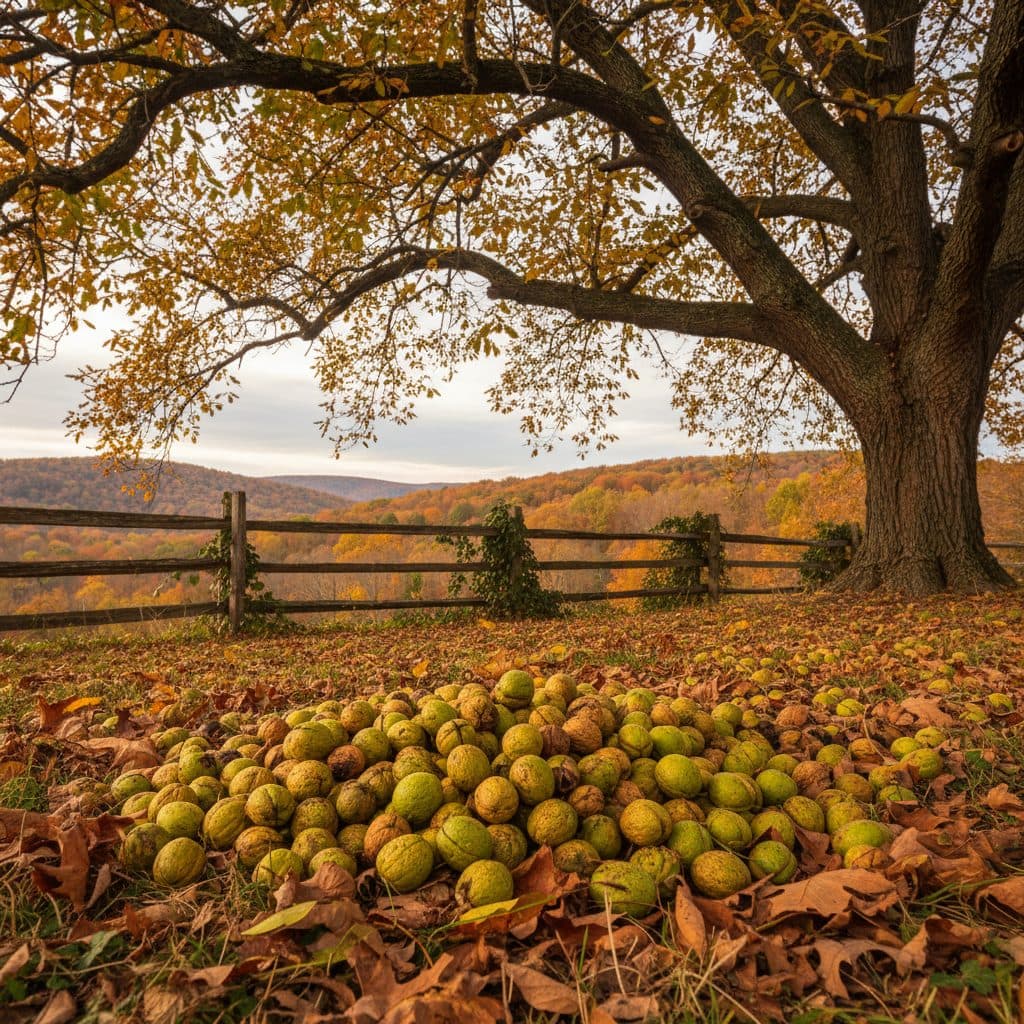
Finding productive trees is the first step in harvesting. Black walnuts, distributed from southern Ontario to Florida and west to Texas, are identified by compound leaves with 15 to 23 leaflets and spherical green hulls that blacken after falling. The roots and hulls produce juglone, an allelopathic compound toxic to nightshades and other garden crops. Mature trees reach 50 to 75 feet in open pastures, fencerows, and bottomlands across USDA zones 4 through 9. Hickories, including shagbark (Carya ovata) and shellbark (Carya laciniosa), grow across USDA zones 4 through 8, marked by straight trunks, loose peeling bark plates on mature trunks, compound leaves with five to seven leaflets, and nuts enclosed in four-part husks that split open at maturity.
Distinguishing features for foraging
Several distinct field marks separate the two genera. Crushed black walnut leaves release a sharp citrus odor, and their fallen green hulls are round balls measuring 1.5 to 2.5 inches across. Hickory husks split into four distinct woody segments, exposing a tan, ribbed nut measuring 0.5 to 2 inches long depending on species. Both trees grow in mixed hardwood stands on well-drained loamy soils, where accurate identification ensures productive harvesting.
- Black walnut leaves: 15-23 leaflets, citrusy scent when crushed.
- Hickory leaves: Typically five to seven leaflets, no distinct scent.
- Black walnut hulls: Spherical, 1.5-2.5 inches, turn black.
- Hickory husks: Four-part, split cleanly, often thicker.
- Tree height: Both commonly reach 50-75 feet in maturity.
Harvesting and hulling black walnuts and hickory nuts
The prime time for harvesting black walnuts and hickory nuts is typically from late September through October, after the nuts have naturally fallen from the trees. It is best to gather them within a few days of falling to prevent mold growth or insect damage, which can compromise the quality of the kernel. In many areas, particularly across states like Missouri and Ohio, you can find significant harvests. For black walnuts, the outer hull is green when fresh but quickly darkens to black, staining anything it touches a deep brown or black. This staining is due to juglone, a natural chemical present in the hull, which can irritate skin and permanently stain clothing and concrete. Hickory nuts, on the other hand, have a cleaner, four-part husk that usually splits open on its own, making them less messy to handle.
Safe and effective hulling methods
Hull black walnuts promptly after gathering. Small batches can be stepped on and rolled under a heavy work boot on gravel or plywood to break off the softening husk. Larger quantities can be processed through a mechanical corn sheller or cement mixer with water. Always wear heavy-duty waterproof work gloves (thin disposable gloves will tear and allow juglone to blacken skin) and dedicated work clothes. After removing hulls, wash nuts in a tub with a stiff brush or jet nozzle to remove pulp residue. Black walnuts yield 10 to 20% nutmeat by weight when cracked, whereas thinskinned hickories yield 25 to 35% [2].
- Wear protective gear: Thick rubber gloves and old clothes are essential.
- Hull promptly: Within 1-2 days of collection to prevent staining and mold.
- Use a hard surface: Concrete or a dedicated huller works best for black walnuts.
- Wash thoroughly: Remove all hull residue with water and a stiff brush.
- Avoid direct contact: Juglone can cause skin irritation and staining.
Curing and storing your wild nuts
After hulling and washing, the nuts require a proper curing period to dry thoroughly, which is essential for long-term storage and optimal flavor. This process typically takes 2-4 weeks. In a region like the Midwest, where humidity can fluctuate, a consistent environment is key. Spread the cleaned nuts in a single layer on screens or in mesh bags in a well-ventilated area, such as a garage, shed, or attic. The ideal curing environment is cool and dry with good air circulation. Good air circulation is critical to prevent mold growth, which can ruin an entire batch. Avoid direct sunlight, as this can cause the nuts to dry too quickly and crack prematurely.
Long-term storage for preserved freshness
Once cured, the nuts should feel lighter and the kernels should rattle slightly when shaken. For long-term storage, place the cured nuts in mesh bags, burlap sacks, or onion bags, which allow continued air circulation. Store them in a cool, dry, dark place where temperatures remain consistently below 50°F, such as a root cellar or unheated basement. Properly stored, black walnuts and hickory nuts can last for 1-2 years in their shells. For even longer storage, up to 3-4 years, shelled kernels can be frozen in airtight containers. This method helps preserve their delicate flavor and prevents rancidity. Monitoring for signs of moisture or insect activity every few months is a good practice to ensure your hard-earned harvest remains viable.
- Ensure good air circulation: Spread nuts in a single layer on screens.
- Maintain ideal conditions: 60-70°F and 60% humidity for curing.
- Store in breathable containers: Mesh bags or burlap sacks are ideal for in-shell nuts.
- Keep cool and dry: Below 50°F in a dark location for up to 2 years.
- Freeze shelled kernels: For 3-4 years of extended freshness.
Cracking and enjoying your wild harvest
Cracking wild nuts requires sturdy tools due to their thick internal ridges. Handheld table nutcrackers will break on black walnut shells [3]. A 3-pound drilling hammer on an anvil or specialized lever-arm crackers (such as the Master Cracker or Kenkel Nut Cracker) fracture the shell without pulverizing the kernel. Hickory shells are somewhat thinner, opening under a bench vise or careful hammer strikes. Expect modest returns: a 5-gallon bucket of in-shell black walnuts yields roughly 1 to 2 pounds of picked nutmeat.
Culinary uses and nutritional benefits
Once cracked, the rich, distinctive flavor of black walnuts and hickory nuts can be enjoyed in a variety of culinary applications. Black walnuts have a bold, earthy, and somewhat pungent flavor, making them excellent in baked goods like brownies, cookies, and quick breads. They also add a unique depth to savory dishes, such as pestos, stuffings, and even sprinkled over salads. Hickory nuts offer a milder, sweeter flavor, often described as buttery, similar to pecans. They are fantastic in pies, ice cream, and granola, or simply roasted and eaten as a snack. Both types of nuts are nutritional powerhouses, rich in healthy fats, protein, and antioxidants. Walnuts, for example, contain significant levels of omega-3 fatty acids, which are beneficial for heart health [1].
- Use specialized tools: A heavy-duty hammer or a dedicated black walnut cracker is essential.
- Protect your eyes: Shell fragments can fly, so wear safety glasses.
- Expect low yield: Black walnuts typically yield 10-20% kernel by weight.
- Store shelled kernels: In an airtight container in the refrigerator or freezer.
- Explore diverse recipes: From baked goods to savory dishes and snacks.
Comparison of black walnuts and hickory nuts
Feature | Black Walnut (Juglans nigra) | Hickory Nut (Carya spp.) |
|---|---|---|
Range (USDA zones) | 4-9 (Eastern & Central US) | 4-8 (Eastern US) |
Hull/husk appearance | Round, green, stains dark, 1.5-2.5 in diameter | Four-part, splits cleanly, often thicker, 0.5-2 in length |
Shell hardness | Extremely hard, deeply ridged | Very hard, smoother than black walnut |
Kernel flavor | Bold, earthy, pungent | Milder, sweeter, buttery |
Kernel yield (by weight) | 10-20% | 25-35% |
Cracking difficulty | High, requires specialized tools | Moderate, requires sturdy tools |
Nutrient Density: A 1-ounce serving of black walnuts provides about 4 grams of protein and 2.5 grams of fiber, contributing significantly to daily nutritional needs [4].
Harvest Window: The optimal time to collect black walnuts and hickory nuts is typically a 4-6 week window from late September to late October, after natural fall.
References
- Walnuts and macadamia nuts benefit lipid profiles (2000).
- Hickory Nuts (2013).
- Why walnuts are such tough nuts to crack (2019).
- EXPLORING THE POTENTIALS OF UNDERUTILIZED AFRICAN NUTS (BLACK WALNUTS AND ALMONDS) FOR NUTRITION AND DISEASES (2021).
- Gathering Hickory Nuts Before the Examination (2022).
- USDA Natural Resources Conservation Service (2024).