support
Flemingia support shrub
Flemingia macrophylla
International hardiness
- USDA 9-12
- RHS H1c
- AU: Tropical, Subtropical
Where it grows — regional guide
| Zones / rating | Regional notes |
|---|---|
USDA 9-12 | Adapted to frost-free microclimates in South Florida and Hawaii (Zones 10 to 12) for mulch and windbreaks; not recommended for livestock forage. |
| Zones / rating | Regional notes |
|---|---|
H1c (5 to 10C) | No region-specific data yet |
| Zones / rating | Regional notes |
|---|---|
Tropical, Subtropical | Grown in tropical Queensland and the Top End as a resilient contour hedge and slope stabiliser; monitor for volunteer seedlings near watercourses. |
| Zones / rating | Regional notes |
|---|---|
USDA 9-12 (USDA scale) Canada uses its own zone system; Canadian zones run roughly one lower than USDA. | No region-specific data yet |
| Zones / rating | Regional notes |
|---|---|
No region-specific data yet | No region-specific data yet |
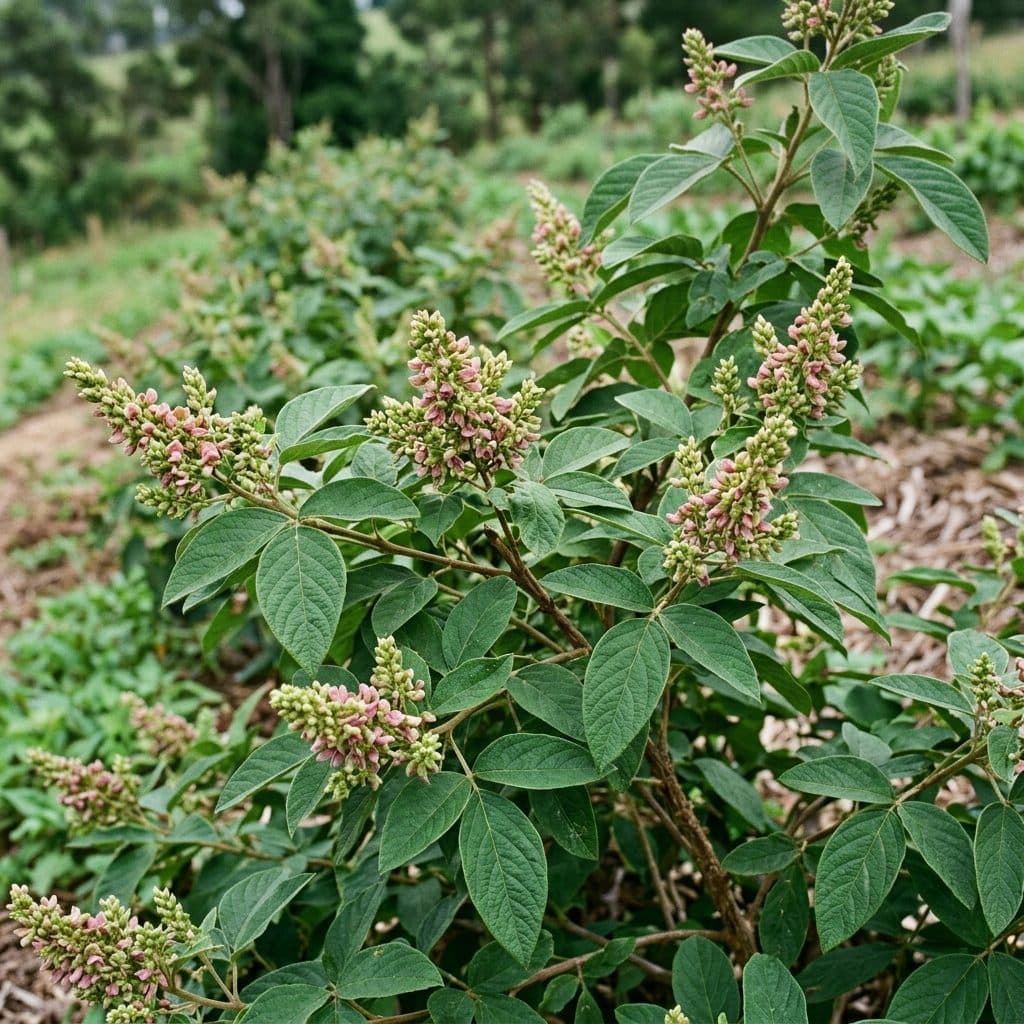
Flemingia support shrub (Flemingia macrophylla), formerly known in botanical literature as Flemingia congesta, is an erect, woody perennial leguminous shrub belonging to the phaseoloid clade of the legume family (Fabaceae). Native to the humid and sub-humid tropical landscapes of South and Southeast Asia, southern China, and northern Australia, the species has been planted extensively across tropical Africa, Latin America, and the Pacific. In regenerative agroforestry and soil conservation, Flemingia macrophylla is regarded as an essential support species: a deep-rooted shrub cultivated to generate durable organic mulch, anchor agricultural slopes against rainfall, and nurse delicate young tree crops.
The agronomic brilliance of Flemingia macrophylla lies in the biochemical composition of its foliage. While many popular agroforestry legumes produce soft leaves that break down within three weeks of cutting, Flemingia leaves possess high concentrations of lignin and polyphenolic tannins. Consequently, Flemingia mulch breaks down slowly over four to six months. This creates a physical blanket over the soil that conserves moisture, buffers surface temperatures, and suppresses weeds throughout a cropping season, benefiting companion plantings of groundnut, malabar spinach, or chaulai. For tropical smallholders managing steep hillside terraces, establishing Flemingia contour hedgerows provides permanent structural erosion defence coupled with ongoing biological soil enrichment.
Growing Flemingia support shrub
Flemingia macrophylla is a tropical and subtropical species that performs best in warm, humid and sub-humid environments. The shrub is reliably perennial in USDA Zones 9b to 12 and rated RHS H1c. While established woody stumps survive non-freezing chills down to -2 °C (28 °F) by dropping foliage, prolonged freezing conditions kill the root system. The plant thrives under mean annual temperatures ranging from 20 to 28 °C (68 to 82 °F) and annual rainfall between 1,100 and 3,500 mm (43 to 140 in). Because it drives an exceptionally deep taproot into the subsoil, established bushes survive dry seasons lasting up to six months with remarkable resilience.
Soil adaptability is one of the shrub's greatest virtues. It tolerates strongly acidic, aluminium-toxic soils with pH values down to 4.0, as well as degraded gravels and low-fertility clays where other leguminous crops succumb to mineral stress. It actively fixes atmospheric nitrogen through symbioses with Bradyrhizobium soil bacteria and tolerates moderate periods of wet-season waterlogging. The shrub thrives in full sun but demonstrates impressive shade tolerance, maintaining active growth beneath the 40 to 50% shade canopies of rubber, coffee, and fruit orchards.
Propagation is carried out primarily by seed. The small, globular black seeds have a hard, water-resistant coat. For high germination, scarify seeds by immersing them in hot water (80 °C / 176 °F) for two to three minutes, followed by an overnight soak in cool water. Sown into moist soil, seeds germinate within seven to ten days. Seedlings invest heavily in early taproot development, meaning above-ground growth is modest during the first two to three months. Regular weeding is necessary during this establishment window until the shrubs reach 50 cm (20 in) in height.
Once established, growth accelerates vigorously, with bushes reaching 1.5 to 3 m (5 to 10 ft) in six to nine months. To establish living erosion barriers and alley-cropping systems, sow or transplant seedlings in double or single contour rows at an in-row spacing of 10 to 20 cm (4 to 8 in), with hedgerows spaced 3 to 6 m (10 to 20 ft) apart down the slope.
Prune hedgerows for the first time when bushes attain 1.5 m (5 ft) in height. Cut woody stems back to 50 to 80 cm (20 to 31 in) above ground. Managed hedgerows tolerate frequent, heavy coppicing, resprouting readily to produce three to five biomass flushes per year.
Harvest and uses
The primary harvest from Flemingia macrophylla is its long-lasting leaf mulch. When coppiced three to four times annually, healthy hedgerows yield 5 to 8 tonnes of dry organic matter per hectare per year. Because leaves contain high lignin (12 to 15%) and condensed tannin concentrations, they decompose slowly over several months. Spreading this coarse leaf harvest across vegetable beds or young fruit trees creates a physical barrier that suppresses weeds, prevents soil crusting, and reduces irrigation requirements by conserving soil moisture.
On steep hillsides, Flemingia contour hedgerows function as powerful erosion barriers. The dense woody crowns and interlocking root networks trap sediment washed downslope by heavy rains. Over three to five years, soil accumulating behind hedges naturally builds stable terraced beds, halting topsoil loss.
The shrub is a nurse and windbreak species in agroforestry. In young cocoa, coffee, and fruit orchards, rows of Flemingia provide windbreak protection and partial shade that shield delicate saplings from intense sun and drying winds. As tree crops mature, Flemingia shrubs can be coppiced down to ground level and converted into mulch.
The woody stems provide useful kindling and staking sticks. Additionally, related species such as Flemingia semialata are cultivated as host plants for the commercial lac insect (Kerria lacca), which yields natural shellac.
Identifying Flemingia support shrub
Flemingia macrophylla can be identified by the following morphological characteristics:
- Habit: An erect, deep-rooted, multi-stemmed woody shrub reaching 1.5 to 3 m (5 to 10 ft) in height, with a dense, spreading, upright branch architecture.
- Stems: Young branchlets are distinctly triangular, ribbed, or grooved in cross-section and covered in soft, silky, appressed hairs; older stems develop smooth, grey-brown bark.
- Leaves: Alternate, large, trifoliate leaves on channeled, winged petioles measuring 4 to 10 cm (1.5 to 4 in) long. The leaflets are elliptic to lanceolate, 8 to 20 cm (3 to 8 in) long and 4 to 10 cm (1.5 to 4 in) wide; the terminal leaflet is slightly larger than the lateral ones. Leaflets are leathery, dark emerald green above, and paler beneath with prominent silky-hairy veins.
- Inflorescences: Compact, dense, axillary racemes 5 to 10 cm (2 to 4 in) long that are shorter than the subtending leaves, densely packed with small, pea-like flowers.
- Flowers: Petals are greenish-white to pale pink with prominent, fine violet or purple striping on the standard petal.
- Fruit: Small, swollen, oblong, two-seeded pods measuring 10 to 15 mm (0.4 to 0.6 in) long and 6 to 9 mm (0.24 to 0.35 in) wide, covered in dense, dark brownish glandular pubescence.
- Seeds: Each pod contains exactly two shiny, globular, hard-coated black seeds measuring roughly 2 to 3 mm in diameter.
It is distinguished from Cajanus cajan (pigeon pea), which has bright yellow flowers and large edible seeds, and from Desmodium species, which have jointed loment pods that break apart into adhesive one-seeded segments.
Cautions
Growers incorporating Flemingia macrophylla into agroforestry systems should be mindful of the following limitations:
- Very low livestock fodder value: Despite being a leguminous shrub with a crude protein content of 14 to 18%, Flemingia foliage has very poor livestock fodder value. The high concentration of condensed tannins and structural lignin makes the leaves tough, astringent, and poorly digestible. In vitro dry matter digestibility is exceptionally low, frequently falling between 30 and 40%. Grazing cattle, goats, and sheep will routinely reject Flemingia leaves unless subjected to severe starvation. The plant should be grown strictly as an erosion-control, mulch, and nurse shrub rather than a primary forage crop.
- Slow initial juvenile establishment: During its first three months, Flemingia prioritises root descent, leaving young seedlings vulnerable to being smothered by aggressive grasses and broadleaf weeds. Clean weeding around young rows is mandatory during early establishment.
- Minor weed risk in wet tropical riparian borders: In humid tropical lowlands with year-round warmth and moisture, the shrub produces plentiful seeds that can wash down waterways and colonise disturbed wetland edges. Manage contour hedges with regular coppicing before pod dehiscence.
- Regulatory note: Regulated in some jurisdictions as a non-native introduced shrub; review local agroforestry and environmental weed lists before introducing to pristine watershed reserves.
Sources
- Royal Botanic Gardens, Kew. Flemingia macrophylla (Willd.) Merr. Plants of the World Online.
- World Agroforestry (ICRAF). Flemingia macrophylla (Willd.) Merr. Agroforestree Database.
- Plants For A Future. Flemingia macrophylla - (Willd.) Merr.
- USDA PLANTS Database. Flemingia macrophylla (Willd.) Merr.