support
Buffalo grass
Bouteloua dactyloides
International hardiness
- USDA 3-9
- RHS H7
- AU: Warm temperate, Arid / semi-arid
Where it grows — regional guide
| Zones / rating | Regional notes |
|---|---|
USDA 3-9 | Dominant native turfgrass across the Great Plains, Midwest, and arid West; requires 75 percent less irrigation than Kentucky bluegrass. |
| Zones / rating | Regional notes |
|---|---|
H7 (below -20C) | Rarely grown in Britain; struggles with prolonged damp, overcast maritime summers and high soil moisture. |
| Zones / rating | Regional notes |
|---|---|
Warm temperate, Arid / semi-arid | Performs well as a low-water native pasture or lawn alternative in semi-arid and warm-temperate inland zones of New South Wales and South Australia. |
| Zones / rating | Regional notes |
|---|---|
USDA 3-9 (USDA scale) Canada uses its own zone system; Canadian zones run roughly one lower than USDA. | Adapted to the dry southern prairies of Alberta and Saskatchewan; survives harsh freezing winters down to Zone 3. |
| Zones / rating | Regional notes |
|---|---|
No region-specific data yet | No region-specific data yet |
Buffalo grass (Bouteloua dactyloides), historically classified as Buchloe dactyloides, is a low-growing, stoloniferous perennial warm-season turfgrass in the grass family (Poaceae). Indigenous to the shortgrass prairies of North America, from the Canadian prairie provinces through the American Great Plains into northern Mexico, this native sod-former anchored prairie soils for millennia and served as the primary forage for wild bison herds. Today, it is planted as a water-conserving alternative to conventional high-input lawn turf.
In an agroforestry layout, homestead orchard, or low-input landscape, buffalo grass performs as a durable living mulch and groundcover. While conventional turfgrasses require heavy feeding and weekly irrigation, buffalo grass utilizes C4 photosynthetic machinery to thrive on natural rainfall in semi-arid environments. Beneath fruit trees or along paths, its dense stoloniferous weave suppresses weed flushes without competing aggressively for deep soil moisture.
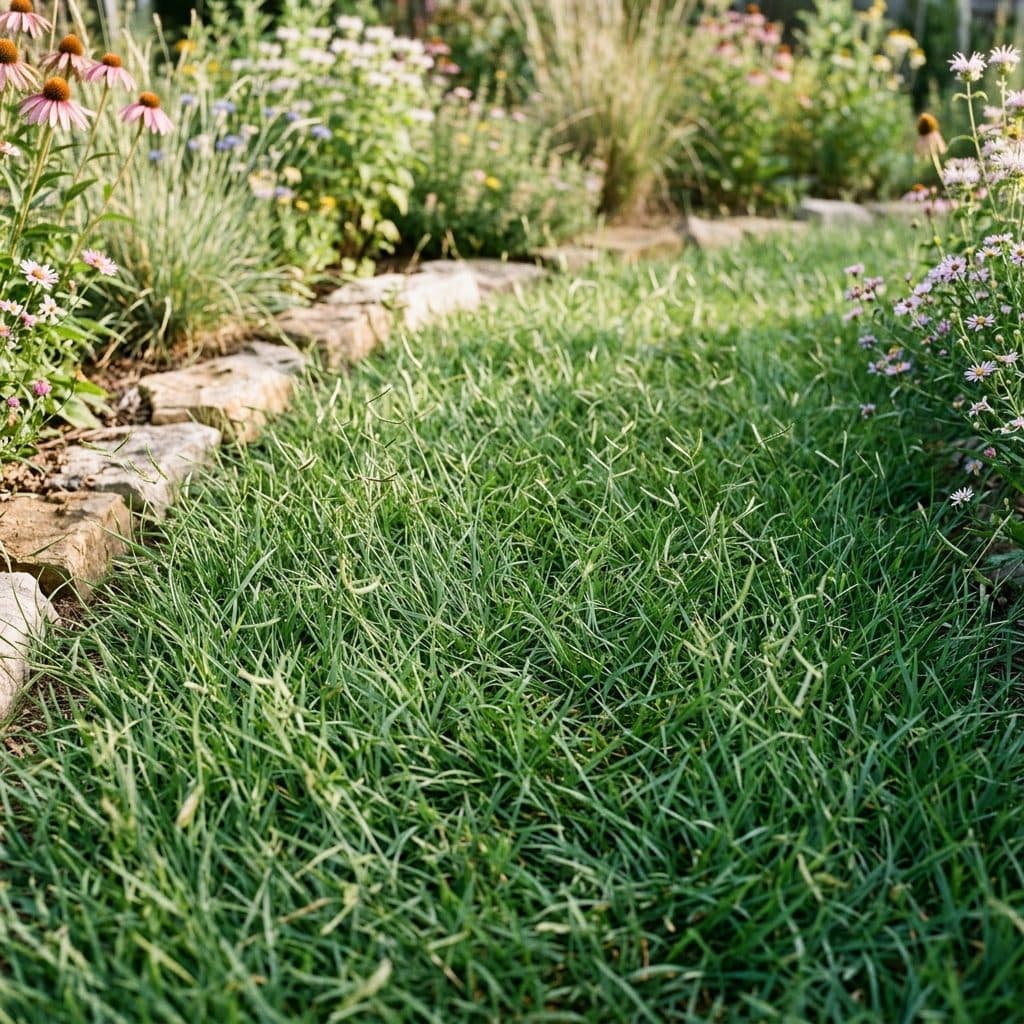
The grass has fine, soft, blue-green blades reaching only 10 to 20 cm (4 to 8 in) tall when unmown. Because it spreads through surface runners rather than underground rhizomes, it is easily contained along garden edges without invading adjacent cultivated vegetable plots like garlic. For homesteaders seeking to reduce mowing, water use, and synthetic fertilizer inputs, it is a practical native ground cover.
Growing buffalo grass
Buffalo grass thrives across USDA Hardiness Zones 3 through 9, enduring winter lows down to -35 °C (-31 °F) in the northern Plains and summer temperatures exceeding 40 °C (104 °F) in the Southwest. As a warm-season grass, it breaks dormancy in mid- to late spring, grows vigorously through summer, and turns an attractive straw-tan color following autumn frosts.
The species prefers moderately heavy to heavy soils, including fertile clay loams and alkaline substrates with a pH between 6.5 and 8.5. It tolerates thin, rocky soils, but fails in loose sands and waterlogged depressions. Full sunlight is mandatory; it requires at least six to eight hours of direct sun daily. Shaded turf quickly thins out and invites broadleaf weeds.
Water conservation is its chief virtue, requiring roughly 75 percent less water than traditional cool-season lawn varieties. In regions receiving 400 to 600 mm (16 to 24 in) of annual rainfall, established sod survives on precipitation alone. During prolonged droughts, the grass halts growth and enters semi-dormancy, greening up promptly upon rain.
Establish from treated seed burs, sod, or plugs in late spring when soil temperatures exceed 15 °C (60 °F). Always purchase burs treated to overcome seed dormancy. Sow at 1 to 1.5 kg per 100 square meters (2 to 3 lb per 1,000 sq ft) at a depth of 6 to 12 mm (0.25 to 0.5 in). Keep moist for three weeks. Plugs planted on 30 cm (12 in) centers knit into continuous sod within 60 to 90 days.
Fertilizer needs are low: apply no more than 0.5 to 1 kg of nitrogen per 100 square meters (1 to 2 lb per 1,000 sq ft) annually in late spring. Excessive feeding stimulates weed competition. For a manicured lawn, mow every two to three weeks at a height of 6 to 10 cm (2.5 to 4 in), or leave unmown as a soft prairie meadow.
Harvest and uses
Because buffalo grass is grown primarily as a functional living turf, soil stabilizer, and pasture forage, harvesting centers on livestock grazing and collecting seed burs for propagation.
For homesteaders managing small-scale livestock, buffalo grass provides superior, nutrient-dense forage. During active summer growth, the young foliage contains 7 to 12 percent crude protein and displays high digestibility for cattle, sheep, and horses. Uniquely among prairie grasses, buffalo grass cures naturally on the stem, retaining 4 to 6 percent protein throughout winter dormancy. This allows pastured animals to graze the dormant turf across winter months with minimal supplemental hay feeding.
In conservation plantings and erosion-control designs, buffalo grass locks vulnerable topsoil in place. Its extensive, dense fibrous root network penetrates 1.2 to 1.8 m (4 to 6 ft) deep into the subsoil, creating a subterranean web that resists wind scouring and torrential water runoff on sloped banks, swales, and terraces.
Around homestead perimeters, a regularly mowed buffalo grass border functions as an effective firebreak. Due to its prostrate habit and low total fuel volume compared to tall prairie grasses like the sunflower or bluestems, it deprives approaching brushfires of continuous fuel.
Identifying buffalo grass
Buffalo grass is identified by its low stature, surface stolons, fine foliage, and dioecious reproductive structures:
- Growth habit: A low-growing, stoloniferous sod-forming perennial grass reaching 10 to 20 cm (4 to 8 in) tall, spreading by slender, leafy surface runners (stolons) that root firmly at the nodes. It produces no underground rhizomes.
- Foliage: Leaf blades are narrow, 1 to 2.5 mm wide and 5 to 15 cm (2 to 6 in) long, soft, dull gray-green to blue-green, with fine, sparse hairs along both surfaces and margins. The blades display a distinctive twisting or curling curl, particularly when water-stressed.
- Male flowers: Borne on separate plants; slender, upright flowering culms 10 to 20 cm (4 to 8 in) high bear two to three small, flag-like spikes measuring 1 to 1.5 cm (0.4 to 0.6 in) long, displaying dangling yellow pollen anthers.
- Female flowers: Borne deep within the leaf crowns on short stalks only 1 to 3 cm (0.4 to 1.2 in) above the soil surface; flowers form hard, egg-shaped, spiny false involucres (burs) measuring 5 to 7 mm long, each enclosing one to five grains.
Buffalo grass is distinguished from Bermuda grass (Cynodon dactylon) by its lack of aggressive subterranean rhizomes (spreading solely by surface stolons), softer gray-green foliage that curls at the tips, and separate flag-like male spikes, whereas Bermuda grass features rigid four- to five-fingered digitate seed heads and aggressive underground runners. It differs from blue grama (Bouteloua gracilis) by its sod-forming stoloniferous habit, whereas blue grama is a clumping bunchgrass with curved, eyelash-like seed heads.
Cautions
Growers should consider the following management, climatic, and ecological factors:
- Weed invasion during early establishment: Buffalo grass establishes more slowly than aggressive non-native turfgrasses. During its first summer, bare spaces between seedlings can be colonized by summer annual weeds such as crabgrass and foxtail. Frequent early mowing and targeted weeding are necessary until the stolons form a closed canopy.
- Intolerance of shade: The grass cannot tolerate shade from buildings, fences, or dense tree canopies. Shaded turf becomes thin, weak, and dies back, allowing broadleaf weeds to dominate.
- Straw-tan winter dormancy: Buffalo grass enters winter dormancy after the first autumn freeze, turning a pale straw-tan color that persists for four to six months until warm spring weather returns. While ecologically beneficial, growers expecting year-round green turf must plan for this seasonal dormancy.
- Incompatibility with over-watering: Excessive irrigation and heavy synthetic fertilization weaken buffalo grass and encourage invasive weeds and fungal brown patch.
- Regulatory note: The plant is regulated in some jurisdictions; check your local list before planting.
Sources
- Royal Botanic Gardens, Kew. Bouteloua dactyloides (Nutt.) Columbus Plants of the World Online.
- NC State Extension Plant Toolbox. Bouteloua dactyloides
- USDA NRCS Plant Guide. Buffalograss (Bouteloua dactyloides)
- Missouri Botanical Garden. Bouteloua dactyloides
- Texas A&M AgriLife Extension. Buffalograss for Texas Turf