support
Ajuga
Ajuga reptans
International hardiness
- USDA 3-9
- RHS H7
- AU: Cool temperate, Warm temperate
Where it grows — regional guide
| Zones / rating | Regional notes |
|---|---|
USDA 3-9 | Exceptional living mulch for shady understories beneath fruit trees; monitor stolon spread to prevent encroachment into lawn edges. |
| Zones / rating | Regional notes |
|---|---|
H7 (below -20C) | A native woodland plant across Britain; flourishes in damp, heavy soils and dappled shade beneath deciduous hedges. |
| Zones / rating | Regional notes |
|---|---|
Cool temperate, Warm temperate | Well-suited to cool-temperate and moist tableland regions of Victoria and New South Wales; provide summer shade and irrigation. |
| Zones / rating | Regional notes |
|---|---|
USDA 3-9 (USDA scale) Canada uses its own zone system; Canadian zones run roughly one lower than USDA. | Hardy down to Zone 3; foliage survives well beneath snowpack and regenerates vigorously in early spring. |
| Zones / rating | Regional notes |
|---|---|
No region-specific data yet | No region-specific data yet |
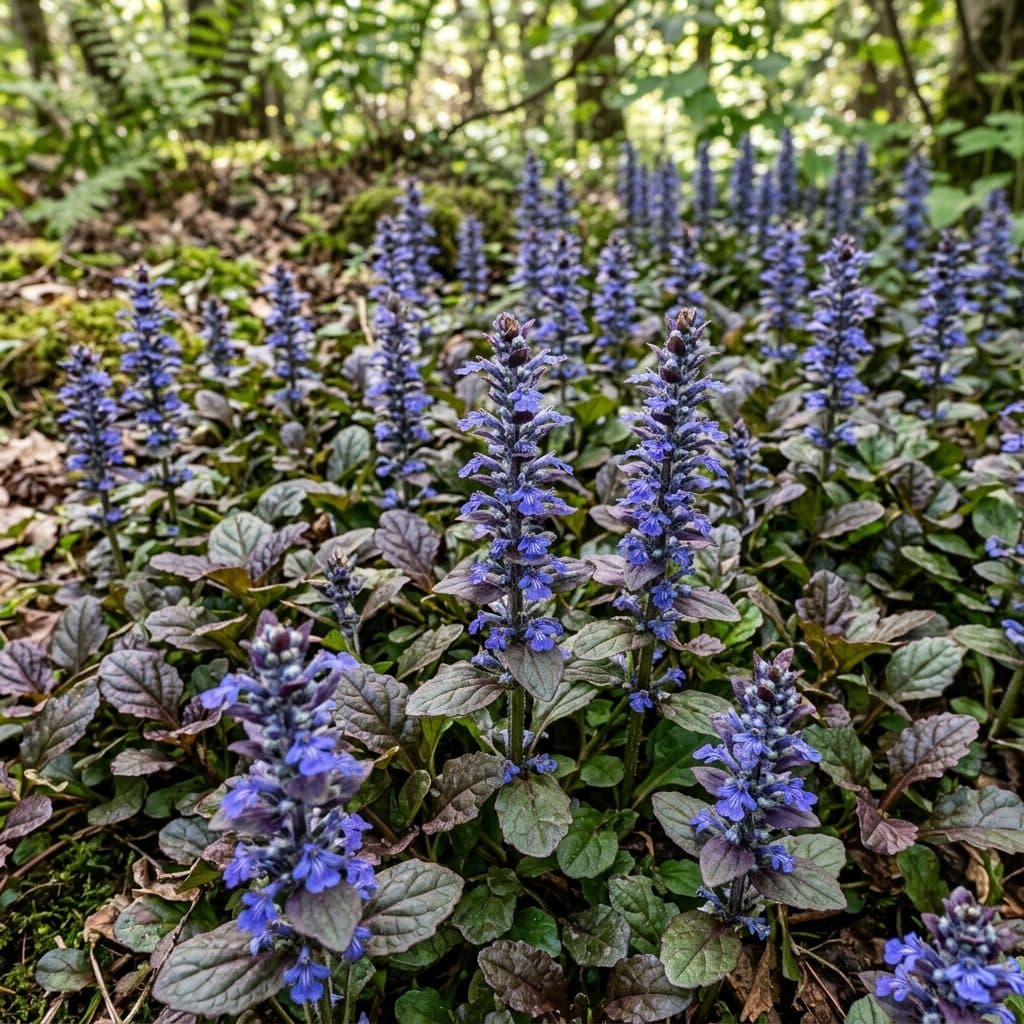
Ajuga (Ajuga reptans), commonly known as bugleweed or carpet bugle, is a vigorous, prostrate, semi-evergreen perennial groundcover in the mint family (Lamiaceae). Native to damp meadows, woodland edges, and hedgerows across Europe, western Asia, and northwestern Africa, this hardy plant has been grown in temperate gardens for centuries. It forms dense rosettes of colorful foliage that creep along the soil, sending up erect spikes of two-lipped, vivid blue-violet flowers in mid-spring.
In an agroforestry orchard or permaculture homestead, ajuga fills the challenging niche of a shade-tolerant, living mulch groundcover. Beneath deciduous fruit trees or shrubs where turfgrass thins and weeds flourish, ajuga weaves a thick vegetative blanket. While sun-demanding groundcovers like the strawberry require open light, ajuga thrives in dappled understory shade. Its shallow root network stabilizes moist topsoil and suppresses weed seeds without competing with tree root systems.
Cultivated selections offer leaves in shades of metallic bronze, chocolate-purple, and variegated pink and cream. In mid-spring, the foliage carpet is covered by thousands of miniature flower spikes that provide early forage for bumblebees and beneficial insects.
Growing ajuga
Ajuga withstands winter lows down to -35 °C (-31 °F), making it hardy across USDA Hardiness Zones 3 through 9. Its semi-evergreen rosettes persist through winter in mild zones, while in northern climates, foliage overwinters under snow cover and resumes growth promptly in spring.
The plant prefers moist, fertile, humus-rich, well-drained loams, but adapts to heavier clay and alkaline soils with a pH between 6.0 and 7.5. Good drainage is vital; saturated waterlogged soil during hot weather fosters fungal crown rot. Keep fertility moderate: excess nitrogen stimulates soft growth prone to disease.
Partial shade to dappled woodland light is ideal. Ajuga grows well beneath deciduous canopies or along eastern foundations where it receives morning sun and afternoon shade. In full sun, soil must stay moist to prevent leaf scorch; in deep shade, foliage colors may turn greener and flowering diminishes.
Provide regular moisture, especially during establishment. While established mats tolerate brief dry spells, prolonged drought causes wilting and thinning. Apply water at ground level to avoid wetting foliage.
Propagate through runner division. The mother rosettes produce leafy above-ground runners (stolons) that root at nodes. In spring or early autumn, sever rooted plantlets and transplant them directly. Divisions establish within two weeks.
Space plugs or divisions 25 to 30 cm (10 to 12 in) apart. Plants reach 10 to 15 cm (4 to 6 in) tall (spikes to 25 cm [10 in]) and spread 30 to 45 cm (12 to 18 in) per year, knitting into a dense carpet within a single season.
After spring bloom finishes, trim off spent flower spikes with hand shears or a mower on a high setting to tidy the carpet. Divide crowded patches every three to four years to maintain airflow.
Harvest and uses
Because ajuga is primarily cultivated as an ecological living mulch, erosion-control cover, and pollinator-support plant, harvesting focuses on gathering vegetative divisions for garden expansion and clipping spring herbal material.
The dense stoloniferous carpet provides weed suppression beneath homestead fruit trees and alongside shaded pathways. The thick layer of overlapping leaves excludes light from the soil surface, preventing annual weed seeds from sprouting. On sloping banks and drainage swales, the shallow fibrous root weave binds loose topsoil against rain erosion without requiring repeated applications of wood mulch.
In European herbal folklore, ajuga was known as "carpenter's herb" or "middle consound", valued for its traditional topical astringent properties. Herbalists historically harvested the flowering aerial parts in late spring, drying the material for infusions and poultices applied to minor cuts, bruises, and surface abrasions. The plant contains tannins, flavonoids, and iridoid glycosides responsible for these historical uses.
Ecologically, ajuga provides early-season nectar and pollen. The two-lipped blossoms emerge in May when fruit trees such as apples and cherries are beginning to bloom, drawing foraging honeybees and native solitary bees into the orchard understory.
Gardeners can select from numerous cultivars tailored to specific garden aesthetics. 'Chocolate Chip' offers miniature, narrow leaves of rich bronze-chocolate color; 'Burgundy Glow' displays tri-colored foliage variegated with pink, creamy white, and green; 'Black Scallop' produces glossy, crinkled, near-black foliage; and 'Catlin's Giant' yields bronze-green rosettes with flower spikes up to 25 cm (10 in) tall.
Identifying ajuga
Ajuga is identified by its prostrate stoloniferous habit, square stems, and upright spikes of bilabiate flowers:
- Habit: Low, mat-forming, semi-evergreen perennial herb growing 10 to 15 cm (4 to 6 in) high, spreading by leafy above-ground runners (stolons) that root at nodes.
- Stems: Erect flowering stems are distinctively four-angled (square in cross-section), softly pubescent along two opposite sides, typical of the Lamiaceae family.
- Foliage: Basal leaves are arranged in dense rosettes, obovate to oblong-spathulate, 5 to 10 cm (2 to 4 in) long and 2 to 4 cm (0.8 to 1.6 in) wide, with sinuate to shallowly scalloped (crenate) margins. Foliage is glossy and glabrous or sparsely hairy, varying in color from rich green to dark bronze, purplish-brown, or variegated depending on cultivar. Stem leaves are smaller, sessile, and opposite.
- Flowers: Produced in dense, terminal, whorled cylindrical spikes (verticillasters) 10 to 25 cm (4 to 10 in) tall in May and June. Individual blossoms are two-lipped (bilabiate), 1 to 1.5 cm (0.4 to 0.6 in) long, with a short, notched upper lip and a prominent, spreading three-lobed lower lip. Flower color is primarily vivid violet-blue, though pink and white forms exist.
- Fruit: Four small, reticulate-veined, one-seeded nutlets enclosed within the persistent calyx.
Ajuga is distinguished from ground ivy (Glechoma hederacea, creeping charlie) by its flat basal rosettes, glossy obovate leaves, and erect, compact flower spikes, whereas ground ivy features trailing stems with rounded, kidney-shaped leaves and small axillary flowers. It differs from self-heal (Prunella vulgaris) by its stoloniferous carpet growth and absence of compact cylindrical floral heads with prominent bracts.
Cautions
Growers should consider the following management, ecological, and horticultural cautions:
- Aggressive stolon spread and lawn encroachment: The leafy stolons creep outward rapidly. In moist, loose soils, runners will invade adjacent turfgrass lawns, perennial borders, and gravel paths. Once intertwined in lawn sod, ajuga is difficult to remove without hand-digging. Install physical edging barriers 10 to 15 cm (4 to 6 in) deep around borders and trim edge runners annually.
- Invasive potential in native woodlands: In parts of eastern and central North America, escaped Ajuga reptans has naturalized along moist woodland trails, stream banks, and floodplains, where dense monocultures displace native spring ephemeral wildflowers. The plant is regulated in some jurisdictions; check your local list before planting.
- Crown rot (Sclerotium rolfsii / Southern blight): In hot, humid conditions and heavy, waterlogged soils with poor air circulation, crown rot fungus attacks root crowns, causing sudden wilting and sunken, dead circular patches in the mat. Avoid overhead watering, improve soil drainage, and thin overgrown beds to prevent disease development.
- Internal medicinal safety: While historically used as a traditional folk herb, ajuga contains bioactive iridoid glycosides and diterpenoids. Internal medicinal use is not recommended without qualified professional medical guidance, and it must not be ingested during pregnancy or lactation.
Sources
- Royal Botanic Gardens, Kew. Ajuga reptans L. Plants of the World Online.
- NC State Extension Plant Toolbox. Ajuga reptans
- Plants For A Future. Ajuga reptans - L.
- Missouri Botanical Garden. Ajuga reptans
- USDA PLANTS Database. Ajuga reptans L.