Key takeaways
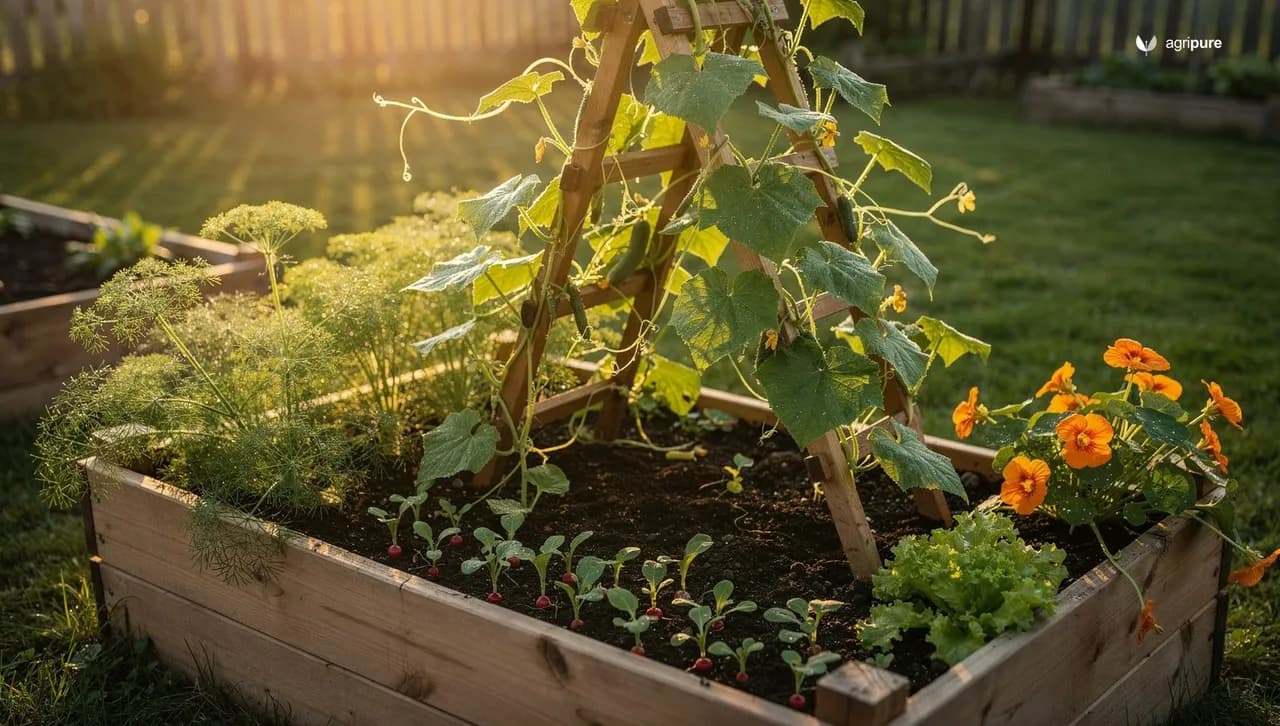
A close-up, ground-level photograph of a healthy cucumber plant trellised upwards, its long vines bearing small cucumbers. At the base, leafy green radishes and compact bush beans grow, with purple borage flowers and feathery dill peeking out between the cucumber foliage, all bathed in soft sunlight.
Companion planting for cucumbers uses vertical space efficiently: climbing vines pair with low-growing partners like radishes and bush beans, while flowers like borage and dill help pollination and pest control.
- Cucumbers grow up a trellis, so the best companions are low: radishes, low greens, and bush beans at the base, with flowers tucked between vines.
- Dill, borage, and other flowers pull in ladybugs, lacewings, parasitic wasps, and pollinators that lift fruit set on a monoecious crop whose separate male and female flowers need an insect to move pollen.
- Cucumber beetles spread bacterial wilt; the home threshold is 2 beetles per plant on 25% of seedlings, so a trap crop and row cover matter more than any repellent.
- Skip potatoes, sage, and other cucurbits nearby — they compete for light or share pests rather than help.
- Most “repels pests” companion charts are not backed by research; treat scent-based claims as folklore and lean on trap crops, flowers, and legumes that have a real mechanism.
A cucumber plant spends the season climbing. Give it a trellis and it pulls 6 feet of vine off the soil, which frees the ground at its feet for shorter partners that earn their place. The trick with companion plants for cucumbers is to think in two layers: what grows up the trellis with the vine, and what fills the 12 to 18 inches of open soil underneath.
Plenty of companion-planting charts promise that one herb will repel a beetle and another will double your yield. Most of those scent-based claims fall apart under testing. The 4 pairings that actually pull their weight do something measurable — draw a pest away, feed a predator, fix nitrogen, or bring in the bees a cucumber flower needs.
How companion planting actually earns its keep
These mechanisms are worth separating from the folklore before you pick a single partner. University of Minnesota Extension is direct that long online lists of pest-repelling plants “are not always accurate or backed by research,” and University of Illinois Extension adds that little garden-scale research exists, with many recommendations resting on anecdotal evidence. So this guide leans on the 3 effects that hold up.
- Trap cropping plants a sacrificial decoy 1 to 2 weeks early so pests prefer it, drawing them off the cucumber — a documented tactic, not a smell trick.
- Beneficial-insect support uses flowers and umbel herbs to feed the predators and parasitic wasps that eat aphids and other soft pests.
- Nitrogen fixing from legumes adds fertility; Minnesota Extension notes legumes “fix nitrogen from the atmosphere and reduce your total fertilizer needs.”
Pollination is the quiet payoff
Cucumbers carry separate male and female flowers and need an insect to move pollen between them, so a poorly pollinated plant sets nubby, curled fruit. Devoting roughly 10% of the bed to flowering partners keeps a steady supply of bees and hoverflies working the vine through the 8 to 10 weeks it fruits.
Mechanism over scent: if a companion claim can’t name how it works — a decoy, a food source for predators, nitrogen — treat it as folklore and don’t crowd the bed for it.
Trellis-side companions that climb or stay low
With the vine sent vertical, the open ground at the base is the real estate to plant. Radishes are the classic understory: they germinate in 4 to 7 days, mark the cucumber row, and pull up before the vines sprawl. A few radishes left to bolt also flower and feed beneficial insects. Low greens — leaf lettuce, spinach, arugula — use the cool shade the trellis throws and finish before midsummer heat. You can read the full radish growing profile for spacing and timing.
Beans and peas are the other strong partner, because they fix nitrogen through a symbiosis with Rhizobium bacteria, as Clemson Cooperative Extension describes. Bush beans sit low without competing for the trellis, while a spring pea can share an early trellis and finish as the cucumber takes over. Keep these understory partners 12 inches off the main stem so the cucumber’s shallow roots aren’t crowded.
- Radishes: sow at the cucumber row’s edge; harvest in 3 to 4 weeks before the canopy closes.
- Bush beans: a low nitrogen-fixer that won’t climb the cucumber’s trellis.
- Low greens: lettuce and spinach use trellis shade and vacate by midsummer.
Cucumber vines trained up a vertical string trellis with radish seedlings and lettuce growing in the open soil at the base of the bed.
Flowers and herbs that bring in the good bugs
These flowering partners are the most reliable companions of all, because they feed beneficial insects. Penn State Extension is specific: planting cilantro, dill, or fennel encourages 5 named aphid-eating beneficials, “including lacewings, ladybugs, parasitic wasps, spiders, and syrphid flies.” Dill’s flat umbel flowers are an easy nectar source, and the plant doubles as a host for black swallowtail caterpillars.
Borage is the other workhorse. Clemson lists it among flowers that draw ladybugs, lacewings, and parasitic wasps, and its blue blooms are a magnet for bees that then service the cucumber flowers a few inches away. Penn State notes borage is the larval host of the painted lady butterfly, so it earns its 18-inch footprint twice over. Let a few flowering partners run continuously so nectar is available across the whole fruiting window.
A planting share that works
Aim for about 10% of the bed in flowers and umbel herbs, clustered at the trellis ends where they won’t shade the crop. A 4-by-8-foot bed has room for 3 to 4 borage or dill plants plus a short row of nasturtium without stealing space from the cucumbers themselves.
Let some herbs flower: dill and cilantro only feed predators once they bolt and open umbels, so resist cutting every plant for the kitchen — leave 2 or 3 to bloom.
Flowering dill umbels and bright nasturtium blooms growing at the edge of a vegetable bed with a hoverfly visiting the dill in warm sunlight.
Cucumber beetles: where trap crops beat repellents
Those nasturtium flowers point at the pest that decides a cucumber season: the striped cucumber beetle. University of Minnesota Extension warns that these beetles “can carry the bacteria that causes bacterial wilt,” which kills cucumbers and melons outright, and that feeding does the most damage when plants are at the small, third-true-leaf stage. The home treatment threshold is low: 2 or more beetles per plant on 25% of seedlings at the cotyledon stage.
This is where a decoy beats a smell. Nasturtium is widely planted as a cucumber companion, and Minnesota Extension credits it with helping reduce squash bug populations; arugula and mustard work as 2 true trap crops that pests hit first. The strongest beetle defense, though, is mechanical: a floating row cover over young plants until they flower keeps beetles off the vulnerable seedling for its first 3 to 4 weeks.
- Trap crop: plant a decoy like blue Hubbard squash 1 to 2 weeks ahead of the main crop to pull beetles off the cucumbers.
- Row cover: cover seedlings through the third-leaf stage, then remove at flowering so bees can reach the blooms.
- Nasturtium and radish: low, flowering understory that supports the strategy without crowding the trellis.
What to keep away from cucumbers
Those defenses protect the cucumber from pests, but a few neighbors still cost more than they give. Strongly aromatic herbs such as sage are commonly cautioned against near cucumbers, and the safest read of the evidence is that some herb-and-vegetable pairings genuinely interfere — Clemson notes, for instance, that “dill can stunt the growth of carrots.” Beyond scent, the real conflicts are competition for light and water and shared pests, which are easy to plan around once you know which 3 groups to separate.
Companion | Role | Mechanism | Verdict |
|---|---|---|---|
Radishes | Understory | Fast catch crop, flowers feed beneficials | Plant |
Bush beans / peas | Soil | Fix nitrogen via Rhizobium | Plant |
Dill / borage | Flowers | Feed predators, draw pollinators | Plant |
Nasturtium | Understory flower | Reduces squash bugs (per research), feeds pollinators | Plant |
Potatoes | Root crop | Competes for water and space | Keep apart |
Sage | Aromatic herb | Reputed growth conflict | Keep apart |
Other cucurbits | Squash, melon | Share beetles and wilt | Separate |
Across all 7 rows, the partners worth planting share a clear mechanism, while the 3 to avoid either compete for the same resources or pass along the same pests. When in doubt, give a doubtful companion its own bed 3 feet away rather than risk the cucumber’s 8-week run.
Planning the vertical bed
That whole companion bed layout follows from the trellis. Set a 5 to 6 foot A-frame or string trellis on the north side of the bed so the climbing cucumbers don’t shade everything else, then read the bed in bands. Mapping it on paper for 10 minutes before sowing saves a season of crowded guesswork, and a raised bed makes the vertical structure easier to anchor.
- Trellis line: cucumbers every 12 inches along the support, trained up as they grow.
- Base band: radishes and low greens in the 12 inches of open soil at the foot of the vines.
- Soil band: a short row of bush beans set back 12 inches to feed nitrogen without crowding.
- Flower ends: dill, borage, and nasturtium clustered at the trellis ends, about 10% of the bed.
Underneath it all, healthy ground does the quiet work. For variety details on the crop itself, the cucumber profile covers spacing and harvest timing. Building good living soil and topping the bed with a 2 to 3 inch layer of mulch holds the even moisture cucumbers need, since the whole bed of companions only works on soil that drains and feeds evenly.
North-side the trellis: a 6-foot vertical structure on the south edge of a bed shades its neighbors all day. Put it on the north or east side so the understory companions still get 6-plus hours of sun.
Conclusion
That same soil and bed reward a layered plan: companion planting for cucumbers is less about scent and more about layers and mechanisms. Send the vine up a north-side trellis, fill the 12 inches of open soil with radishes, low greens, and nitrogen-fixing beans, and cluster dill, borage, and nasturtium across about 10% of the bed for the predators and pollinators. Keep potatoes, sage, and other cucurbits out of the bed, cover seedlings against the 2-beetle wilt threshold, and the vertical cucumber bed runs itself for the full 8 to 10 weeks of fruiting.
Frequently asked questions
What should not be planted near cucumbers?
Keep these 3 groups out of the bed: potatoes, other cucurbits like squash and melon, and strongly aromatic herbs such as sage. Potatoes compete for water and space, fellow cucurbits share cucumber beetles and bacterial wilt, and sage is widely cautioned against for a reputed growth conflict.
Do radishes and nasturtium really stop cucumber beetles?
Not by repelling them. They work as low, flowering understory that supports a trap-crop strategy, and Minnesota Extension credits nasturtium with reducing squash bug numbers. The 2 real beetle defenses are a sacrificial trap crop and a row cover over seedlings until flowering.
What flowers help cucumber pollination?
Dill, borage, and nasturtium draw bees and hoverflies that move pollen between a cucumber’s separate male and female flowers. Dedicating about 10% of the bed to these flowering partners keeps pollinators working the vine through its 8 to 10 weeks of fruiting.
Can I plant beans and cucumbers together?
Yes. Bush beans and peas fix nitrogen through Rhizobium bacteria and sit low without competing for the cucumber’s trellis. Keep them about 12 inches off the main stem so the cucumber’s shallow roots are not crowded.
What is the best layout for a vertical cucumber bed?
Put a 5 to 6 foot trellis on the north side, plant cucumbers every 12 inches along it, fill the base with radishes and low greens, set bush beans back 12 inches, and cluster flowers at the ends. That keeps tall vines from shading the shorter companions.
References
- University of Minnesota Extension — Cucumber beetles
- University of Minnesota Extension — Companion planting in home gardens
- Penn State Extension — Herbs Make Good Plant Partners and Companions
- Penn State Extension — Culinary Herbs are Good for Beneficial Insects, Including Pollinators
- Clemson Cooperative Extension — Plant Partners: 5 Benefits of Companion Planting
- University of Illinois Extension — Companion planting: Combining plants for a healthy, well-balanced garden