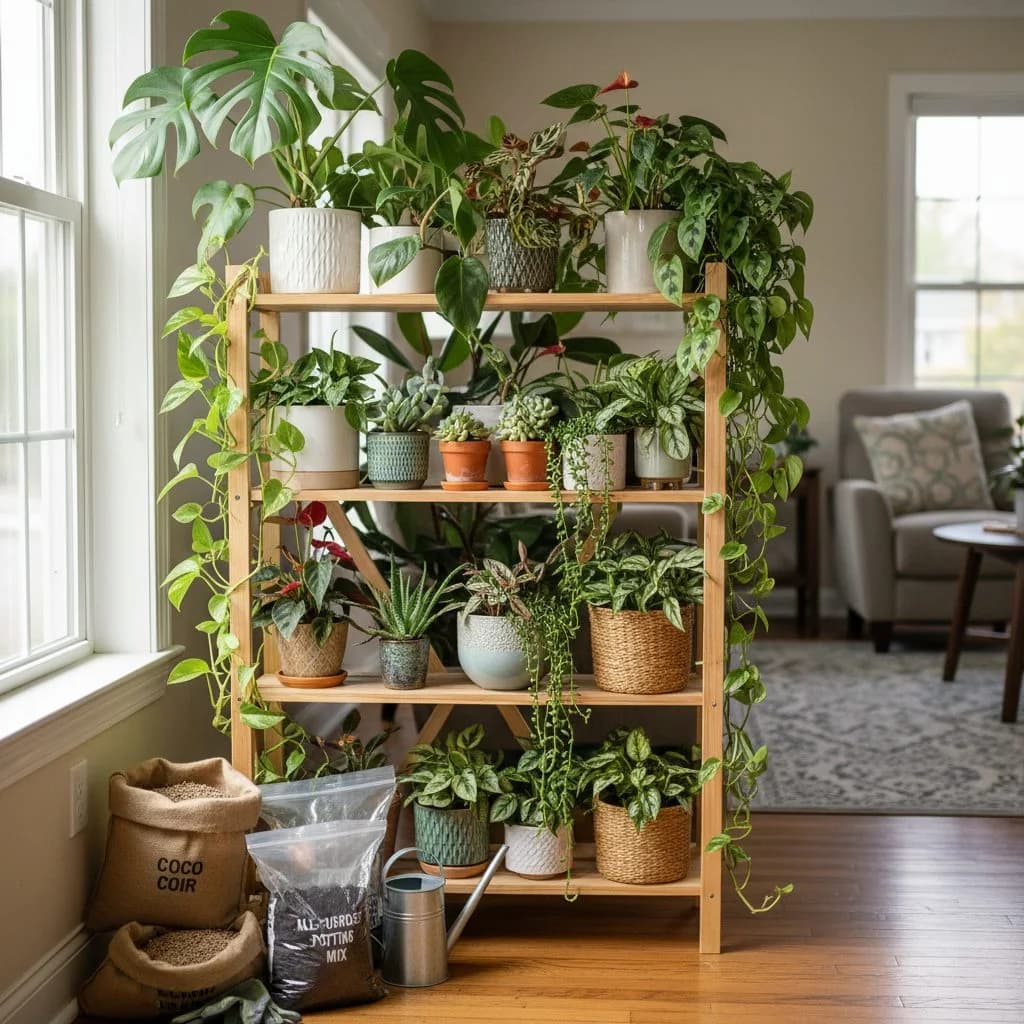
Key takeaways
- Custom potting mixes can save up to 30% compared to commercial blends for specific plant needs.
- Aroids thrive in airy, well-draining mixes with components like orchid bark and perlite, often in a 2:1:1 ratio.
- Succulents require gritty, fast-draining media, typically using pumice or perlite with minimal organic matter.
- Tropical plants need a balance of moisture retention and drainage, often achieved with coco coir, perlite, and compost.
- Sterilizing components like compost at 180°F for 30 minutes can prevent pathogen introduction.
- Proper storage of bulk ingredients in sealed containers maintains quality and prevents contamination for up to 12 months.
Quick answer: Crafting custom potting mixes allows indoor growers to save up to 30% compared to commercial blends while providing tailored growing conditions for specific plants like aroids, succulents, and tropicals. This approach improves plant health, growth rates, and extends repotting cycles.
In many US homes, particularly across USDA zones 4 through 10, houseplants are a significant part of indoor decor and personal well-being. However, selecting the right potting mix for diverse plants like aroids, succulents, and tropicals can be a challenge, and pre-made specialty blends often carry a premium price tag, sometimes significantly higher than bulk components. This article explores how crafting your own custom potting mixes can provide superior growing conditions tailored to each plant’s specific requirements, all while offering substantial cost savings over time.
Understanding the fundamental needs of your indoor plants (whether they prefer a chunky, airy substrate or a fast-draining, gritty one) is the first step toward successful cultivation. By sourcing individual components in larger quantities, such as a 50-pound bag of perlite or a 2-cubic-foot block of coco coir, growers can significantly reduce their annual expenditure on potting media. For example, a typical 8-quart bag of commercial aroid mix might cost $15, while the raw materials to make an equivalent volume can be purchased for under $10, leading to significant savings.
The foundation: understanding your plant’s needs
Before mixing components, identify the native environment of your houseplants. Aroids, such as Monstera deliciosa or Philodendron hederaceum, originate from tropical rainforests and require a substrate that mimics the loose, well-aerated conditions found in their natural habitat. This means a mix with excellent drainage to prevent root rot, yet enough organic matter to retain some moisture and nutrients. In contrast, succulents like Echeveria or Sedum, often from arid regions like the American Southwest (USDA zone 8-10), demand extremely fast-draining, gritty soil to prevent waterlogging, which is their primary killer.
Tailoring mixes for specific plant types
Tropical houseplants, from ferns to Ficus, need a balanced mix that holds steady moisture while letting air reach the roots. Using one bagged potting soil for every indoor plant often leads to stunted growth or root rot when moisture retention misses the mark. A dense, peat-heavy mix that suits a peace lily (Spathiphyllum) will quickly suffocate a desert cactus. Customizing each blend helps plants grow faster than in generic mixes and keeps roots healthy longer between repots.
- Aroids: Require excellent aeration and drainage.
- Succulents: Need fast-draining, gritty media.
- Tropicals: Prefer consistent moisture with good air circulation.
- Bonsai: Demand specialized mixes for root health and stability.
Essential components for custom blends
Building your own potting mix starts with understanding the roles of various components. Organic materials like coco coir and pine bark fines provide structure, retain moisture, and offer some nutrient exchange capacity. Coco coir, derived from coconut husks, is a sustainable alternative to peat moss, offering good water retention and aeration, often holding a significant amount of water. Pine bark, especially orchid bark, provides excellent drainage and air pockets needed by aroids and epiphytic plants. A 2-cubic-foot bag of coco coir can yield enough material for dozens of small plants, costing around $20-$30, a significant saving over pre-mixed bags.
Choosing inorganic amendments
Inorganic amendments provide drainage and aeration. Perlite, a volcanic glass, is lightweight and creates air pockets, improving drainage and preventing compaction. Pumice, another volcanic rock, offers similar benefits but is heavier and less prone to floating, making it ideal for succulent mixes. Coarse sand, not play sand, can also be used for succulents, but sparingly, as too much can impede drainage. Vermiculite, a hydrated mineral, excels at retaining both water and nutrients, making it suitable for tropical mixes that need consistent moisture. Using these components allows for precise control; for example, a mix with 30% perlite will drain considerably faster than one with 10% perlite, which prevents prolonged saturation around roots. You can find large bags of perlite, often 4 cubic feet, for about $30 at garden supply stores, providing ample material for numerous batches of custom soil. For those looking to optimize their indoor growing environment, consider integrating these mixes with a reflective indoor grow tent to maintain consistent temperature and humidity.
- Coco coir: Excellent water retention and aeration.
- Pine bark fines/orchid bark: Provides drainage and structure.
- Perlite: Lightweight, improves drainage and aeration.
- Pumice: Heavier, stable, excellent for drainage.
- Vermiculite: Retains water and nutrients, good for tropicals.
Crafting specific mixes: aroids, succulents, and tropicals
For aroids, a common and effective mix can be achieved with a ratio of two parts orchid bark, one part coco coir, and one part perlite. This blend ensures excellent drainage and aeration, mimicking their epiphytic or semi-epiphytic nature. Many growers in Florida (USDA zone 10) find this mix ideal for their outdoor aroids as well. Adding a small amount, perhaps 5% to 10% by volume, of worm castings can provide a slow-release nutrient boost, which is particularly beneficial for actively growing plants during the spring and summer months. This mix typically dries out in three to five days, depending on environmental conditions.
Succulent and tropical mix recipes
Succulents require a significantly grittier mix. A good starting point is a 1:1:1 ratio of pumice (or perlite), coarse sand, and a high-quality compost or coco coir. Some growers prefer an even higher inorganic content, such as two parts pumice to one part coco coir, especially for desert cacti that need near-instant drainage. This type of mix can dry completely within one to two days, preventing the root rot that plagues many succulent enthusiasts. For tropical plants, a balanced approach is best: two parts coco coir, one part perlite, and one part high-quality compost. This mix offers good moisture retention while still providing adequate drainage and aeration. For example, a 5-gallon batch of this tropical mix would require approximately 2.5 gallons of coco coir, 1.25 gallons of perlite, and 1.25 gallons of compost, costing roughly $8 to $12 in raw materials. This is a substantial saving compared to a 5-gallon bag of commercial tropical mix, which can retail for $25 or more. For those interested in advanced growing techniques, these custom mixes can also be adapted for DIY hydroponic systems, especially for semi-hydroponic setups.
- Aroid Mix: 2 parts orchid bark, 1 part coco coir, 1 part perlite.
- Succulent Mix: 1 part pumice, 1 part coarse sand, 1 part coco coir.
- Tropical Mix: 2 parts coco coir, 1 part perlite, 1 part compost.
- Optional: Add 5-10% worm castings for nutrient enrichment.
Sterilization and storage of potting mix components
When using bulk components, especially compost or garden soil, pasteurization prevents introducing pests, diseases, or weed seeds into your indoor environment. Research shows that steaming potting mixes at 180°F for 30 minutes can effectively kill most pathogens and weed seeds without significantly degrading beneficial microbial activity [3]. This process is particularly important if you are incorporating outdoor compost, which can harbor fungal spores or insect larvae. For smaller batches, you can sterilize components by baking them in an oven at 200°F for 30 minutes so the internal temperature reaches 180°F. Allow the material to cool completely before mixing or using.
Safe handling and long-term storage
Proper storage of bulk components maintains their quality and prevents contamination. Store materials like coco coir, perlite, and bark in sealed, airtight containers in a cool, dry place. This prevents moisture absorption, which can lead to mold growth, and keeps out pests like fungus gnats. For example, a 5-gallon bucket with a tight-fitting lid is ideal for storing 10-15 pounds of perlite or pumice. Compost should be stored in a breathable container, like a sturdy plastic bin with small ventilation holes, to allow for air exchange while minimizing pest access. Properly stored inorganic components can last indefinitely, while organic materials like coco coir and compost are best used within about a year to ensure optimal performance. For larger scale operations or those with many plants, considering a greenhouse kit might offer a dedicated space for mixing and storage.
- Sterilize: Heat components to 180°F for 30 minutes to kill pathogens.
- Airtight containers: Store inorganic materials to prevent moisture and pests.
- Breathable containers: Use for compost to allow air exchange.
- Cool, dry place: Ideal storage conditions for all components.
Troubleshooting common potting mix issues
Even with custom mixes, issues can arise. One common problem is overwatering, often indicated by yellowing leaves or a persistent dampness in the soil. This usually means your mix is retaining too much moisture, or your plant’s watering schedule is too frequent. For aroids, if the top 2 inches of soil remain wet for more than five days, consider adding more perlite or orchid bark to increase drainage. For succulents, if the mix stays damp for more than two days after watering, it’s a sign that the inorganic content needs to be increased, perhaps by adding another 20% pumice or coarse sand. Adjusting the mix can significantly improve drainage.
Addressing compaction and nutrient deficiencies
Compaction is another issue, especially in older mixes or those with too much fine-grained material. Over time, organic components break down, and fine particles settle, reducing aeration. This can lead to root suffocation and stunted growth, sometimes reducing plant vigor. To combat this, ensure your initial mix includes plenty of chunky components like bark or larger perlite particles. If a mix becomes compacted, repotting with a fresher, chunkier blend is often the best solution. Nutrient deficiencies can manifest as pale leaves or slow growth. While custom mixes provide a good base, they are not inherently rich in nutrients unless compost or worm castings are included. Supplementing with a balanced liquid fertilizer at half strength every two to four weeks during the growing season, particularly for tropical plants, can address this. For example, a 5-1-1 NPK fertilizer is often recommended for foliage plants. Regular observation of your plants, perhaps once every three days, will help you catch these issues early and make timely adjustments.
- Overwatering: Indicated by yellowing leaves, persistent dampness.
- Compaction: Leads to stunted growth, reduced aeration.
- Nutrient deficiency: Pale leaves, slow growth.
- Pests: Fungus gnats often indicate overly moist conditions.
Benefits of DIY mixes: cost, control, and customization
The most immediate and tangible benefit of creating your own potting mixes is cost savings. Purchasing components in bulk, such as a 3-cubic-foot bag of perlite for $25 or a 50-pound bag of pumice for $40, is significantly more economical than buying small bags of specialized pre-mixed soils. Over a year, for a grower with 10-20 houseplants, this can translate to significant savings on potting media costs. This financial advantage becomes even more pronounced for those maintaining larger collections or propagating plants frequently,
Unparalleled control and customization
Beyond cost, DIY mixes offer unparalleled control over the ingredients. You know exactly what goes into your plants’ homes, avoiding fillers, unknown slow-release fertilizers, or potentially harmful additives found in some commercial products. This control helps organic growers and those with sensitive plants. Furthermore, the ability to customize each mix to the precise needs of individual plant species means healthier, more vigorous growth. A Philodendron ‘Pink Princess’ will thrive in a mix specifically designed for aroids, showing faster growth and better variegation, compared to a generic houseplant mix. This level of tailoring can reduce plant stress and significantly decrease the incidence of common issues like root rot or nutrient lockout. By taking control of your potting media, you are providing your plants with the best possible start, leading to a more rewarding and successful indoor gardening experience, especially for growers who track plant progress over multiple seasons.
- Cost savings: Up to 50% compared to commercial mixes.
- Ingredient control: Know exactly what your plants are growing in.
- Customization: Tailor mixes for specific plant needs.
- Healthier plants: Reduced stress and better growth.
Potting mix component comparison
Component | Primary Function | Typical Cost (per cubic foot) | Best For |
|---|---|---|---|
Coco Coir | Moisture retention, aeration | $10 – $15 | Aroids, Tropicals |
Orchid Bark | Drainage, aeration, structure | $15 – $25 | Aroids, Epiphytes |
Perlite | Aeration, drainage, lightweight | $8 – $12 | All types, especially Aroids, Tropicals |
Pumice | Drainage, aeration, weight | $12 – $18 | Succulents, Cacti |
Worm Castings | Nutrient enrichment, soil health | $20 – $30 | All types (as amendment) |
Coarse Sand | Drainage, grit | $5 – $10 | Succulents, Cacti (sparingly) |
Cost Savings: DIY potting mixes can significantly reduce annual material costs for the average indoor grower.
Sterilization Temp: Steaming potting mixes at 180°F for 30 minutes effectively eliminates most pathogens and weed seeds [3].
References
- Testing Potting Mixes (2008).
- Testing potting mixes (2008).
- Effects of steaming on plant growth and microbial survival and physiological activity in potting mixes. (2024).
- Uses of Compost in Potting Mixes (2005).
- Effect of Root Trainer Size and Potting Mixes on Growth and Survival of Seedlings of Dalbergia Latifolia (2024).
- USDA Natural Resources Conservation Service (2024).