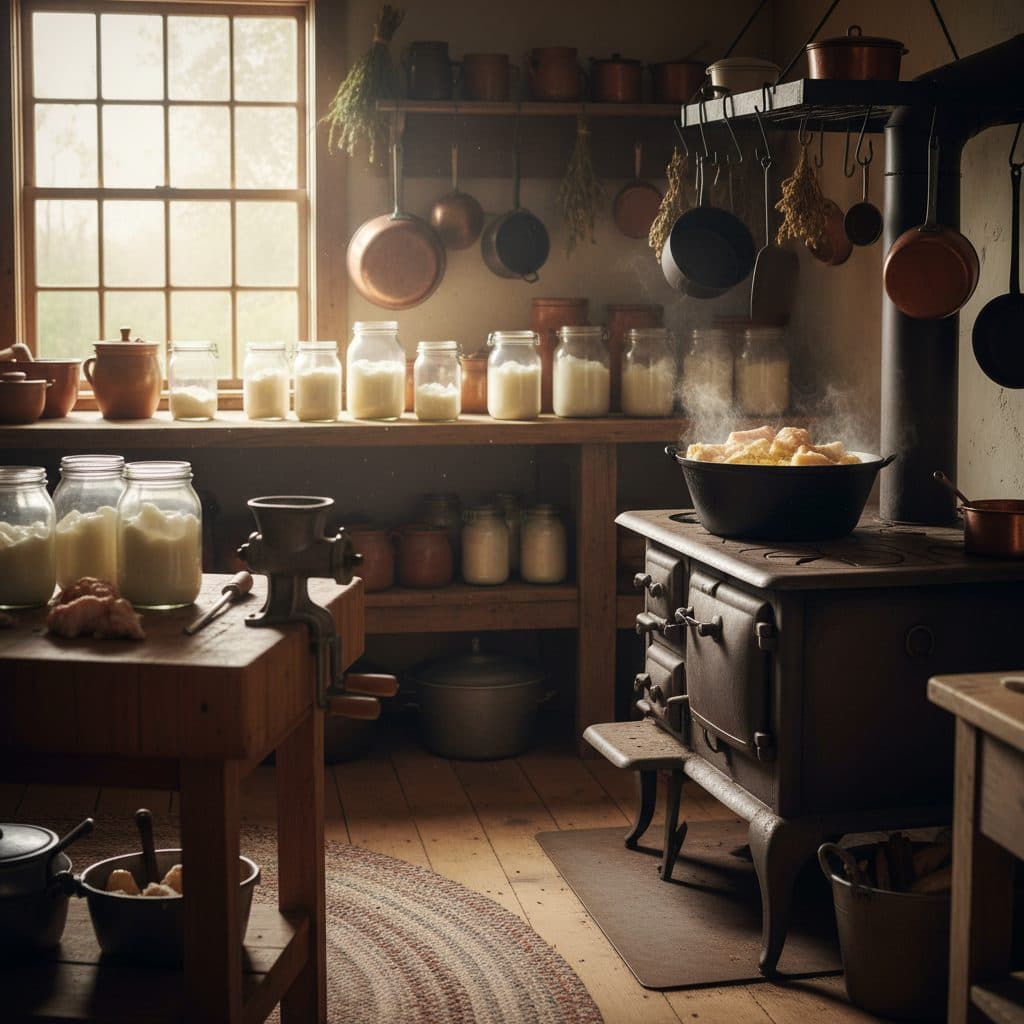
Key takeaways
- Rendering animal fats like tallow and lard transforms raw fat into a stable, versatile ingredient for home products.
- Both wet and dry rendering methods exist, with dry rendering being simpler and wet rendering offering a purer, whiter product.
- Proper preparation, including cleaning and cutting raw fat into 1-inch cubes, ensures efficient rendering.
- Filtering through cheesecloth or fine mesh removes impurities, while a water wash can further purify the rendered fat.
- Store rendered fats in airtight containers in a cool, dark place below 60 °F for up to 12 months.
- Rendered tallow and lard are foundational ingredients for crafting homemade soaps, long-burning candles, and nourishing skincare products.
Quick answer: Rendering tallow and lard involves heating raw animal fat to separate impurities and water, transforming it into a stable, versatile ingredient for homemade soaps, candles, and skincare products. This process requires cleaning, cutting, and filtering the fat, then storing it properly.
Across the United States, from California to Georgia, home growers and homesteaders are returning to traditional practices that support self-sufficiency. One such practice, rendering animal fats like tallow and lard, gives a sustainable way to create useful household products. This process, which involves heating raw fat to separate impurities and water, has been a cornerstone of domestic life for centuries, providing essential materials for everything from cooking to personal care. Historically, instructions for making soap and candles from lard and tallow date back to at least 1856, demonstrating their long-standing utility [2].
For those in USDA zone 6, or any region where livestock is raised or local butchers are accessible, rendering fat can significantly reduce reliance on commercial products. A batch of raw beef suet, for instance, can yield a good amount of pure tallow, which can then be used to make dozens of bars of soap or several pounds of candles. This guide covers the practical steps of rendering tallow and lard for homemade soaps, candles, and skincare formulations.
The practical value of rendered fats for home use
For generations, rendered animal fats were central to household self-sufficiency across the United States. From the early American frontier to rural communities in the Midwest today, families relied on these fats for a multitude of purposes, long before the advent of petroleum-based products. Tallow, primarily from beef or sheep, and lard, from pork, offer distinct properties that make them suitable for various applications. Tallow, for example, is known for its hardness and high melting point, typically around 110 °F to 120 °F, making it an excellent base for durable candles and firm soap bars [1]. Lard, on the other hand, often has a lower melting point, generally between 95 °F and 115 °F, producing a creamier soap and a softer candle [3].
The practical benefits extend beyond simple utility; rendering fats can offer significant cost savings. A pound of raw beef fat might cost a few dollars from a local butcher in a state like Iowa, yet it can yield enough tallow to produce several 4-ounce bars of soap, saving money compared to purchasing commercial alternatives. Beyond economics, there is a satisfaction in creating products with your own hands, knowing the exact ingredients. This process connects us to a long history of domestic craft, where materials were valued and repurposed, a tradition still strong in many homesteads across states like Vermont and Oregon. The USDA Natural Resources Conservation Service promotes practices that support healthy livestock, which in turn can influence the quality of animal fats available for rendering [6].
Historical uses and modern relevance
Historically, rendered fats were indispensable. In the 19th century, before widespread electricity, tallow candles were a primary source of light, and instructions for their creation were common in household manuals from 1853 [4]. Today, while we have electric lights, the desire for natural, handmade products persists. Many individuals seek to avoid synthetic fragrances and chemicals found in commercial items, opting instead for ingredients like tallow and lard. For example, a simple tallow soap can be made with just three ingredients: rendered tallow, lye, and water, offering a pure product for sensitive skin. This revival of traditional skills matches a broader movement towards sustainable living, where every resource, including animal byproducts, is utilized thoughtfully.
- Provides a cost-effective base for homemade products.
- gives a natural alternative to synthetic ingredients.
- Supports resourcefulness and reduces waste.
- Connects to historical domestic practices dating back centuries.
- Allows for customization of scents and textures in finished goods.
Sourcing and preparing raw animal fat
The journey to excellent homemade products begins with sourcing quality raw animal fat. For tallow, look for beef suet, which is the hard fat found around the kidneys and loins of cattle. This suet, often available from local butchers or directly from farms in states like Texas or Nebraska, yields a whiter, purer tallow than other beef fats. For lard, seek out pork leaf fat, found around the kidneys of pigs. This fat is prized for its neutral scent and superior quality, making it ideal for culinary uses and skincare alike. A pig can yield several pounds of leaf fat, while a beef carcass can offer a significant amount of suet. Always ask your butcher for unprocessed, fresh fat; avoid pre-ground or rendered fats that may contain additives or be partially oxidized.
Once you have your raw fat, preparation is key to a successful rendering process. First, remove any meat scraps, blood, or connective tissues. These impurities can scorch during rendering, imparting an undesirable odor and color to your finished product. A sharp knife is essential for this task. After cleaning, cut the fat into small, uniform pieces, ideally 1-inch cubes. Smaller pieces expose more surface area, which helps the fat render quickly and efficiently. For larger quantities, or to ensure even smaller pieces, you can use a meat grinder. Grinding 5 pounds of fat might take 15 to 20 minutes, depending on your equipment, and results in a very fine texture that renders exceptionally well. If you’re not rendering immediately, store the prepared fat in the refrigerator at 35 °F to 40 °F for up to a few days, or freeze it for longer storage, up to 6 months.
Tools and techniques for fat preparation
Having the right tools can make preparation much smoother. A sturdy cutting board and a sharp chef’s knife are fundamental. For those processing larger volumes, a meat grinder (either manual or electric) saves time and effort by turning chunks of fat into a fine, consistent texture. This consistency helps achieve an even render and maximize fat yield. Minimizing waste ensures full use of every resource. For example, a 10-pound batch of raw fat, properly trimmed and cut, can yield 7 to 8 pounds of pure rendered product.
- Source fresh, unprocessed fat from local butchers or farms.
- Trim away all meat scraps and connective tissue thoroughly.
- Cut fat into 1-inch cubes for even rendering.
- Consider grinding fat for faster, more efficient rendering.
- Store raw fat at 35 °F to 40 °F if not rendering immediately.
Wet rendering versus dry rendering methods
There are two primary methods for rendering animal fat: dry rendering and wet rendering. Each has its advantages, and the choice often depends on the desired purity of the fat and the equipment available. Dry rendering is the simpler method, requiring only the fat itself and a heat source. In this process, the fat is slowly heated in a heavy-bottomed pot, like a Dutch oven, over low to medium-low heat, typically between 200 °F and 250 °F. As the fat melts, the moisture evaporates, and the solid cracklings (the crispy bits of tissue) separate and sink to the bottom. This method is effective for both tallow and lard, yielding a product that is often slightly yellowish and retains a bit more of its characteristic flavor. A 5-pound batch of fat might take 2 to 3 hours to render completely using this dry method.
Wet rendering, on the other hand, involves adding water or a small amount of salt water to the fat during heating. For example, you might use 1 gallon of water for every 5 pounds of fat. The water helps to prevent scorching, draws out impurities, and results in a whiter, more neutral-smelling fat, especially desirable for skincare products or candles. The mixture is simmered gently, again around 200 °F to 220 °F, for several hours. As the fat melts, it floats to the top, while the water and impurities settle below. This method is particularly popular for lard, as it helps to remove some of the stronger pork scent. After cooling, the rendered fat solidifies into a clean, white disk on top of the water. This process might take 4 to 6 hours for a 5-pound batch, including cooling time.
Choosing the right method for your needs
When deciding between wet and dry rendering, consider your end product. For culinary uses where a slight flavor is acceptable, or for a faster process, dry rendering is often preferred. For skincare items or candles where a neutral scent and clean color are important, wet rendering produces a cleaner result. Regardless of the method, constant, low heat is critical to avoid burning the fat, which can impart a bitter taste and unpleasant smell. Using a slow cooker set to low can be an excellent option for hands-off rendering, maintaining a consistent temperature of approximately 180 °F to 200 °F over 6 to 8 hours. This gentler heat minimizes the risk of scorching and ensures a high-quality yield, often 70% to 80% of the raw fat’s weight.
- Dry rendering is simpler, uses only fat, and takes 2-3 hours for 5 pounds.
- Wet rendering uses water, yields a purer, whiter fat, and takes 4-6 hours.
- Maintain low, consistent heat (200 °F to 250 °F) to prevent scorching.
- A slow cooker can provide gentle, hands-off rendering over 6-8 hours.
- Choose method based on desired purity, color, and scent of the final product.
Purifying and storing your rendered fat
Once the fat has been rendered, purification and proper storage ensure its longevity and quality. After the initial rendering, whether wet or dry, the hot liquid fat will contain small impurities and cracklings. To remove these, carefully strain the hot fat through several layers of cheesecloth, a fine-mesh sieve, or even a coffee filter placed in a funnel. This initial straining removes the larger solids, resulting in a clearer product. For a 5-pound batch of rendered fat, this straining process might take 10 to 15 minutes as the fat slowly passes through the filter. Repeat this process if necessary until the fat appears clean and free of visible particles.
For an even purer, whiter fat, especially after dry rendering, a water wash (or re-rendering) can be performed. To do this, combine your strained rendered fat with an equal volume of water in a clean pot. Gently heat the mixture until the fat melts and emulsifies with the water. Simmer for about 30 minutes, then remove from heat and allow it to cool completely in the pot. As it cools, the fat will separate and solidify on top, while the water, now containing additional impurities, will settle below. Once solid, lift the fat disk out of the pot. You may notice a layer of brownish impurities on the bottom of the fat disk; simply scrape this off with a knife. This re-rendering process can remove a significant amount of residual odors and colors, yielding a more pristine product. This technique was even explored in 1946 for systematic crystallization of fats [5].
Optimal storage for longevity
Proper storage preserves the quality of rendered fat. Store rendered tallow and lard in airtight containers, such as glass jars with tight-fitting lids, or food-grade plastic tubs. Label each container with the date and type of fat. The ideal storage environment is a cool, dark place, such as a pantry or root cellar, where temperatures remain consistently below 60 °F. At these temperatures, well-rendered fat can last for many months, often up to 12 months, without rancidity [1]. For longer storage, refrigeration at 35 °F to 40 °F can extend its shelf life to over a year, and freezing can preserve it for several years. Always check for off-odors or discoloration before use; rancid fat will have a distinct, unpleasant smell and should be discarded. A 1-gallon jar, for instance, can hold approximately 7 pounds of rendered fat, making it a practical storage solution for larger batches.
- Strain hot fat through cheesecloth to remove initial impurities.
- Perform a water wash (re-rendering) for maximum purity and whiteness.
- Scrape off any brownish impurities from the bottom of the solidified fat disk.
- Store in airtight containers in a cool, dark place below 60 °F.
- Properly stored fat can last up to 12 months at cool temperatures [1].
Crafting home products: soap, candles, and skincare
With your beautifully rendered tallow or lard, a world of homemade products awaits. These fats are foundational ingredients for crafting items that are both practical and personal. For soap making, tallow and lard contribute to a hard, long-lasting bar with a creamy lather. A common ratio for a balanced soap involves combining rendered fat with lye (sodium hydroxide) and water. For example, a 2-pound batch of tallow soap might require approximately 8.5 ounces of lye and 20 ounces of water, adjusted by a lye calculator for a 5% superfat content to ensure a moisturizing bar. The saponification process, where fats react with lye, transforms these simple ingredients into soap, a chemical reaction that has been understood for centuries.
When it comes to candle making, rendered fats offer a traditional, natural alternative to paraffin or soy waxes. Tallow candles, known for their bright flame and slow burn, were once the standard for illumination. To make a basic tallow candle, melt the rendered fat, add a cotton wick, and pour into a heat-safe container. For improved burn quality, especially with lard, historical texts from 1853 suggest combining it with other fats or treating it to increase hardness [4]. A well-made tallow candle can provide hours of light. You can also add natural scents; for instance, a few drops of essential oil from garden sage can give your candles a pleasant, earthy aroma.
Skincare and other applications
Beyond soap and candles, rendered fats are excellent for skincare products. Their compatibility with human skin makes them highly moisturizing and nourishing. Tallow, in particular, is rich in fat-soluble vitamins A, D, E, and K, making it a potent ingredient for balms, salves, and lotions. A simple tallow balm can be made by gently melting 4 ounces of rendered tallow with 1 ounce of a liquid oil like olive oil, then allowing it to cool. This creates a rich, protective skin barrier. Lard, with its slightly softer texture, is also superb for lotions and creams. These fats provide a stable base, allowing for the addition of various botanicals or essential oils for specific benefits. For example, a salve made with 3 ounces of lard and infused calendula oil can be soothing for dry hands.
- Use rendered fats to create hard, long-lasting soap bars with creamy lather.
- Craft traditional candles that offer a bright flame and slow burn rate (e.g., 30 minutes per ounce).
- Incorporate fats into nourishing skincare products like balms and lotions.
- Experiment with natural essential oils for scent in soaps and candles.
- Ensure proper lye calculations for safe and effective soap making.
Tallow vs. lard: key properties for home products
Property | Tallow (Beef/Sheep) | Lard (Pork) |
|---|---|---|
Source | Beef or sheep fat (suet) | Pork fat (leaf fat) |
Melting Point | 110-120 °F (harder) | 95-115 °F (softer) |
Hardness | Very firm, solid | Softer, more pliable |
Scent | Mild, beefy (can be neutral with wet render) | Mild, porky (can be neutral with wet render) |
Soap Quality | Hard, long-lasting bar, creamy lather | Creamy, conditioning bar, good lather |
Candle Quality | Bright flame, slow burn, firm structure | Softer candle, good burn, can be combined for hardness |
Historical Use: Lard and tallow have been used for soap and candles for centuries, with instructions dating back to at least 1856 [2].
Optimal Storage: Well-rendered fat, stored properly, can last for many months, sometimes over a year, at cool temperatures below 60 °F [1].
References
- LARD, TALLOW, SOAP AND CANDLES (1982).
- To Make Lard and Tallow Candles (1856).
- Determination of tri-saturated glycerides in lard, hydrogenated lard, and tallow (1946).
- Candles Equal to Wax or Sperm, Made from Tallow and Lard (1853).
- Fractionation of lard and tallow by systematic crystallization (1946).
- USDA Natural Resources Conservation Service (2024).