Key takeaways
- Maintain consistent airflow at 0.5 to 1.0 feet per second to reduce fungal diseases like damping-off.
- Provide 14 to 16 hours of bright, full-spectrum light daily with lights positioned 2 to 4 inches above seedlings.
- Utilize watering-from-below methods, allowing capillary action to moisten soil evenly without wetting seedling crowns.
- Aim for soil temperatures between 68°F and 75°F for optimal germination and root development.
- Space seedlings 2 to 3 inches apart to promote air circulation and prevent overcrowding.
- Regularly check soil moisture (lift the tray to judge it by weight, or use a soil moisture meter) to avoid both overwatering and desiccation.
Quick answer: To prevent seedling failures and keep crowns dry, maintain consistent airflow (0.5-1.0 ft/s), provide 14-16 hours of full-spectrum light 2-4 inches above plants, and use bottom watering to avoid wetting crowns.
In the Mid-Atlantic region, where spring weather can shift from 70°F sunshine to 40°F cold snaps in a single day, starting seeds indoors is a common practice for many growers. Germinating and growing healthy seedlings requires careful attention to environmental controls, particularly airflow, light, and watering. Most seedling failures in indoor setups trace back to moisture management and air movement, which both need deliberate setup.
Keeping the seedling crown (the point where the stem meets the soil) dry prevents fungal infections that can quickly destroy an entire tray of young plants. By implementing specific routines for air circulation, light provision, and watering from below, growers can significantly increase their success rates. This routine produces sturdy seedlings ready for transplanting into the garden, whether you grow tomatoes in USDA zone 7 or peppers in USDA zone 5.
Managing airflow around seedlings
Good air circulation is one of the most straightforward yet overlooked aspects of seedling care, directly impacting plant health and disease prevention. Without adequate airflow, stagnant, humid conditions around young seedlings create an ideal environment for fungal pathogens, particularly those responsible for damping-off disease. Gentle, continuous air movement (roughly the speed at which you can just feel a draft on the back of your hand) keeps a boundary layer of still, humid air from forming on leaf surfaces, which fungal spores need to germinate. For example, in a 4-foot by 2-foot propagation area, a small oscillating fan set on its lowest speed can provide sufficient air movement.
Setting up effective air movement
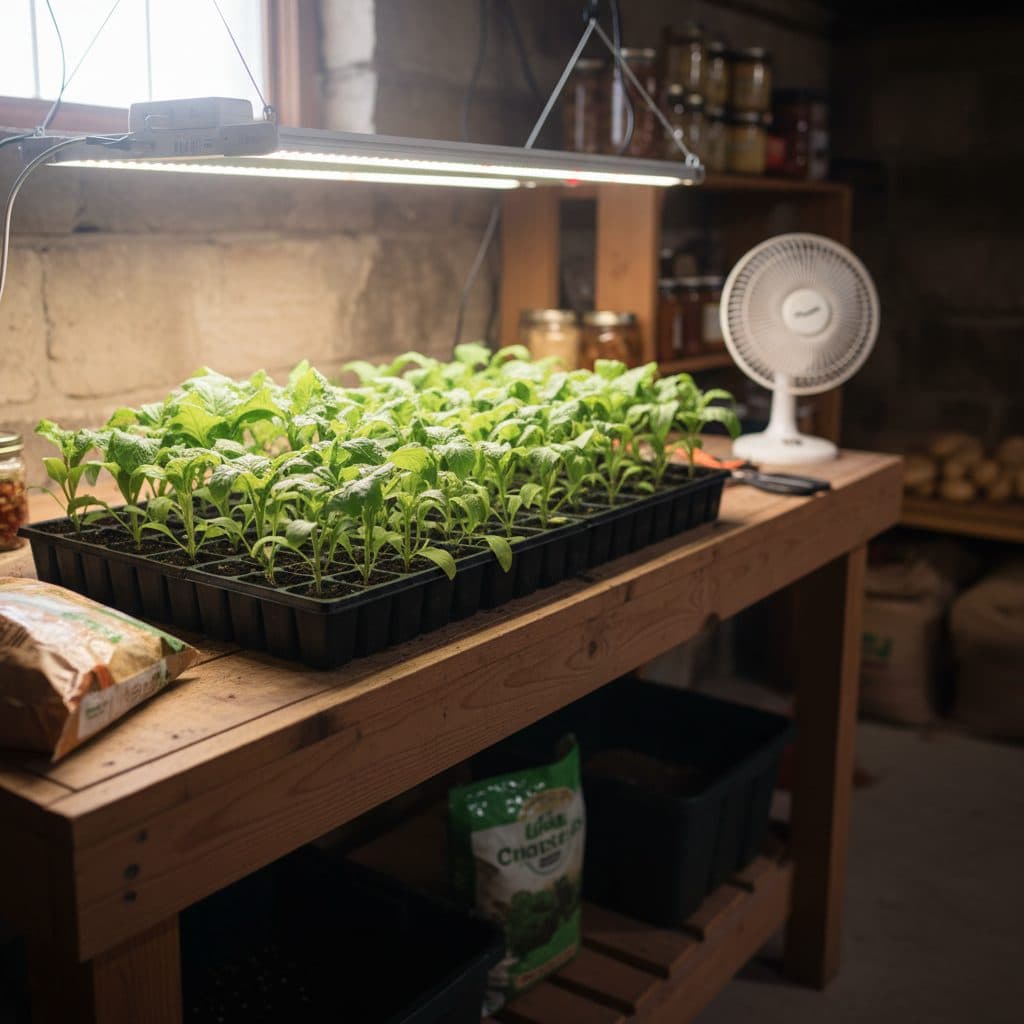
To establish proper airflow, position a small fan approximately 2 to 4 feet away from seedling trays so it gently oscillates across the plants. The goal is a light breeze, not a strong gale that could dry out the soil too quickly or physically damage delicate stems. Running the fan for 12 to 16 hours a day, synchronized with your grow lights, is often sufficient. This constant, gentle movement also helps strengthen seedling stems, encouraging them to develop thicker, more resilient tissues capable of withstanding outdoor conditions. In a typical 10-inch by 20-inch seedling tray, keeping at least one inch of space between individual cells or pots improves air circulation around each plant and breaks up humid pockets between crowded cells.
- Position fan 2 to 4 feet from seedlings.
- Ensure gentle oscillation, not direct blast.
- Run fan for 12 to 16 hours daily.
- Maintain 1 to 2 inches of space between trays.
- Aim for 0.5 to 1.0 feet per second air speed.
Optimizing light for compact, sturdy growth
Light drives seedling growth, and providing adequate intensity prevents leggy, weak plants. Seedlings require 14 to 16 hours of intense, full-spectrum light daily to develop strong stems and compact foliage. Insufficient light, common in many home setups, causes seedlings to stretch excessively towards the light source, resulting in thin, elongated stems that are prone to breaking and damping-off. For example, a light source providing a Daily Light Integral (DLI) of 10 to 15 mol/m²/day is generally sufficient for most vegetable seedlings.
Getting light distance right
Ensure your primary light source is 2 to 4 inches above the seedling canopy, adjusting as plants grow to maintain this distance and deliver a Photosynthetic Photon Flux Density (PPFD) of 200 to 300 µmol/m²/s. You can monitor light levels with a 3-in-1 Soil pH, Moisture & Light Meter.
- Provide 14 to 16 hours of light daily.
- Maintain 2 to 4 inches distance from light source.
- Aim for 200 to 300 µmol/m²/s PPFD.
- Use full-spectrum LED or fluorescent lights.
Watering seedlings from below
Watering from below, often called bottom watering, is a superior method for seedling care because it allows the growing medium to absorb water through capillary action, moistening the soil evenly without wetting the delicate seedling crowns. This practice significantly reduces the risk of damping-off and other fungal diseases, which thrive in moist conditions around the stem base. When you top water, you often compact the soil, displace seeds, and create splash-back that can spread pathogens. For example, a 24-Cell Seedling Propagation Tray with Dome fits a standard 10-inch by 20-inch nursery flat, which makes a workable bottom-watering setup.
How to bottom water effectively
To bottom water, place your seedling trays into a larger, watertight tray or reservoir filled with 0.5 to one inch of water. Allow the trays to sit in the water for 15 to 30 minutes, or until the top of the soil surface appears visibly moist. The exact time depends on the type of growing medium and the dryness of the soil. A good quality seed-starting mix, typically composed of peat moss, perlite, and vermiculite, can absorb water efficiently. After the soil is adequately moist, remove the trays from the water to prevent them from sitting in standing water, which can lead to root rot. Monitoring soil moisture with a Soil Moisture Meter can help you determine the ideal watering frequency, typically every two to five days, depending on environmental conditions and plant size.
- Place seedling trays in a watertight reservoir.
- Add 0.5 to one inch of water to the reservoir.
- Allow trays to soak for 15 to 30 minutes.
- Remove trays once soil surface is visibly moist.
- Never let seedlings sit in standing water for extended periods.
Maintaining a dry crown and healthy roots
The combination of excellent airflow and precise bottom watering creates an environment where seedling crowns remain dry, while roots receive consistent moisture. This dual approach is fundamental for cultivating strong, disease-free plants, especially for species like basil and petunias, which are particularly susceptible to crown rot. Soil temperature also governs germination; most vegetable seeds sprout best when soil temperatures remain between 68°F and 75°F. Using a heat mat can help achieve these temperatures, especially in cooler environments like a basement in USDA zone 4, where ambient temperatures might hover around 60°F.
Integrated care for healthy seedlings
Beyond airflow and watering, spacing seedlings prevents overcrowding, which otherwise restricts air circulation and traps humidity around plant crowns. Aim to space individual seedlings or cells at least 2 to 3 inches apart once they have developed their first true leaves. This spacing allows for better light penetration to lower leaves and promotes healthier growth. Regularly rotating trays can also help ensure even light exposure for all plants. If ambient temperatures are too low, a thermostatically controlled seedling heat mat sized to the tray holds the root zone in range without the fire risk of a suspended lamp. Combining these practices reduces common seedling problems and keeps a higher percentage of plants healthy from germination to transplant.
- Ensure seedling crowns remain dry at all times.
- Maintain soil temperature between 68°F and 75°F.
- Space seedlings 2 to 3 inches apart for airflow.
- Rotate trays periodically for even light exposure.
- Monitor for signs of stress or disease regularly.
Comparison of Top Watering vs. Bottom Watering for Seedlings
Feature | Top Watering | Bottom Watering |
|---|---|---|
Crown Moisture | High risk of wetting crown, increasing disease risk | Crown remains dry, significantly reducing disease risk |
Soil Compaction | Can compact soil, reducing aeration and root growth | Maintains soil structure, promoting healthy root development |
Water Distribution | Uneven, can create dry spots or oversaturated areas | Evenly moistens soil through capillary action |
Disease Spread | Water splash can carry fungal spores from cell to cell | Minimizes splash, reducing pathogen spread |
Nutrient Leaching | Higher potential for nutrients to leach out of soil | Reduces nutrient loss, keeping them in the root zone |
Effort/Time | Quick, but requires more frequent, careful application | Takes longer per session (15-30 minutes), but less frequent |
Humidity Control: Maintaining relative humidity between 50% and 60% in seedling environments slows fungal growth, especially when temperatures are above 65°F.
Damping-Off Risk: Damping-off is a leading cause of indoor seedling loss, and excessive moisture around the seedling crown is what sets it up.
Frequently asked questions
What is damping-off disease and how can I prevent it?
Damping-off is a fungal disease that causes young seedlings to collapse at the soil line, often killing them overnight. It’s primarily caused by overly wet conditions and poor air circulation. You can prevent it by ensuring soil temperatures are between 68°F and 75°F, using sterile seed-starting mix, providing consistent airflow of 0.5 to 1.0 feet per second, and watering from below.
How often should I bottom water my seedlings?
The frequency of bottom watering depends on your growing medium, seedling size, and environmental humidity. Generally, seedlings need watering every two to five days. Always check soil moisture by feeling the weight of the tray or using a moisture meter before watering again, making sure the top 0.5 inch of soil has dried.
Can I use any fan for seedling airflow?
Almost any small fan works if it provides a gentle, oscillating breeze rather than a direct, strong blast. A small 6-inch clip-on fan on its lowest setting, positioned 2 to 4 feet away, is often ideal. The airflow should be barely perceptible to the hand when held near the seedlings, moving at approximately 0.5 to 1.0 feet per second.
What kind of light is best for seedlings?
Full-spectrum LED or fluorescent lights are best for seedlings, providing the necessary wavelengths for photosynthesis. Aim for a Photosynthetic Photon Flux Density (PPFD) of 200 to 300 µmol/m²/s for 14 to 16 hours daily. Keep the lights 2 to 4 inches above the seedling canopy, adjusting as they grow to maintain this distance.
Why is keeping the seedling crown dry so important?
Keeping the seedling crown dry prevents fungal pathogens from establishing themselves at the soil line, which is where damping-off disease primarily attacks. Wet crowns create a humid, hospitable environment for fungi, leading to stem rot and seedling collapse. Bottom watering is the most effective way to achieve a dry crown while ensuring roots get adequate moisture.