Key takeaways
- Dynamic accumulator plants are species recognised in permaculture for mining subsoil minerals and concentrating them in their above-ground foliage.
- Deep-rooted taproot perennials (such as comfrey, chicory, and dandelion) access moisture and leached minerals far below shallow grass root zones.
- Plants cannot create minerals from nothing; they can only concentrate elements that already exist within the accessible soil profile and parent rock.
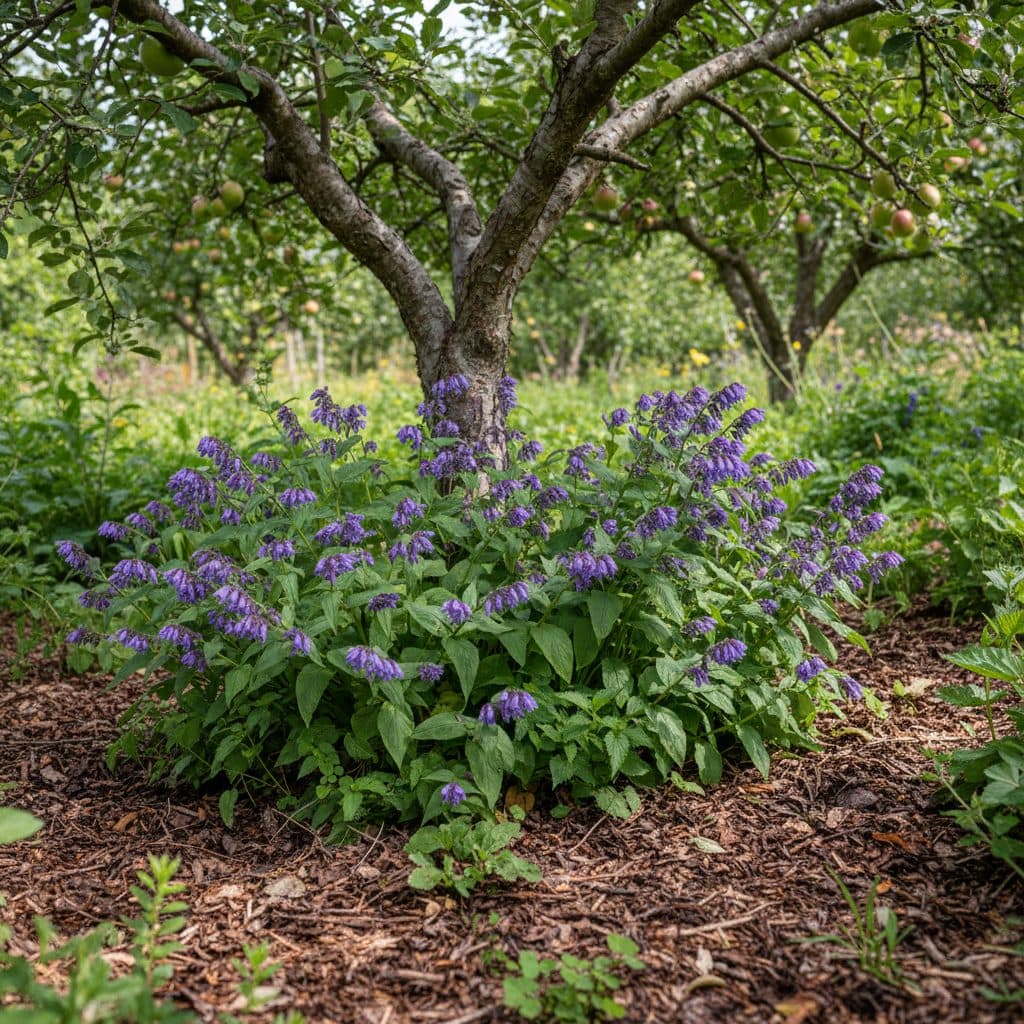
- Russian comfrey (Symphytum x uplandicum 'Bocking 14') is an upright, sterile clumping herbaceous perennial (not a creeping ground cover) rich in bio-available potassium.
- Chop-and-drop mulching cuts accumulator foliage three to five times per season, depositing organic matter directly onto topsoil to feed soil biology.
- Fermenting accumulator leaves in water creates concentrated liquid organic teas for fruiting nightshades and heavy-feeding garden crops.
Quick answer: Dynamic accumulator plants are deep-rooted perennials (like Russian comfrey, stinging nettle, chicory, and dandelion) that draw potassium, calcium, iron, and trace minerals from deep subsoil layers into their leaves. Harvesting their foliage for chop-and-drop mulch or liquid teas returns these concentrated minerals to the topsoil where shallow-rooted vegetables can absorb them.
The concept of dynamic accumulation is one of the most widely referenced concepts in modern permaculture, agroforestry, and regenerative soil design. Popularised in ecological gardening literature, dynamic accumulators are celebrated as living nutrient pumps that mine inaccessible minerals from deep underground and deliver them directly to your garden beds without imported synthetic fertilisers.
However, an evidence-grounded approach requires separating botanical reality from folklore. While dynamic accumulator plants cannot conjure minerals out of depleted or parent rock, their specialised root architectures, mycorrhizal fungal associations, and rapid biomass generation make them useful biological tools for closed-loop soil building.
This global guide examines the scientific evidence behind dynamic accumulation, profiles commonly listed accumulator species, clarifies the true botanical habit of comfrey, and details practical chop-and-drop management.
+-------------------------------------------------------------+
|              DYNAMIC ACCUMULATION BIOLOGICAL CYCLE          |
|                                                             |
|   1. Deep Taproots Mine:     Scavenge K, Ca, Fe, Si from subsoil
|   2. Leaf Storage:           Concentrate minerals in foliage|
|   3. Chop-and-Drop Cut:      Cut biomass 3-5 times per year |
|   4. Surface Humus Release:  Decomposition feeds topsoil web|
|   5. Shallow Crop Uptake:    Vegetables absorb cycled nutrients
+-------------------------------------------------------------+
What is the science and evidence behind dynamic accumulation?
To use these plants effectively, growers must understand what dynamic accumulators can and cannot achieve in the soil food web.
+-------------------------------------------------------------+
|              SCIENTIFIC FACTS VS POPULAR MYTHS              |
|                                                             |
|   PERMACULTURE MYTH            BOTANICAL REALITY            |
|   ----------------             -----------------            |
|   Plants "create" minerals     Can only absorb existing ions|
|   Comfrey is a ground cover    Comfrey is a tall upright clump|
|   Any weed accumulates all     Accumulation is element-specific|
|   Replaces all soil amendments Must match baseline mineral tests
+-------------------------------------------------------------+
1. Proposed and observed mechanisms
- Subsoil scavenging: Deep taproots (reaching 1.5 to 3.0 m / 5 to 10 ft deep) access nutrients that have leached downward beyond the reach of shallow-rooted annual vegetables and lawn grasses.
- Root exudates and mineral weathering: Accumulator roots exude organic acids (such as citric and malic acids) that lower rhizosphere pH, dissolving insoluble calcium phosphates, potassium silicates, and trace iron from parent rock.
- Surface cycling: When foliage is chopped and applied as surface mulch, earthworms, arthropods, and saprophytic fungi break down plant tissues, releasing concentrated minerals into the upper 5 to 15 cm (2 to 6 in) of topsoil.
2. The scientific limitations
- No elemental transmutation: A plant cannot accumulate boron, zinc, or phosphorus if the regional subsoil is entirely devoid of those elements. Dynamic accumulators mobilise existing subsoil reservoirs instead of manufacturing new fertility.
- Tissue concentration variability: Leaf nutrient levels fluctuate dramatically depending on the plant's growth stage, soil moisture, ambient temperature, and mycorrhizal colonisation. Tissue mineral density peaks just as flower buds form, prior to seed development.
To see how these support species fit into multi-layered polycultures, review what is a food forest and species selection in forest garden plants.
What are the top dynamic accumulator species and their minerals?
Different botanical families specialise in accumulating specific macronutrients and trace minerals.
+-------------------------------------------------------------+
|             COMMONLY LISTED ACCUMULATOR SPECIES             |
|                                                             |
|   SPECIES (BOTANICAL)         PRIMARY NUTRIENTS   ROOT DEPTH|
|   -------------------         ------------------  ----------|
|   Russian Comfrey (*Symphytum*)Potassium (K), Ca   2.0 - 3.0 m|
|   Stinging Nettle (*Urtica*)  Nitrogen (N), Fe, S 0.5 - 1.0 m|
|   Dandelion (*Taraxacum*)     Calcium (Ca), Fe, K 0.5 - 1.5 m|
|   Chicory (*Cichorium intybus*)Calcium, K, Trace   1.5 - 2.5 m|
|   Yarrow (*Achillea*)         Potassium, P, S     0.3 - 0.8 m|
|   Horsetail (*Equisetum*)     Do not plant (weed) Harvest wild|
+-------------------------------------------------------------+
Note: These element-by-element attributions are traditional list entries instead of measured data, with comfrey's high potassium the main claim supported by tissue analyses. Horsetail (Equisetum): do not plant. Harvest from existing stands only; it is a declared weed in Australia and regulated elsewhere, and cannot be removed once it takes hold.
1. Russian comfrey (Symphytum x uplandicum 'Bocking 14')
- Primary minerals: Exceptionally rich in potassium (often 3% to 5% dry weight), calcium, and magnesium.
- Habit: An upright, caespitose (clump-forming) perennial growing 90 to 120 cm (3 to 4 ft) tall with large, hairy leaves. It is not a creeping ground cover.
- The 'Bocking 14' cultivar: Always plant root crowns of the sterile Russian hybrid 'Bocking 14'. 'Bocking 14' does not set viable seed, so it will not seed around, but it regrows from any root fragment, so plant it only where you want it permanently. Symphytum is naturalised in parts of North America and New Zealand and is subject to restrictions on sale for internal human use in Australia.
2. Stinging nettle (Urtica dioica)
- Primary minerals: Abundant organic nitrogen, iron, magnesium, and sulfur.
- Function: Makes an effective liquid fertilizer when steeped in water. Learn brewing techniques in our guide to stinging nettle fermented liquid feeds.
3. Dandelion (Taraxacum officinale) and chicory (Cichorium intybus)
- Primary minerals: High levels of calcium, potassium, iron, and boron.
- Root action: Stout vertical taproots drill through compacted clay subsoils, opening macro-pore aeration channels for subsequent crop roots.
4. Yarrow (Achillea millefolium)
- Primary minerals: Potassium, phosphorus, and sulphur.
- Ecosystem role: In addition to nutrient cycling, its flat-topped corymbs attract beneficial predatory insects including lacewings, ladybirds, and parasitic mini-wasps.
To compare dynamic accumulators with living legumes, explore red clover vs white clover.
How do you harvest and apply chop-and-drop mulch?
Chop-and-drop is the practical permaculture technique of cutting accumulator foliage and leaving it directly on the soil surface around surrounding crops.
+-------------------------------------------------------------+
|              CHOP-AND-DROP PRUNING PROTOCOL                 |
|                                                             |
|   [ Comfrey Clump at Budding ] ===(Sickle Cut 5cm High)===> |
|                                             |               |
|                                             v               |
|   Spread 5-10 cm Deep Around:  [ Fruit Tree Drip-Line ]     |
|                                [ Tomato & Pepper Beds ]     |
|                                [ Squash & Heavy Feeders ]   |
+-------------------------------------------------------------+- Harvest timing: Cut foliage when flower buds first appear, but before blossoms fully open. At this vegetative peak, mineral concentration in leaf tissue is at its highest point.
- Cutting height: Using a sharp grass hook, sickle, or hedge shears, slice the entire comfrey or nettle clump 5 to 7 cm (2 to 3 in) above ground level.
- Application: Lay the harvested leaves in a 5 to 10 cm (2 to 4 in) layer beneath the drip-line of fruit trees, berry bushes, or around fruiting vegetables like tomatoes and peppers. Comfrey leaves are low in lignin and high in water, so they break down within about two weeks, releasing potassium directly into the topsoil.
- Regeneration: Vigorous comfrey clumps regrow rapidly, yielding three to five full harvests per growing season in temperate and subtropical climates.
+-------------------------------------------------------------+
|              ACCUMULATOR HARVESTING CYCLES                  |
|                                                             |
|   HARVEST FLUSH       TIMELINE (NORTH)     TIMELINE (SOUTH) |
|   -------------       ----------------     ---------------- |
|   Cut #1 (Spring)     May to early June    Nov to early Dec |
|   Cut #2 (Midsummer)  July                 January          |
|   Cut #3 (Late Summer)August               February         |
|   Cut #4 (Autumn)     Late Sept to October Late March to Apr|
+-------------------------------------------------------------+
How do you make concentrated dynamic accumulator liquid feeds?
Liquid plant ferments deliver rapidly available soluble nutrients directly to plant roots and foliage during peak flowering and fruit sizing stages.
+-------------------------------------------------------------+
|            LIQUID COMPOST TEA BREWING PROCEDURE             |
|                                                             |
|   [ Step 1 ] Pack bucket tightly with chopped leaves        |
|   [ Step 2 ] Water-steep: cover with water & seal lid       |
|              Dry-press: weight with brick, drain out base   |
|   [ Step 3 ] Steep for 2 to 3 weeks                         |
|   [ Step 4 ] Strain liquid extract                          |
|   [ Step 5 ] Water-steep drench: dilute 1:10 with water     |
|              Dry-press concentrate: dilute 1:20 with water  |
+-------------------------------------------------------------+- Dry-press concentrate (odourless method): Pack a 20-litre bucket with fresh comfrey leaves. Drill a small hole in the bottom and weight the leaves down with a heavy brick. Place a collection jug underneath. Over two to three weeks, leaves decompose into a thick, dark, odourless liquid concentrate. Dilute 1:20 with clean water.
- Traditional water steep: Fill a bucket with chopped leaves, cover with water, seal with a tight-fitting lid, and allow to ferment for 14 to 21 days. The resulting dark tea will have a strong manure-like odour. Always dilute 1:10 with clean water before applying as a soil drench around flowering tomatoes, eggplants, and fruit shrubs.
How should you position accumulators in orchard guilds?
- Tree guild placement: Plant comfrey clumps in a ring 1.0 to 1.5 m (3 to 5 ft) outside the drip-line of fruit trees. This prevents the vigorous comfrey root system from competing with young tree roots while providing an on-site source of chop-and-drop mulch.
- Containment: Because comfrey regenerates from tiny root fragments, plant it in dedicated permanent perimeter zones. Never rotavate or till through established comfrey patches, which fragments roots and creates hundreds of new plants.
Regional management notes
In cool temperate climates: Accumulator foliage dies back completely after the first autumn freeze. Make the final cut about four to six weeks before your first hard frost as protective winter mulch over tree root zones.
In subtropical and tropical climates: Perennial accumulators grow year-round under adequate moisture. Position clumps in partial shade beneath tree canopies to prevent leaf scorch during peak dry seasons.
By integrating proven dynamic accumulator plants into your garden design, respecting their true botanical growth habits, and cycling their biomass through chop-and-drop mulching and liquid feeds, you can build resilient, self-sustaining soil fertility.