Key takeaways
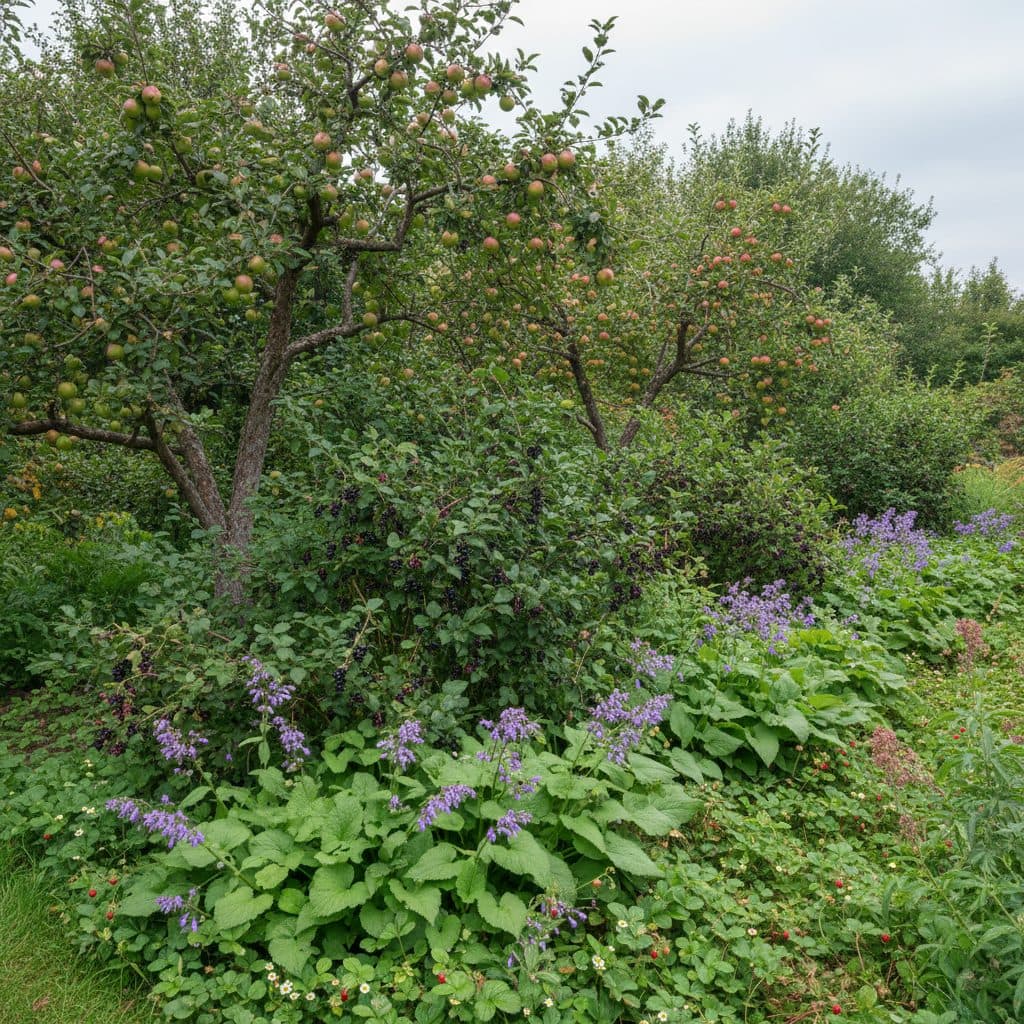
- Forest gardening in the UK mimics native woodland edges to create self-sustaining, low-maintenance polycultures of edible perennials.
- Select species tailored to the seven distinct structural layers: canopy, sub-canopy, shrub, herbaceous, ground cover, rhizosphere, and vertical climber.
- Nitrogen-fixing woody shrubs like sea buckthorn (Hippophae rhamnoides) supply soil fertility, but need male and female plants for fruit and a containment barrier against suckering.
- Clumping Russian comfrey (Symphytum x uplandicum 'Bocking 14') is a tall herbaceous accumulator and mulch source, not a creeping ground cover.
- Shade-tolerant ground covers such as wild garlic (Allium ursinum) and wild strawberry (Fragaria vesca) suppress weeds beneath fruit shrubs.
- Choose disease-resistant rootstocks and cultivars certified for cool, maritime UK growing conditions to minimise fungal pressure.
Quick answer: Essential forest garden plants for the UK include top-tier fruit trees (apples on MM106 or M26 rootstocks, damsons, medlars), hardy berry shrubs (blackcurrants, gooseberries, jostaberries), perennial vegetables (Good King Henry, Turkish rocket, sweet cicely), and shade-tolerant ground covers (wild garlic, wild strawberries). Support species like Russian comfrey 'Bocking 14' and contained sea buckthorn build long-term fertility.
Temperate forest gardening designs productive food-growing ecosystems modelled on the structural layers of natural British woodland edges. Rather than fighting natural ecological succession with annual tilling and weeding, you establish perennial polycultures that yield fruits, nuts, culinary greens, edible roots, and medicinal herbs year after year.
Choosing appropriate forest garden plants requires understanding each plant's mature height, light demands, rooting habit, and ecological function within the guild. In the cool, maritime UK climate, maximising sunlight capture across vertical tiers is critical for ripening fruit while maintaining vigorous understorey growth.
+-------------------------------------------------------------+
|              THE SEVEN LAYERS OF A UK FOREST GARDEN         |
|                                                             |
|  1. Canopy Tree Layer       Sweet Chestnut, Walnut, Standard|
|  2. Sub-Canopy/Orchard      Apples, Medlars, Damsons, Pears |
|  3. Shrub Layer             Currants, Gooseberries, Berries |
|  4. Herbaceous Layer        Comfrey, Good King Henry, Rocket|
|  5. Ground Cover Layer      Wild Garlic, Wild Strawberry    |
|  6. Rhizosphere / Roots     Jerusalem Artichoke, Horseradish|
|  7. Vertical Climbers       Hops, Wineberry, Climbing Beans |
+-------------------------------------------------------------+
Which canopy and sub-canopy fruit trees suit UK forest gardens?
The upper canopy and mid-tier orchard layers form the structural backbone of your system, capturing primary sunlight and casting dappled shade over the understorey.
High canopy species (large gardens and smallholdings)
- Sweet Chestnut (Castanea sativa): Produces abundant starchy autumn nuts and rot-resistant coppice timber. Prefers well-drained, slightly acidic soils; avoid waterlogged heavy clays. Always source certified UK-grown stock from a reputable nursery to prevent the spread of sweet chestnut blight (Cryphonectria parasitica) and Phytophthora ramorum. Check current Forestry Commission plant-health guidance for demarcated zones before planting and report suspected blight via TreeAlert.
- English Walnut (Juglans regia): Yields high-value culinary nuts. Note that walnut roots and foliage produce juglone, which stunts or kills juglone-sensitive crops including apples, blueberries, and solanaceous crops. Keep walnuts well clear of apple trees and soft fruit beds.
- Standard Apples and Perry Pears: Grafted onto vigorous M25 or Pyrus communis rootstocks, standard trees form long-lived specimen trees that anchor wildlife corridors.
Sub-canopy and mid-tier fruit trees (standard plots)
For residential plots and allotments, starting with a semi-dwarf sub-canopy allows adequate light penetration to lower tiers. To understand the foundational architecture of these multi-tiered layouts, review what is a food forest.
- Culinary and Dessert Apples (Malus domestica): Choose dwarfing rootstock M26 (reaches 2.4 to 3 m) for smaller gardens, or semi-vigorous MM106 (3.5 to 4.5 m). Note that MM106 is susceptible to Phytophthora collar rot in poorly drained, heavily mulched soils, so ensure planting sites drain freely. Choose scab- and canker-resistant varieties bred for maritime climates, such as 'Discovery', 'Egremont Russet', or 'Lord Derby'.
- Damsons and Gages (Prunus domestica): The 'Shropshire Prune' damson and 'Cambridge Gage' thrive in UK hedgerows, providing heavy crops with minimal pruning requirements. Learn foundational tree shaping in our guide on how to prune fruit trees.
- Medlar (Mespilus germanica): A traditional heritage tree bearing russet-brown autumn fruit that softens (blets) into spiced puree in November. Highly ornamental with large white spring blossoms.
- Hazel (Corylus avellana): A versatile UK native producing nutritious cobnuts and flexible coppice rods for plant staking and basketry.
+-------------------------------------------------------------+
|            CANOPY AND ORCHARD TIER RECOMMENDATIONS          |
|                                                             |
|   SPECIES             ROOTSTOCK / HABIT     PRIMARY YIELD   |
|   -------             -----------------     -------------   |
|   Apple 'Discovery'   MM106 (Semi-vigorous) Early dessert   |
|   Damson 'Shropshire' St. Julien A          Culinary plum   |
|   Medlar 'Nottingham' Quince A              Winter fruit    |
|   Cobnut 'Webb's'     Multi-stem shrub/tree Autumn nuts     |
+-------------------------------------------------------------+
What soft fruit shrubs thrive in the understorey layer?
The shrub layer (1 to 2.5 metres tall) occupies the dappled light zone beneath the tree canopies, taking advantage of forest microclimates that shelter tender blossom from late spring frosts.
- Blackcurrants (Ribes nigrum): Highly productive in partial shade, producing dark berries rich in vitamin C. Cultivars like 'Ben Hope' offer genetic resistance to gall mite.
- Redcurrants and Whitecurrants (Ribes rubrum): Best grown as open goblets or trained cordons along northern boundary fences. Whitecurrants are sweeter for fresh snacking, while redcurrants make classic jellies.
- Gooseberries (Ribes uva-crispa): Exceptionally hardy and happy in cooler northern aspects. Select mildew-resistant varieties such as 'Invicta' (culinary) or 'Hinnonmaki Red' (dessert).
- Jostaberry (Ribes x nidigrolaria): A vigorous, thornless cross between a blackcurrant and gooseberry that produces abundant heavy fruit clusters without demanding intensive feeding.
- Sea Buckthorn (Hippophae rhamnoides): A native, nitrogen-fixing coastal shrub that tolerates poor soil while bearing tart, vitamin-packed orange berries. Note that sea buckthorn is dioecious: you need at least one male plant per group of females to produce fruit. Because it suckers vigorously and is actively controlled on dunes outside its native range, grow it only with a root barrier and never plant near sand dunes or open coastal habitats. For more nitrogen-fixing companion candidates, see our guide on cold-hardy nitrogen-fixing plants.
+-------------------------------------------------------------+
|                  PERENNIAL SHRUB LAYER METRICS              |
|                                                             |
|   CROP            SHADE TOLERANCE     PRUNING REQUIREMENT   |
|   ----            ---------------     -------------------   |
|   Blackcurrant    Moderate (4-6 hrs)  Prune 1/3 oldest wood |
|   Redcurrant      High (partial shade)Maintain open centre  |
|   Gooseberry      High (north aspect) Spur-prune in winter  |
|   Jostaberry      Moderate            Thin crowded canes    |
+-------------------------------------------------------------+
Which perennial vegetables and herbs belong in the herbaceous layer?
The herbaceous layer comprises clumping perennials that die back in winter and re-emerge vigorously in spring, providing sustained harvests without seed starting.
Edible perennial greens
- Good King Henry (Blitum bonus-henricus): Traditional English perennial vegetable whose young triangular leaves are cooked like spinach, and flower shoots steamed like asparagus.
- Turkish Rocket (Bunias orientalis): A hardy, deep-rooted brassica perennial yielding broccoli-like flower heads and mustard-flavoured spring shoots. It regenerates aggressively from deep root fragments and is classed as invasive in parts of central/northern Europe and North America; plant it within bounded beds to prevent unwanted spread.
- Sweet Cicely (Myrrhis odorata): Aniseed-scented ferny foliage that appears in late winter; cooked with tart fruits like gooseberries and rhubarb to reduce the need for added sugar. Know the toxic Apiaceae lookalikes (such as hemlock, Conium maculatum, and rough chervil, Chaerophyllum temulum); crush and smell the leaf for distinct aniseed aroma, and never eat an unverified rosette. It self-seeds prolifically.
- Babington's Leek (Allium ampeloprasum var. babingtonii): Native perennial leek that produces perennial bulbs and edible stem bulbils every summer.
Nutrient support plants
- Russian Comfrey (Symphytum x uplandicum 'Bocking 14'): A sterile clumping perennial whose deep root system accesses minerals and produces heavy biomass for chop-and-drop mulching. To understand the botanical facts and limitations of these species, explore our detailed analysis of dynamic accumulator plants.
+-------------------------------------------------------------+
|               HERBACEOUS LAYER PLANT ATTRIBUTES             |
|                                                             |
|   PLANT NAME          HABIT           PRIMARY FUNCTION      |
|   ----------          -----           ----------------      |
|   Good King Henry     Clump-forming   Cooked spring greens  |
|   Turkish Rocket      Deep taproot    Broccoli-like florets |
|   Sweet Cicely        Fern-like clump Natural sweetener     |
|   Comfrey 'Bocking 14'Upright clump   Biomass & mulch plant |
+-------------------------------------------------------------+
What ground covers and root crops complete the lower tiers?
The ground cover and rhizosphere layers protect bare soil from erosion, suppress invasive weeds, and harvest root carbohydrates.
Ground covers (living mulch)
- Wild Garlic / Ramsons (Allium ursinum): A native bulb that carpets damp woodland shade in late winter and early spring, offering pungent garlicky leaves, stems, and edible white flowers before going dormant in midsummer. Ensure positive identification by crushing leaves for a pungent garlic scent before eating; ramsons foliage closely resembles poisonous lords-and-ladies (Arum maculatum), lily-of-the-valley (Convallaria majalis), and autumn crocus (Colchicum autumnale). It self-seeds and spreads prolifically.
- Wild Strawberry (Fragaria vesca): Low-creeping ground cover that sends out shallow runners to form a dense weed-suppressing carpet, bearing intensely sweet miniature fruit throughout summer.
- Creeping Thyme (Thymus serpyllum): Thrives along sunny southern edges and stony paths, attracting native pollinators and providing aromatic ground cover.
Rhizosphere and root crops
- Jerusalem Artichoke (Helianthus tuberosus): Tall perennial sunflowers producing knobby, inulin-rich edible tubers. Because plants regrow from any missed tuber fragments and can spread into damp areas, plant inside sunken containers or bounded root zones along northern borders as a windbreak.
- Horseradish (Armoracia rusticana): A vigorous taproot perennial. Plant inside sunken containers or bounded root zones to prevent it spreading into adjacent perennial beds.
- Chinese Artichoke (Stachys affinis): Small, ridged tubers with a crisp, nutty water chestnut texture, thriving in loose, humus-rich woodland soil.
Which vertical climbers maximise perimeter space?
Vertical climbers use tree trunks, trellises, and boundary fences to produce crops without consuming ground footprint.
- Japanese Wineberry (Rubus phoenicolasius): A bristly cane fruit producing glistening, sticky orange-red berries in late summer. Wineberry tip-roots wherever a cane touches soil. Keep it on a support, cut out fruited canes and any rooted tips each winter, and do not plant it near woodland edges or watercourses.
- Common Hop (Humulus lupulus): Native vigorous climbing vine whose young spring shoots are harvested like asparagus, and autumn hop strobiles used for brewing and sleep pillows.
- Climbing Beans and Edible Climbers: Annual runner beans (Phaseolus coccineus) provide vigorous vertical production. Toxicity warning: Never plant or consume perennial sweet pea (Lathyrus latifolius), as its seeds are toxic (lathyrism) and resemble edible peas.
By combining well-adapted perennial species across all seven vertical tiers, your UK forest garden will mature into a self-sustaining edible ecosystem that yields nutritious food while enriching local biodiversity.