Key takeaways
- Phase one focuses on observation, solar mapping, and soil preparation instead of immediate tree buying.
- Sheet mulching smothers weed seeds and lawn turf while building deep fungal networks for perennial roots.
- Pioneer support species fix nitrogen and generate chop-and-drop biomass to feed high-value fruit trees.
- Planting in guilds balances nutrient accumulation, pollinator attraction, and root space utilization.
- Budgeting realistic food forest cost structures prevents over-purchasing fragile nursery stock before soil matures.
Quick answer: To start a food forest, map your site's sun and water patterns, smother existing turf with sheet mulch, establish windbreaks and soil-building support plants, and install fruit trees and berry bushes in multi-layered guilds. Phasing your installation over two to three years ensures strong root establishment and minimizes ongoing irrigation.
Starting a food forest offers an ecological alternative to resource-intensive annual vegetable gardening. By establishing a perennial ecosystem modeled after young woodland edges, you invest labor upfront to harvest fruit, berries, edible greens, and culinary herbs for decades.
Learning how to start a food forest for beginners requires shifting from annual bed cultivation to long-term soil biology management. Instead of turning soil each spring, growers establish self-maintaining layers that cycle nutrients internally.
Whether you are converting a standard residential lawn or rehabilitating degraded pasture, breaking the process into orderly phases ensures high survival rates for your nursery stock and keeps overall maintenance manageable.
How do you assess and design your site before planting?
Before purchasing plants, spend time observing environmental patterns across your property. Track how sunlight moves across the yard during different seasons. Canopy fruit trees require at least six to eight hours of direct daily sunlight during the growing season to produce sweet, bountiful fruit.
Next, observe natural water flows during moderate and heavy rainstorms. Look for low spots where water stands for days, as well as dry ridges where runoff drains too quickly. You can dig shallow swales on contour to capture surface water and direct it toward future tree planting lines, reducing the need for municipal irrigation.
Identify existing wind vectors. Cold winter winds or dry summer gusts can desiccate young blossoms and break tender branches. Planting a hardy windbreak of native shrubs along the prevailing wind edge protects delicate fruit cultivars. If working with a compact residential lot, compare layout strategies in our guide to backyard food forest planning.
How do you convert lawn to food forest beds without tilling?
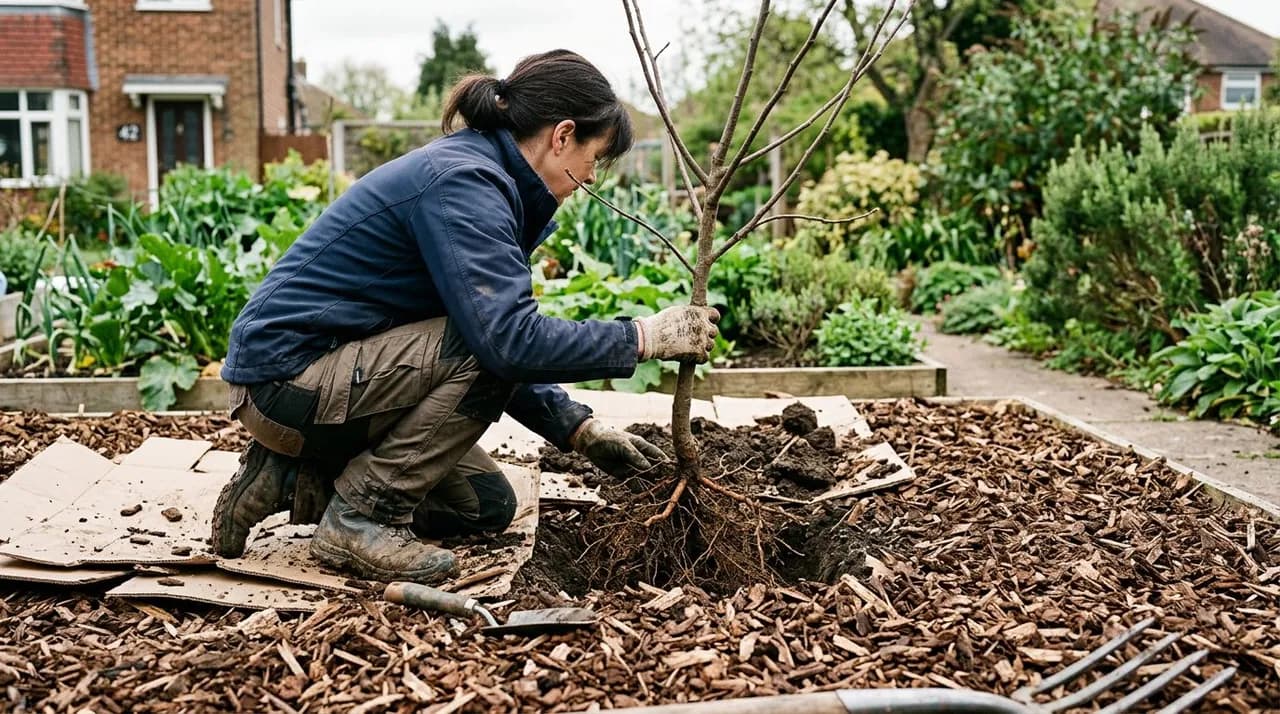
Tilling established turf grass damages existing fungal networks, exposes dormant weed seeds to light, and causes soil compaction beneath the tilled layer. The preferred method to convert lawn to food forest planting ground is sheet mulching, which smothers grass while building rich topsoil.
Begin by cutting grass and weeds as low as possible with a mower. If the soil is compacted, aerate it with a broadfork without turning the soil profile over. Water the area deeply to jumpstart microbial decomposition.
Lay overlapping sheets of thick, unwaxed cardboard across the entire planting zone, with edges overlapping by 6 to 8 inches (15 to 20 cm) to block sunlight from reaching hardy perennial grass roots. On top of the cardboard, spread a 2 to 3-inch (5 to 8 cm) layer of compost, well-rotted manure, or worm castings. Cap this with 4 to 6 inches (10 to 15 cm) of coarse arborist woodchips. For detailed moisture management techniques during this phase, see our guide on sheet mulching for soil moisture.
What is the food forest first year installation sequence?
Attempting to plant every layer simultaneously during year one often overwhelms home growers and leads to plant losses. Following a step-by-step planting sequence yields reliable results:
Step 1: Establish access and earthworks
Dig pathways, access points, and water-harvesting berms before planting. Make paths wide enough to maneuver tools and harvest carts.
Step 2: Plant pioneer species and windbreaks
Install fast-growing nitrogen-fixing shrubs (such as goumi or sea buckthorn) and deep-rooting accumulator plants. These pioneers buffer harsh winds, shade bare soil, and provide green matter for future mulching.
Step 3: Plant canopy and sub-canopy fruit trees
Plant bare-root or potted fruit trees directly through the sheet mulch into the native soil below. Dig a hole twice the width of the root system but the same depth as the root ball, with the graft union kept 2 to 3 inches (5 to 8 cm) above the final soil line.
Step 4: Add understory shrubs and ground covers
Place currant bushes, gooseberries, elderberries, nutrient accumulators like comfrey, and perennial ground covers like wild strawberries around each tree to form protective guilds. To explore vertical layering rules in detail, read our breakdown of food forest layers.
How do you build an effective fruit tree guild?
In nature, trees do not grow in isolated monocultures; they thrive alongside companion plants that exchange nutrients, deter insect pests, and protect root zones. In food forestry, this plant community is called a guild.
A standard guild centered around a fruit tree includes four functional plant types:
- Nutrient accumulators: Comfrey, horseradish, and dandelion send taproots deep into the subsoil, bringing up potassium, calcium, and trace minerals that become topsoil mulch when leaves are trimmed.
- Nitrogen fixers: Leguminous shrubs and clover host Rhizobium bacteria on their roots, converting airborne nitrogen into organic compounds accessible to surrounding plants.
- Insectary plants: Umbelliferous herbs like dill, fennel, yarrow, and sweet alyssum produce small, open blossoms that feed beneficial predator wasps, lacewings, and syrphid flies.
- Pest confusers and grass barriers: Alliums, chives, garlic, and daffodils planted around the drip line repel browsing animals and block vigorous grass roots.
For specific tree guild designs and compatible cultivar pairings, see our guide on fruit tree guild construction.
What is a realistic food forest cost and how do you save money?
Calculating your initial food forest cost depends on whether you buy mature container plants from retail nurseries or propagate materials yourself. Purchasing large, potted fruit trees and hundreds of nursery-grown perennials for a quarter-acre lot can cost several thousand dollars.
You can significantly reduce startup expenses through several practical strategies:
- Buy bare-root stock: Bare-root trees purchased during dormant winter seasons typically cost half as much as containerized saplings and establish root systems more rapidly.
- Source free organic mulch: Contact local arborists or tree-trimming utilities to secure drop-offs of free fresh woodchips.
- Propagate perennials from cuttings: Plants like comfrey, currants, elderberries, and willows root readily from hardwood cuttings taken in late winter.
- Plant cover crops: Using annual green manures like clover, peas, and buckwheat in year one improves soil fertility at minimal cost before perennials fill the space. Review cover crops for the home garden for seasonal seed recommendations.
How do you maintain and manage early food forest growth?
During the first two growing seasons, your primary maintenance tasks focus on root establishment, weed management, and moisture retention.
Water young saplings consistently during dry summer periods, aiming for deep weekly soakings that encourage roots to travel downward instead of remaining near the surface. Maintain a 4-inch (10 cm) woodchip barrier around all plants, pulling mulch 3 inches (8 cm) away from tree trunks to prevent rodent nesting and fungal collar rot.
Prune lightly during early years to establish balanced structural framework branches, removing dead, damaged, or crossing limbs. As herbaceous plants mature, perform "chop-and-drop" trimming two to three times per season, dropping leaf biomass directly around the tree root zones to feed earthworms and build rich fungal topsoil.