Key takeaways
- Red clover (Trifolium pratense) and white clover (Trifolium repens) are nitrogen-fixing legumes that enrich soil fertility through symbiotic Rhizobium bacteria.
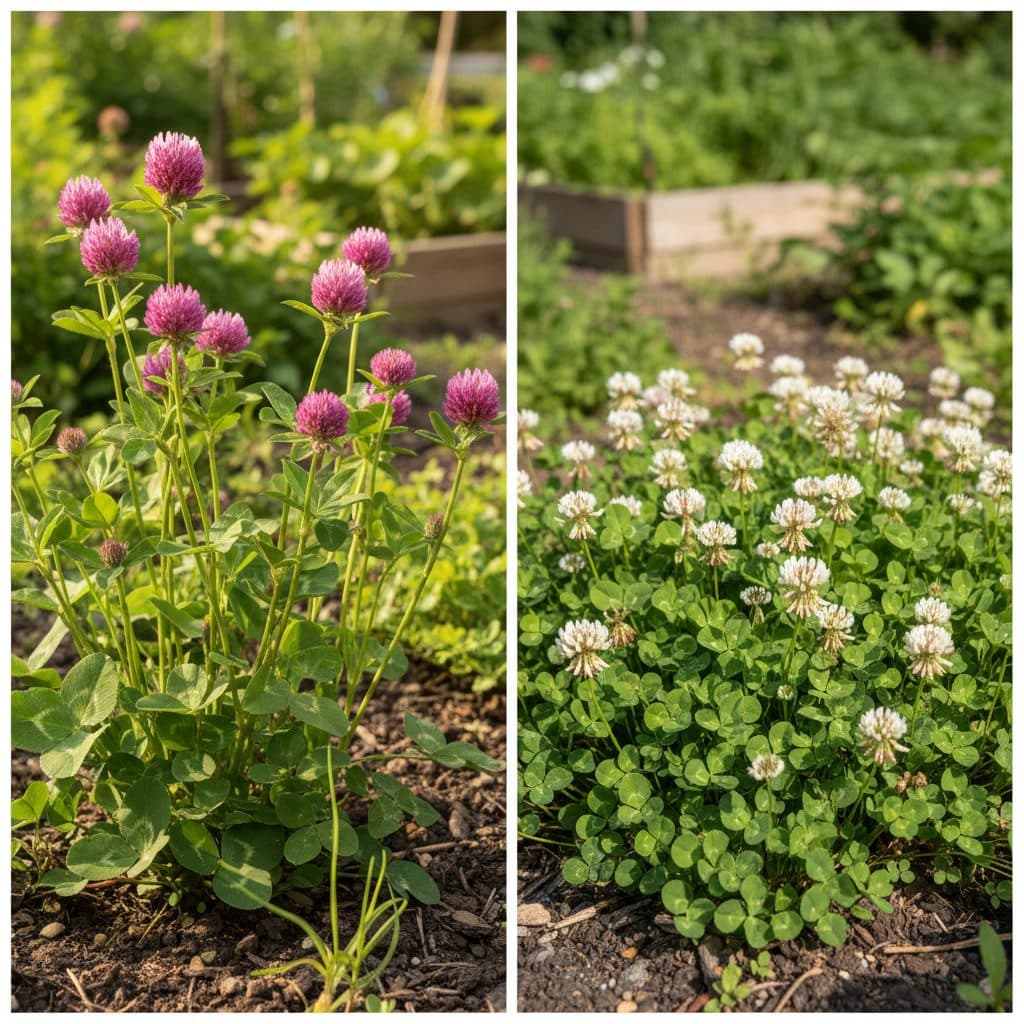
- Red clover is an upright, clump-forming biennial reaching 30 to 60 cm (12 to 24 in) tall with a deep taproot, making it ideal for high-biomass green manure.
- White clover is a prostrate, creeping perennial reaching 10 to 20 cm (4 to 8 in) tall with spreading surface stolons, making it the premier living mulch.
- Red clover's stout taproot commonly penetrates 60 cm to 1 m (up to 1.5 m in friable soils), scavenging subsoil nutrients and creating drainage channels.
- White clover withstands heavy foot traffic and repeated mowing, forming a durable ground cover in orchard understoreys and garden pathways.
- Honeybees readily forage on white clover's short flower corollas, whereas red clover's deeper floral tubes are primarily pollinated by long-tongued bumblebees.
Quick answer: Choose white clover for permanent, low-growing living mulches in pathways, lawn mixes, and orchard understoreys because its creeping stolons tolerate foot traffic and frequent mowing. Choose red clover for short-term rotational cover cropping and green manure because its upright growth and deep taproot produce massive biomass and break up compacted subsoil.
Clovers in the Trifolium genus provide biological fertility for organic growers, permaculturists, and farmers worldwide. By forming symbiotic root nodules with atmospheric nitrogen-fixing Rhizobium leguminosarum bacteria, clovers supply natural fertility to surrounding soil while protecting bare earth from erosion. Red clover fixes roughly 100 to 200 kg N/ha (90 to 180 lbs N/acre) per year in pure stands, while white clover typically contributes 80 to 150 kg N/ha (70 to 135 lbs N/acre) when maintained as a companion in mixed grass pastures.
However, when deciding between red clover vs white clover, gardeners frequently misunderstand their differing growth habits, root architectures, and operational lifespans. Planting tall red clover in a walking pathway results in tangled, floppy growth, while planting low white clover as a short-term green manure yields far less biomass than desired.
Comparing their botanical differences, root physiology, pollinator value, and management strategies helps you choose the right species for your soil.
+-------------------------------------------------------------+
|              RED CLOVER VS WHITE CLOVER COMPARISON          |
|                                                             |
|   TRAIT               RED CLOVER (*T. pratense*)WHITE CLOVER (*T. repens*) |
|   -----               --------------------  ------------------- |
|   Growth Habit        Upright / Caespitose  Prostrate / Creeping|
|   Height              30 to 60 cm (12-24 in)10 to 20 cm (4-8 in)|
|   Root Architecture   Deep central taproot  Shallow stolon roots|
|   Lifespan            Biennial (2-3 years)  Perennial (Long)    |
|   Traffic Tolerance   Low (Stems break)     High (Regenerates)  |
|   Primary Use         Green manure & forage Living mulch & paths|
|   Primary Pollinator  Bumblebees (Long tube)Honeybees & natives |
+-------------------------------------------------------------+
What are the botanical differences in growth habit and lifespan?
Both species belong to the Fabaceae (legume) family and have the classic trifoliate ("three-leaf") leaf pattern, but their above-ground growth habits differ.
+-------------------------------------------------------------+
|              CLOVER ARCHITECTURE & ROOT PROFILE             |
|                                                             |
|       RED CLOVER (Upright Clump)       WHITE CLOVER (Creeping) |
|                                                             |
|           \   /  (30-60 cm)                 --*--*--*--     |
|            \ /                             / Surface   \    |
|          ---|--- Soil Line               ---|--Stolons--|---|
|             |                               |   |   |   |   |
|             | Deep Taproot                 (Fibrous Roots)  |
|             | (0.6 - 1.0 m)                 (Shallow 15 cm) |
|             v                                               |
+-------------------------------------------------------------+
1. Red clover (Trifolium pratense)
- Architecture: Upright, bushy clumping habit. Stems emerge from a central root crown, growing 30 to 60 cm (12 to 24 in) in height. Leaves are large, oval, and display a distinctive pale white or chevron-shaped "V" mark across the center of each leaflet.
- Lifespan: Short-lived perennial or biennial, typically persisting for two to three growing seasons before natural thinning occurs.
- Biomass yield: Produces dense, leafy top growth yielding 3 to 5 tonnes of dry organic matter per hectare when grown as a pure cover crop stand.
- Livestock reproduction caveat: Red clover contains formononetin, an isoflavone with oestrogenic activity. Grazing breeding ewes on red-clover-dominant pasture in the month before and during mating can cause infertility, difficult lambing, and "clover disease". Keep ewes on white clover or grass swards during tupping. Both clovers can also cause frothy bloat in cattle if grazed hungry without roughage, and mouldy red clover hay infected with Rhizoctonia leguminicola causes slaframine toxicosis ("slobbers") in horses and cattle.
2. White clover (Trifolium repens)
- Architecture: Prostrate, creeping ground cover. White clover spreads across the soil via horizontal above-ground runners called stolons. As stolons extend, they put down adventitious roots at every leaf node, knitting into a continuous, dense sod 10 to 20 cm (4 to 8 in) tall.
- Lifespan: True perennial. Individual plants self-propagate indefinitely through vegetative stolon expansion, even in cold climates.
- Cultivar groups: Divided into three broad types: Small-leaved (wild white clover, ideal for lawns and heavy grazing), Medium-leaved (Dutch white clover, the standard living mulch), and Large-leaved (Ladino clover, taller and higher yielding for pastures).
- Weed caveat: Note that white clover (Trifolium repens) is naturalised worldwide and can be an aggressive weed in lawns, sports turf, and native grasslands where not intended.
How does crimson clover differ?
- Crimson Clover (Trifolium incarnatum): A winter annual with striking, elongated conical blood-red flower heads. Unlike perennial red and white clovers, crimson clover completes its life cycle in a single season, producing rapid spring biomass before dying completely after seed set.
To discover regional legume species for living covers, explore our guide on living mulch cover crops by zone.
How do their root architectures affect soil conditioning?
The underground root systems of red and white clover perform distinct ecological functions in the soil food web.
+-------------------------------------------------------------+
|              SOIL CONDITIONING MECHANISMS                   |
|                                                             |
|   FUNCTION            RED CLOVER            WHITE CLOVER    |
|   --------            ----------            ------------    |
|   Hardpan Penetration High (0.6-1.0m taprootLow (Shallow)   |
|   Surface Erosion CtrlModerate              Exceptional (Sod|
|   Subsoil Mineral MineHigh (Scavenges Ca/K) Low             |
|   Moisture Compaction Susceptible           Tolerates treading
+-------------------------------------------------------------+- Red clover taproot subsoiling: Red clover produces a stout central taproot that commonly penetrates 60 cm to 1 metre (with some roots reaching 1.5 metres in loose, friable subsoils), helping open clay topsoils, create drainage channels, and draw moisture from below shallow turf roots.
- White clover erosion control: White clover's shallow, dense network of fibrous roots concentrates in the top 15 to 20 cm (6 to 8 in) of soil. It binds loose topsoil particles together, preventing surface water runoff, raindrop splash erosion, and wind loss on sloped ground.
To evaluate non-chemical termination methods for these root systems, consult cover crops and occultation weed control.
When should you use red clover vs white clover in the garden?
Matching the species to your specific garden design ensures successful management without unwanted crop competition.
+-------------------------------------------------------------+
|              CLOVER APPLICATION SELECTION GUIDE             |
|                                                             |
|   GARDEN APPLICATION          RECOMMENDED CLOVER SPECIES    |
|   ------------------          --------------------------    |
|   Walking Paths & Rows        White Clover (Dutch / Wild)   |
|   Living Mulch Under BrassicasWhite Clover (Dutch)          |
|   1 to 2-Year Fallow Bed      Red Clover (Medium Red)       |
|   Orchard Floor Ground Cover  White Clover (Ladino)         |
|   Chop-and-Drop Biomass Bed   Red Clover (Mammoth / Medium) |
|   Lawn Eco-Turf Blend         White Clover (Micro-Clover)   |
+-------------------------------------------------------------+
1. Best uses for white clover
- Permanent living mulch between beds: Sow Dutch white clover in 45 to 60 cm (18 to 24 in) permanent garden paths. It keeps boots clean in wet weather, tolerates regular foot traffic, and continually feeds nitrogen to adjacent raised beds via mycorrhizal root connections.
- Orchard understorey: Plant beneath established fruit trees to suppress persistent grasses while fixing nitrogen for shallow tree roots. Learn understorey guild principles in cover crops for the home garden.
- Eco-lawn turf alternative: Mix 5% to 10% micro-clover seed into standard lawn grass seed to eliminate the need for synthetic nitrogen fertilizers and reduce summer irrigation demands.
2. Best uses for red clover
- Green manure in crop rotations: Sow red clover in late summer or early autumn following heavy feeders like sweet corn or brassicas. Inoculate beds over winter and terminate in spring by flail mowing or sheet mulching to release stored nitrogen.
- Chop-and-drop biomass mulch: Grow a dedicated border patch of red clover and cut the upright leafy stems three to four times per season with a sickle, using the nutrient-rich clippings as fresh mulch around heavy-feeding vegetables.
How do their pollinator values compare?
Both species provide valuable nectar and pollen for beneficial insects, but floral morphology dictates which pollinators can access the blooms.
+-------------------------------------------------------------+
|              POLLINATOR ACCESSIBILITY METRICS               |
|                                                             |
|   SPECIES      FLOWER STRUCTURE        PRIMARY FORAGERS     |
|   -------      ----------------        ----------------     |
|   White Clover Short Corolla Tube      Honeybees, Native    |
|                (3 to 4 mm deep)        Solitary Bees, Hover |
|   Red Clover   Deep Corolla Tube       Long-Tongued Bumble  |
|                (9 to 10 mm deep)       Bees (*Bombus* spp.) |
+-------------------------------------------------------------+- White clover: Has short, shallow flower tubes (3 to 4 mm deep). Honeybees (Apis mellifera), native sweat bees, mason bees, and syrphid hoverflies easily reach the nectar, making white clover one of the most prolific honey-producing plants in the world.
- Red clover: Bears dense, globular magenta flower heads with deep corolla tubes (9 to 10 mm deep). Short-tongued honeybees struggle to reach the nectar wells, making red clover primarily dependent on long-tongued bumblebees (Bombus species) and butterflies for cross-pollination.
For comprehensive pollinator garden design, review our guide to plants for pollinators.
How do you sow and manage clover across climate zones?
+-------------------------------------------------------------+
|              CLOVER SOWING SPECIFICATIONS                   |
|                                                             |
|   PARAMETER             RED CLOVER          WHITE CLOVER    |
|   ---------             ----------          ------------    |
|   Sowing Depth          0.5 to 1.0 cm       0.3 to 0.6 cm   |
|   Broadcast Rate (Pure) 15-20 g / 10 sq m   10-15 g / 10 sq m|
|   Soil pH Preference    6.0 to 7.0          6.0 to 6.8      |
|   Germination Days      4 to 8 Days         5 to 10 Days    |
+-------------------------------------------------------------+
Regional timing guidelines
In cool temperate climates: Sow in early to mid-spring (March to May in the north, September to November in the south) once soil temperatures exceed 10°C (50°F), or in late summer (August to September in the north, February to March in the south) so seedlings establish 6 weeks before freezing ground temperatures.
In subtropical and tropical climates: Sow during the cool, dry winter months (October to December in the north, April to June in the south) under irrigation, avoiding hot, waterlogged monsoon periods.
- Rhizobium inoculation: Always ensure clover seeds are coated with or inoculated with viable Rhizobium leguminosarum bv. trifolii bacteria before sowing in soils where clover has not grown recently.
- Mowing management: Mow white clover living mulches when flowers begin setting seed to keep the carpet low (5 to 10 cm / 2 to 4 in) and stimulate root shedding, which pulses nitrogen directly into the surrounding soil.
Matching red clover's taproot biomass to rotational cover cropping and white clover's creeping growth to paths and living mulches provides organic nitrogen across garden beds.