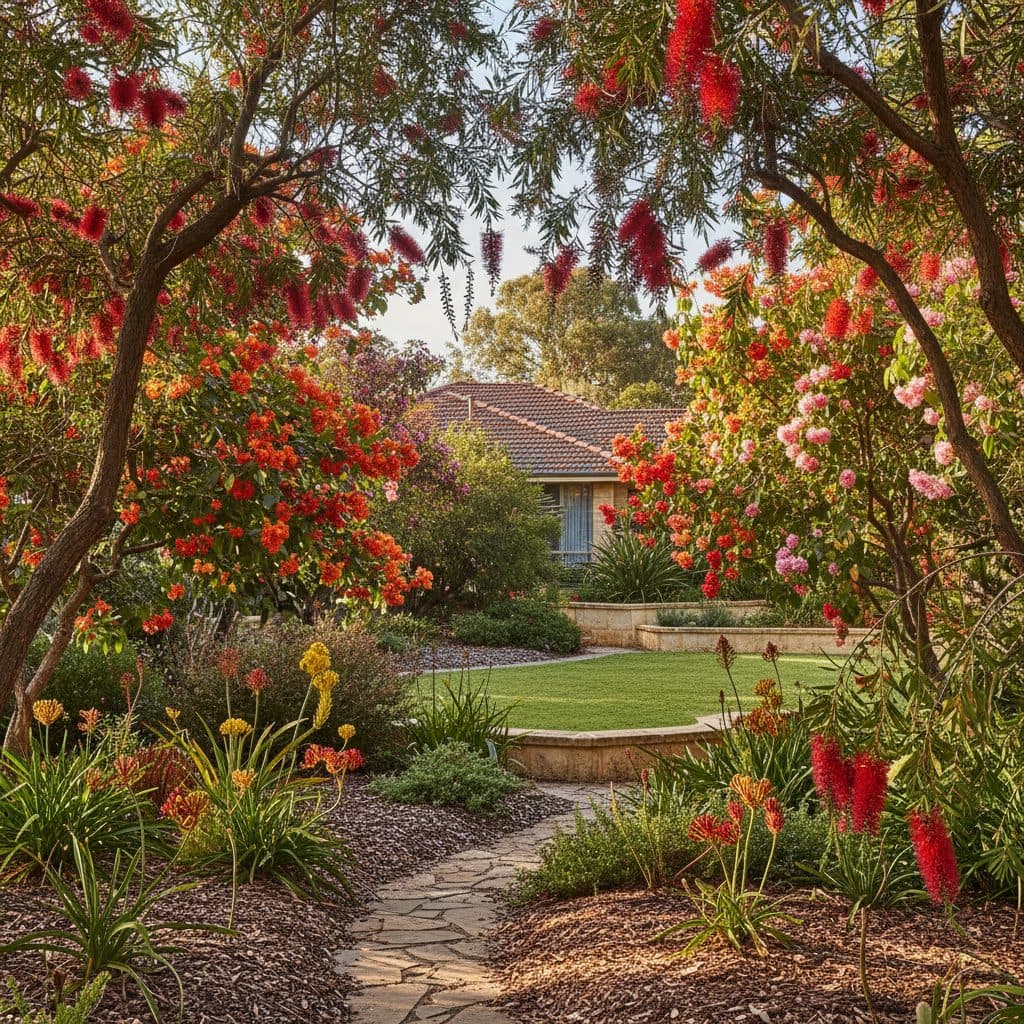
Key takeaways
- Select species matched to your specific Australian climate descriptor: tropical, subtropical, temperate, cool, or arid.
- Fast-growing native species like weeping bottlebrush, golden wattle, and blueberry ash provide rapid shade, bird habitat, and privacy.
- Maintain a minimum setback of at least 5 metres from sewer connections, stormwater lines, or building footings, increasing the distance for large mature trees and older jointed pipes.
- Incorporate firewise landscaping by clearing fallen eucalyptus bark and maintaining non-flammable buffer areas around homes.
- Plant during autumn (March to May) or early spring (September to October) to allow root systems to establish before summer heatwaves.
- Consult your local council tree management guidelines regarding boundary setback distances and protected native species.
Quick answer: For fast-growing shade and privacy in Australian gardens, plant native species such as weeping bottlebrush (Callistemon viminalis), ivory curl tree (Buckinghamia celsissima), or blueberry ash (Elaeocarpus reticulatus). These species establish rapidly, tolerate heatwaves once settled, and support native pollinators.
Establishing fast-growing trees is one of the most effective ways to create cool summer shade, reduce household cooling costs, block prevailing winds, and secure privacy in Australian gardens. Whether you are landscaping a newly built suburban block or developing a rural acreage property, choosing the right tree species transforms an open landscape within a few seasons.
However, rapid growth brings specific design responsibilities. Understanding root invasiveness, branch structure, water requirements, and local council regulations ensures your trees deliver shade and habitat without threatening underground plumbing or building footings.
Climate region considerations across Australia
Australia spans vastly diverse climatic conditions. Selecting tree species adapted to your regional climate ensures strong establishment without excessive supplemental irrigation.
+-------------------------------------------------------------+
|               AUSTRALIAN CLIMATE REGIONS                    |
|                                                             |
|   TROPICAL & SUBTROPICAL (Darwin, Cairns, Brisbane, QLD):   |
|   - High summer humidity, wet monsoon, mild winter          |
|                                                             |
|   TEMPERATE & MEDITERRANEAN (Sydney, Perth, Adelaide):      |
|   - Warm-to-hot dry summers, cool wet winters               |
|                                                             |
|   COOL & COLD TEMPERATE (Melbourne, Hobart, Tablelands):    |
|   - Chilly winters, frost frequency, moderate rainfall      |
|                                                             |
|   ARID & SEMI-ARID (Alice Springs, Inland Plains):          |
|   - Extreme heat, low rainfall, severe frost potential      |
+-------------------------------------------------------------+
Region | Climate Type | Best Fast-Growing Species | Typical Mature Height | Key Purpose |
|---|---|---|---|---|
Subtropical / Tropical | Warm, humid summer | Ivory Curl Tree (Buckinghamia celsissima) | 5–8 m | Creamy summer flowers, shade |
Subtropical / Temperate | Coastal, mild | Blueberry Ash (Elaeocarpus reticulatus) | 6–9 m | Pink bell flowers, blue berries, screen |
Temperate / Mediterranean | Dry summer, wet winter | Weeping Bottlebrush (Callistemon viminalis) | 4–7 m | Red brush flowers, screen |
Cool / Cold Temperate | Frost prone, alpine | Snow Gum (Eucalyptus pauciflora subsp. niphophila) | 4–8 m | Extreme cold hardiness, twisted trunk |
Arid / Semi-Arid | Low rainfall, high heat | Mulga (Acacia aneura) | 4–7 m | Drought resilience, silver foliage |
For broader windbreak and canopy design ideas, explore our guide on fast growing shade trees.
Top fast-growing Australian native trees
Australian native trees are naturally adapted to ancient, low-phosphorus soils and fluctuating rainfall patterns.
+-------------------------------------------------------------+
|                NATIVE TREE CANOPY COMPARISON                |
|                                                             |
|   WEEPING BOTTLEBRUSH         BLUEBERRY ASH                 |
|   - Spreading weeping canopy  - Upright columnar habit      |
|   - Nectar for honeyeaters    - White/pink fringed bells    |
|   - Tolerates clay & wet soil - Excellent boundary screen   |
|                                                             |
|   GOLDEN WATTLE               IVORY CURL TREE               |
|   - Rapid pioneer (3-5 years) - Dense subtropical shade     |
|   - Fixes atmospheric nitrogen- Spectacular summer plumes   |
|   - Yellow spring puff blooms - Attractive glossy leaves    |
+-------------------------------------------------------------+
1. Weeping Bottlebrush (Callistemon viminalis / Melaleuca viminalis)
A classic Australian favourite featuring pendulous branches lined with brilliant red bottlebrush blooms in spring and autumn. It grows 1 to 1.5 metres per year, tolerates heavy clay and waterlogging, and attracts native honeyeaters and lorikeets. Ideal for screening along fence lines and filtering harsh wind.
2. Blueberry Ash (Elaeocarpus reticulatus)
A versatile, non-invasive rainforest native suited to frost-free and light-frost coastal and warm-temperate gardens; shelter young plants from frost. It features dark green foliage, flushes of bronze new growth, delicate fringed white or pink bell flowers in spring, and bright blue decorative berries in autumn. Its upright, compact form makes it suited for tight boundary plantings and privacy screening.
3. Ivory Curl Tree (Buckinghamia celsissima)
Native to Queensland, this small to medium tree produces a dense, glossy green canopy covered in long, fragrant, creamy-white cylindrical flower spikes from late summer through autumn. Highly attractive to bees and beneficial insects, it provides thick overhead shade during hot summer afternoons.
4. Golden Wattle (Acacia pycnantha) and Indigenous Wattles
Wattles are natural pioneer species that establish with extraordinary speed, often reaching 4 metres within three years while fixing atmospheric nitrogen in root nodules, which returns to the soil as leaf litter and fine roots break down. While shorter-lived (10 to 15 years), they provide instant wind protection and shade while slower hardwood trees mature beneath them. Note: Acacia baileyana (Cootamundra wattle) is a declared or recognised environmental weed in several states outside its small natural range near Cootamundra — check your state or regional weed list, and prefer a wattle indigenous to your district.
5. Willow Bottlebrush (Callistemon salignus)
An upright native tree reaching 5 to 8 metres that displays striking pink or bronze new foliage flushes followed by creamy-white bottlebrush flowers in spring. It thrives in heavy clay soils and damp depressions where other garden trees struggle.
For privacy hedge options, check our overview of fast growing privacy trees.
Site planning: root safety, fences, and powerlines
The rapid growth rate of vigorous trees is driven by aggressive root systems seeking moisture and nutrients. Careful site placement prevents structural complications.
- Underground pipes: Maintain a minimum setback of at least 5 metres from sewer connections, stormwater lines, or septic drain fields, increasing the distance for large mature trees and older jointed pipes. For moisture-tolerant options along wet gullies, consult native trees and shrubs for wet spots.
- Overhead powerlines: Choose small-stature species (under 5 metres mature height) such as dwarf bottlebrush cultivars if planting beneath electricity easements.
- Boundary fences and footings: Large canopy trees should be positioned at least 3 to 4 metres away from dividing fences and home footings to prevent root-lift damage to paving or retaining walls.
- Council regulations: Check your local municipal council's tree preservation orders (TPOs) and preferred street tree planting lists before planting along verges or property boundaries.
Firewise landscaping and garden safety
In bushfire-prone areas of Australia, tree selection and placement must support property safety:
+-------------------------------------------------------------+
|                FIREWISE GARDEN SPACING RULES                |
|                                                             |
|   [ Home & Gutters ] <--- 5m Clear Zone ---> [ Smooth Bark ]|
|   ========================================================= |
|   - Clean gutters regularly                 - Low oil trees |
|   - No ribbon-bark eucalypts near house     - Clear mulch   |
+-------------------------------------------------------------+- Avoid stringybarks near buildings: Ribbon gums and stringybark eucalypts shed long ribbons of dry bark that act as fire ladders, carrying ground embers into tree canopies.
- Maintain separation: Keep tree canopies separated by at least 3 to 5 metres so crowns do not form a continuous flammable bridge to the house roof.
- Smooth-barked and fleshy-leaved natives: Choose smooth-barked rainforest natives like blueberry ash or lilly pilly (Syzygium species), which have higher leaf moisture content and lower volatile oil levels than high-oil eucalypts.
- Regular maintenance: Rake up fallen leaf litter and dead twigs beneath canopies prior to the start of the summer bushfire danger period.
Planting, watering, and establishment
Proper planting technique accelerates establishment and builds deep, drought-resilient root systems.
- Dig a broad planting hole: Excavate a hole twice the width of the root ball but no deeper than the container. Roughen the smooth glazed sides of clay holes with a garden fork to allow roots to penetrate surrounding soil.
- Water in thoroughly: Place the tree at natural ground level, backfill with native soil, and water deeply to settle air pockets without adding heavy synthetic fertilisers into the planting hole.
- Apply chunky organic mulch: Spread a 7.5 cm layer of coarse woodchip mulch around the tree, keeping the mulch 10 cm clear of the trunk to prevent fungal collar rot.
- Deep weekly watering: For the first summer, provide 15 to 20 litres of water once a week directly to the root zone. Deep, infrequent soakings train roots downward into subsoil moisture layers, whereas frequent light sprinkling creates shallow roots vulnerable to summer heatwaves.
To protect young trees during scorching summer weather, review protecting fruit trees in a heatwave.
Selecting locally adapted native species, allowing for root boundaries, and watering deeply through establishment gives you shade and bird habitat for decades.