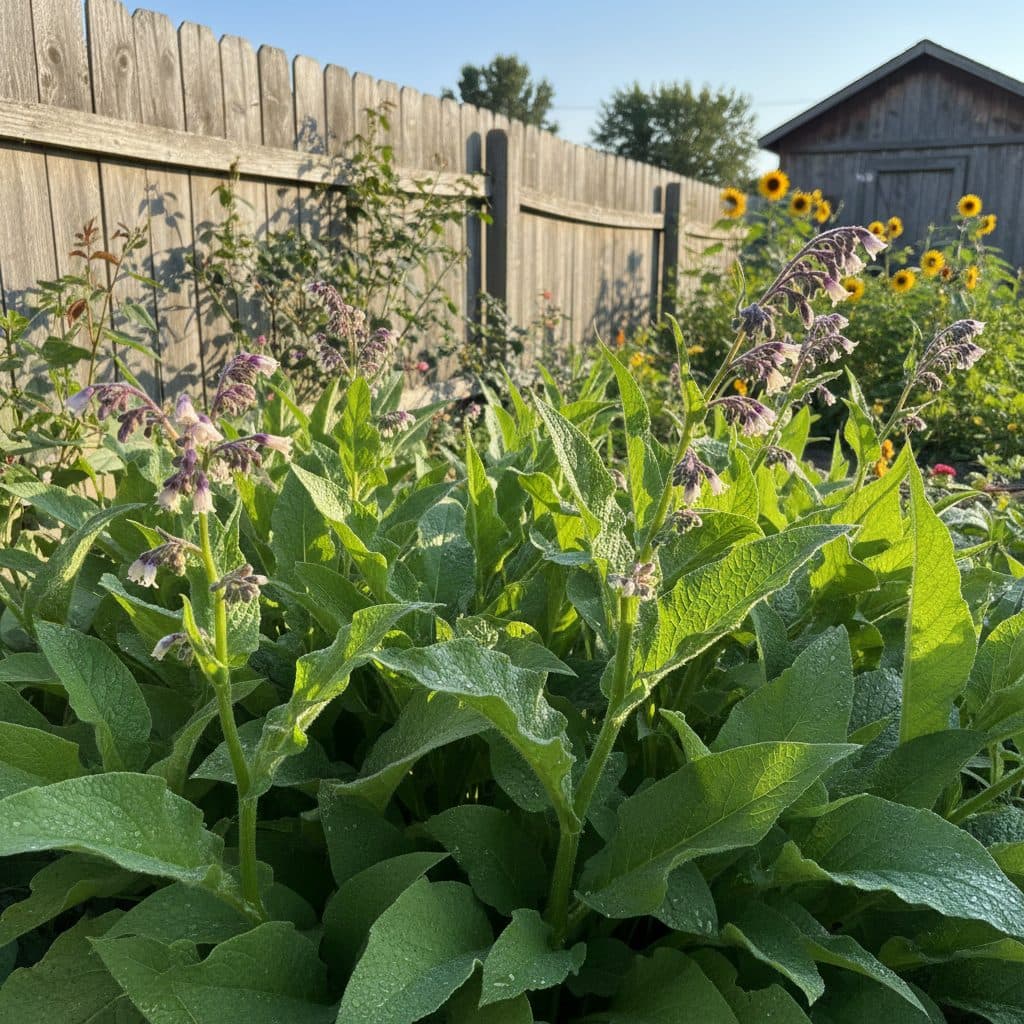
Key takeaways
- Comfrey (Symphytum x uplandicum ‘Bocking 14’) is a sterile hybrid, preventing unwanted spread in most US gardens.
- Its deep taproots, reaching 10 feet or more, draw up essential nutrients like potassium and phosphorus from subsoil layers.
- Comfrey leaves have a low carbon-to-nitrogen ratio, typically 10:1 to 15:1, making them an excellent compost activator.
- Using comfrey as a chop-and-drop mulch slows soil moisture loss and suppresses weed growth.
- Regular harvesting, four to five times per growing season, maximizes nutrient cycling and plant vigor.
- While beneficial for soil, comfrey contains pyrrolizidine alkaloids, so its use in home apothecary should be strictly external.
Quick answer: Comfrey (Symphytum x uplandicum ‘Bocking 14’) significantly improves garden soil health by acting as a nutrient accumulator, compost activator, and effective mulch. Its deep roots draw up subsoil nutrients, which are then released to shallow-rooted plants when used as chop-and-drop or in compost.
Across the United States, from the humid summers of USDA zone 8 in the Southeast to the cooler growing seasons of zone 4 in the Upper Midwest, gardeners are constantly seeking ways to improve soil health and plant vitality. Many turn to compost and mulches, but few realize the significant contribution a single plant can make. Comfrey, specifically the sterile hybrid Symphytum x uplandicum ‘Bocking 14’, stands out as a remarkable ally in this endeavor.
This perennial herb, known for its rapid growth and deep root system, acts as both a potent compost activator and a nutrient-rich dynamic-accumulator mulch. Its ability to mine subsoil nutrients and return them to the surface biomass offers a sustainable path to richer garden beds, reducing the need for external inputs and supporting a more resilient growing environment for your medicinal herb garden and beyond.
Comfrey’s deep roots and nutrient mining ability
Comfrey, particularly the ‘Bocking 14’ cultivar, is known for its extensive root system. These roots can penetrate the soil to depths of 10 feet or more, reaching beyond the typical feeding zones of most garden vegetables and annual herbs. This deep reach allows comfrey to access and accumulate micronutrients and minerals that have leached past the topsoil, effectively bringing them back to the surface in its foliage.
how comfrey accumulates nutrients
This idea, known in permaculture as dynamic accumulation, holds that the plant concentrates elements such as potassium, phosphorus, calcium, magnesium, and trace minerals within its leaves. When these leaves are harvested and used as mulch or compost, these previously inaccessible nutrients become available to shallow-rooted plants in the top 6 to 12 inches of soil. Comfrey leaves are notably high in potassium relative to most garden greens, which is what makes them useful as an organic fertilizer. In regions like the sandy soils of Florida’s USDA zone 9, where nutrient leaching can be a significant issue, comfrey’s ability to retrieve these elements is particularly beneficial.
- Potassium (K) for fruit and flower development.
- Phosphorus (P) for root growth and energy transfer.
- Calcium (Ca) for cell wall structure and disease resistance.
- Magnesium (Mg) for chlorophyll production.
- Trace minerals like iron, manganese, and boron.
Comfrey as a compost activator
A healthy compost pile relies on a balanced carbon-to-nitrogen (C:N) ratio to facilitate rapid decomposition. Many home composters struggle to find enough ‘green’ nitrogen-rich materials to balance ‘brown’ carbon-rich inputs like dry leaves and wood chips. This is where comfrey shines. Its fresh leaves boast a low C:N ratio, typically ranging from 10:1 to 15:1, which is comparable to that of alfalfa or grass clippings. This high nitrogen content acts as a powerful catalyst, accelerating the microbial activity that breaks down organic matter.
boosting decomposition rates
Adding a layer of chopped comfrey leaves to your compost pile can significantly increase its temperature within 24 to 48 hours, signaling active decomposition. For a typical 3-foot by 3-foot compost bin, a 6-inch layer of fresh comfrey can provide the necessary nitrogen boost for a 2-foot layer of carbon-rich materials. This helps a pile finish faster. The USDA Natural Resources Conservation Service emphasizes the importance of balanced C:N ratios for efficient composting [1]. Using a wooden-handle garden fork to turn the pile after adding comfrey helps distribute the nitrogen evenly.
- Provides a balanced C:N ratio for microbes.
- Increases compost pile temperature quickly.
- Speeds up the decomposition process by weeks.
- Adds a broad spectrum of accumulated micronutrients.
- Reduces reliance on purchased compost activators.
Comfrey as a dynamic-accumulator mulch
Beyond its role in compost, comfrey excels as a direct mulch, sometimes referred to as ‘chop and drop.’ This method involves cutting the leafy biomass and laying it directly onto garden beds around plants. The benefits are multifold: it suppresses weeds, retains soil moisture, and slowly releases its stored nutrients as it decomposes. In dry climates, such as parts of California’s USDA zone 9, a mulch layer shades the soil surface, slows evaporation, and reduces how often you need to irrigate.
benefits of chop-and-drop mulching
When applied as mulch, comfrey leaves create a dense barrier that shades the soil, preventing weed seeds from germinating and competing with desired crops. As the leaves break down, they release their rich store of potassium, nitrogen, and other minerals directly into the topsoil, feeding the plants above. This slow-release fertilization minimizes nutrient runoff, making it an efficient and sustainable feeding strategy. A 2-inch thick layer of comfrey mulch around plants like Garden Pea or Garden Sage can provide consistent nourishment throughout their growing season, often lasting four to six weeks before needing replenishment.
- Suppresses weed growth effectively.
- Retains soil moisture, reducing watering needs.
- Provides a slow-release source of essential nutrients.
- Builds soil organic matter over time.
- Protects soil from erosion and temperature fluctuations.
Growing comfrey in the home garden
Establishing a comfrey patch is relatively straightforward, especially with the ‘Bocking 14’ cultivar, which is sterile and will not spread by seed. This is an important distinction from common comfrey (Symphytum officinale), which can become invasive. ‘Bocking 14’ is typically grown from root cuttings or crowns, planted in early spring or fall. Choose a site with full sun to partial shade and well-drained soil. In USDA zone 6, planting root cuttings 3 to 6 inches deep and 2 to 3 feet apart will allow for robust growth.
planting and care for optimal yield
Once established, comfrey is remarkably low-maintenance. It tolerates a wide range of soil types, though it thrives in rich, moist loam. Regular watering, especially during dry spells, will promote lush growth. The first harvest can usually be taken in late spring or early summer, about 10 to 12 weeks after planting. Subsequent harvests can occur every four to six weeks, yielding four to five cuts per growing season in many US regions. Using a lightweight garden hand trowel can make planting root cuttings easier. For optimal nutrient accumulation, avoid harvesting after late summer to allow the plant to store energy for winter dormancy.
- Plant ‘Bocking 14’ root cuttings in spring or fall.
- Provide full sun to partial shade and well-drained soil.
- Space plants 2 to 3 feet apart for mature growth.
- Water regularly, especially during dry periods.
- Harvest leaves every four to six weeks for maximum biomass.
Practical considerations and management
While ‘Bocking 14’ comfrey is sterile and won’t spread by seed, its vigorous root system can still make it challenging to remove once established. It’s best to choose a permanent location for your comfrey patch, perhaps in a dedicated area of the garden or along a fence line. Consider planting it where it won’t compete directly with other plants for space, as a single mature plant can have a diameter of 3 to 4 feet. The ATTRA / NCAT Sustainable Agriculture program often recommends careful placement of perennial crops to avoid future management issues [4].
managing comfrey for longevity
To maintain plant health and maximize biomass production, regular harvesting is key. Cutting the leaves back to 2 inches from the ground encourages new growth and prevents the plant from flowering, which can divert energy from leaf production. If you notice yellowing leaves or stunted growth, a soil test might be in order. A soil moisture meter can help ensure consistent hydration, as comfrey prefers consistently moist soil. In cooler regions like upstate New York, a light winter mulch of straw can protect crowns, though comfrey is generally hardy down to USDA zone 4.
- Select a permanent location to avoid difficult removal.
- Harvest regularly to encourage new leaf growth.
- Monitor soil moisture, aiming for consistent hydration.
- Consider a soil test if plant vigor declines.
- Protect crowns in colder zones with a light winter mulch.
Comfrey in the home apothecary: external uses only
While comfrey is a powerhouse for the garden, its use in the home apothecary requires careful consideration due to the presence of pyrrolizidine alkaloids (PAs). These compounds are present in all comfrey, including ‘Bocking 14’, and are most concentrated in the roots and older leaves. They can be toxic to the liver if ingested. Therefore, all internal use of comfrey is strongly discouraged. However, for external applications, comfrey has a long history of traditional use, including among settlers in Appalachia.
traditional external applications
Comfrey’s external applications are primarily due to allantoin, a compound that promotes cell proliferation and tissue regeneration. It has been traditionally used to soothe bruises, sprains, and skin irritations. A poultice made from crushed fresh comfrey leaves can be applied directly to affected areas, or a salve can be prepared from dried leaves infused in oil. Always perform a patch test on a small area of skin first to check for any sensitivities, and avoid applying to broken skin. A typical salve might contain 1 part dried comfrey to 5 parts carrier oil, infused for 2 to 3 weeks.
- Soothes bruises and minor sprains.
- Traditionally used on closed bruises and strains — never on broken skin.
- Reduces inflammation from insect bites.
- Relieves muscle soreness and joint discomfort.
- Promotes skin cell regeneration due to allantoin.
Comfrey ‘Bocking 14’ vs. common comfrey
Feature | Symphytum x uplandicum ‘Bocking 14’ | Symphytum officinale (Common Comfrey) |
|---|---|---|
Seed production | Sterile (no viable seeds) | Produces viable seeds |
Spread | Spreads only by root division (manageable) | Spreads aggressively by seed and root |
Alkaloid content | Contains pyrrolizidine alkaloids, including echimidine; not a lower-toxicity choice than common comfrey | Contains pyrrolizidine alkaloids; concentrations are highest in the roots |
Growth habit | Robust, upright growth, up to 3-4 feet tall | Variable, can be less vigorous, 2-3 feet tall |
Garden use | Ideal for chop-and-drop, compost activator | Use with caution due to invasiveness |
Deep root system: Comfrey’s taproots can extend over 10 feet deep, drawing up subsoil nutrients like potassium and phosphorus that are unavailable to most garden plants.
Compost accelerator: With a low carbon-to-nitrogen ratio of 10:1 to 15:1, fresh comfrey leaves are a strong nitrogen source that will push a carbon-heavy pile’s temperature up within a day or two.
Water retention: A 2-inch layer of comfrey mulch shades the soil surface and slows evaporation, lowering irrigation needs in dry climates.
Frequently asked questions
What is the best type of comfrey for a home garden?
For most home gardeners in US USDA zones 4 through 9, <i>Symphytum x uplandicum</i> ‘Bocking 14’ is the preferred cultivar. It is a sterile hybrid, meaning it does not produce viable seeds, which prevents it from becoming invasive like common comfrey (<i>Symphytum officinale</i>).
How often should I harvest comfrey for mulch or compost?
Established comfrey plants can be harvested four to five times per growing season. You can typically take a cut every four to six weeks, starting in late spring when the plants are about 18 to 24 inches tall. Leave at least 2 inches of stem to encourage rapid regrowth.
Can comfrey be used on all garden plants?
Yes, comfrey mulch and compost can benefit almost all garden plants, from vegetables like tomatoes and peppers to fruit trees and ornamental shrubs. Its steady nutrient release and soil-building properties suit almost any bed.
Is comfrey safe for internal use?
No, comfrey should not be used internally. It contains pyrrolizidine alkaloids, which can be toxic to the liver if ingested. Its use in the home apothecary should be strictly limited to external applications, such as poultices or salves for unbroken skin, following traditional guidelines.
How much comfrey do I need for a typical garden?
For a small to medium-sized home garden, three to five established ‘Bocking 14’ comfrey plants can provide a substantial amount of biomass. A single plant can yield 10 to 15 pounds of fresh leaves per season, enough to mulch a 50 square foot area multiple times.
Does comfrey attract pests or diseases?
Comfrey is generally robust and resistant to most common garden pests and diseases. Its strong scent may even deter some pests. However, in very wet conditions, it can occasionally be susceptible to powdery mildew, especially if air circulation is poor, which can be mitigated by proper spacing of 2 to 3 feet between plants.
References
- USDA Natural Resources Conservation Service (2024). USDA Natural Resources Conservation Service.
- EPA — Soak Up the Rain (2024). EPA — Soak Up the Rain.
- SARE — Sustainable Agriculture Research & Education (2023). SARE — Sustainable Agriculture Research & Education.
- ATTRA / NCAT Sustainable Agriculture (2023). ATTRA / NCAT Sustainable Agriculture.
- USDA National Agroforestry Center (2023). USDA National Agroforestry Center.