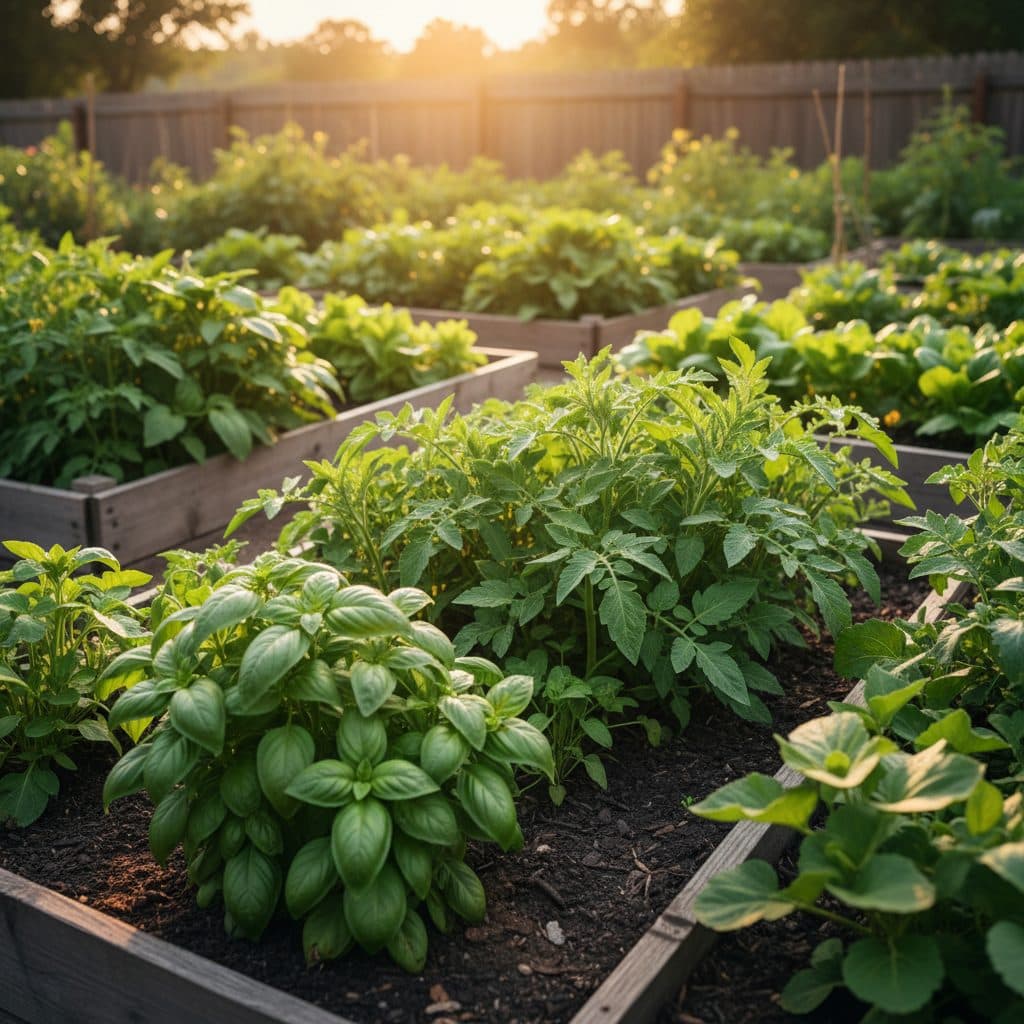
Key takeaways
- Plant guilds are intentionally designed communities where multiple species support a central plant, mimicking natural ecosystems.
- Guilds typically include a central plant, nitrogen fixers, dynamic accumulators, pest deterrents, and groundcovers.
- Designing a guild requires assessing your site’s climate, soil, and sun exposure, especially your USDA plant hardiness zone.
- Examples like an apple guild in USDA zone 5 can cut the fertilizer, mulch, and irrigation you bring in from outside, and make the planting more productive than the same trees grown in bare ground.
- Integrating guilds into larger permaculture designs, such as food forests and swales, improves water retention and biodiversity.
- Established guilds hold soil moisture better than bare ground and give pest predators somewhere to live, so both watering and intervention tend to fall over several years.
Quick answer: Permaculture plant guilds are intentionally designed communities of multiple plant species that cooperatively support a central plant, mimicking natural ecosystems to reduce external inputs, build soil, and deter pests. They increase resilience and productivity by creating self-supporting miniature ecosystems.
In the dry plains of eastern Colorado, where annual rainfall averages just 15 inches, growers face significant challenges in maintaining productive gardens. Traditional row cropping often requires substantial irrigation, but a different approach — permaculture plant guilds — offers a path toward greater self-sufficiency and resilience. These intentionally designed plant communities mimic natural ecosystems, working together to conserve water, build soil fertility, and deter pests, often reducing external inputs by 50% or more over several years.
A plant guild is a collection of species that cooperatively support a central plant, typically a fruit tree or shrub, creating a miniature ecosystem. For example, a mature apple tree in USDA zone 5 might be surrounded by nitrogen-fixing clover, deep-rooted Bocking 14 comfrey, and pest-deterring chives. This integrated system aims to reduce labor, minimize disease and pest pressure, and make the planting more productive overall than the same species grown in isolation.
Understanding plant guilds and their benefits
A plant guild is a strategic grouping of plants that work together to create a thriving, low-maintenance ecosystem, centered around a main crop, often a fruit tree. Unlike a simple companion planting of two or three species, a guild typically involves five to seven or more different plant types, each fulfilling a specific function. This multi-species approach builds resilience and productivity, reducing the need for external inputs like fertilizers and pesticides over time. For instance, in a temperate climate like USDA zone 6, an apple tree might be the central plant, surrounded by a diverse community.
the core components of a functional guild
Each plant in a guild plays a role, contributing to the health and productivity of the entire system. These roles include nutrient cycling, pest management, and soil improvement, leading to a more productive growing space. Nitrogen-fixing plants build nitrogen into their own tissue and root nodules. Most of it reaches neighboring plants only as that tissue dies back or is cut and dropped, so treat a nitrogen fixer as a slow mulch crop rather than a fertilizer injection. A well-established guild can also improve soil structure, so water soaks into heavy clay instead of running off it.
- Central plant: The primary crop, often a fruit tree like apple, pear, or peach, or a large shrub.
- Nitrogen fixers: Plants like clover, vetch, or lupine that convert atmospheric nitrogen into a form usable by other plants.
- Dynamic accumulators: Deep-rooted plants such as Bocking 14 comfrey (the sterile cultivar — common comfrey seeds itself through a bed) or dandelion, whose leaves make a mineral-rich mulch when cut and dropped.
- Pest deterrents/attractors: Aromatic herbs like chives, garlic, or marigolds that repel pests or flowering plants that attract beneficial insects.
- Groundcovers: Plants like strawberries or creeping thyme that suppress weeds, retain soil moisture, and protect the soil surface from erosion.
Designing your first guild
Designing a plant guild begins with a thorough understanding of your site’s conditions. This includes assessing your USDA plant hardiness zone, which dictates what plants can survive your winter temperatures, and understanding local rainfall patterns, which might range from 15 inches in arid regions to over 60 inches in the Pacific Northwest. Consider the amount of sunlight your chosen area receives daily — most fruit trees require at least six to eight hours of direct sun for optimal fruit production. Soil testing also matters; a basic test can reveal pH levels and nutrient deficiencies, which guides your plant and soil amendment choices.
site assessment and plant selection
Once you have a clear picture of your site, you can begin selecting your central plant and its supporting cast. For example, in USDA zone 5, a ‘Honeycrisp’ apple tree could be your central plant. Then, consider plants that fulfill the various guild roles while also thriving in your specific microclimate. Remember that a guild is typically a circular area, often 10 to 15 feet in diameter, centered around the main plant. For more detailed guidance on site analysis, refer to our article on permaculture design: how to read a site before you plant it.
- Assess sunlight: Determine hours of direct sun, aiming for six to eight hours for most fruit trees.
- Test soil: Check pH and nutrient levels; ideal pH for many fruit trees is 6.0 to 7.0.
- Know your USDA zone: Essential for selecting cold-hardy plants; ‘Fuji’ apple is generally rated zones 5-8 and needs a long, warm season to color and sweeten properly.
- Observe water flow: Note areas where water collects or drains rapidly, influencing plant placement.
- Consider microclimates: Identify warmer or cooler spots due to buildings or fences, which can extend growing seasons by several weeks.
Key guild components and examples
The effectiveness of a plant guild hinges on selecting species that complement each other and thrive in your local conditions. For instance, in USDA zone 7, a peach tree could be the central element. Around it, you might plant white clover as a nitrogen fixer. Comfrey — plant only the sterile Bocking 14 cultivar (Symphytum × uplandicum) — roots deeply and makes a great deal of leaf, so cutting it several times a season gives you a potassium-rich mulch that feeds the peach tree as it breaks down. The wider ‘dynamic accumulator’ idea, that it mines subsoil minerals and hands them to its neighbors, is a permaculture rule of thumb rather than a measured effect. Comfrey is mulch, not food or fodder: its pyrrolizidine alkaloids are hepatotoxic.
examples of successful plant pairings
Pest deterrents are another critical component. Garlic and chives around the base of a fruit tree add early flowers for beneficial insects and cost nothing to try, but do not rely on them for pest control. There is no good evidence that alliums deter trunk borers, which need trunk inspection, mechanical removal, or a targeted control instead. Marigolds can deter nematodes in the soil. Groundcovers like strawberries or creeping thyme shade the soil, which suppresses weed germination and slows evaporation, so the top few inches stay moister than bare ground. For more ideas on beneficial plant relationships, explore our article on companion planting: what to plant together (and what to keep apart).
- Apple tree (central): ‘Liberty’ or ‘Enterprise’ varieties, suitable for USDA zones 4-7.
- Comfrey (dynamic accumulator): Bocking 14, a sterile variety, growing 2 to 3 feet tall and wide.
- White clover (nitrogen fixer/groundcover): Spreads readily, covers 10 square feet per plant, fixes nitrogen.
- Chives/Garlic: Planted in a ring 1 to 2 feet from the trunk, they add early flowers for beneficial insects; do not count on them as pest control.
- Yarrow (beneficial insect attractor): Grows 2 feet tall, attracts ladybugs and lacewings that prey on aphids.
Integrating guilds into a larger permaculture design
Plant guilds are powerful on their own, but their impact multiplies when integrated into a broader permaculture design, such as a food forest or a zoned garden. A food forest, for example, is a multi-layered plant community that mimics a natural woodland, incorporating seven distinct layers of vegetation from tall canopy trees to groundcovers and root crops [5]. Guilds form the building blocks within these layers, with each guild centered around a canopy or understory tree. This approach can create incredibly productive systems, yielding a diverse range of foods and other resources over many decades.
zones, swales, and food forests
Consider how guilds fit into permaculture zones, where Zone 1 is closest to the home and Zone 5 is wild. A productive fruit tree guild might be placed in Zone 2, where it receives regular attention but doesn’t demand daily care. Swales, which are earthworks designed to slow, spread, and sink water into the landscape, are excellent partners for guilds. A well-designed swale slows, spreads, and sinks runoff along its contour, directing moisture to the roots of guild plants below it. How much it can take depends on your soil’s intake rate, the swale’s cross-section, and the storm — size yours from a percolation test rather than a rule of thumb. This meaningfully reduces irrigation needs, most of all in drier climates. For more on planning your entire site, see our article on a permaculture garden plan: zones, guilds, and a first-year layout.
- Food forests: Utilize seven layers of plants, with guilds forming the core productive units [5].
- Zoning: Place high-maintenance guilds (e.g., young fruit trees) in Zone 1 or 2 for easier access.
- Swales: Plant guilds along the downhill edge of swales to benefit from increased soil moisture, potentially doubling water availability.
- Keyline design: Use contour lines to guide swale placement, maximizing water distribution across a property, often covering several acres.
- Biodiversity: A diverse food forest with multiple guilds supports far more beneficial insects and wildlife than a monoculture.
Soil Health: A 4-inch layer of wood chip mulch keeps most weed seed from germinating and slows evaporation from the soil surface, benefiting guild plants.
Water Retention: A swale holds runoff on contour long enough for it to soak in rather than leave the site. One inch of rain drops roughly 27,000 gallons on an acre, and the swale’s job is to keep as much of that in the soil profile as your ground will accept.
Frequently asked questions
How long does it take for a plant guild to establish?
Typically 3 to 5 years for a fruit tree guild to become self-sustaining, with initial yields starting in year two or three. During this period, regular observation and some minor adjustments are important for optimal growth.
Can I build a plant guild in a small backyard?
Yes, even a 10 ft by 10 ft space can support a small fruit tree guild built around one dwarf tree. One thing the guild cannot supply, though, is pollination: most apples, pears, plums, and sweet cherries are not self-fertile, so you need a second compatible variety flowering at the same time within bee range, or a multi-graft tree, or you will get blossom and no fruit. The principles scale down effectively for smaller areas.
What’s the difference between companion planting and a plant guild?
Companion planting focuses on two or three beneficial plant relationships, often for pest control or growth enhancement. A guild, however, involves five to seven or more species supporting a central plant in a multi-layered system, often over a 10-foot diameter, creating a more complete miniature ecosystem.
Do plant guilds require less water?
Once established, guilds with deep-rooted plants and thick mulch layers need less irrigation than conventional gardens. This is due to improved soil moisture retention and reduced evaporation.
Are plant guilds suitable for all USDA zones?
While principles apply broadly, specific plant choices must match your USDA zone’s climate. For instance, citrus guilds thrive in zones 9-11, while apple guilds are common and highly productive in zones 3-8. Research local plant varieties for best results.
How do plant guilds deter pests?
Guilds use diverse strategies, including aromatic plants that confuse pests, trap crops that draw pests away, and flowering plants that attract beneficial insects like ladybugs. This biological control minimizes the need for chemical interventions.
References
- USDA Natural Resources Conservation Service (2024). USDA Natural Resources Conservation Service.
- EPA — Soak Up the Rain (2024). EPA — Soak Up the Rain.
- SARE — Sustainable Agriculture Research & Education (2023). SARE — Sustainable Agriculture Research & Education.
- ATTRA / NCAT Sustainable Agriculture (2023). ATTRA / NCAT Sustainable Agriculture.
- USDA National Agroforestry Center (2023). USDA National Agroforestry Center.