Key takeaways
- Aim for a PPFD of 150-300 µmol/m²/s for most leafy greens, adjusting for growth stage and species.
- A balanced light spectrum with significant red (600-700 nm) and blue (400-500 nm) light promotes optimal growth and morphology.
- Provide 12-18 hours of light daily, ensuring a consistent dark period for plant respiration and development.
- LED fixtures offer superior energy efficiency, often reducing electricity consumption by 40% compared to traditional HPS lights.
- Measure light intensity with a PAR meter to ensure plants receive the correct Daily Light Integral (DLI) for robust growth.
- Reflective materials in grow spaces can increase light availability to plants by up to 20%, improving overall efficiency.
Quick answer: Optimizing grow lights for leafy greens involves balancing Photosynthetic Photon Flux Density (PPFD) between 150-300 µmol/m²/s, providing a balanced light spectrum with significant red and blue light, and ensuring 12-18 hours of daily light with a consistent dark period.
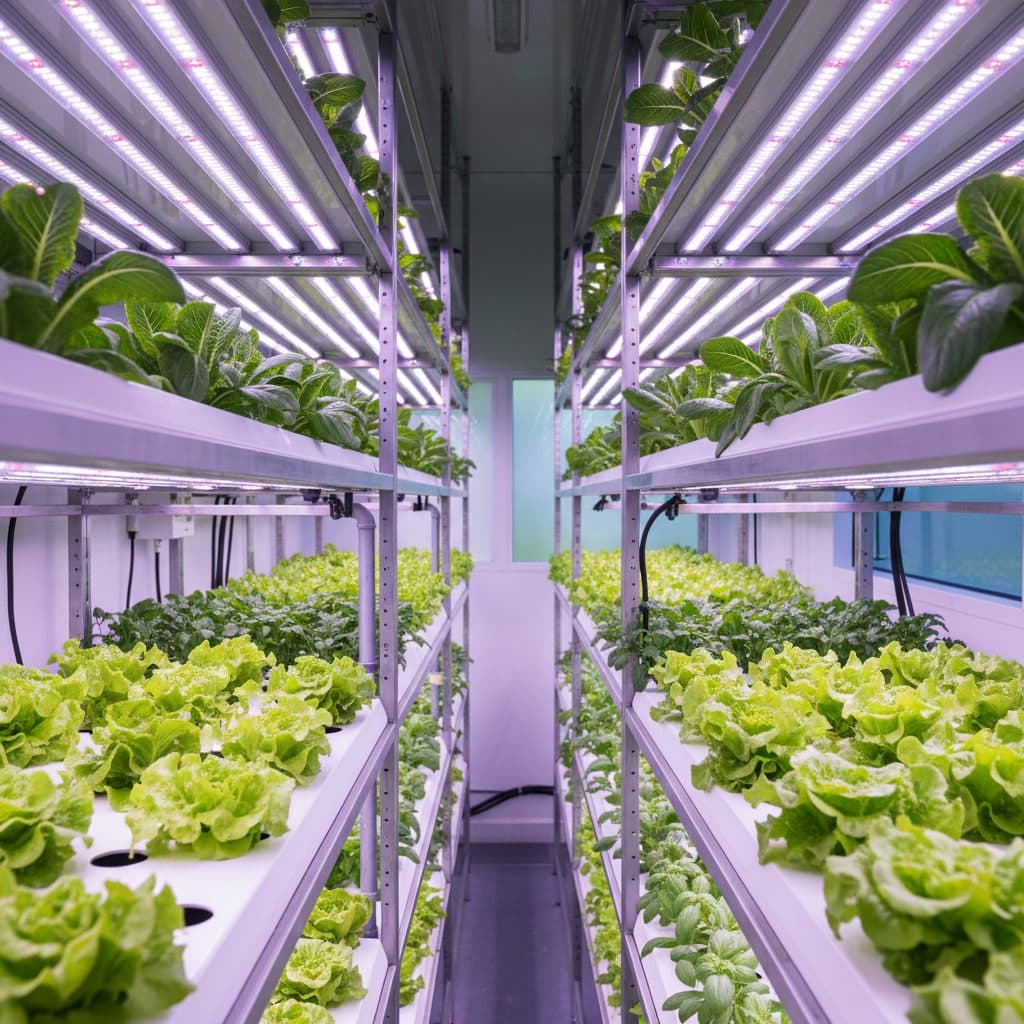
For growers in USDA zone 7, where winter days offer limited natural light, supplemental grow lighting can extend the growing season for leafy greens year-round. In controlled environments like hydroponic setups, light is often the most critical factor after nutrient delivery, directly influencing plant growth, nutrient content, and overall yield. Many commercial operations, such as those in the arid climate of Arizona, see increased winter production by carefully managing their lighting schedules and intensities.
Managing Photosynthetic Photon Flux Density (PPFD), light spectrum, and daily light hours determines how well indoor leafy greens grow. Balancing these factors produces sturdy plants and steady yields across both home shelving and commercial setups.
Understanding PPFD: the measure of usable light
Photosynthetic Photon Flux Density, or PPFD, quantifies the amount of photosynthetically active radiation (PAR) that actually reaches your plants. It’s measured in micromoles per square meter per second (µmol/m²/s) and represents the light intensity available for photosynthesis. For most leafy greens like lettuce, spinach, and kale, an optimal PPFD range typically falls between 150 and 300 µmol/m²/s for vegetative growth [1]. Going too high can stress plants and waste energy, while too low will result in slow, leggy growth.
Measuring and adjusting PPFD
To accurately measure PPFD, a PAR meter is indispensable. These devices provide precise readings, allowing you to adjust your light fixtures’ height or intensity to achieve the target PPFD. For instance, if your lettuce is receiving only 100 µmol/m²/s, lowering your light by six inches might increase the reading to 180 µmol/m²/s. Reflective surfaces, like the interior of a reflective indoor grow tent, can significantly improve light distribution and increase PPFD across the canopy, ensuring more uniform plant growth.
- Seedling stage: 100-150 µmol/m²/s for one to two weeks.
- Vegetative growth: 150-300 µmol/m²/s for most leafy greens.
- Flowering/fruiting (not typical for greens): 400-600+ µmol/m²/s.
- Light distance: Adjust fixture height to achieve target PPFD, often 12-24 inches above canopy.
- Uniformity: Aim for less than a 10% variation in PPFD across the growing area.
The importance of light spectrum for plant development
The light spectrum, or the specific wavelengths of light emitted by your grow fixture, profoundly impacts plant morphology, pigment production, and overall growth. Plants primarily use red and blue light for photosynthesis, but other wavelengths also play roles. For instance, blue light (400-500 nm) promotes compact growth, thicker leaves, and can increase the nutritional value of greens. On the other hand, red light (600-700 nm) is crucial for stem elongation, leaf expansion, and driving photosynthesis, often contributing up to 80% of the photosynthetic activity.
balancing red and blue light
While red and blue light are dominant, a balanced spectrum that includes some green light (500-600 nm) and even far-red light (700-800 nm) can be beneficial. Green light penetrates deeper into the plant canopy, reaching lower leaves that might otherwise be shaded, and can contribute to total photosynthesis in dense canopies. Many modern LED fixtures offer adjustable spectrums, allowing growers to fine-tune light recipes for specific crops like mustard greens or different growth stages, potentially increasing biomass.
- Blue light (400-500 nm): Promotes compact growth, strong stems, and chlorophyll production.
- Green light (500-600 nm): Penetrates deeper, contributes to photosynthesis, and influences plant signaling.
- Red light (600-700 nm): Essential for photosynthesis, stem elongation, and flowering (though less critical for leafy greens).
- Far-red light (700-800 nm): Can enhance stem elongation and leaf area, but too much can cause stretch.
- UV light (280-400 nm): Can increase secondary metabolite production, like antioxidants, by a few percent.
Daily light hours and the daily light integral (DLI)
Beyond intensity and spectrum, the duration of light exposure, or photoperiod, is crucial. For most leafy greens, a daily light period of 12 to 18 hours is ideal, followed by a consistent dark period of six to twelve hours. This dark period allows for plant respiration, nutrient translocation, and metabolic processes that occur when photosynthesis is inactive. Interrupting the dark period can stress plants and reduce growth.
Calculating daily light integral
The Daily Light Integral (DLI) is a cumulative measure of the total amount of PAR light a plant receives over a 24-hour period, expressed in moles of light per square meter per day (mol/m²/day). It combines PPFD and photoperiod, providing a more comprehensive understanding of a plant’s light needs. For example, a head of romaine lettuce typically requires a DLI of 12-17 mol/m²/day to reach maturity. You can calculate DLI by multiplying your average PPFD (in µmol/m²/s) by the number of seconds in your light period, then dividing by 1,000,000 to convert micromoles to moles. A 3-in-1 soil pH, moisture & light meter can give you a basic light reading, but a PAR meter is needed for DLI calculations.
- Lettuce: 12-17 mol/m²/day for optimal growth.
- Spinach: 10-15 mol/m²/day.
- Kale: 14-20 mol/m²/day.
- Herbs (basil, mint): 10-15 mol/m²/day.
- Dark period: A minimum of six hours is essential for plant health.
Choosing the right grow light fixtures
The market offers several types of grow light fixtures, each with distinct advantages and drawbacks for leafy green cultivation. LED (Light Emitting Diode) lights are widely favored for their energy efficiency, long lifespan (often 50,000+ hours), and customizable spectrums. They can reduce electricity costs compared to older technologies, making them a cost-effective choice in the long run. While the initial investment for quality LEDs can be higher, their operational savings and precise control over light quality often justify the expense for commercial and serious home growers.
Comparing light technologies
Fluorescent lights, such as T5 HO (High Output) bulbs, are a more affordable option for smaller setups or for starting seedlings, providing a decent spectrum and lower heat output. However, their efficiency is lower than LEDs, and bulbs typically need replacement every 10,000-20,000 hours. High-Intensity Discharge (HID) lights, including Metal Halide (MH) and High-Pressure Sodium (HPS) lamps, offer very high light output suitable for large-scale operations or fruiting plants, but they generate significant heat and consume more energy, often requiring additional cooling systems. For leafy greens, which prefer cooler temperatures around 65-70°F, managing heat from HIDs can be a challenge, unlike the more temperature-neutral LEDs. Heat lamps designed for livestock produce warmth rather than the photosynthetically active radiation required for plant growth, making them unsuitable for crops.
- LEDs: High efficiency, long lifespan, customizable spectrum, low heat, higher upfront cost.
- T5 Fluorescents: Affordable, good for seedlings, lower heat, moderate efficiency, shorter lifespan.
- Metal Halide (MH): Good for vegetative growth, high light output, high heat, moderate efficiency.
- High-Pressure Sodium (HPS): Excellent for flowering/fruiting, high light output, very high heat, moderate efficiency.
- Fixture placement: Ensure even light distribution over the entire canopy, typically 12-36 inches depending on light type.
Grow light technology comparison for leafy greens
Feature | LED Lights | T5 Fluorescent | HID (MH/HPS) |
|---|---|---|---|
Energy Efficiency | Excellent (40%+ savings) | Good | Moderate to Low |
Lifespan (hours) | 50,000 – 100,000+ | 10,000 – 20,000 | 10,000 – 24,000 |
Heat Output | Low | Low to Moderate | High |
Spectrum Control | Highly Customizable | Fixed (daylight/cool white) | Fixed (blue for MH, red for HPS) |
Initial Cost | High | Low to Moderate | Moderate |
Best Use for Greens | All stages, commercial & home | Seedlings, small setups | Not ideal (high heat, spectrum) |
PPFD for Greens: Most leafy greens thrive with a Photosynthetic Photon Flux Density (PPFD) between 150 and 300 µmol/m²/s for optimal vegetative growth.
LED Energy Savings: Switching to LED grow lights can reduce electricity consumption by 40% or more compared to older lighting technologies [2].
DLI for Lettuce: Romaine lettuce typically requires a Daily Light Integral (DLI) of 12-17 mol/m²/day to reach maturity.
Frequently asked questions
What is the ideal PPFD for growing lettuce indoors?
For most varieties of lettuce, an ideal PPFD (Photosynthetic Photon Flux Density) range is between 150 and 250 µmol/m²/s during the vegetative growth phase. This intensity supports robust growth without causing stress, typically allowing a head to mature.
How many hours of light do leafy greens need per day?
Leafy greens generally require 12 to 18 hours of light per day, followed by a consistent dark period of 6 to 12 hours. This ensures adequate photosynthesis and allows for essential metabolic processes to occur, contributing to an increase in biomass over continuous light.
Is blue light or red light more important for leafy greens?
Both blue and red light are important for leafy greens. Blue light (400-500 nm) promotes compact growth and thicker leaves, while red light (600-700 nm) drives photosynthesis and leaf expansion. A balanced spectrum, often with a higher proportion of red, leads to the best overall development and can increase yields.
Can I use regular household LED bulbs as grow lights?
While regular household LED bulbs emit light, they are not optimized for plant growth. Their spectrum often lacks sufficient red and blue wavelengths, and their intensity (PPFD) is usually too low for proper photosynthesis. Dedicated grow lights provide the specific spectrum and intensity plants need.
What is Daily Light Integral (DLI) and why is it important?
Daily Light Integral (DLI) measures the total amount of photosynthetically active radiation a plant receives over a 24-hour period, expressed in mol/m²/day. It’s important because it accounts for both light intensity and duration, providing a comprehensive metric for a plant’s total light energy intake. For example, spinach thrives with a DLI of 10-15 mol/m²/day [1].
How does light affect food safety in hydroponic leafy greens?
While light directly impacts growth, its role in food safety is more indirect. Proper light management contributes to healthy, stress-free plants, which are less susceptible to certain issues. However, food safety in hydroponics is primarily managed through water quality, nutrient solution sanitation, and environmental controls, as detailed in research on improving food safety.
References
- Grow It: Leafy Greens (2020). Grow It: Leafy Greens.
- The Greens grow up (2016). The Greens grow up.
- Evaluation of lettuce germplasm for resistance to impatiens necrotic spot virus.
- Improving Food Safety of Hydroponic Leafy Greens (2025). Improving Food Safety of Hydroponic Leafy Greens.
- How bacteria infiltrate edible leafy greens.
- USDA Natural Resources Conservation Service.