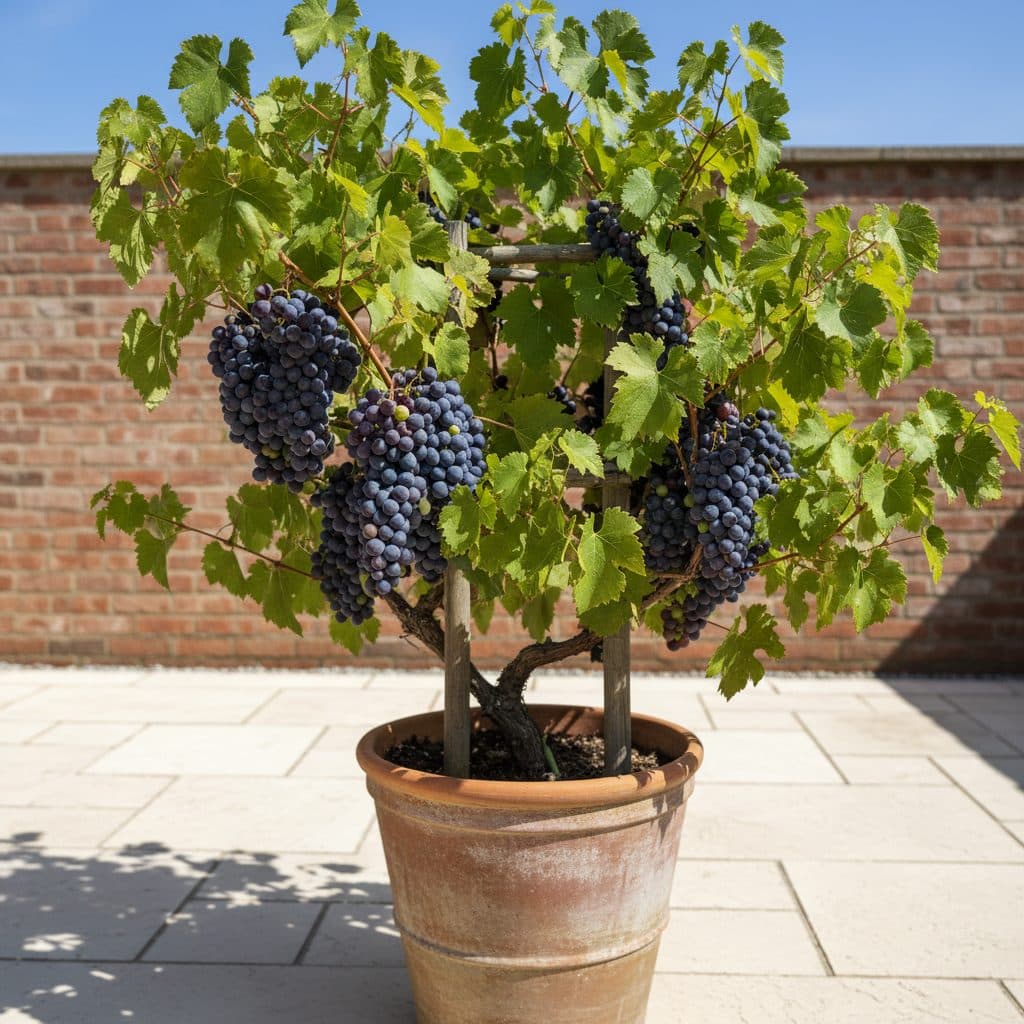
Key takeaways
- Select cold-hardy, self-pollinating grape varieties suitable for container growth, such as ‘Concord’ or ‘Himrod’, especially in USDA zones 5-8.
- Use a minimum 20-gallon container with excellent drainage, filled with a well-draining, bark-based potting mix.
- Implement careful dormant pruning and summer training to manage vine vigor and maximize fruit production.
- Provide consistent watering, especially during fruit development, and a balanced fertilizer regimen.
- Ensure adequate sun exposure, at least six to eight hours daily, for optimal growth and fruit quality.
- Protect container grapevines from winter damage by insulating pots or moving them to a sheltered location below 20°F.
Quick answer: To grow ‘Concord’ grapevines in containers on a patio in USDA zone 6, select cold-hardy varieties, use a minimum 20-gallon container with well-draining soil, ensure 6-8 hours of sun, and implement dormant pruning with winter protection. This approach allows for successful fruit production even in limited spaces.
Growing grapes on a patio in a container is a rewarding project, even for those in urban settings like Chicago, Illinois, where garden space is limited. With thoughtful planning, you can harvest your own fruit from a vine thriving in a pot as small as 20 gallons. This approach allows gardeners in USDA zones 5 through 9 to cultivate varieties that might otherwise struggle with ground soil conditions or space constraints, providing a yield of several pounds of fruit per mature vine.
Success hinges on selecting the right grape variety, providing an adequately sized container, and understanding specific pruning techniques. ‘Reliance’ is a good pick for cooler, shorter-season areas such as the Pacific Northwest. The key is to mimic optimal growing conditions while adapting to the confined space of a container, ensuring the vine receives sufficient nutrients and sunlight—typically six to eight hours daily.
Choosing the right grape variety for container growth
Selecting an appropriate grape variety is the first critical step for container success. For US patios, look for varieties known for their cold hardiness, self-pollinating nature, and moderate vigor. ‘Concord’ (Vitis labrusca), a classic American grape, is an excellent choice for USDA zones 5-8 due to its robust nature and reliable fruit production. Other suitable options include ‘Himrod’, a seedless white grape hardy to USDA zone 5, and ‘Reliance’, another seedless red variety that performs well in containers.
consider disease resistance and vigor
When selecting, prioritize disease-resistant varieties to minimize maintenance. For instance, ‘Mars’ shows better resistance to common fungal issues than ‘Niagara’, which is prone to downy mildew and black rot. Also, consider the vine’s natural vigor; extremely vigorous varieties might become unmanageable in a pot. A moderate-vigor vine, like ‘Mars’ (a seedless blue grape), will be easier to train and prune, requiring less frequent intervention. Many nurseries offer bare-root vines in early spring, which establish quickly in containers. Ensure the chosen variety is also self-pollinating to guarantee fruit set without needing a second plant.
- ‘Concord’ (blue, seeded, USDA zones 5-8)
- ‘Himrod’ (white, seedless, USDA zones 5-8)
- ‘Reliance’ (red, seedless, USDA zones 5-8)
- ‘Niagara’ (white, seeded, USDA zones 5-8)
- ‘Mars’ (blue, seedless, USDA zones 5-8)
Pot size and growing medium requirements
The container’s size directly impacts the grapevine’s health and productivity. A mature grapevine needs a minimum of a 20-gallon container to accommodate its extensive root system and provide sufficient soil volume for moisture and nutrient retention. For larger varieties, a 25-gallon or even 30-gallon pot can offer more stability and growth potential. Ensure the pot has ample drainage holes—at least four to six holes, each 0.5 to 1 inch in diameter—to prevent waterlogging, which is detrimental to grapevines.
crafting the ideal potting mix
A well-draining, nutrient-rich potting mix is crucial. Standard garden soil is too heavy and compacts easily in containers, restricting root development. A good mix should include pine bark fines (50-60%), peat moss or coco coir (20-30%), and perlite or coarse sand (10-20%). This combination provides excellent aeration and drainage while retaining necessary moisture. Adding a slow-release granular fertilizer, such as a 10-10-10 formulation at planting, can provide initial nutrients for up to three months. When potting, use a small hand shovel like this lightweight garden trowel to carefully fill around the roots. Monitor soil moisture regularly with a soil moisture meter to maintain consistent hydration, especially during the hot summer months when temperatures can exceed 90°F in many US regions.
- Minimum 20-gallon pot capacity
- At least four 0.5-inch drainage holes
- 50-60% pine bark fines for drainage
- 20-30% peat moss or coco coir for moisture retention
- 10-20% perlite or coarse sand for aeration
Pruning and training for container grapevines
Pruning is perhaps the most critical aspect of growing grapes in containers, influencing both vine shape and fruit production. For container grapes, the cane pruning method is generally preferred over spur pruning, as it helps manage vigor in a confined space. Each winter, typically in late January or early February in USDA zone 6, you will remove about 90% of the previous season’s growth, leaving only one to four fruiting canes and one to two renewal spurs. This aggressive pruning encourages new, productive growth for the upcoming season, aiming for far fewer buds than the 30-60 a full-size vineyard vine carries.
establishing a sturdy trellis system
A strong trellis system is essential to support the vine’s weight, especially when laden with fruit. For patio containers, a simple two-wire trellis or an obelisk-style support works well. Install the trellis at planting, ensuring it’s securely anchored in the pot or to a nearby structure. Train the main trunk vertically up the support, tying it loosely with soft ties every 6-12 inches as it grows. During the growing season, summer pruning involves removing suckers, lateral shoots, and leaf tucking to improve air circulation and sunlight penetration to the developing fruit. This also helps prevent fungal diseases common in humid regions like the Southeastern US.
- Perform dormant pruning in late winter (January-February)
- Remove 90% of old growth, leaving 1-4 fruiting canes
- Leave 1-2 renewal spurs with 2 buds each
- Install a sturdy trellis or obelisk at planting
- Train the main trunk vertically, tying every 6-12 inches
Watering, fertilizing, and winter protection
This builds directly on pruning and training.
Container-grown grapevines require more frequent watering than those in the ground, especially during dry spells and fruit development. In hot climates like Arizona, a mature vine in a 20-gallon pot might need watering daily, sometimes twice a day, when temperatures exceed 95°F. The goal is consistent moisture, not saturation. Check the soil moisture by hand or with a soil moisture meter to ensure the top 2-3 inches are dry before rewatering. Overwatering can lead to root rot, a common issue for container plants.
feeding your container grapevine
Grapevines are moderate feeders. Begin fertilizing in early spring as new growth emerges, using a balanced granular fertilizer like a 10-10-10 or 15-15-15 formulation. Apply according to product instructions, typically every 4-6 weeks until mid-summer. Reduce nitrogen in late summer to encourage fruit ripening rather than vegetative growth. A container vine needs a small fraction of what a vineyard vine gets — follow the label rate for the pot's volume and stop feeding by mid-summer. As fall approaches, reduce watering frequency. For winter protection in USDA zones 5-7, insulate the pot by wrapping it with burlap and straw, or move the entire container to a sheltered, unheated garage or shed where temperatures remain above 20°F. In colder regions like Minnesota, move the dormant pot into an unheated garage, shed or basement — cold enough that the vine stays dormant, but out of the deep freeze that damages roots in an exposed container. For more general advice, consider visiting our beginner vegetable gardening FAQs.
- Water daily in hot weather, less in cooler periods
- Check soil moisture before watering (top 2-3 inches dry)
- Apply balanced granular fertilizer (e.g., 10-10-10) every 4-6 weeks in spring/early summer
- Reduce nitrogen in late summer
- Insulate pots or move to sheltered location for winter below 20°F
Common challenges and troubleshooting
Even with careful planning, container grapevines can face challenges. One common issue is insufficient fruit set, often due to inadequate pollination or nutrient deficiencies. If your vine produces few or no grapes, ensure it receives at least six to eight hours of direct sunlight daily. In urban settings, reflected light can sometimes compensate, but direct sun is best. Another factor is inconsistent watering; irregular moisture can stress the plant, leading to flower drop. Aim for a consistent watering schedule, especially when temperatures are above 80°F.
managing pests and diseases
Pests like grape phylloxera and Japanese beetles can significantly damage vines. Inspect your vine regularly, at least once a week, for signs of infestation. For small infestations, hand-picking Japanese beetles can be effective. For more widespread issues, consider horticultural oils or insecticidal soaps. Fungal diseases such as powdery mildew and downy mildew are prevalent, especially in humid climates like Florida. Good air circulation, achieved through proper pruning and spacing, can prevent many fungal problems. If mildew appears, apply a fungicide specifically labeled for grapes, following package directions carefully. Early detection and intervention are key to maintaining a healthy, productive vine.
- Insufficient fruit set (lack of sun, poor pollination, inconsistent water)
- Pest infestations (Japanese beetles, phylloxera)
- Fungal diseases (powdery mildew, downy mildew)
- Nutrient deficiencies (yellowing leaves, stunted growth)
- Root rot (overwatering, poor drainage)
Comparison of Grape Varieties for Container Growing
Variety | USDA Zones | Fruit Color | Seedless | Vigor | Disease Resistance |
|---|---|---|---|---|---|
Concord | 5-8 | Blue/Purple | No | Moderate-High | Good |
Himrod | 5-8 | Green/Yellow | Yes | Moderate | Good |
Reliance | 5-8 | Red | Yes | Moderate | Good |
Niagara | 5-8 | Green/White | No | Moderate-High | Fair |
Mars | 5-8 | Blue | Yes | Moderate | Good |
Minimum Pot Size: A mature grapevine requires at least a 20-gallon container to thrive, supporting a root ball up to 18 inches deep.
Sunlight Needs: Container grapes need six to eight hours of direct sunlight per day for good fruit production.
Pruning Impact: Dormant pruning removes approximately 90% of the previous year’s growth, ensuring new, productive canes for the upcoming season.
Frequently asked questions
How much fruit can I expect from a container grapevine?
A grapevine in a 20-gallon container yields far less than the same variety in open ground — expect a few pounds of grapes per season once the vine is established. This yield can vary based on variety and growing conditions in your specific USDA zone.
What kind of pot is best for container grapes?
The best pot is at least 20 gallons in size, made of durable material like terracotta, plastic, or whiskey barrels, and must have excellent drainage. Ensure there are four to six drainage holes, each 0.5 to 1 inch wide, to prevent waterlogging.
How often should I water my container grapevine?
Watering frequency depends on climate and pot size. In hot, dry conditions (e.g., above 85°F), you may need to water daily, sometimes twice. In cooler weather, check the top 2-3 inches of soil; water only when it feels dry.
Do container grapes need a trellis?
Yes, container grapes absolutely need a sturdy trellis or support system. A mature vine with fruit can weigh 20-30 pounds, and without support, it will sprawl, hindering air circulation and fruit development.
How do I protect my container grapevine in winter?
For USDA zones 5-7, insulate the pot by wrapping it with burlap or straw, or move it to a sheltered, unheated location like a garage where temperatures stay above 20°F. In colder zones, move the pot into an unheated garage or basement so the vine stays dormant but out of the deep freeze.
Can I grow any grape variety in a container?
While many varieties can be grown, it’s best to choose cold-hardy, self-pollinating types with moderate vigor, such as ‘Concord’ or ‘Himrod’, which are well-suited for container life and produce good yields in a 20-gallon pot.
References
- I International Symposium on Grapevine Growing, Commerce and Research (2004). I International Symposium on Grapevine Growing, Commerce and Research.
- GROUND BARK – A CONTAINER GROWING MEDIUM (1969). GROUND BARK – A CONTAINER GROWING MEDIUM.
- USDA Natural Resources Conservation Service (2024). USDA Natural Resources Conservation Service.
- EPA — Soak Up the Rain (2024). EPA — Soak Up the Rain.