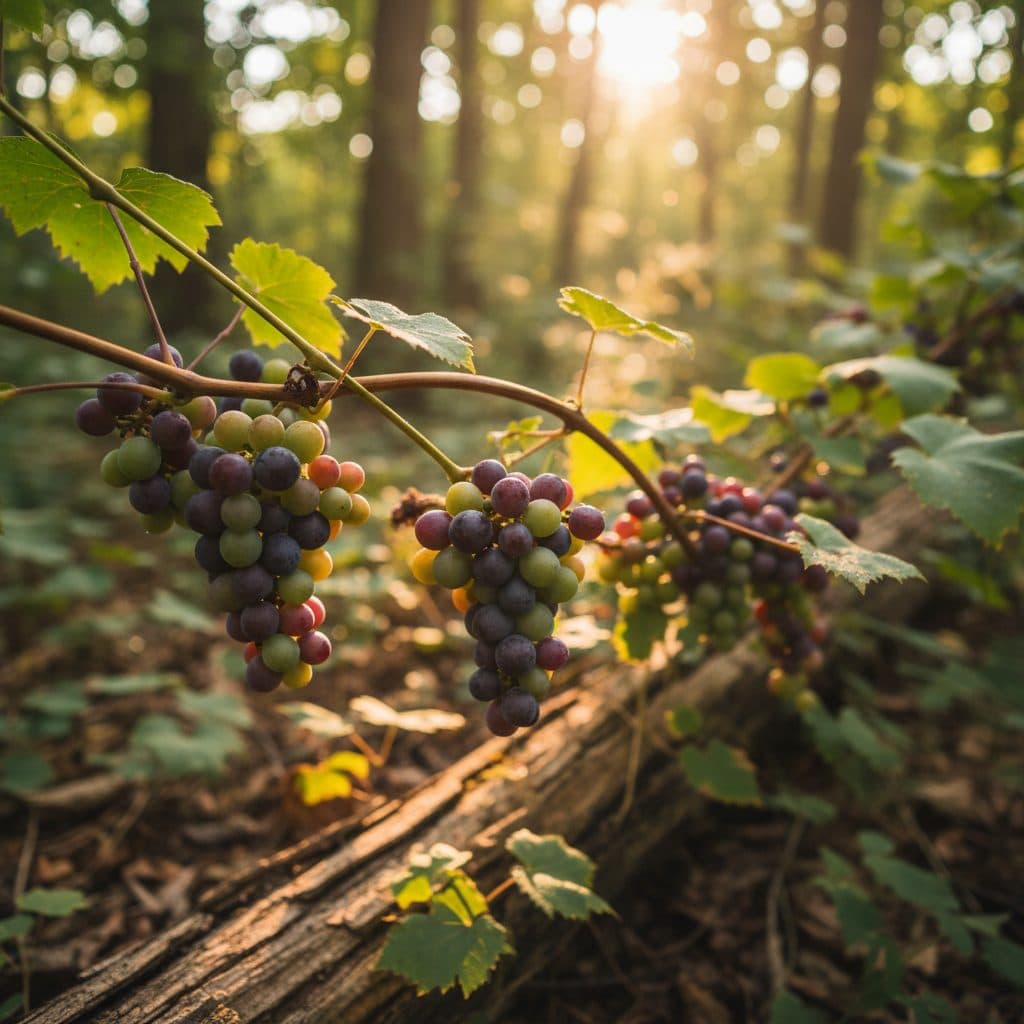
Key takeaways
- Muscadine grapes (Vitis rotundifolia) thrive in USDA zones 7-10 across the southeastern US, often found in forests and along stream banks.
- Fox grapes (Vitis labrusca) are common in USDA zones 4-8, particularly in the northeastern and midwestern states, preferring woodland edges.
- Moonseed (Menispermum canadense) is highly toxic and can be distinguished by its single, crescent-shaped seed and the complete absence of tendrils.
- Always verify identification using multiple characteristics, including leaves, tendrils, fruit clusters, and seed count, before consuming any wild plant.
- Wild grape leaves are alternate, often lobed, and have tendrils opposite some leaves, unlike moonseed, which lacks tendrils entirely.
- Muscadine grapes typically have one to two seeds per fruit, while fox grapes have two to four, and moonseed has a single, distinctive seed.
Quick answer: Wild grapes can be identified by alternate, often lobed leaves, tendrils opposite some leaves, and fruit in clusters. Distinguish them from toxic moonseed by the complete absence of tendrils and a single, crescent-shaped seed in moonseed.
In the southeastern United States, from Florida to North Carolina, wild muscadine grapes (Vitis rotundifolia) grow vigorously in USDA zones 7 through 10. These native vines produce thick-skinned fruit gathered for fresh eating, jellies, and winemaking since at least the 16th century [2]. Their broad distribution across bottomlands and forest edges makes them a common late-summer and early-autumn forage.
Accurate identification is essential when foraging wild fruit. Distinguishing wild grapes from toxic lookalikes like Canada moonseed (Menispermum canadense), found across USDA zones 3 through 8 in the eastern US, requires checking vine tendrils, leaf pubescence, and seed structure.
The allure of wild grapes and the risk of misidentification
Foraging for wild edibles gives a unique connection to the land and a chance to harvest fresh, unprocessed foods. Across the United States, there are over 20 native species of wild grapes, each with its own regional prevalence and characteristics [6]. The appeal of finding a vine laden with ripe fruit, whether it is the thick-skinned muscadine or the slip-skinned fox grape, is undeniable. However, this pursuit demands diligence, as several plants bear a superficial resemblance to grapes but harbor significant toxicity. A single misidentification can turn a rewarding experience into a medical emergency, showing the importance of precise identification techniques.
The eastern half of the US, in particular, is home to both abundant wild grapes and their toxic doppelgänger, moonseed. While wild grapes are generally safe to consume, their leaves, stems, and fruits all present distinct features that must be carefully observed. For instance, true grapevines, including muscadines and fox grapes, consistently possess tendrils that help them climb, a feature entirely absent in moonseed. Understanding these specific botanical markers is the first step toward a safe and successful foraging trip. Many resources, including Foraging for beginners: identifying common wild edibles safely, can provide a foundational understanding of these critical safety practices.
General characteristics of wild grapes
Wild grapevines are typically woody lianas that can climb to heights of 30 ft or more, supported by their environment. Their leaves are arranged alternately along the stem, often lobed, and can vary in size from 3 in to 10 in across, depending on the species and growing conditions. A key diagnostic feature for all true grape species is the presence of tendrils, which emerge opposite a leaf at some nodes, but not necessarily every node. These tendrils are modified stems that coil around supports, allowing the vine to ascend. The fruit, usually ripening in late summer or early fall, grows in clusters, though the size and density of these clusters vary significantly between species.
- Leaves are alternate, often heart-shaped or lobed.
- Stems are woody, with shredding bark on older vines.
- Tendrils are present, emerging opposite some leaves.
- Fruit grows in clusters, ranging from loose to compact.
- Berries are typically dark purple to black when ripe, 0.25 in to 1 in in diameter.
Muscadine grapes: a southern treasure
Muscadine grapes (Vitis rotundifolia), often called scuppernongs, grow native in USDA hardiness zones 7 through 10 [6]. Their range extends from Delaware south to Florida and west to eastern Texas and Oklahoma along stream banks, fence lines, and open woods. Muscadines carry natural resistance to common grape pathogens, including Pierce’s disease, which devastates European vinifera varieties [4]. This disease resistance allows wild vines to crop consistently without fungicides.
The fruit of the muscadine is distinctive. Berries are relatively large, typically 0.5 in to 1 in in diameter, and grow in small, loose clusters of two to ten grapes, or sometimes individually. The skin is thick and tough, often described as ‘leathery,’ and ranges in color from bronze (like the ‘Scuppernong’ cultivar) to dark purple or black. Inside, the pulp is juicy and sweet, with a unique musky flavor. Each berry usually contains one to two relatively large, roundish seeds [1]. These seeds are easily removed, making the fruit pleasant for fresh eating, though the thick skin is often discarded by some consumers. Muscadines are a rich source of antioxidants, with skin extract containing compounds like resveratrol at concentrations up to 100 mg per 100 g of dry weight [5].
Identifying muscadine vines
Muscadine vines develop woody stems with smooth, reddish-brown bark that does not shed in loose strips. The leaves are broad and roundish to heart-shaped, measuring 3 to 5 inches across with smooth or finely pubescent undersides. Muscadine tendrils are unbranched, occurring intermittently opposite leaf nodes rather than continuously. Ripe berries detach individually with a clean stem scar. Genetic variation across wild populations has yielded more than 100 named cultivars [1].
- Thick, tough skin on berries, often bronze or dark purple.
- Berries grow in small clusters of two to ten, or individually.
- Leaves are broad, roundish to heart-shaped, and often shallowly lobed.
- Tendrils are unbranched and appear intermittently along the stem.
- Each berry contains one to two roundish seeds.
Fox grapes: northern resilience
Fox grapes (Vitis labrusca) are another prominent wild grape species native to the eastern United States, primarily found in USDA zones 4 through 8 [6]. Their range extends from New England south to Georgia, and west to Michigan and Missouri. These vines are often found in woodland edges, thickets, and along fences, preferring slightly cooler climates than muscadines. The ‘foxy’ aroma and flavor, which gives them their common name, is a distinct characteristic, often described as musky or earthy. This species is the progenitor of many cultivated varieties, most famously the Concord grape, which was first cultivated in Concord, Massachusetts, in 1849.
Fox grape berries ripen from August to September in medium to large, compact clusters. The fruit is dark purple to black, measuring 0.5 to 0.75 inches in diameter, with a slip skin where the pulpy interior separates cleanly from the outer skin under light pressure. Each berry contains two to four pear-shaped seeds. High natural pectin content makes fox grapes well suited for jams, jellies, and juices.
Distinguishing fox grape vines
Fox grape vines climb vigorously, reaching lengths of 40 feet or more with shaggy bark that peels in loose vertical strips on mature wood. The leaves measure 4 to 8 inches across, with three broad lobes and coarsely toothed edges. The underside of each leaf carries a dense coating of whitish or rusty-brown fuzz that feels woolly to the touch. Tendrils are branched and fork opposite successive leaves, distinguishing the vine from unbranched muscadines.
- Berries have a ‘slip-skin’ that separates easily from the pulp.
- Fruit grows in medium to large, relatively compact clusters.
- Leaves are large, broadly oval, often three-lobed, with fuzzy undersides.
- Tendrils are branched and appear intermittently along the stem.
- Each berry contains two to four pear-shaped seeds.
The toxic imposter: identifying moonseed
Moonseed (Menispermum canadense) is a highly toxic vine that poses a significant risk to foragers due to its superficial resemblance to wild grapes. It is native to eastern and central North America, commonly found in USDA zones 3 through 8, growing in similar habitats to wild grapes, such as moist woodlands, stream banks, and thickets [6]. All parts of the moonseed plant, especially the berries, contain toxic alkaloids, including dauricine, which can cause severe gastrointestinal distress, convulsions, and even death if ingested. Children are particularly vulnerable, as even a small number of berries can be lethal.
The most critical distinguishing feature of moonseed is the complete absence of tendrils. While wild grapes use tendrils to climb, moonseed vines twine around other plants for support, reaching lengths of up to 20 ft. The leaves of moonseed are alternate, often broadly lobed, and can resemble grape leaves, typically measuring 4 in to 8 in across. However, moonseed leaves usually have a more rounded base and lack the coarse teeth often seen on grape leaves. The berries are dark blue to black, about 0.25 in to 0.5 in in diameter, and grow in loose clusters, similar in appearance to some wild grapes. However, the internal structure of the fruit provides the definitive identification.
The definitive moonseed seed
Examining the seeds provides definitive identification. Canada moonseed berries contain a single flat, crescent-shaped seed resembling a crescent moon. True wild grapes contain multiple (one to four) rounded or pear-shaped seeds. Inspecting the seed of an unknown berry is an essential safety step. Moonseed stems are smooth and green to brown without tendrils or shredding bark. Because moonseed contains toxic isoquinoline alkaloids that cause severe poisoning, never consume wild berries without confirming seed shape.
- No tendrils present; the vine twines for support.
- Berries contain a single, crescent-shaped seed.
- Leaves often have a more rounded base and lack coarse teeth.
- Stems are generally smooth, without shredding bark.
- All parts of the plant are highly toxic if ingested.
Safe foraging practices and responsible harvesting
Successful and safe foraging relies on a combination of accurate identification, ethical harvesting, and a healthy respect for the environment. Before heading out, always carry a reliable field guide specific to your region and consider consulting multiple sources. For example, while Small-Leaved Wild Grape might be present in some areas, its characteristics will differ from the more common muscadine or fox grape. Never consume any wild plant unless you are 100% certain of its identity. If there is any doubt, even a 1% uncertainty, it is safest to leave the plant untouched. This ‘when in doubt, throw it out’ rule is the most important principle in wild edibles foraging.
When you have positively identified an edible wild grape vine, harvest responsibly. Take only what you need and leave plenty for wildlife and for the plant to regenerate. A good rule of thumb is to aim to harvest no more than 10% to 20% of the available fruit from any single plant or patch. Use clean tools, such as clippers or scissors, to avoid damaging the vine. Wear gloves to protect your hands from potential irritants or thorns. Always wash any foraged items thoroughly before consumption to remove dirt, insects, or residues. Be aware of your surroundings; avoid foraging in areas that may have been sprayed with pesticides or are near busy roads, as plants can absorb pollutants.
Ethical considerations for foragers
Beyond personal safety, ethical foraging practices ensure the long-term sustainability of wild plant populations. Avoid disturbing the surrounding ecosystem; walk carefully and leave no trace. Do not uproot plants unless you are specifically harvesting roots and have confirmed it is a sustainable practice for that species. Consider the impact of your harvesting on other foragers, both human and animal. For instance, leaving 80% of the berries ensures that birds and other wildlife still have a food source while aiding the overall health of the ecosystem. Documenting your finds, including the location and date, can also help you track seasonal changes and plant abundance over time, improving your foraging knowledge for future seasons.
- Always use multiple identification guides and confirm all features.
- Aim to harvest no more than 10% to 20% of available fruit from any single plant.
- Wash all foraged items thoroughly before eating.
- Avoid foraging in areas potentially exposed to pesticides or pollutants.
- Respect private property and obtain permission if foraging on private land.
Main differences between muscadine, fox grape, and moonseed
Feature | Muscadine (Vitis rotundifolia) | Fox Grape (Vitis labrusca) | Moonseed (Menispermum canadense) |
|---|---|---|---|
Tendrils | Present, unbranched, intermittent | Present, branched, intermittent | Absent (vine twines) |
Leaves | Broad, roundish to heart-shaped, shallowly lobed, smooth underside | Large, broadly oval, 3-lobed, fuzzy/hairy underside | Broadly lobed, often rounded base, smooth underside, no tendrils |
Fruit cluster | Small, loose clusters (2-10 berries) or individual | Medium to large, compact clusters | Loose clusters, similar to grapes |
Berry size | 0.5 in to 1 in diameter | 0.5 in to 0.75 in diameter | 0.25 in to 0.5 in diameter |
Skin texture | Thick, tough, leathery | Slip-skin (pulp separates easily) | Thin, not slip-skin |
Seeds per berry | One to two, roundish | Two to four, pear-shaped | Single, crescent-shaped |
Toxicity | Edible | Edible | Highly toxic |
USDA zones | 7-10 | 4-8 | 3-8 |
Muscadine Range: Wild muscadine grapes are primarily found in USDA hardiness zones 7 through 10, extending across the southeastern US.
Moonseed Toxicity: All parts of the moonseed plant, especially the berries, contain toxic alkaloids that can cause severe illness or death if ingested, even in small amounts for a child.
Fox Grape Seeds: Fox grape berries typically contain two to four pear-shaped seeds, which is a key differentiator from muscadine’s one to two roundish seeds.
References
- Genetic Diversity of Wild and Cultivated Muscadine Grapes (Vitis rotundifolia Michx.) (2022).
- The muscadine grapes / (1913).
- Humans and Grapes (2015).
- Seasonal Concentration of the Pierce’s Disease Bacterium in ‘Carlos’ and ‘Welder’ Muscadine Grapes Compared with ‘Schuyler’ Bunch Grape (1984).
- Muscadine Grape Skin Extract (2020).
- USDA Natural Resources Conservation Service (2024).