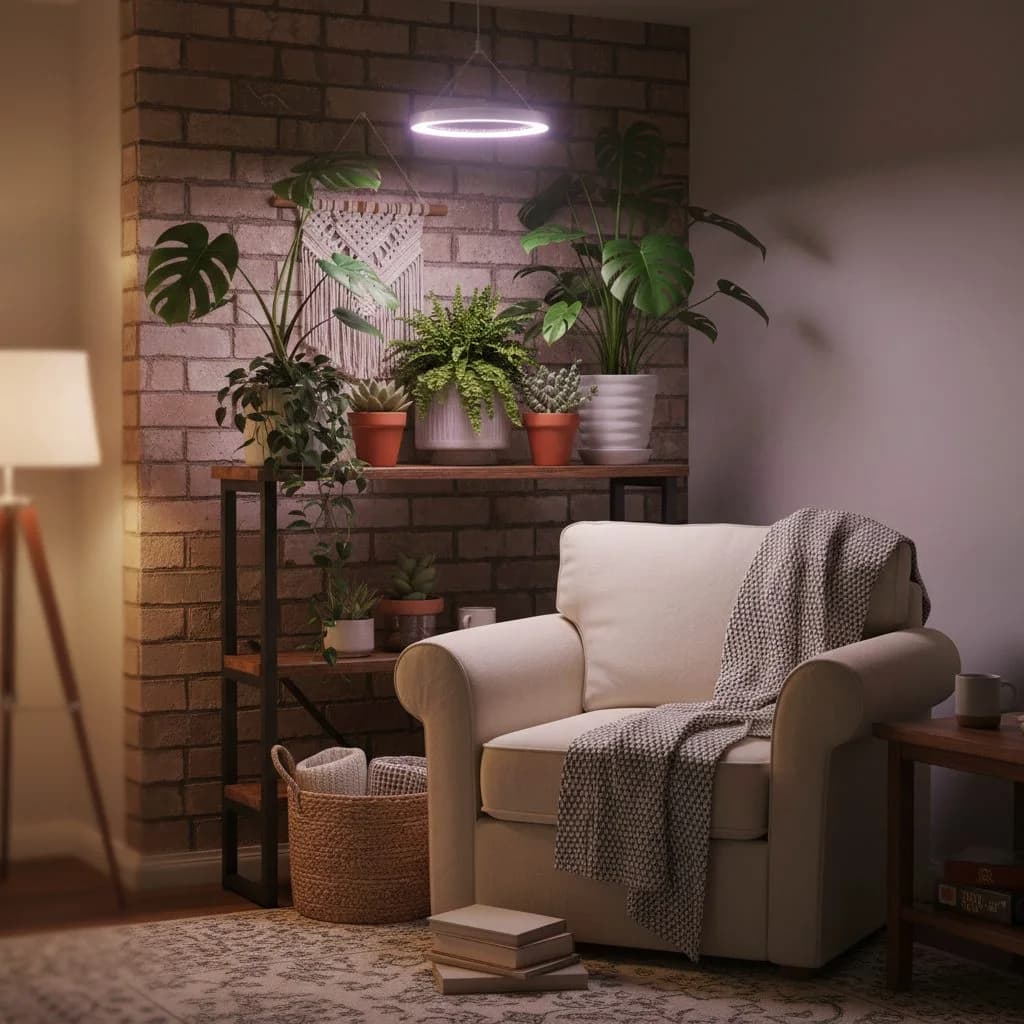
Key takeaways
- Select plants tolerant of low light and high humidity, such as ZZ plants, Pothos, and Peace Lilies, which can adapt to less than 100 foot-candles of light.
- Invest in full-spectrum LED grow lights, providing 10-16 hours of light daily, with a color temperature between 4000K and 6500K.
- Monitor humidity levels, aiming for 50-80% for most tropical plants, especially in typically humid bathroom environments.
- Use a soil moisture meter to prevent overwatering, as plants in low-light conditions use water more slowly.
- Ensure proper air circulation to deter fungal issues, which can be common in enclosed, humid spaces like a 60 sq ft bathroom.
- Consider the average temperature of your space; basements often stay between 55-65°F, while bathrooms can fluctuate more.
Quick answer: To grow plants in basements and windowless bathrooms, select low-light tolerant species like ZZ plants or Pothos, and provide 10-16 hours of full-spectrum LED grow light daily. Monitor humidity and soil moisture to ensure optimal conditions for plant health.
Across the United States, millions of homes and apartments feature spaces that seem unsuitable for plant life: basements and windowless bathrooms. These areas, often measuring between 40 and 100 square feet, present unique challenges like consistently low light levels, fluctuating temperatures, and sometimes high humidity. However, with a thoughtful selection of resilient houseplants and a strategic approach to artificial lighting, these forgotten corners can become healthy, green sanctuaries. My experience as a grower in USDA zones 6-8 has shown me that even the darkest rooms can support thriving plant collections.
The key to success in these environments lies in understanding the specific needs of plants that tolerate low light and then supplementing with the right artificial illumination. We’re not talking about grow tents for large-scale operations here, but rather targeted lighting solutions that mimic natural sunlight. This guide will walk you through choosing the best plants, setting up effective lighting, and maintaining optimal conditions so your plants can flourish, even in a basement that receives zero natural light.
Understanding your low-light environment
Before bringing any plant home, assess the specific conditions of your basement or windowless bathroom. Basements, particularly in northern states like Michigan or Minnesota, often maintain cooler, more consistent temperatures, typically ranging from 55-65°F year-round. This can be significantly different from the 70-75°F ambient temperature found in upper living spaces. Windowless bathrooms, on the other hand, often experience sharp humidity spikes during a shower, then dropping back down within an hour. These fluctuations can stress many plant species.
Measuring light and humidity
To accurately gauge your environment, consider using a a calibrated soil pH or moisture test. While its light sensor provides a general reading, a dedicated lux meter can offer more precise measurements, indicating light levels below 100 foot-candles in truly dark areas. For humidity, a simple hygrometer will display the percentage of moisture in the air. Understanding these numbers is the first step toward successful plant cultivation in challenging indoor spaces. For example, a 60 sq ft bathroom might have a small exhaust fan that only removes 50 cubic feet of air per minute, impacting humidity dispersal.
- Measure ambient temperature, typically 55-65°F in basements.
- Use a hygrometer to track humidity, noting spikes to 80-90% in bathrooms.
- Assess light levels, often below 100 foot-candles in windowless rooms.
- Note air circulation, especially in small rooms like a 5×8 ft bathroom.
- Consider the average duration of high humidity, perhaps 30 minutes after a shower.
Top houseplants for low-light, high-humidity spaces
When selecting plants for basements and windowless bathrooms, prioritize species known for their tolerance to low light and adaptability to varying humidity. Many of these plants originate from the understory of tropical forests, where they receive filtered light and consistent moisture. For example, the ZZ plant (Zamioculcas zamiifolia), native to eastern Africa, can survive on as little as 25 foot-candles of light for 10-12 hours daily, making it incredibly resilient [5]. Its thick rhizomes store water, allowing it to tolerate periods of drought, which is useful if you forget to water for a week or two.
Resilient plant species
Other excellent choices include the Pothos (Epipremnum aureum), which can thrive in as little as 50 foot-candles of light and is very forgiving of inconsistent watering. Peace Lilies (Spathiphyllum wallisii) are also strong contenders, often blooming even in dim conditions, though they prefer consistent moisture and humidity above 60%. Spider plants (Chlorophytum comosum) are another sturdy option, known for producing numerous plantlets, and they can tolerate light levels down to 75 foot-candles. These plants generally prefer temperatures between 65-80°F, which can be maintained with supplemental heating in colder basements.
- ZZ Plant (Zamioculcas zamiifolia): Tolerates very low light, needs infrequent watering, grows to 2-3 ft tall.
- Pothos (Epipremnum aureum): Adaptable to low light, easy to propagate, vines can reach 10 ft or more.
- Peace Lily (Spathiphyllum wallisii): Flowers in low light, prefers consistent moisture, grows 1-3 ft tall.
- Spider Plant (Chlorophytum comosum): Air-purifying, produces plantlets, can handle 75 foot-candles.
- Snake Plant (Sansevieria trifasciata): Extremely hardy, tolerates neglect, grows 1-4 ft tall.
Selecting and setting up artificial grow lights
Since natural light is scarce or absent in these areas, artificial grow lights are indispensable. Not all lights are created equal; plants require specific wavelengths for photosynthesis, primarily in the blue and red spectrums. Full-spectrum LED grow lights are an efficient and effective choice, consuming less energy than traditional fluorescent bulbs and offering a long lifespan. A 15-watt LED grow light can provide sufficient intensity for a single plant or a small grouping in a 2 sq ft area.
Grow light types and placement
When choosing a grow light, look for models with a color temperature between 4000K and 6500K, which mimics natural daylight. The intensity, measured in Photosynthetic Photon Flux Density (PPFD), is also important; for low-light plants, aim for 50-150 PPFD at the plant canopy. Position the light 6-12 inches above the plant foliage, adjusting as the plant grows to maintain consistent light exposure. A timer is essential to provide a consistent light cycle, typically 12-16 hours per day, followed by 8-12 hours of darkness for plant respiration [5]. For larger areas, like a 4×4 ft basement corner, a 40-60W panel light might be necessary. You could even use a Reflective Indoor Grow Tent to maximize light efficiency in a dedicated basement growing area.
- Choose full-spectrum LED grow lights, 4000K-6500K color temperature.
- Position lights 6-12 inches above plant canopy for optimal PPFD.
- Use a timer for consistent 12-16 hours of light daily.
- Consider wattage: 15W for small plants, 40-60W for larger areas.
- Ensure lights are waterproof or water-resistant for bathroom use.
Watering, humidity, and air circulation in confined spaces
Watering is perhaps the most critical aspect of plant care in low-light environments. Plants photosynthesize less in dim conditions, meaning they transpire less water, and their soil dries out much more slowly. Overwatering is the number one killer of houseplants, accounting for a significant portion of plant deaths. Always check the soil moisture before watering; the top 1-2 inches should feel dry to the touch for most plants. A soil moisture meter can be a gardener’s best friend here, providing a precise reading.
Maintaining optimal conditions
While bathrooms often provide high humidity, basements can be quite dry, especially if they have forced-air heating. For plants that prefer 60-80% humidity, consider a small humidifier or a pebble tray filled with water. Conversely, in a humid bathroom, good air circulation is vital to prevent fungal diseases like powdery mildew, which thrives in stagnant, moist air. An oscillating fan set on a low speed for a few hours a day can make a significant difference, especially in a small 50 sq ft bathroom. Ensure your pots have drainage holes, and empty any saucers after 30 minutes to prevent root rot. The average household temperature in the US is around 70°F, but basements can be 10-15°F cooler, requiring adjustments to watering frequency.
- Check soil moisture with a meter before watering, allowing top 1-2 inches to dry.
- Aim for 60-80% humidity for tropical plants using humidifiers or pebble trays.
- Provide air circulation with a small fan for 2-4 hours daily in humid spaces.
- Ensure pots have drainage holes and empty saucers after 30 minutes.
- Adjust watering frequency based on ambient temperature, often less in 55-65°F basements.
Troubleshooting common issues in low-light environments
Even with careful planning, plants in basements and windowless bathrooms can face specific challenges. One common issue is etiolation, where plants stretch towards a light source, resulting in long, leggy stems and sparse foliage. This indicates insufficient light intensity or duration. If your Pothos vines are stretching 6 inches between leaves instead of the usual 2-3 inches, it’s time to increase light. Adjust your grow light closer to the plant, or extend the light cycle from 12 to 16 hours per day.
Pest and disease management
Pests like fungus gnats are often a sign of overwatering, as they lay eggs in consistently moist topsoil. Allowing the top inch of soil to dry out completely between waterings can break their life cycle, which usually spans 2-3 weeks. For more persistent infestations, consider using sticky traps or a diluted neem oil solution (1 teaspoon per quart of water). Fungal diseases, such as powdery mildew, thrive in high humidity and poor air circulation, common in a 7×8 ft bathroom. Improve air flow with a small fan and ensure leaves are dry, especially after misting. Regularly inspect your plants, perhaps once a week, for any signs of distress or pests, as early detection can prevent minor issues from becoming major problems.
- Increase light intensity or duration if plants show etiolation (stretching).
- Allow topsoil to dry completely to deter fungus gnats, which have a 2-3 week life cycle.
- Improve air circulation with a fan to prevent fungal diseases in humid areas.
- Inspect plants weekly for pests like spider mites, which are 0.5 mm in size.
- Adjust nutrient feeding; plants in low light need 25-50% less fertilizer than those in bright light.
Low-Light Houseplant Comparison for Basements and Bathrooms
Plant Name | Light Needs (Foot-candles) | Water Needs | Humidity Tolerance | Typical Height |
|---|---|---|---|---|
ZZ Plant | 25-100 | Low (drought tolerant) | Low to Moderate (30-50%) | 2-3 ft |
Pothos | 50-200 | Moderate (let dry out) | Moderate to High (50-70%) | Vining, 6-10 ft |
Peace Lily | 100-250 | High (consistently moist) | High (70-85%) | 1-3 ft |
Snake Plant | 25-150 | Very Low (drought tolerant) | Low to Moderate (30-50%) | 1-4 ft |
Spider Plant | 75-250 | Moderate (keep slightly moist) | Moderate (50-60%) | 1-2 ft |
Cast Iron Plant | 25-75 | Low (drought tolerant) | Low to Moderate (30-50%) | 1-2 ft |
Light Duration: Most low-light tolerant houseplants require 12-16 hours of artificial light daily to thrive, simulating a full day’s cycle.
Humidity Range: For tropical plants in windowless bathrooms, aim for a humidity level between 60% and 80% for optimal growth, especially during and after a 15-minute shower.
Temperature Stability: Basements typically maintain cooler temperatures, often 55-65°F, which can slow plant growth and reduce watering frequency by 25-50% compared to warmer rooms.
References
- To All the Houseplants I Have Killed (2023).
- Materials in bathrooms and sanitary facilities (2015).
- Queering bathrooms: sexing bathrooms (2012).
- Fundamental criteria in planning private bathrooms (2015).
- Happy houseplants : how to grow and maintain your indoor plants / by Elizabeth Walker. (1992).
- USDA Natural Resources Conservation Service (2024).