Key takeaways
- Most US bottles labeled '70% neem oil' are clarified hydrophobic extract with azadirachtin removed—they suffocate pests and curb powdery mildew but lack hormonal growth-regulator activity.
- True insecticidal soap is purified potassium salts of fatty acids mixed in soft or distilled water; hard tap water precipitates calcium soap scum that clogs sprayers and spots foliage.
- Never use household dish detergent, never combine full-strength neem oil and soap in one tank, and space oil sprays 14 to 30 days away from sulfur treatments.
- Indoor air lacks wind and rapid evaporation: spray below 85°F out of direct sunlight or bright LEDs, run an oscillating fan, and patch-test sensitive ferns, palms, and powdery succulents for 48 to 72 hours.
- Both neem oil and potassium soaps are toxic to fish and irritate cats if licked wet: spray inside a vented bathroom or porch, shield aquariums, and use odorless Bti tea instead of neem drenches for fungus gnats.
Quick answer: Choose insecticidal soap (potassium salts of fatty acids at 1% to 2% in distilled water) for fast, odorless knockdown of aphids, thrips, spider mites, whiteflies, and scale crawlers indoors, and save 100% cold-pressed neem oil (0.5% to 1% with mild Castile emulsifier) for lingering antifeedant and insect-growth-regulator pressure or powdery mildew—remembering that 70% clarified hydrophobic extract of neem oil contains zero azadirachtin and works only as a suffocating oil and fungicide. Spray plants inside a ventilated bathroom or shaded porch, keep temperatures below 85°F out of direct window sun, patch-test one hidden leaf for 48 to 72 hours, and isolate cats and covered aquariums until foliage dries completely.
Why Indoor Neem Oil and Soap Sprays Backfire Without Chemistry Clarity
Inside a climate-controlled American home, houseplants sit in dry winter heating, stagnant airflow, and concentrated sunlight magnified through double-pane glass. Those indoor physics turn two of horticulture's mildest tools—neem oil and insecticidal soap—into frequent causes of blackened leaf margins, dropped foliage, and stubborn sticky messes.
Half the confusion comes straight from product labels. Many growers buy a bottle marked '70% neem oil' expecting systemic insect-growth-regulator power against stubborn spider mites or mealybugs, not realizing the active triterpenoid azadirachtin was extracted out at the factory. Others mix potassium fatty-acid soaps into mineral-rich hard tap water, turning an effective contact spray into chalky soap scum, or haul pots straight back onto a blazing 88°F south windowsill before oily droplets dry.
Understanding the chemistry inside the bottle, the dilution math per 32-ounce quart sprayer, and the household exposure rules for pets, aquariums, and air quality turns either spray into a clean, repeatable indoor reset.
Cold-Pressed Neem Oil vs. Clarified Hydrophobic Extract vs. Insecticidal Soap
Before measuring a drop, read the exact active-ingredient panel on the front bottom corner of your bottle. U.S. EPA biopesticide registrations separate two distinct neem formulations alongside potassium salts of fatty acids—and all three behave differently indoors.
Active Chemistry & Indoor Performance: Cold-Pressed Neem vs. Clarified Extract vs. Soap
Feature or Parameter | 100% Cold-Pressed Neem Oil | 70% Clarified Hydrophobic Extract of Neem Oil | Insecticidal Soap (Potassium Salts of Fatty Acids) |
|---|---|---|---|
Active Chemistry | Natural glycerides + limonoids including azadirachtin | Refined neem oil triglycerides; azadirachtin removed via alcohol extraction | Potassium hydroxide reacted with long-chain plant fatty acids (typically oleic/C18) |
Primary Mode of Action | Spiracle suffocation + antifeedant + Insect Growth Regulator (stops molting/egg laying) + mild fungicide | Contact spiracle suffocation + foliar fungicide only (no hormonal IGR action) | Contact-only cuticle & cell membrane breakdown causing rapid dehydration |
Residual Activity | Short (degrades over days; mild feeding deterrence while intact) | None once oil dries (must wet pest directly during spraying) | Zero residual kill once spray dries |
Powdery Mildew Control | Moderate foliar suppression | High (primary labeled orchard/houseplant use for powdery mildew & rust) | None (insects and mites only) |
Best Indoor Targets | Spider mites, whiteflies, thrips, aphids, soft scale crawlers, mealybugs | Spider mite eggs/adults, aphids, whiteflies, scale crawlers, powdery mildew | Aphids, spider mites, whiteflies, thrips, scale crawlers, young mealybugs |
Indoor Odor & Residue | Strong pungent garlic/onion/sulfur scent; slight oily sheen | Mild citrus/nutty odor (often pre-formulated); light sheen | Virtually odorless; dries clean and matte without oil shine |
Requires Emulsifier? | Yes (needs 1/4 tsp mild Castile soap per quart) | No (commercial concentrate already contains emulsifiers) | No (water-soluble potassium salt concentrate; avoid hard tap water) |
Notice how that changes product selection. If your priority is apartment-friendly air quality and rapid knockdown of green aphids on a windowsill herb or spider mites on heartleaf philodendron, a pre-mixed or concentrated potassium salts of fatty acids soap leaves zero garlic odor and zero lingering gloss. When fighting persistent chewing or piercing colonies alongside powdery mildew, raw cold-pressed oil supplies azadirachtin while clarified hydrophobic extract delivers cleaner pre-emulsified suffocation—compare broader outdoor crop differences in our full neem oil guide and neem and horticultural oils overview.
Exact Quart & Gallon Dilution Math, Hard Water Traps, and Mixing Limits
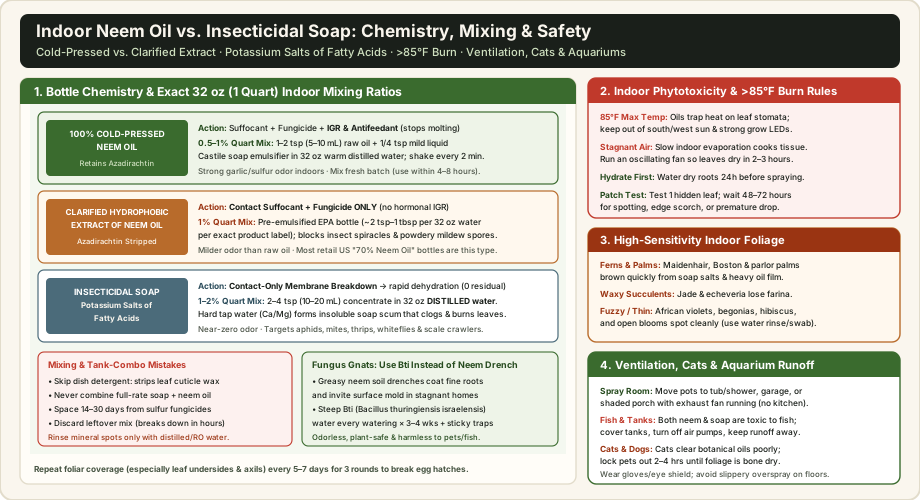
Most indoor growers mix too much batch volume in a 1-gallon jug, watch unused concentrate separate overnight, and spray stale emulsion next week. Indoors, mix strictly in a 32-ounce (1 quart / ~950 mL) trigger sprayer sized for three to six houseplants, use it the same afternoon, and dump leftovers safely.
32 oz (1 Quart) and 1-Gallon Indoor Mixing Ratios by Product Type
Product Type | Target Concentration | Per 32 oz (1 Quart) Sprayer | Per 1 Gallon (3.8 L) Batch | Water & Shelf-Life Rule |
|---|---|---|---|---|
100% Cold-Pressed Neem Oil (raw) | 0.5% (sensitive) to 1.0% (standard) | 1 tsp (5 mL) to 2 tsp (10 mL) neem + 1/4 tsp mild liquid Castile soap | 4 tsp (20 mL) to 8 tsp (40 mL) neem + 1 tsp Castile soap | Warm distilled water (85–95°F) melts solid oil; shake every 2 min; use within 4–8 hours |
70% Clarified Hydrophobic Neem Extract | 1.0% active oil equivalent (check exact label) | Approx. 2 tsp to 1 tbsp (10–15 mL) per exact label rate | Approx. 1 to 2 fl oz (30–60 mL) per exact label rate | Pre-emulsified; mix with cool or tepid water and spray immediately |
Insecticidal Soap Concentrate (~49% potassium salts) | 1.0% (delicate) to 2.0% (standard) | 2 tsp (10 mL) to 4 tsp (20 mL) concentrate (check label) | 2.5 fl oz / 5 tbsp (75 mL) for 2% solution | Use distilled, RO, or rainwater ONLY if tap water is hard; mix fresh each session |
Why hard tap water ruins insecticidal soap
Extensions at Clemson HGIC and Colorado State emphasize water chemistry for a chemical reason: potassium fatty-acid salts stay soluble only in soft water. When mixed into hard US municipal or well tap water loaded with dissolved calcium (Ca²⁺) and magnesium (Mg²⁺), those minerals swap with potassium and lock the fatty acids into insoluble calcium and magnesium soap scum.
That reaction triggers three failures at once: the precipitated scum loses its insect-killing power, milky residue clogs fine trigger nozzles, and chalky white films dry onto glossy peace lily and money plant leaves. If your home runs water softeners (high sodium, which also damages potting roots) or hard mineral water—check our houseplant water quality guide—buy $1-per-gallon distilled water strictly for spray mixing.
Four mixing mistakes that burn leaves or fail
- Never use household dish detergent: Dish liquids such as Dawn or Palmolive are synthetic alkyl sulfonates engineered to strip kitchen grease; Colorado State and UConn IPM warn they dissolve protective waxy plant cuticles and burn indoor leaves far worse than purified potassium salts. Keep Castile soap strictly at 1/4 teaspoon per quart as a pure neem emulsifier, never as a strong pesticide base—verify label details in our insecticidal soap dilution guide.
- Do not stack full-strength neem and full-strength soap together: While a tiny drop of Castile soap emulsifies cold-pressed oil, mixing a full 2% insecticidal soap dose with a 1% neem dose doubles surfactant penetration and frequently triggers acute necrotic spotting on indoor foliage.
- Observe a 14-to-30-day sulfur buffer: Never apply neem oil or horticultural oil within 14 to 30 days of any sulfur dust or sulfur fungicide spray, as oil-sulfur reactions strip chlorophyll and scorch leaf tissue.
- Warm solid cold-pressed oil safely: Pure neem oil solidifies below roughly 70°F. Stand the sealed concentrate bottle in a bowl of warm tap water (never boil or microwave) for 5 minutes until clear golden liquid forms, mix into tepid distilled water, and shake vigorously every 60 to 90 seconds while spraying.
Indoor Phytotoxicity Prevention: The 85°F Cutoff, Grow Lights, and Sensitive Species
Phytotoxicity—chemical or thermal injury to plant cells—shows up 24 to 72 hours after spraying as bronze speckles, crisp brown leaf tips, translucent water-soaked patches, yellow chlorosis, or sudden leaf drop. Outdoors, afternoon breezes evaporate sprays quickly. Indoors, still room air leaves oil films clinging to leaf stomata for hours.
Indoor Plant Sensitivity Watchlist: Neem Oil & Insecticidal Soap Risk Profiles
Indoor Plant Group | Examples | Sensitivity & Injury Risk | Safer Pest Alternative |
|---|---|---|---|
Ferns & Delicate Palms | Maidenhair fern, Boston fern, parlor palm | High risk for both soap salts and neem oil; fronds brown rapidly along pinnae | Lukewarm shower rinse + manual wiping; spot-test 0.5% soap on 1 frond for 72h |
Glaucous / Powdery Succulents | Echeveria, blue chalksticks, jade plant | High aesthetic & burn risk; oils and soaps strip protective farina coating permanently and spot jade | 70% isopropyl alcohol dabbed via cotton swab; high-airflow drying |
Fuzzy / Pubescent Foliage | African violets, Rex begonias, velvet-leaf philodendrons | Moderate-high risk; dense leaf hairs trap droplets for hours and cause circular ring spots | Dry soft-brush removal + alcohol stem swabs + systemic cultural prevention |
Smooth Glossy Tropicals & Citrus | Low-moderate risk if kept below 85°F, pre-hydrated, and dried out of sun; new soft flush remains tender | 1% clarified neem or 1%–2% distilled-water soap after 48–72h patch test |
The 85°F + direct-light burn rule: Never spray neem oil or insecticidal soap when room or sunlit windowsill temperatures exceed 85°F, on drought-stressed pots, or under active sunshine or intense grow fixtures. Move treated plants into bright shade with an oscillating fan running for 2 to 4 hours until every droplet evaporates cleanly before returning them to south windows or LEDs.
Follow a tight pre-spray checklist before coating any valued specimen: water dry potting mix thoroughly 24 hours ahead so leaf cells are fully turgid (wilted leaves pull oil deeper through open stomata), shut off nearby indoor LED grow lights for at least 3 hours, and run a 48-to-72-hour patch test on a single older lower leaf first. If no spotting or curling appears after three days, treat the whole plant—covering leaf undersides, petiole attachments, and tight crown crevices where thrips and aphids hide.
If accidental tip scorch or edema appears on tender plants—check other causes in our leaf-drop and stress guide—rinse residual soap gently with lukewarm distilled water after 2 to 3 hours on ultrasensitive plants. Wait for active pests to die during wet contact first, because washing wet soap off immediately cancels kill efficacy.
Ventilation, Pets, Aquariums, and Choosing the Right Pest Target
Even EPA-exempt or low-toxicity botanicals belong out of living-room upholstery, food prep counters, pet bowls, and fish tanks. An apartment bathroom or utility laundry sink gives you easy tile cleanup, an exhaust fan, and instant floor protection.
- Spray in an enclosed ventilated room or shaded porch: Carry pots to a bathtub, utility sink, or shaded patio rather than spraying beside sofas or kitchen islands. Turn on the bathroom exhaust fan, wear nitrile gloves and simple eye protection (potassium soaps sting eyes on contact per UC IPM hazard sheets), and wipe wet overspray off tile floors so nobody slips.
- Protect cats and dogs until leaves are bone dry: While dried residues pose minimal mammalian hazard, wet neem oil or soapy sprays cause drooling, vomiting, or diarrhea if pets lick freshly misted leaves. Cats are unusually sensitive to concentrated botanical oils because feline livers lack specific glucuronyl transferase enzymes needed to clear plant terpenes rapidly. Keep dogs and cats out of the drying bathroom for 2 to 4 hours until foliage dries completely, and surround living spaces with cat- and dog-safe houseplants.
- Shield aquariums, betta bowls, and aquatic pets: National Pesticide Information Center (NPIC) fact sheets classify both neem oil (azadirachtin and oil extracts) and potassium salts of fatty acids as slightly to moderately toxic to fish and aquatic invertebrates. Never mist spray bottles near uncovered tanks, cover glass lids with plastic sheeting and switch off aquarium air pumps while treating nearby rooms, and never dump leftover neem or soap bucket wash into backyard ponds or storm drains.
- Do not pour neem oil drenches onto fungus gnats: While older internet blogs tell growers to drench potting soil with neem oil for fungus gnats, extension educators strongly favor **Bacillus thuringiensis israelensis (`Bti`)** paired with yellow sticky traps and drying the top 1 to 2 inches of soil. Greasy neem drenches coat fine roots, smell strongly of sulfur indoors, encourage white surface molds in low-airflow pots, and work much slower than odorless Bti—follow our complete 28-day indoor fungus gnat eradication plan.
Match your spray to the exact pest lifecycle as well. Neither neem oil nor insecticidal soap penetrates hardened adult scale insect shells or fluffy adult mealybugs quickly; dab adult bumps first with 70% alcohol (mealybug alcohol swab guide), then schedule 3 consecutive soap or neem sprays spaced 5 to 7 days apart to catch newly hatched crawlers and nymphs before they harden. Target whiteflies and spider mites every 5 days during warm summer stretches when egg-to-adult cycles speed up.
Long-Term Prevention: Stopping Reinfestation Without Monthly Sprays
Monthly preventative spraying on clean indoor plants wastes time and stresses waxy cuticles unnecessarily. Keep pests out with four low-effort habits that address how insects actually enter US apartments:
- Inspect before checkout and quarantine 30 days: Check leaf axils, undersides, and nursery pot rims under bright phone light using our pre-purchase houseplant inspection checklist, then keep every new plant or cut bouquet in a separate room for 30 days of quarantine.
- Manage indoor relative humidity (40%–60% RH): Dry 20%–30% winter furnace air accelerates two-spotted spider mite egg hatch dramatically. Track rooms with a digital sensor—see our indoor hygrometer humidity guide—without letting foliage stay dripping wet overnight.
- Wash dust off broad leaves monthly: Dust traps mite webbing and shields eggs from natural drying. Wipe broad tropicals like spider plants and philodendrons gently with a damp microfiber cloth, or carry sturdy pots to the shower once a month using chemical-free houseplant pest habits.
- Inspect indoor citrus and overwintered porch herbs: Overwintered peppers and container citrus carry outdoor scale, aphid, and whitefly eggs indoors every October. Give outdoor patio pots two spaced soap rinses five days apart before moving them inside for winter.