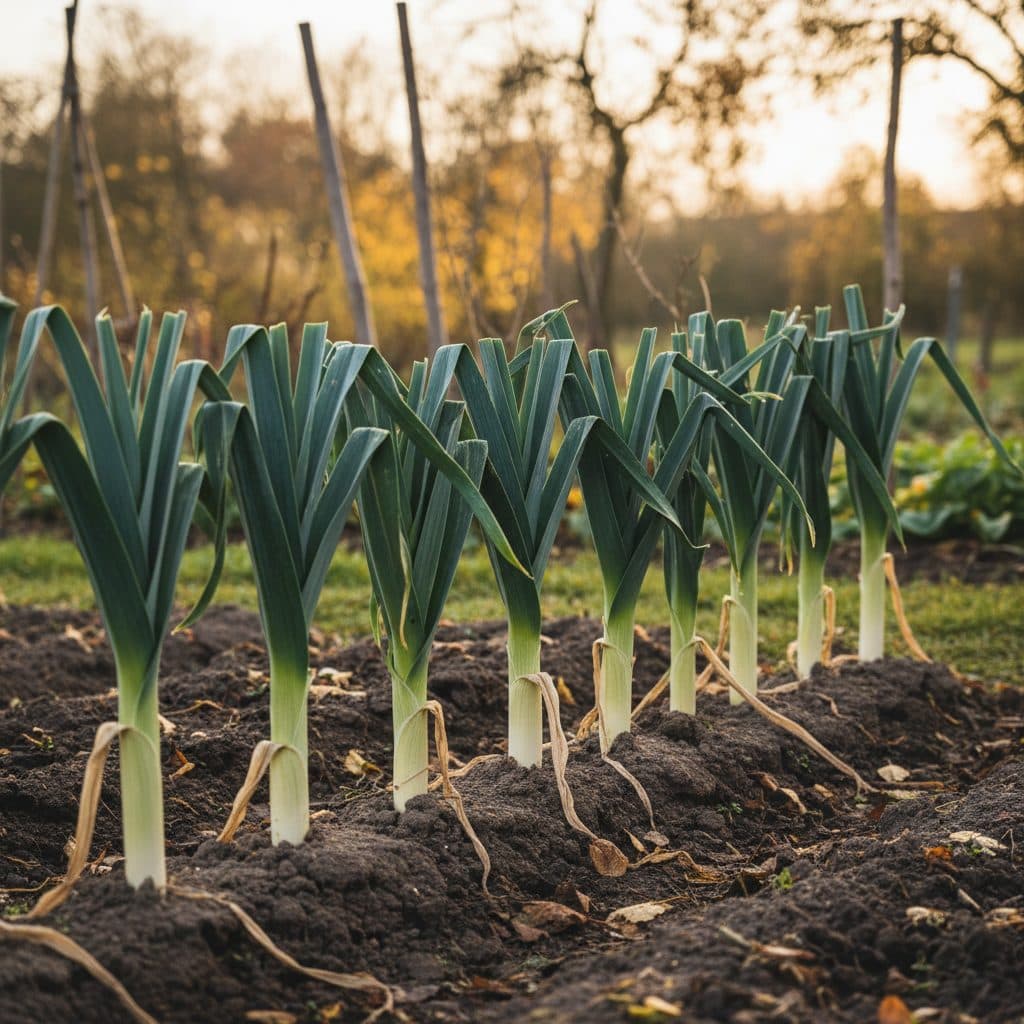
Key takeaways
- Sow leek seeds indoors or under glass from February to April, or direct in prepared seedbeds from April to May.
- Transplant seedlings in June when they reach pencil thickness into individual 15 cm deep dibber holes without backfilling soil.
- Puddle the transplants in by filling each planting hole with water, allowing dislodged soil to settle naturally around the roots.
- Blanch the lower stems by gradually earthing up soil or sliding cardboard collars around the shafts to produce long, tender white shanks.
- Protect crops against leek moth and allium leaf miner using fine insect mesh netting from early spring through autumn.
- Harvest hardy winter cultivars continuously from late autumn through to early spring, with the hardiest types standing into April.
Quick answer: To grow leeks successfully in the UK, sow seeds in deep pots in February or March, transplant the pencil-thick seedlings into 15 cm deep dibber holes in June, and water them in without backfilling soil. Earth up the stems as they grow to create long, blanched white shanks, and harvest fresh throughout the winter months.
Leeks (Allium ampeloprasum var. porrum) are one of the most reliable and rewarding winter vegetable crops for UK gardeners and allotment holders. Hardy winter leeks tolerate frost, snow, and rain, and stay in the plot when little else can be harvested fresh from the soil.
Growing superb leeks requires patience and attention to a few distinctive cultural techniques. From making deep transplanting holes with a traditional wooden dibber to protecting tender stems from allium pests, mastering the crop's lifecycle ensures a bountiful harvest from late summer right through to early spring.
Choosing the right leek varieties for your UK plot
Leek cultivars are broadly categorised by their maturity period and cold tolerance. Selecting a combination of early, mid-season, and winter-hardy types extends your cropping window across eight months of the year.
Group | Sowing Period | Harvest Window | Key Characteristics | Popular UK Cultivars |
|---|---|---|---|---|
Early Season | February to March | August to November | Fast growing, long white shafts, pale green leaves, moderate frost hardiness | 'King Richard', 'Early Market' |
Mid-Season (Autumn) | March to April | October to December | Balanced shaft length, darker foliage, withstands moderate autumn frosts | 'Autumn Giant', 'Autumn Mammoth' |
Late (Winter Hardy) | April to early May | December to April | Short, thick stems, deep blue-green flags, supreme frost and snow hardiness | 'Musselburgh', 'Bandit', 'Below Zero' |
For reliable winter cropping on exposed northern plots, heritage cultivars like 'Musselburgh' remain the benchmark for frost tolerance.
Sowing leek seeds: indoor trays versus outdoor seedbeds
Leeks have a long growing cycle of 20 to 30 weeks. Getting them started early in the season ensures seedlings develop sufficient girth before summer transplanting.
+-------------------------------------------------------------+
|                     LEEK LIFECYCLE TIMELINE                 |
|                                                             |
|   Feb - Apr: Sow in deep pots indoors / greenhouse          |
|         |                                                   |
|   May - Jun: Harden off; seedlings reach pencil thickness   |
|         |                                                   |
|   Jun - Jul: Transplant into deep dibber holes; puddle in   |
|         |                                                   |
|   Aug - Oct: Earth up stems; blanch white shanks            |
|         |                                                   |
|   Nov - Mar: Harvest hardy leeks as needed through winter   |
+-------------------------------------------------------------+
Sowing indoors in containers (February to March)
Sowing in deep modular trays, pots, or recycled plastic fruit punnets indoors gives seeds the steady warmth they need for uniform germination. Use a quality peat-free seed compost. Sow seeds thinly across the surface and cover with 5 mm of sieved compost or vermiculite.
Maintain a germination temperature between 15°C and 20°C. Seeds typically emerge within 10 to 14 days. Once germinated, move the containers to a bright, unheated greenhouse, cold frame, or sunny windowsill to grow steadily without turning leggy.
Sowing outdoors in a nursery bed (April)
If indoor space is limited, sow leek seeds directly outdoors in an open nursery bed in April. Prepare a fine, weed-free seedbed in full sun. Sow seeds thinly in shallow drills 1 cm deep with rows spaced 15 cm apart. Water the drills thoroughly with a fine-rose watering can. Seedlings will develop steadily outdoors and be ready for lifting and transplanting into permanent beds by early summer.
Transplanting into deep dibber holes: the traditional method
The traditional UK method of transplanting leeks creates long, blanched white stems while giving the young plants room to expand.
+-------------------------------------------------------------+
|                TRANSPLANTING WITH A DIBBER                  |
|                                                             |
|   1. Make hole: 15 cm deep, 3-5 cm wide                     |
|   2. Drop seedling inside (roots at bottom, tips poking out)|
|   3. Fill hole with WATER (do NOT fill with soil)           |
|                                                             |
|         |   |                                               |
|         |   |   <-- Green leaves emerging above rim         |
|   ======|===|====== Soil Surface                            |
|         |   |                                               |
|         |   |   <-- 15 cm open cylindrical hole             |
|         ( * )   <-- Seedling base & roots at bottom         |
|         -----                                               |
+-------------------------------------------------------------+
Step-by-step planting process:
- Select pencil-thick seedlings: In June or early July, choose sturdy seedlings that are approximately 15 cm to 20 cm tall and as thick as a standard pencil.
- Lift and trim (optional): Carefully fork up the seedlings to preserve the root mass. If roots are extremely tangled, trim the tips lightly to 5 cm to make insertion easier. Trimming leaf tips is optional and only necessary if foliage is excessively sprawling.
- Make holes with a dibber: In prepared, weed-free ground, use a wooden dibber or broom handle to press vertical holes 15 cm deep. Space the holes 15 cm to 20 cm apart in rows spaced 30 cm apart.
- Drop one seedling into each hole: Lower one seedling into each hole so the roots rest in the bottom and the green leaves emerge from the top.
- Puddle the plants in: Fill each hole to the brim with water using a watering can with the rose removed. Do not fill the hole with soil. The water carries loose particles down to settle snugly around the roots while leaving the open cylinder around the stem. As the leek grows, rain and hoeing gradually fill the hole with soil, blanching the stem naturally.
Establishing good beds built on organic gardening soil ensures ample drainage and fertility during this critical establishment window.
Blanching leeks for tender white stems
The prized culinary portion of a leek is the tender, sweet, blanched lower shaft. Because light stimulates chlorophyll production and turns plant tissue green and tough, excluding light from the lower stem is essential for quality shanks.
- Earthing up: From August onwards, use a draw hoe to gradually pull loose soil up around the base of the stems every few weeks. Never earth up too high at once, as soil granules can lodge between the leaf sheaths and make cleaning gritty.
- Cardboard collars or pipes: Slip recycled cardboard tubes, toilet roll inners, or short lengths of plastic pipe over the plants in late summer. This keeps the stems completely shielded from light without introducing dirt into the inner leaf layers.
Soil, watering, and feeding requirements
Leeks are moderately heavy feeders that thrive in moisture-retentive, well-drained soil rich in organic matter. Avoid planting leeks in beds freshly dressed with unrotted animal manure, as excessive nitrogen causes coarse, flabby growth susceptible to fungal disease.
- Watering: Leeks have relatively shallow fibrous roots. Water thoroughly during dry summer spells to maintain steady, unchecked development. Mulching the bed surface with compost or straw helps conserve soil moisture.
- Feeding: Apply a balanced organic liquid feed, such as seaweed extract or diluted comfrey tea, every three weeks through mid-summer. Stop feeding by late August so plants can harden off before winter frosts arrive.
- Soil and weather factors: In waterlogged conditions, plants can show signs of cold wet soil nutrient deficiency. Ensure your beds have adequate drainage before planting.
Managing common leek pests and diseases organically
Maintaining high standards of garden hygiene and rotation prevents most allium problems.
Leek moth (Acrolepiopsis assectella)
The larvae of the leek moth tunnel through the leaves, leaving whitish patches and ragged holes, eventually boring into the central stem and causing rot.
- Control: Net from transplanting onward and keep the crop covered into October; if you have sown or planted earlier, net from the point the plants go into their final bed to prevent adult moths from laying eggs.
Leek rust (Puccinia allii)
A fungal disease causing bright orange, powdery pustules on the foliage during warm, damp late-summer weather. Severe infections reduce plant vigor.
- Control: Ensure generous plant spacing to maximise airflow between rows. Avoid overhead watering in the late afternoon. Remove heavily infected outer leaves promptly and dispose of them in the municipal waste bin rather than your compost heap. Choose rust-tolerant varieties like 'Below Zero', 'Porbella', or 'Bandit'.
Allium leaf miner (Phytomyza gymnostoma)
Tiny flies that puncture leaf tips before larvae tunnel downward into the stems, leading to secondary bacterial rotting during autumn.
- Control: Fine mesh netting (0.8 mm) is the only reliable defense. Keep crops covered during the two peak fly generations in spring (March–April) and autumn (October–November).
Harvesting and storing winter leeks
Begin harvesting early varieties in late August once they achieve culinary size. Winter leeks can remain in the ground all season and be harvested as needed.
- Lifting: Never pull leeks straight up by their foliage, which often snaps the stem. Insert a garden fork deeply beside the plant, lever gently to sever deep roots, and lift the entire shaft cleanly.
- Hard frost preparation: When deep snow or freezing temperatures are forecast, lift a week's supply in advance or mulch around the row with thick straw so the ground does not freeze solid around the stems.
With proper timing, deep dibber planting, and simple pest netting, leeks provide fresh garden produce through the coldest months of the year.