Key takeaways
- Egyptian walking onions (Allium cepa var. proliferum) are a low-maintenance perennial allium that propagate themselves via top-setting bulbils.
- These alliums offer continuous harvests of green tops, bulbils, and underground bulbs from early spring through fall, even in USDA zone 3.
- Planting is simple: choose a sunny site with well-drained soil, spacing bulbils or small bulbs 6 to 12 inches apart and 2 inches deep.
- Perennial alliums like chives and garlic chives require minimal care once established, thriving for 10 to 20 years with little intervention.
- They are generally resistant to common pests and diseases, and their hardiness allows them to overwinter successfully in most US climates.
- Harvesting can occur throughout the growing season, providing a steady supply of fresh allium flavor for cooking and preservation.
Quick answer: Egyptian walking onions are self-propagating perennial alliums that provide continuous harvests of greens, bulbils, and underground bulbs with minimal care. Plant bulbils or small bulbs 2 inches deep and 6-12 inches apart in a sunny, well-drained location for decades of productivity.
In many US gardens, especially those in cooler climates like USDA zone 4 in the Upper Midwest, gardeners seek reliable, low-effort crops that provide consistent yields. Egyptian walking onions (Allium cepa var. proliferum) and other perennial alliums fit this need perfectly, offering a hands-off approach to growing onions and chives for years on end. They need minimal replanting and continue producing with little intervention once established in a suitable location.
Unlike annual onions that demand replanting from sets or seeds each season, these perennial varieties establish themselves and return year after year, often spreading to create a self-sustaining patch. They offer a continuous harvest of greens, bulbils, and small underground bulbs from early spring through late fall, providing fresh flavor for a significant portion of the year. This guide will walk you through the simple steps to cultivate these resilient alliums, for a steady supply of onion-like flavor with minimal fuss in your home garden.
What are Egyptian walking onions and perennial alliums?
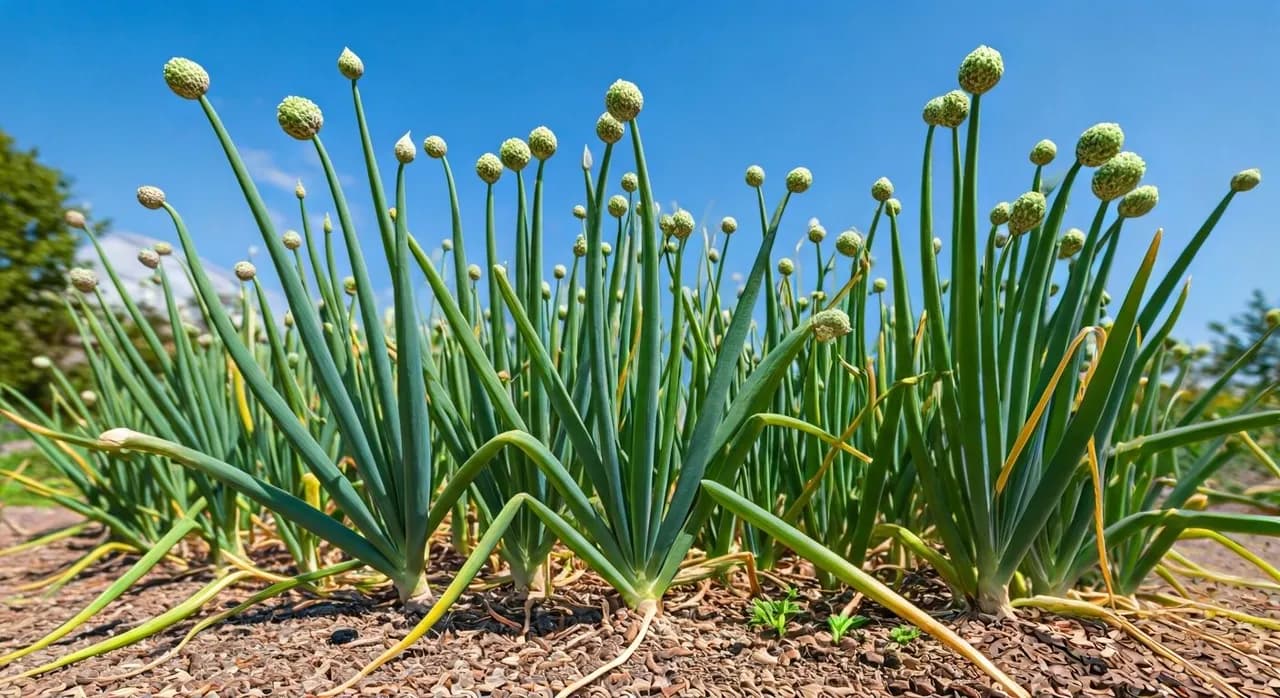
Egyptian walking onions, botanically known as Allium cepa var. proliferum, are a unique type of onion that produces small, edible bulbils at the top of their flower stalks instead of traditional flowers and seeds. These bulbils mature and eventually cause the stalk to bend over, ‘walking’ a few feet away from the parent plant to root and grow new plants. This self-propagating habit makes them low-maintenance: because each generation roots itself where it falls, a patch can carry on indefinitely with little intervention.
the anatomy of a walking onion
Beyond walking onions, the category of perennial alliums includes familiar favorites like chives (Allium schoenoprasum) and garlic chives (Allium tuberosum). Chives produce slender, hollow leaves with a mild onion flavor, while garlic chives offer flat, grass-like leaves with a distinct garlic undertone. Both species are hardy perennials, returning reliably each spring and forming dense clumps that can be divided every three to five years to expand your patch or share with neighbors. These plants are valued for their continuous harvest, minimal care requirements, and flavorful contributions to the kitchen, making them staples in many US herb gardens. Their structural components, including the leaves, bulbils, and underground bulbs, are all edible and contribute to their versatility [1].
- Walking onions produce bulbils on stalks up to 36 inches tall.
- Chives grow to about 12 inches in height, forming dense clumps.
- Garlic chives reach 18 to 24 inches, with broader, flat leaves.
- All parts of these alliums above ground are edible for people, including the bulbils — but every allium is toxic to dogs, cats, horses, cattle and poultry, so keep a walking-onion patch away from paddocks, runs and anywhere pets graze.
- They offer a mild to pungent flavor, depending on the specific variety and growing conditions.
Site selection and planting for long-term success
Establishing a perennial allium patch requires careful site selection to ensure decades of productivity. These plants prefer a location with at least six hours of direct sunlight per day, which supports strong growth and bulbil production. In regions like the arid Southwest, some afternoon shade can be beneficial to prevent scorching in temperatures exceeding 90°F. The soil should be well-drained, as alliums are susceptible to rot in waterlogged conditions. A soil pH between 6.0 and 7.0, slightly acidic to neutral, is ideal and supports optimal nutrient uptake [5].
planting your perennial alliums
Once you have chosen your site, prepare the soil by incorporating 2 to 4 inches of compost or other organic matter to improve fertility and drainage. For Egyptian walking onions, plant individual bulbils or small underground bulbs 2 inches deep and 6 to 12 inches apart. For chives and garlic chives, plant small divisions of established clumps at the same depth and spacing. Consider planting them in a dedicated perennial bed, similar to how one might establish a long-lasting asparagus patch, to avoid disturbance from annual cultivation. Initial watering after planting helps settle the soil, but established plants are quite drought tolerant, requiring less than 1 inch of supplemental water per week in many US regions [5].
- Choose a site with full sun exposure for at least six hours daily.
- Ensure soil is well-drained; sandy loam is preferred.
- Amend soil with 2-4 inches of compost before planting.
- Plant bulbils or divisions 2 inches deep and 6-12 inches apart.
- Consider a permanent location to avoid future disturbance.
Hands-off care and harvest strategies
One of the most appealing aspects of Egyptian walking onions and perennial alliums is their minimal care requirements once established. After the first year, these plants typically need little more than occasional weeding and perhaps a light top-dressing of compost in early spring. They are remarkably self-sufficient, especially in USDA zones 4 through 8, where winter dormancy protects them from extreme cold. Unlike annual onions that require specific day-length considerations for bulb formation, perennial alliums simply grow and produce, simplifying the gardening process [3]. For more on traditional onion growing, you can visit how to grow onions.
harvesting throughout the season
Harvesting perennial alliums is a continuous process, providing fresh greens from early spring until the first hard frost. For walking onions, you can snip the green tops as needed, leaving at least 2 inches of growth to allow the plant to regenerate. The bulbils can be harvested in mid-to-late summer when they are firm and well-formed; they can be used fresh in cooking, pickled, or replanted. Chives and garlic chives can be cut back to 1 inch above the ground multiple times throughout the season, yielding fresh growth every three to four weeks. A mature chive clump, for example, can provide 8 to 10 harvests in a single growing season in temperate climates. This consistent yield makes them an excellent addition to a starting a herb garden, offering fresh flavor without constant replanting [5].
- Snip green tops from walking onions, leaving 2 inches to regrow.
- Harvest walking onion bulbils in mid-to-late summer for replanting or cooking.
- Cut chives and garlic chives back to 1 inch above ground for continuous harvests.
- Expect chives to regrow every three to four weeks during the growing season.
- Consider leaving some bulbils to drop and ‘walk’ for natural propagation.
Pest and disease resistance, and winter hardiness
Perennial alliums generally resist many common garden pests and diseases, thanks to the sulfur compounds in their tissues [2]. This natural defense mechanism means less reliance on chemical interventions, making them a practical choice for home gardeners across the US. While no plant is entirely immune, issues like onion thrips or downy mildew are less frequent and less severe in perennial allium patches compared to large monoculture plantings of annual onions. Maintaining good air circulation by proper spacing, typically 6 to 12 inches between plants, helps further reduce disease pressure [5].
overwintering in diverse climates
One of the greatest advantages of these alliums is their exceptional winter hardiness. Egyptian walking onions, chives, and garlic chives are reliably perennial in USDA zones 3 through 9, meaning they can withstand winter temperatures as low as -40°F in northern states like Minnesota or Montana. The plants enter a dormant phase as temperatures drop, with their foliage dying back to the ground. The underground bulbs or root systems remain viable, storing energy to re-emerge vigorously in early spring. In very cold climates, a layer of mulch, such as 2 to 4 inches of straw or shredded leaves, can provide additional insulation, though it’s often not strictly necessary for established plants. This resilience makes them useful for a garden aiming for long-term productivity and reduced seasonal effort, much like the benefits of planting cover crops for soil health [4].
- Perennial alliums contain sulfur compounds that deter many pests.
- Good plant spacing (6-12 inches) helps prevent fungal diseases.
- They are hardy in USDA zones 3-9, tolerating temperatures down to -40°F.
- Foliage dies back in winter, but underground parts survive.
- Mulching with 2-4 inches of organic material can offer extra winter protection.
Comparison of Egyptian walking onions and standard bulb onions
Feature | Egyptian Walking Onions (Perennial) | Standard Bulb Onions (Annual) |
|---|---|---|
Life Cycle | Perennial (10-20 years) | Annual (one growing season) |
Propagation | Top-setting bulbils, underground bulbs | Seeds, sets, or transplants |
Replanting Effort | Minimal to none (self-propagating) | Required annually |
Harvest Type | Green tops, bulbils, small underground bulbs | Large bulb, limited greens |
Harvest Season | Early spring to late fall (continuous) | Late summer (single harvest) |
Hardiness | USDA Zones 3-9 | Varies by cultivar, generally less hardy |
Storage Potential | Bulbils for short-term, small bulbs for a few months | Large bulbs store for 6-12 months |
Walking onion spread: An established Egyptian walking onion plant can ‘walk’ and root new plants 12 to 24 inches away from its original location each season.
Chive productivity: A single mature chive clump can yield 8 to 10 harvests of fresh greens in a typical growing season in USDA zone 6.
Frequently asked questions
How long do Egyptian walking onions live?
Once established, Egyptian walking onions can live and produce for 10 to 20 years or even longer in a suitable location. Their self-propagating nature means the patch will continually renew itself over decades, providing a steady supply of greens and bulbils.
Are all parts of Egyptian walking onions edible?
Yes, all parts of the Egyptian walking onion are edible. You can eat the green tops, the small bulbils that form on top of the stalks, and the small underground bulbs. The flavor is typically milder than a pungent storage onion, often described as a cross between an onion and a leek.
How do I start an Egyptian walking onion patch?
You can start an Egyptian walking onion patch by planting the small bulbils or underground bulbs. Plant them 2 inches deep and 6 to 12 inches apart in well-drained soil with at least six hours of sun. They will root and grow new plants, often within a few weeks.
Do perennial alliums spread aggressively?
Egyptian walking onions spread by ‘walking’ their bulbils, typically creating new plants 12 to 24 inches from the parent plant each year. Chives and garlic chives spread by forming larger clumps that can be divided. Garlic chives are the exception worth planning around: they self-seed prolifically, and unless you cut the flower heads off before the seed ripens they will volunteer through nearby beds, paths and lawn, where established clumps are tedious to dig out.
Can I grow perennial alliums in containers?
Yes, perennial alliums like chives and garlic chives grow very well in containers, provided the container is at least 8 inches deep and has good drainage. Walking onions can also be grown in containers, but their ‘walking’ habit will be limited, requiring you to manually replant the bulbils if you want them to spread.
When is the best time to plant perennial alliums?
The best time to plant perennial alliums is in early spring or early fall. Planting in spring allows them to establish before summer heat, while fall planting gives them time to root before winter dormancy. In USDA zone 7, planting in September or October is often ideal for good establishment.
References
- The structure of edible alliums. (2008). The structure of edible alliums..
- Biochemistry, health benefits and food science of alliums. (2008). Biochemistry, health benefits and food science of alliums..
- Onions and other vegetable alliums (2008). Onions and other vegetable alliums.
- Crop storage and dormancy. (2008). Crop storage and dormancy..
- Agronomy and crop production. (2008). Agronomy and crop production..