
Key takeaways
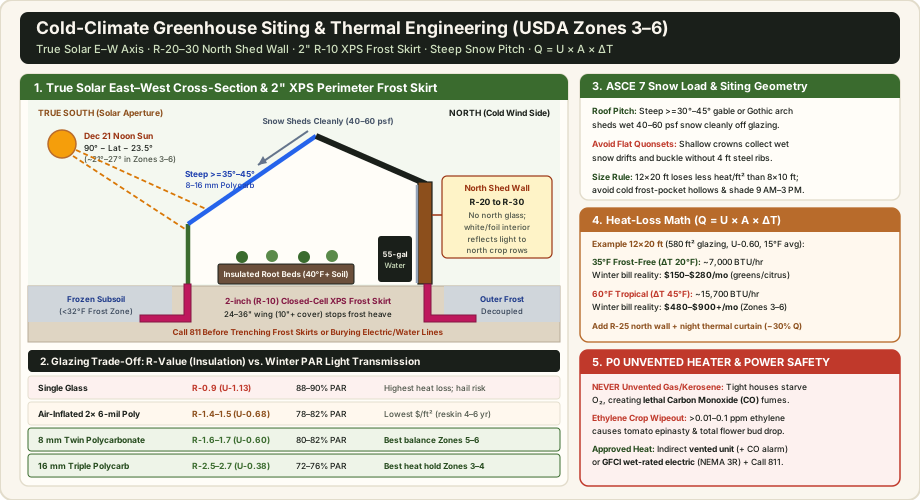
- Run the long ridge true solar East–West (correcting compass readings for magnetic declination) and replace north glazing with `R-20–30` insulated shed framing painted matte white or foil-faced to bounce winter sun onto benches.
- Wrap the outer perimeter in `2-inch` (`R-10`) closed-cell XPS extruded polystyrene buried `24–36 in` deep or as a sloped outward wing (minimum `10 in` soil cover) to stop frost heave and decouple cold subsoil from interior root beds.
- Avoid single glass (`R-0.9`, `U-1.13`) in Zones 3–6: pick `8 mm` twin-wall polycarbonate (`R-1.6–1.7`, `~80–82%` PAR) in Zones 5–6 or `16 mm` triple-wall (`R-2.5–2.7`, `~72–76%` PAR) in Zones 3–4, or double air-inflated `6-mil` poly (`R-1.5`).
- Choose a steep `>= 30–45°` gable or Gothic arch frame rated for `40–60 psf` local snow loads; shallow-crowned Quonset hoop houses trap heavy wet snow and buckle under midwinter storms.
- Run `Q = U × A × ΔT` before sizing heaters: overwintering hardy greens at `35°F` runs `~$150–$280/mo` in a `12×20 ft` house, whereas maintaining `60°F` for tomatoes easily reaches `$480–$900+/mo`.
- P0 safety: ban unvented propane or kerosene heaters (lethal carbon monoxide plus `>0.01–0.1 ppm` ethylene flower/tomato drop), install vented heaters with CO alarms or GFCI NEMA 3R electric heaters, and Call `811` before trenching.
Quick answer: To build an efficient greenhouse in USDA Zones 3–6, align the long ridge true solar East–West so steep south glazing (`>= 30–45°` gable or Gothic arch) captures December 21 noon sun (`90° − latitude − 23.5°`) and sheds 40–60 psf wet snow without crushing like a flat-crowned Quonset. Replace north glass with `R-20–30` insulated shed framing lined with white reflective sheathing, wrap foundations with a `2-inch` (`R-10`) closed-cell XPS frost skirt `24–36 in` deep, glaze with `8–16 mm` polycarbonate (`R-1.6–2.7`) or double air-inflated poly (`R-1.5`), and calculate `Q = U × A × ΔT` (`$150–$280/mo` for `35°F` frost-free greens vs. `$480–$900+/mo` for `60°F` tomatoes). Ban unvented propane or kerosene heaters (lethal CO and ethylene flower drop); run vented units or GFCI wet-rated electric heat, and call `811` before digging.
True Solar Orientation, December Sun Angles, and the R-20–30 North Wall
Conventional all-glass backyard greenhouses bleed heat through every square foot in Minnesota, Montana, Maine, Michigan, and New England because northern winter sun sits low in the south while bitter winds strike from the north and northwest. Before staking corners, map your site using our microclimate and windbreak checklist and align the greenhouse long ridge true solar East–West so one full broad side faces due south.
Magnetic compasses drift 5° to 18° east or west of true geographic south across the northern United States depending on longitude. Look up your local magnetic declination on NOAA maps or trace solar noon (halfway between local sunrise and sunset) so your glazed collector sits within `15°` of true south, ensuring unobstructed winter sun from 9:00 AM to 3:00 PM. Detailed latitude tilt tables in our passive solar greenhouse latitude guide complement the core winter solstice geometry below.
Calculating December 21 winter sun altitude and ditching north glass
On December 21, noon solar altitude drops to `90° − latitude − 23.5°`:
- Zone 3 (`47°N`, Fargo ND / Duluth MN): `90° − 47° − 23.5° = 19.5°` above the southern horizon. A `60-foot` deciduous or evergreen tree `120 feet` south casts shadow across the entire greenhouse at midday.
- Zone 4–5 (`43°N`, Madison WI / Concord NH): `90° − 43° − 23.5° = 23.5°` noon solar altitude. South-facing glazing sloped steeply (`35–55°` or vertical lower knee plus sloped upper roof) admits low rays deep into beds instead of bouncing them skyward.
- Zone 6 (`40°N`, Columbus OH / Denver CO): `90° − 40° − 23.5° = 26.5°` noon altitude, raising daily winter solar irradiance while still demanding solid northern wind protection.
In winter above `38°N` latitude, the north wall receives zero direct beam sunlight while losing heat continuously to `-10°F` to `-30°F` winds. Replacing north glass with opaque insulated shed framing (`R-20` to `R-30` cavity plus exterior rigid foam) and sheeting the interior wall with matte white poly-coated boards or bright painted OSB slashes conductive loss across roughly one-third of the building shell while bouncing low southern rays downward onto benches—the core principle behind four-season passive solar greenhouses.
Sizing Footprint, Surface-to-Volume Ratio, and ASCE 7 Snow-Load Profiles
First-time cold-climate builders routinely pick tiny `6×8 ft` or `8×10 ft` hobby kits thinking smaller spaces cost less to warm. Physics works against miniature footprints: an `8×10 ft` (`80 ft²`) house exposes roughly `320 ft²` of cold wall and roof (`4.0 ft²` of shell per square foot of floor), whereas a `12×20 ft` (`240 ft²`) structure exposes `~580 ft²` (`2.4 ft²` of shell per square foot of floor)—cutting heat loss per crop bed nearly in half while leaving space for wide wheelbarrows, potted trees, and thermal barrels. Compare layout dimensions in our greenhouse styles and builds overview and hobby kit cost guide.
Structural geometry matters just as much as floor width once heavy lake-effect or wet coastal nor'easter snow arrives. Under ASCE 7 cold-climate snow-load engineering, ground snow loads of 40 to 60+ pounds per square foot (psf) rapidly crush shallow-crowned hoops.
USDA Zones 3–6 Structural Profiles: Snow Shedding (ASCE 7), Surface-to-Volume Ratio & Realistic Shell Cost
Structural Profile | Roof Pitch & 40–60 psf Snow Shedding | Typical Zone 3–6 Footprint | Materials Cost & Key Engineering Note |
|---|---|---|---|
Steep Shed-Roof Passive Solar | South slope `35–55°`; insulated north roof sheds cleanly | `10×16` to `12×24 ft` | `$30–$65/ft²` DIY; `R-20–30` north wall cuts heating load `30–40%` |
Gothic Arch (Pointed Peak) | Steep crown `>= 30–45°`; sheds heavy wet snow effortlessly | `12×20` to `20×40 ft` | `$8–$22/ft²`; use `4 ft` bow spacing & `11–12 ga` galvanized pipe per snow-load bracing guide |
Steep Gable (Twin/Triple Poly) | Fixed `>= 30–45°` ridge pitch; requires ridge purlins & knee bracing | `10×12` to `16×24 ft` | `$25–$55/ft²`; check hoop house anchoring specs for uplift bolts |
Rounded Quonset Hoop House | Flat crown collects sticky wet snow; high collapse risk >25–30 psf | `12×20` to `14×30 ft` | `$3–$7/ft²`; avoid unbraced kits in Zones 3–5 unless stripping film or adding `4 ft` centers; see DIY hoop house |
Never buy a rounded Quonset kit on snow-belt averages alone: Wet spring snow weighs 15 to 20 lb per cubic foot (`24 inches = 30–40 psf`), and drifting wind piles double depth onto one slope. Unless a manufacturer supplies stamped drawings for your local county ASCE 7 psf load—or you run `4 ft` Gothic-arch steel hoops with purlins and cross-ties—skip low-pitch rounded tunnels in Zones 3–5. Compare tunnel trade-offs in polytunnel vs. greenhouse and hoop house durability comparisons.
2-Inch XPS Perimeter Frost Skirts and Foundation Decoupling
Even an `R-30` north wall fails if frozen exterior soil (`0°F` to `20°F`) conducts cold straight beneath shallow sills into interior growing beds and heaves doors out of square. Traditional northern frost footings excavate concrete piers `48–60 inches` below grade—expensive work that still fails to insulate horizontal soil beds unless lined with perimeter foam.
Cold-climate research centers (Penn State Housing Research Center and Alaska's Cold Climate Housing Research Center) validate Frost-Protected Shallow Foundations (FPSF) using `2-inch` closed-cell extruded polystyrene (`XPS`, ASTM C578, `R-10`) as a perimeter frost skirt. Unlike beaded EPS foam (which absorbs groundwater over time) or foil-faced polyisocyanurate (which loses R-value below grade and delaminates when damp), pink or blue closed-cell XPS retains `R-5` per inch in saturated soil.
- Call 811 before trenching: Always dial 811 at least 3 business days before digging perimeter frost trenches or utility ditches so utility locators mark buried gas, power, fiber, and water lines.
- Install vertical + outward wing `24–36 in` deep/wide: Run `2-inch` (`R-10`) XPS vertically down the inside or outside of the stem wall and kick a horizontal or slightly sloped outward frost wing `24–36 inches` wide around the outer perimeter (increasing width to `36–48 in` at corners, where frost penetrates from two directions). Keep at least `10 inches` of drained topsoil or pea gravel above horizontal wings.
- Protect exposed above-grade foam: UV rays pulverize bare XPS within two summers and string trimmers chew exposed edges. Cap above-grade foam with galvanized steel flashing, cementitious parge coat, or pressure-treated ground-contact skirt boards.
- Consider earth-berming carefully: Sinking beds can stabilize soil temperatures, as covered in our walipini design guide and earth-bermed cold-zone greenhouse guide, but never dig deep pits into high water tables or heavy clay without perimeter French drains.
Glazing Trade-Offs: Glass vs. 8–16 mm Polycarbonate vs. Double Inflated Poly
Choosing glazing in Zones 3–6 balances thermal retention (`R-value` / `U-factor`) against Photosynthetically Active Radiation (`PAR`, `400–700 nm`)—the exact wavelengths plants use to photosynthesize during short 8-to-9-hour December days. Every extra wall layer cuts conductive heating bills while filtering out `6%` to `15%` of precious winter sun.
Cold-Climate Greenhouse Glazing Comparison: U-Factor, R-Value & Winter PAR Transmission
Glazing Material | R-Value / U-Factor (BTU/hr·ft²·°F) | PAR Light Transmission | Zones 3–6 Performance & Service Life |
|---|---|---|---|
Single Tempered Glass (`3–4 mm`) | `R-0.9` (`U-1.13`) | `88–90%` PAR | 20+ yr clarity, zero UV fade, but catastrophic winter fuel bills and hail breakage risk |
Double Air-Inflated `6-mil` UV Poly | `R-1.4–1.5` (`U-0.67–0.70`) | `78–82%` PAR | Lowest cost; `~3–4 in` air cushion requires `30–50 W` continuous squirrel-cage blower; replace film every 4–6 yrs |
`8 mm` Twin-Wall Polycarbonate | `R-1.6–1.7` (`U-0.58–0.62`) | `80–82%` PAR | 10–15 yr UV lifespan; flexible against hail and snow; best all-around pick for USDA Zones 5–6 |
`16 mm` Triple-Wall / 5-Wall Polycarbonate | `R-2.5–2.7` (`U-0.37–0.42`) | `72–76%` PAR | Cuts conductive heat loss `~35–40%` vs. 8 mm; ideal for Zones 3–4 if cool greens tolerate diffuse lower PAR |
When installing `8 mm` or `16 mm` multi-wall polycarbonate, seal top flute ends cleanly with solid aluminum foil tape and bottom flute ends with breathable vent tape inside U-channel drip profiles so condensation drains out without inviting algae inside hollow flutes. On double-layer poly houses, pull inflation air strictly from dry outside air—not humid indoor air—or frost and mildew will fog the cavity between layers. For extreme winter cold snaps, add inner floating row covers or winter cold frames over beds to gain another `6–10°F` leaf-zone buffer at near-zero energy cost.
Worked Heat-Loss Math (Q = U × A × ΔT) and Winter Bill Reality Check
Before choosing crops or buying a heater, run the standard land-grant extension conduction equation (`Q = U × A × ΔT`) plus an infiltration allowance (`0.018 × Volume × ACH × ΔT` for air leaks) to turn vague heating promises into real monthly utility numbers. Check local frost dates in our frost-date calculator tool and model thermal buffers using our passive thermal mass guide.
Take a well-built `12×20 ft` (`240 ft²`) Zone 4/5 passive-solar-hybrid greenhouse with an `R-25` insulated north wall (`200 ft²`, `U = 0.04`), `2-inch` XPS perimeter skirt, and `380 ft²` of `8 mm` twin-wall polycarbonate (`U = 0.60`), giving a blended envelope heat-loss factor of `~236 BTU/hr per °F` (`380 × 0.60 + 200 × 0.04`) plus roughly `35 BTU/hr per °F` for tight `0.75 ACH` infiltration (`~270 BTU/hr/°F` total). Compare two realistic January operating targets when overnight winter averages `15°F` and Arctic nights plunge to `-15°F`:
Worked Heat-Loss Equation (Q = U × A × ΔT) & Monthly Utility Reality for a 12×20 ft Zones 3–6 Greenhouse
Target Interior Temp & Crop Tier | Avg Jan ΔT (vs. 15°F Night) & Peak ΔT (-15°F) | Required Heater Capacity & Daily Load | Monthly Winter Utility Reality (Zones 3–6) |
|---|---|---|---|
`35°F` Frost-Free (Spinach, Kale, Lettuce, Overwintered Lemon / Fig) | Avg `ΔT = 20°F`; Peak `ΔT = 50°F` | `~5,400 BTU/hr` avg (`13,500 BTU/hr` peak); `~1.6 kW` avg night draw | `$150–$280/mo` (electric at `$0.15/kWh` or vented propane, assuming daytime solar covers 8–10 hrs) |
`45°F` Cool-Season Active Growth (Carrots, Beetroot, Radishes, Arugula, Leeks) | Avg `ΔT = 30°F`; Peak `ΔT = 60°F` | `~8,100 BTU/hr` avg (`16,200 BTU/hr` peak); `~2.4 kW` avg night draw | `$240–$420/mo` (drops `30–35%` with insulated night thermal curtain pulled at dusk) |
Avg `ΔT = 45°F`; Peak `ΔT = 75°F` | `~12,150 BTU/hr` avg (`20,250 BTU/hr` peak); needs `~30,000 BTU/hr` vented unit margin | `$480–$900+/mo` in Zones 3–6 (often costs more than grocery organic produce unless excess waste/wood heat exists) |
Thermal mass smooths daytime heat spikes and delays midnight heater startup, though water barrels are buffers—not active heaters. Each `55-gallon` drum stores `~458 BTU` per `1°F` rise; ten dark barrels cooling `15°F` overnight release `~68,700 BTU`, enough for clear `20°F` nights at `35°F` inside yet exhausted after three cloudy `-15°F` days. Small off-grid solar photovoltaic kits and LiFePO4 batteries run solar ventilation fans, inflation blowers, and pumps cleanly via off-grid DC wiring, but solar batteries cannot economically power electric space heaters in winter.
P0 Unvented Heater Hazards, Electrical Wet-Location Rules, and Ventilation
P0 SAFETY WARNING — Never Use Unvented Propane or Kerosene Heaters: Unvented portable propane ("buddy") heaters or kerosene salamanders burn indoor oxygen rapidly inside sealed cold-climate houses, causing incomplete combustion. Exhaust fills the space with lethal, odorless carbon monoxide (`CO`) and `>0.01–0.1 ppm` (up to `1.0 ppm`) ethylene gas (`C2H4`), causing tomato epinasty, flower bud abortion, and blossom drop. Install indirect-fired vented unit heaters (outside combustion air, sealed flue past the ridge, calibrated `CO` alarm) OR GFCI-protected, NEMA 3R wet-rated electric heaters only.
- Wet-location electrical compliance: Condensation drips off every cold seam. Protect every circuit on a GFCI breaker inside NEMA 3R "while-in-use" enclosures, hardwire `240 V` heaters (`3–5 kW`) in liquid-tight conduit, and never run household extension cords across wet gravel.
- Daytime venting even at `20°F`: Clear winter sun spikes tight `12×20 ft` greenhouses past `85°F` while outdoor air stays sub-freezing, wilting spinach and dripping condensation. Size automated ridge vents and circulation fans via our greenhouse climate control guide and summer cooling guide.
- Winter water & zone crops: Drain exterior hoses before hard freezes, protect indoor barrels using cold-climate rainwater storage specs, and match overwintering crops across USDA Zone 3 gardening through Zones 4–6 and winter greens selection via the plant finder.