Key takeaways
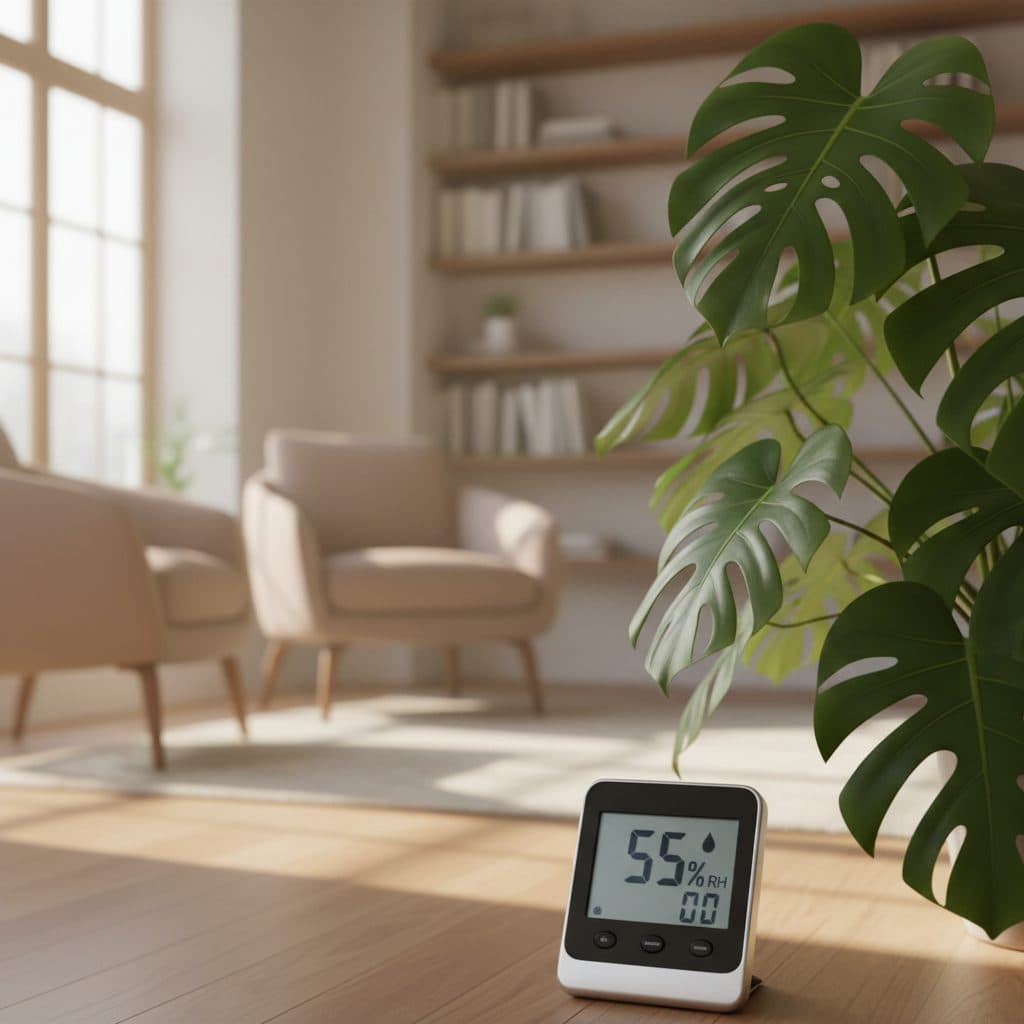
- Relative humidity (RH) is a critical, often overlooked, factor for houseplant health, impacting growth and disease resistance.
- Hygrometers provide precise measurements of indoor humidity, allowing growers to make informed adjustments for their plants.
- Most common houseplants thrive within a 40% to 60% RH range, but specific species like ferns or succulents have narrower ideal zones.
- Digital hygrometers offer convenience and accuracy, typically within plus or minus 3% RH, making them suitable for most home growers.
- Strategies like grouping plants, using pebble trays, or employing humidifiers can effectively raise indoor humidity levels.
- Monitoring humidity consistently, especially during seasonal changes in regions like the dry Southwest or cold Midwest, is crucial for plant well-being.
Quick answer: A hygrometer measures indoor relative humidity, which is crucial for houseplant health. Most common houseplants thrive in 40-60% RH, though specific species may vary, and consistent monitoring helps prevent issues.
In many homes across the United States, from the arid climates of Arizona to the heated interiors of a Minnesota winter, maintaining consistent indoor humidity for houseplants can be a real challenge. While we often focus on light, water, and soil, the air around our plants — specifically its moisture content — plays a significant role in their health and vitality. A 2023 study measured atmospheric moisture for various applications, including agriculture and indoor climate control [1].
Understanding and managing relative humidity (RH) is not just for commercial greenhouses; it is a practical skill for any home grower aiming for thriving plants. Many popular houseplants originate from tropical or subtropical regions and require ambient humidity levels far higher than the typical 30% to 40% found in many heated or air-conditioned US homes. This guide will walk you through using a hygrometer, understanding what its readings mean, and establishing ideal humidity ranges for your green companions.
what is a hygrometer and why do you need one?
A hygrometer is an instrument designed to measure the amount of water vapor in the air, expressed as relative humidity. The term ‘hygrometer’ itself dates back to the early 19th century, derived from Greek words meaning ‘moisture’ and ‘measure’ [4]. For houseplant enthusiasts, this tool is as essential as a soil moisture meter, providing crucial data that visual inspection alone cannot. Without a hygrometer, you are essentially guessing your plants’ atmospheric needs, which can lead to stress, disease, or stunted growth. For example, a home in upstate New York might experience indoor humidity drops to 25% during winter heating, a level detrimental to many tropical plants.
types of hygrometers for home use
There are several types of hygrometers available, each with varying levels of accuracy and cost. The most common for home use are digital hygrometers, which offer easy-to-read displays and often include temperature readings. These typically measure relative humidity with an accuracy of plus or minus 3% to 5% within a range of 10% to 99% RH. Analog hygrometers, often less expensive, use a coil spring that reacts to moisture, but they can be less precise, sometimes deviating by 5% or more. More specialized devices, like aspirated hygrometers or whirling hygrometers, are used in scientific or industrial settings, offering higher precision, sometimes within 1% RH [0, 2]. For most home growers, a reliable digital model placed near your plants will provide sufficient data to make informed decisions about your plant care. Investing just $15 to $30 in a good digital hygrometer can significantly improve your plant’s environment.
- Digital Hygrometers: Easy to read, often include temperature, good for general home use.
- Analog Hygrometers: Often less expensive, can be less accurate, mechanical movement.
- Thermo-Hygrometers: Combine temperature and humidity measurement in one device.
- Smart Hygrometers: Connect to apps, offer data logging and remote monitoring.
understanding relative humidity for houseplants
Relative humidity (RH) is the amount of water vapor present in the air, expressed as a percentage of the maximum amount of water vapor the air can hold at a given temperature. When the air is 100% saturated, it cannot hold any more moisture, and condensation occurs. For plants, RH matters because it directly affects transpiration, the process by which plants release water vapor through their leaves. If humidity is too low, plants transpire too quickly, leading to wilting, brown leaf tips, and overall stress. In a typical US home with central heating or air conditioning, indoor RH can often drop below 30%, especially during winter months in regions like the Great Plains.
how humidity affects plant health
High humidity, on the other hand, can reduce transpiration, which can be beneficial for some tropical plants, but too much can lead to fungal diseases and bacterial infections if air circulation is poor. For instance, a consistently high RH above 80% combined with stagnant air can encourage powdery mildew on plants like African violets. Plants also absorb some moisture directly through their leaves, especially epiphytes. Knowing your home’s average RH, which might fluctuate between 35% in summer and 20% in winter in a New England apartment, allows you to proactively adjust your plant care. Regularly checking your hygrometer readings, perhaps once or twice daily, helps you understand these fluctuations and respond before your plants show visible signs of distress. This proactive approach can save many plants from irreversible damage.
- Low Humidity Issues: Brown leaf tips, wilting, stunted growth, increased pest susceptibility.
- High Humidity Issues: Fungal diseases (e.g., powdery mildew), bacterial leaf spots, root rot if soil stays wet.
- Transpiration Rate: Directly influenced by ambient humidity, affecting water uptake and nutrient transport.
- Leaf Absorption: Some plants can absorb atmospheric moisture through specialized leaf structures.
target humidity ranges for popular houseplants
While a general range of 40% to 60% relative humidity is suitable for many common houseplants, specific species have unique requirements. For example, many tropical plants, such as ferns, orchids, and prayer plants, thrive in higher humidity, often needing 60% to 80% RH to prevent their delicate leaves from drying out. A Boston fern, for instance, will quickly develop crispy frond tips if the humidity consistently falls below 50%. On the other hand, succulents and cacti, native to arid regions, prefer much lower humidity, typically between 20% and 40% RH, and can suffer from rot in overly moist air. Understanding these species-specific needs is key to successful indoor gardening.
grouping plants by humidity needs
To simplify humidity management, consider grouping plants with similar needs. For instance, you might create a high-humidity zone for your tropicals, perhaps near a humidifier or in a reflective indoor grow tent, where you can maintain 70% RH. Conversely, succulents can be placed in a drier area, perhaps on a sunny windowsill where ambient humidity might naturally be lower, around 30%. Even common plants like the common myrtle benefit from moderate humidity, performing best around 50% RH. Regularly checking the hygrometer in each zone will confirm if you are meeting these targets. Remember that even within a single room, humidity can vary depending on proximity to windows, vents, or other moisture sources.
- Tropical Plants (e.g., Ferns, Orchids, Calatheas): 60% to 80% RH.
- General Houseplants (e.g., Pothos, Philodendrons, Spider Plants): 40% to 60% RH.
- Succulents & Cacti: 20% to 40% RH.
- Flowering Plants (e.g., African Violets, Peace Lilies): 50% to 70% RH.
maintaining ideal humidity in your home
Once you know your target humidity ranges, the next step is to actively manage the moisture levels in your home. For homes in drier climates, such as parts of USDA zone 7 in the Southwest, or during winter heating cycles across much of the Northern US, increasing humidity is often necessary. One of the most effective methods is using a humidifier. A small room humidifier can raise the RH in a 200-square-foot room within a few hours, often holding 1 to 2 gallons of water. Place your humidifier near your plants but not so close that leaves get constantly wet, which can encourage fungal growth. Many humidifiers come with built-in hygrometers and can be set to maintain a specific RH, making management easier.
practical tips for humidity control
Beyond humidifiers, several other methods can help. Grouping plants together creates a microclimate where their combined transpiration increases local humidity. Using pebble trays – shallow trays filled with pebbles and water – can also add moisture to the air as the water evaporates, effectively increasing local RH by a few percentage points directly around the plant. Misting plants, while providing a temporary boost, is often less effective for long-term humidity control than humidifiers or pebble trays, as the moisture evaporates within minutes. For specific high-humidity needs, especially for delicate plants, consider a terrarium or a mini-greenhouse setup. Even something as simple as drying laundry indoors can temporarily raise the RH in a room. Remember that consistency is key; wild swings in humidity, from 30% to 70% and back, can be more stressful for plants than a consistently lower, but stable, environment.
- Humidifiers: Most effective for consistent and significant humidity increases.
- Pebble Trays: Provide localized humidity boosts through evaporation.
- Grouping Plants: Creates a beneficial microclimate from collective transpiration.
- Terrariums/Grow Tents: Excellent for maintaining very high, stable humidity for specific plants.
- Avoid Over-Misting: Offers only temporary relief and can promote fungal issues.
Hygrometer Types: Key Differences for Home Growers
Type | Accuracy | Cost Range (USD) | Best Use Case |
|---|---|---|---|
Digital Hygrometer | ±3-5% RH | $15-$40 | General houseplant care, easy reading |
Analog Hygrometer | ±5-10% RH | $5-$20 | Budget-friendly, less precise, aesthetic appeal |
Thermo-Hygrometer | ±3-5% RH | $20-$50 | Monitoring both temperature and humidity |
Smart Hygrometer | ±2-4% RH | $30-$80 | Remote monitoring, data logging, app integration |
Typical Home RH: Many US homes, especially with heating or AC, maintain an indoor relative humidity between 30% and 40%, which is often too low for tropical houseplants.
Humidifier Impact: A standard room humidifier can increase the relative humidity in a 200-square-foot room within a few hours of operation.
Frequently asked questions
How often should I check my hygrometer?
You should check your hygrometer at least once daily, or even twice, especially during seasonal changes or if you notice your plants showing signs of stress. Humidity levels can fluctuate by 10% or more throughout a single day due to heating, cooling, or outdoor weather conditions.
Can too much humidity harm my houseplants?
Yes, excessive humidity, particularly above 80% RH without adequate air circulation, can lead to fungal diseases like powdery mildew or root rot. This is especially true for plants that prefer drier conditions, such as most succulents, which thrive at 20% to 40% RH.
What is the ideal humidity for most common houseplants?
Most common houseplants, including popular varieties like Pothos, Philodendrons, and Spider Plants, thrive best within a relative humidity range of 40% to 60%. This range supports healthy growth and minimizes stress from either too dry or too moist air.
How do I know if my hygrometer is accurate?
You can perform a simple salt test to check your hygrometer’s accuracy. Place the hygrometer in an airtight bag with a small dish of saturated salt solution (salt and a little water). After 8 hours, it should read approximately 75% RH; adjust or note the deviation if it differs by more than 3%.
Are there any plants that prefer very low humidity?
Yes, many succulents and cacti, native to desert environments, prefer very low humidity, typically in the 20% to 40% RH range. These plants are adapted to dry air and can suffer from overwatering and fungal issues if kept in consistently high humidity above 50%.
References
- Specification for aspirated hygrometer (2023). Specification for aspirated hygrometer.
- Hygrometer (2023). Hygrometer.
- Specification for whirling hygrometer (2023). Specification for whirling hygrometer.
- hygrometer, n. (2023). hygrometer, n..
- Specification for whirling hygrometer (2023). Specification for whirling hygrometer.
- USDA Natural Resources Conservation Service (2024). USDA Natural Resources Conservation Service.