Key takeaways
- Groundcovers can significantly reduce weed emergence when properly established.
- Full sun environments benefit from vigorous spreaders like Creeping Thyme and Sedum.
- Dry shade requires tough, drought-tolerant plants such as Barrenwort or Sweet Woodruff.
- Proper site preparation, including removing existing weeds and amending soil, is crucial for success.
- Intercropping with specific plants can boost weed suppression efficiency.
- Selecting the right plant for the specific light and moisture conditions minimizes long-term maintenance.
Quick answer: Groundcovers reduce weed growth by forming a dense living mat that blocks sunlight, suppresses germination, and outcompetes weeds for water and nutrients, potentially reducing weed emergence by 80% to 90%.
In many US gardens, especially those in USDA zones 5 through 8, managing weeds can consume significant time and effort. This constant battle against unwanted plants often feels like a losing fight, particularly in large beds or on slopes where manual weeding is impractical or even dangerous. However, strategic planting of groundcovers offers a powerful, long-term solution, capable of significantly reducing weed populations once established. These plants form a dense living mat that blocks sunlight, suppresses germination, and outcompetes weeds for water and nutrients.
Choosing the right groundcover depends critically on your site’s conditions—specifically, the amount of sunlight it receives and its moisture levels. A plant thriving in the intense 6+ hours of full sun in a California garden will likely struggle in the deep, dry shade under a mature oak in Georgia. This guide will help you select the most effective weed-smothering groundcovers, tailored for both bright, open areas and challenging, low-light, low-moisture spots, ensuring a healthier, lower-maintenance landscape with less effort over the next 10 to 15 years.
understanding weed smothering in full sun environments
In environments receiving 6 or more hours of direct sunlight daily, like many areas across the American Southwest or the plains states, groundcovers face both opportunities and challenges. The primary goal of a weed-smothering groundcover is to create a dense, living canopy that blocks sunlight from reaching the soil surface, thereby preventing weed seeds from germinating. This physical barrier is highly effective at reducing weed emergence once the canopy closes. Beyond light deprivation, these plants also compete vigorously for soil moisture and nutrients, further starving out unwanted vegetation. For instance, in agricultural settings, intercropping with specific plants has been shown to increase weed suppression efficiency.
the mechanics of full sun weed suppression
The success of groundcovers in full sun hinges on their ability to establish quickly and spread aggressively. Plants that form dense mats, have rapid growth rates, and possess extensive root systems are ideal candidates. These characteristics allow them to quickly cover bare soil, outcompeting weeds like crabgrass or dandelions that thrive in open, sunny spots. When selecting, consider plants that are well-adapted to your specific USDA zone—from the heat-tolerant plants of zone 9 to the cold-hardy varieties in zone 4. For more options suitable for sunny spots, consider exploring our guide on plants for full sun.
- Light exclusion: Blocks much of the sunlight from reaching weed seeds.
- Resource competition: Outcompetes weeds for available soil moisture and nutrients.
- Physical barrier: Creates a dense canopy that physically impedes weed growth.
- Soil stabilization: Significantly reduces soil erosion on slopes.
- Microclimate alteration: Lowers soil temperature, deterring some weed species.
top groundcovers for full sun exposure
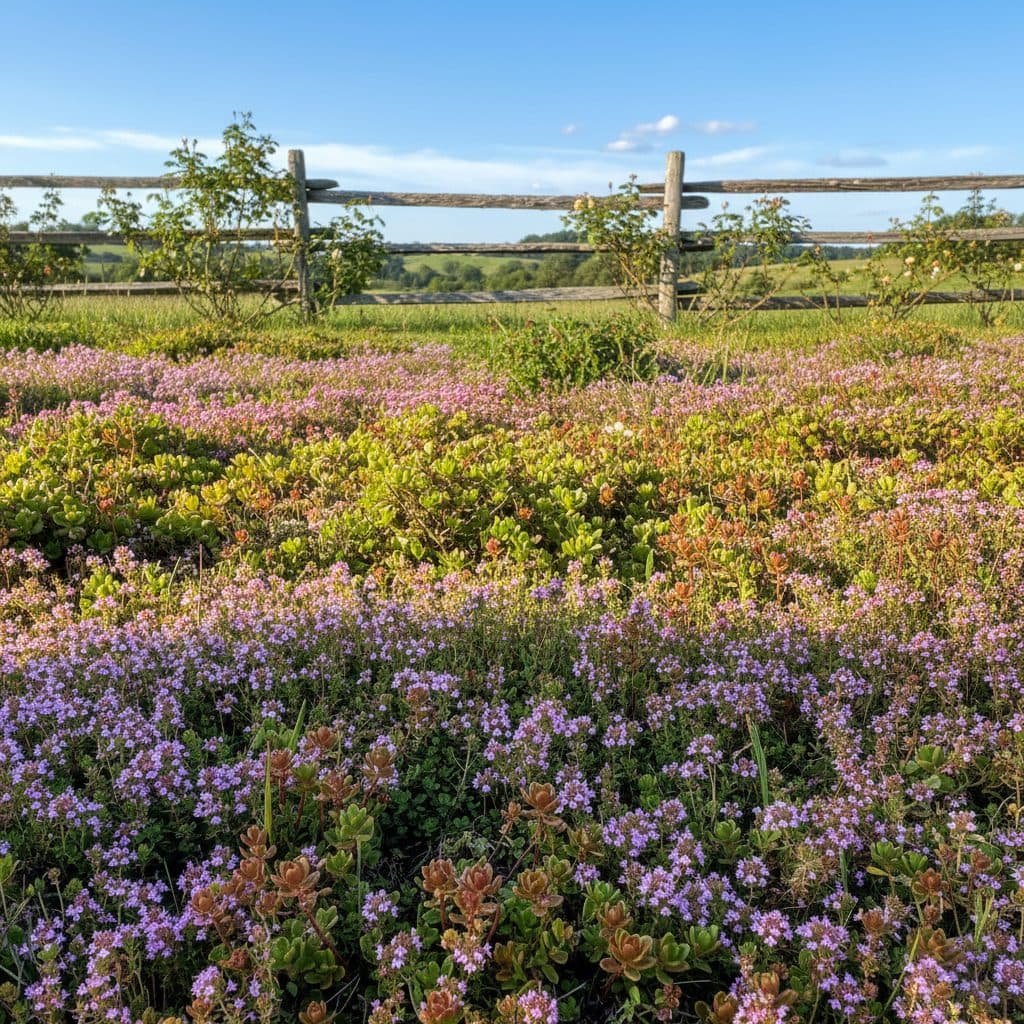
For areas bathed in full sun, selecting groundcovers that are both resilient and aggressive is key. In USDA zones 4 through 9, Creeping Thyme (Thymus serpyllum) is an excellent choice, forming a dense mat just 2 to 4 inches tall. It tolerates foot traffic, thrives in dry, well-drained soil, and its aromatic foliage deters some pests. Another strong performer is Sedum (Sedum spurium or Sedum reflexum), particularly varieties like ‘Dragon’s Blood’ or ‘Blue Spruce’. These succulents grow 4 to 8 inches high, spread quickly, and are incredibly drought-tolerant once established, requiring less frequent watering in arid regions like Arizona. They are hardy in zones 3 to 9 and provide vibrant color from summer into fall.
vigorous spreaders for open spaces
Creeping Phlox (Phlox subulata) offers a spectacular spring display and forms a thick, weed-resistant carpet 4 to 6 inches high, suitable for zones 3 to 9. It prefers full sun and well-drained soil, making it perfect for slopes or rock gardens. For larger areas, Dwarf Mondo Grass (Ophiopogon japonicus ‘Nana’) is a slow-growing but incredibly dense option for zones 6 to 10, reaching only 2 to 3 inches in height. While it establishes slower, perhaps taking a few years to fully fill in an area, its mature density effectively suppresses weeds. Consider also Ice Plant (Delosperma cooperi), which forms a brilliant, low-growing mat in zones 5 to 10, tolerating extreme heat and requiring minimal irrigation after its first year.
- Creeping Thyme: 2-4 inches tall, zones 4-9, tolerates light foot traffic.
- Sedum (Stonecrop): 4-8 inches tall, zones 3-9, highly drought-tolerant.
- Creeping Phlox: 4-6 inches tall, zones 3-9, vibrant spring blooms.
- Ice Plant: 1-3 inches tall, zones 5-10, thrives in hot, dry conditions.
- Dwarf Mondo Grass: 2-3 inches tall, zones 6-10, excellent long-term density.
tackling weeds in dry shade conditions
Dry shade, the challenging combination of low light and limited moisture, is a common problem under mature trees, along north-facing walls, or in dense urban canyons. In regions like the Pacific Northwest or the Northeast, where large deciduous trees are prevalent, these conditions can make gardening difficult. Weeds that do manage to grow here, such as English ivy or certain types of wild ginger, can be particularly aggressive. The key to successful weed suppression in dry shade is selecting plants that can tolerate both reduced sunlight (often less than 3 hours of direct sun) and competition for water from established tree roots. Research suggests that mixed species installations can reduce weed biomass by 70% in shaded areas compared to single-species plantings [4].
strategies for moisture-deprived, low-light areas
Groundcovers for dry shade must be drought-tolerant, shade-loving, and capable of forming a dense canopy even with limited resources. Many traditional groundcovers struggle here, as the soil often remains dry due to tree root uptake and lack of rainfall penetration. Amending the soil with organic matter, such as compost, can significantly improve moisture retention, increasing water availability in the topsoil. This initial investment in soil health can significantly reduce the need for supplemental irrigation during establishment. For more insights into plants that thrive in these conditions, refer to our guide on plants for full shade.
- Root competition: Groundcovers outcompete tree roots for surface moisture and nutrients.
- Light deprivation: Leaves block much of the ambient light, preventing weed seed germination.
- Soil improvement: Adds organic matter, improving water retention.
- Erosion control: Stabilizes soil on slopes with limited light, reducing runoff.
- Reduced maintenance: Significantly cuts weeding time after establishment.
resilient groundcovers for dry shade
Finding plants that thrive in dry shade can be challenging, but several species excel in these tough conditions, providing excellent weed suppression. Barrenwort (Epimedium spp.), hardy in USDA zones 4 through 9, is a standout. It forms a dense, evergreen or semi-evergreen mat 8 to 12 inches tall, tolerating dry soil once established and offering delicate flowers in spring. Its tough foliage effectively blocks sunlight and outcompetes weeds. Another reliable choice is Sweet Woodruff (Galium odoratum), which spreads vigorously to form a lush carpet 6 to 10 inches high. It prefers consistent moisture during establishment but becomes quite drought-tolerant in zones 4 to 8 after its first year, reducing weed growth significantly.
tough plants for challenging spots
Bigroot Geranium (Geranium macrorrhizum) is a robust, semi-evergreen perennial that grows 12 to 18 inches tall and spreads effectively in zones 3 to 8. It tolerates a wide range of conditions, including dry shade, and its aromatic leaves help deter deer—a significant advantage in many US regions. For smaller, more delicate areas, Foamflower (Tiarella cordifolia) provides a lovely textured groundcover, reaching 6 to 12 inches in height. It thrives in moist to dry shade in zones 3 to 8, establishing a dense cover within 2 to 3 years. Consider also Spotted Deadnettle (Lamium maculatum), particularly cultivars like ‘Beacon Silver’, which grows 6 to 8 inches tall and provides year-round foliage in zones 3 to 8, suppressing many weeds in its footprint. For more options that can handle challenging conditions, explore our guide on ground cover plants, and for deer-resistant options, see our deer resistant plants article.
- Barrenwort (Epimedium): 8-12 inches tall, zones 4-9, evergreen foliage.
- Sweet Woodruff: 6-10 inches tall, zones 4-8, spreads rapidly after establishment.
- Bigroot Geranium: 12-18 inches tall, zones 3-8, deer-resistant qualities.
- Foamflower: 6-12 inches tall, zones 3-8, delicate texture in deep shade.
- Spotted Deadnettle: 6-8 inches tall, zones 3-8, provides year-round silver foliage.
successful installation and long-term care
Proper installation is just as critical as plant selection for effective weed suppression. Begin by thoroughly clearing the area of all existing weeds, including their roots. For stubborn perennial weeds, this might involve multiple rounds of weeding over several weeks, or using a non-selective herbicide before planting. Next, amend the soil with 2 to 4 inches of organic compost, especially in dry shade areas to improve water retention by 15% to 20%. This provides a nutrient boost and helps establish a healthy root system. Plant groundcovers at the recommended spacing to ensure they knit together quickly, ideally within one to two growing seasons.
establishing a weed-free foundation
After planting, water thoroughly and consistently for the first 6 to 8 weeks to help plants establish. A soil moisture meter can be an invaluable tool to monitor soil humidity, preventing both overwatering and underwatering, especially in new beds. Aim to keep the topsoil consistently moist, but not waterlogged. Once established, most weed-smothering groundcovers are remarkably low-maintenance, requiring minimal supplemental water—perhaps every 10 to 14 days during dry spells. An annual top-dressing of compost in spring can replenish nutrients and further suppress any new weed seeds. This approach can significantly reduce overall maintenance time compared to traditional mulching or frequent weeding. For more low-maintenance plant options, see our guide on low maintenance perennials.
- Thorough Weed Removal: Clear all existing weeds, including roots, 2-3 weeks before planting.
- Soil Amendment: Incorporate organic compost to improve soil structure.
- Correct Spacing: Plant groundcovers 6-12 inches apart for quick coverage within 1-2 seasons.
- Consistent Watering: Water deeply for the first 6-8 weeks, aiming for 1 inch of water weekly.
- Annual Top-Dressing: Apply 1 inch of compost each spring to maintain soil health.
Weed-Smothering Groundcovers: Full Sun vs. Dry Shade
Characteristic | Full Sun Groundcovers | Dry Shade Groundcovers |
|---|---|---|
Light Requirement | 6+ hours direct sun | Less than 3 hours direct sun |
Moisture Tolerance | Drought-tolerant once established | Tolerates dry soil (after establishment) |
Growth Habit | Vigorous, spreading, mat-forming | Spreading, often rhizomatous |
Typical Height | 2-8 inches | 6-18 inches |
Weed Suppression | Excellent (80-90% reduction) | Very Good (60-85% reduction) |
Examples | Creeping Thyme, Sedum, Creeping Phlox | Barrenwort, Sweet Woodruff, Bigroot Geranium |
Weed Reduction: Well-established groundcovers can reduce weed emergence by 80% to 90% in garden beds [3].
Soil Improvement: Adding 2-3 inches of organic compost can increase soil moisture retention by 15% to 20%.
Frequently asked questions
How long does it take for groundcovers to effectively suppress weeds?
Most groundcovers achieve significant weed suppression within one to two growing seasons. For example, a planted area with fast-spreading varieties can reach good coverage in 12 to 18 months, drastically reducing weed growth.
Do I need to prepare the soil before planting weed-smothering groundcovers?
Yes, thorough soil preparation is crucial. Removing all existing weeds and incorporating 2 to 4 inches of organic compost improves soil structure and moisture retention by 15% to 20%, giving your new plants a strong start.
Can groundcovers completely eliminate weeds?
While groundcovers can reduce weed emergence by 80% to 90% [3], complete elimination is rare. Some persistent weeds may still emerge, especially during the first year, requiring occasional manual removal.
Are there any groundcovers that are also deer-resistant?
Yes, several weed-smothering groundcovers exhibit deer resistance. Bigroot Geranium (<em>Geranium macrorrhizum</em>) is a good example, often left untouched by deer in USDA zones 3 through 8 due to its aromatic foliage.
How much water do groundcovers need after establishment?
Once established, many groundcovers are quite drought-tolerant. In most climates, they may only need supplemental watering of about 1 inch every 10 to 14 days during prolonged dry spells, especially in zones 6 to 8.
References
- Weed smothering in jute with green gram intercropping (2016). Weed smothering in jute with green gram intercropping.
- Weed smothering efficiency and cotton equivalent productivity of Bt cotton based intercropping systems (2021). Weed smothering efficiency and cotton equivalent productivity of Bt cotton based intercropping systems.
- The Smothering Effect of <i>Dolichos lablab</i> L. (1967). The Smothering Effect of <i>Dolichos lablab</i> L..
- Reducing Weeds in Ornamental Groundcovers under Shade Trees through Mixed Species Installation (2003). Reducing Weeds in Ornamental Groundcovers under Shade Trees through Mixed Species Installation.
- SELECTIVE BROADLEAF WEED CONTROL IN GROUNDCOVERS (2006). SELECTIVE BROADLEAF WEED CONTROL IN GROUNDCOVERS.
- Long-term response of groundcover components to organic and conventional weed control in shaded and open-sun coffee in Nicaragua (2020). Long-term response of groundcover components to organic and conventional weed control in shaded and open-sun coffee in Nicaragua.