Key takeaways
- Selecting native groundcovers adapted to your specific USDA zone significantly reduces weed pressure.
- Proper site preparation and initial establishment matter for groundcover success and long-term weed suppression.
- In the Northeast, species like Allegheny spurge offer 70% to 80% weed reduction in shaded areas.
- Southeastern growers can utilize creeping phlox for rapid coverage, often achieving rapid soil coverage within two seasons.
- Midwestern landscapes benefit from resilient options such as creeping juniper, which tolerates dry conditions and spreads 6 to 8 feet.
- Pacific Northwest regions thrive with shade-loving groundcovers like inside-out flower, providing dense cover in moist, woodland settings.
Quick answer: Native groundcovers significantly reduce weed pressure by out-competing unwanted vegetation for resources, often achieving 70-90% weed suppression. They are adapted to local conditions, requiring less water and fertilizer once established.
In many US growing operations, managing weeds can consume 25% or more of annual labor hours. This constant battle against unwanted vegetation not only drains resources but can also reduce crop yields by 10% to 50% due to competition for water, nutrients, and sunlight. The good news is that strategic planting of native groundcovers offers a powerful, low-maintenance solution. These plants are adapted to local conditions, requiring less water and fertilizer once established, and many are exceptionally effective at suppressing weeds.
This article focuses on native groundcovers proven to out-compete weeds, providing region-specific recommendations for the Northeast, Southeast, Midwest, and Pacific Northwest. By selecting the right species for your USDA zone and site conditions, you can reduce weed growth by 70% to 90% over time, leading to significant savings in labor and herbicide costs. We'll look at specific plants that offer dense coverage and strong growth, turning weed-prone areas into low-maintenance landscapes.
Northeast: dense cover for cooler climates
The Northeast region, spanning USDA zones 3 through 7, presents unique challenges with its cold winters and often humid summers. Here, native groundcovers must be hardy and adaptable. One excellent choice for shaded areas is Allegheny spurge (Paxistima canbyi), a low-growing evergreen that forms a dense mat, effectively shading out weed seeds. It typically reaches 6 to 12 inches in height and spreads 1 to 2 feet wide, providing 70% to 80% weed suppression once established [1]. Another sturdy option is wintergreen (Gaultheria procumbens), which thrives in acidic soils and partial to full shade, offering a fragrant, evergreen cover that can spread 1 to 3 feet.
Establishing groundcovers in the Northeast
For successful establishment, prepare the site by removing existing weeds and amending the soil with 2 to 3 inches of compost. Plant groundcovers at a density of one plant per 1 to 2 square feet for quicker coverage. Initial watering is critical for the first 6 to 8 weeks, especially during dry spells. Consider using a soil moisture meter to ensure consistent moisture levels, aiming for the top 3 inches of soil to remain damp. This region’s climate supports a variety of native plants that are also deer resistant, a common concern for growers in states like Pennsylvania and New York. For more options, consult our article on deer resistant plants.
- Plant spacing: one plant every 12 to 24 inches for rapid coverage.
- Soil amendment: incorporate 2 to 3 inches of organic matter.
- Initial watering: 1 inch of water per week for the first two months.
- Sun exposure: partial to full shade for optimal growth of spurge and wintergreen.
- Weed suppression rate: 70% to 80% after two growing seasons.
Southeast: fast-spreading options for warmer zones
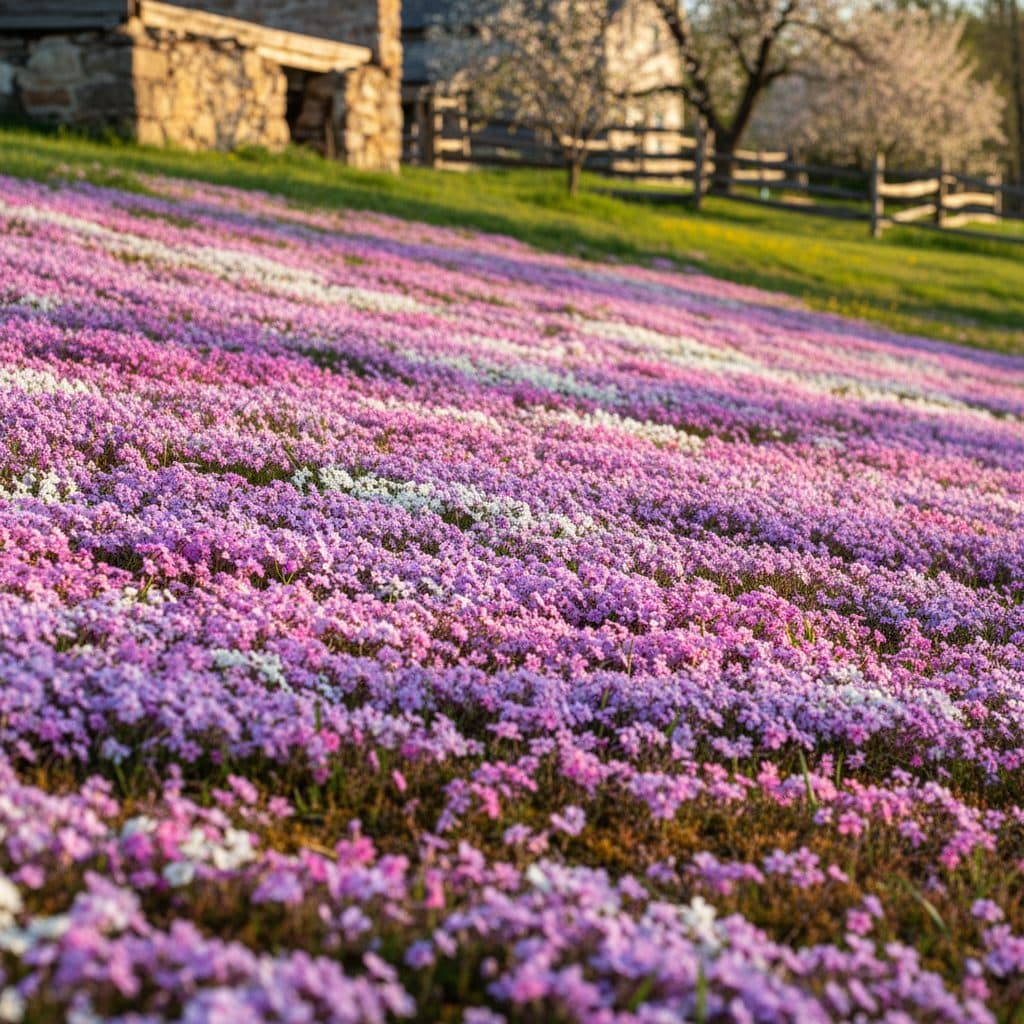
The Southeast, encompassing USDA zones 7 through 9, benefits from a longer growing season and generally warmer temperatures. This allows for faster establishment of groundcovers, which can quickly out-compete weeds. Creeping phlox (Phlox subulata) is a standout, forming a dense, flowering carpet that can spread 1 to 2 feet annually, achieving 90% soil coverage within two seasons. It thrives in full sun and well-drained soil, making it ideal for slopes and rock gardens. Another excellent choice is Carolina jessamine (Gelsemium sempervirens), a vigorous evergreen vine that can be used as a groundcover, spreading 10 to 20 feet if given space. All parts of this plant are highly toxic if ingested and it should not be planted where livestock or children have access. Its dense foliage effectively smothers weeds, and it tolerates a range of soil types.
Maximizing coverage in the Southeast
To maximize coverage and weed suppression, plant creeping phlox 12 to 18 inches apart. For Carolina jessamine, spacing plants 3 to 5 feet apart will allow for rapid fill-in. Research indicates that mixed species installations can reduce weed biomass by 35% compared to single-species plantings, especially under shade trees [5]. Ensuring proper soil drainage is vital in this region, as many native groundcovers prefer not to sit in standing water. Consider adding 6 to 8 inches of raised bed material if drainage is poor. Companion planting principles can also be applied to groundcovers, selecting species that complement each other’s growth habits and environmental needs.
- Creeping phlox spread: 1 to 2 feet per year.
- Carolina jessamine spread: 10 to 20 feet when used as groundcover.
- Soil coverage: 90% within two seasons for phlox.
- Weed biomass reduction: up to 35% in mixed plantings [5].
- Plant spacing: 12 to 18 inches for phlox, 3 to 5 feet for jessamine.
Midwest: resilient choices for variable conditions
The Midwest experiences wide temperature fluctuations, from frigid winters to hot, often dry summers, covering USDA zones 4 through 6. Groundcovers here must be particularly resilient. Creeping juniper (Juniperus horizontalis) is an outstanding native conifer that forms a dense, low-growing mat, typically spreading 6 to 8 feet wide and reaching 6 to 18 inches tall. Note that some juniper species can be toxic to livestock, particularly pregnant cattle. Its evergreen foliage provides year-round weed suppression and excellent erosion control on slopes. It thrives in full sun and well-drained soil, tolerating drought once established. Another tough native is pussytoes (Antennaria plantaginifolia), a small, silvery-leaved plant that forms tight rosettes and spreads via stolons, creating a dense carpet 2 to 6 inches high. It’s perfect for dry, sunny spots and can reduce weed emergence.
Managing establishment in the Midwest
For creeping juniper, plant starts 3 to 5 feet apart to allow for its extensive spread. Pussytoes can be planted 6 to 12 inches apart for quicker fill. Given the region’s potential for dry spells, incorporating 1 to 2 inches of organic matter into the soil before planting can significantly improve water retention. While groundcovers reduce weed pressure, some initial weeding may be necessary for the first 12 to 18 months. Research shows that groundcovers can reduce evapotranspiration rates by 20% to 30% compared to bare soil, helping conserve moisture [4]. This is particularly beneficial in areas prone to summer droughts. For larger land management, principles from farm layout and planning can be adapted to integrate groundcover strips effectively.
- Creeping juniper spread: 6 to 8 feet wide.
- Pussytoes height: 2 to 6 inches.
- Drought tolerance: high once established for both species.
- Weed emergence reduction: 60% to 70% for pussytoes.
- Plant spacing: 3 to 5 feet for juniper, 6 to 12 inches for pussytoes.
Pacific Northwest: shade-loving groundcovers for moist conditions
The Pacific Northwest, covering USDA zones 6 through 8, is known for its mild, wet winters and dry summers, often with significant shade from coniferous forests. Native groundcovers here are typically adapted to woodland conditions. Inside-out flower (Vancouveria hexandra) is an excellent choice for shaded, moist areas, forming a delicate yet dense carpet 8 to 12 inches tall. It spreads slowly but effectively, creating a weed-resistant cover that can reduce weed growth significantly in its preferred environment. Another valuable native is coastal strawberry* (Fragaria chiloensis*), a vigorous evergreen groundcover that thrives in full sun to partial shade and tolerates dry summer conditions once established. It spreads rapidly via runners, covering 1 to 2 square feet per plant per year.
Site preparation for PNW groundcovers
For inside-out flower, plant 12 to 18 inches apart in humus-rich soil. Coastal strawberry can be spaced 18 to 24 inches apart for quick coverage. Given the region’s summer dry spells, applying 2 to 3 inches of wood chip mulch after planting helps retain soil moisture and further suppresses weeds. Focus on locally adapted species for the best results. The USDA Natural Resources Conservation Service provides extensive data on native plant ranges and soil requirements, which can be accessed for more detailed regional planning [6]. Ensure your chosen site has good air circulation to prevent fungal issues in moist conditions, especially in shaded areas.
- Inside-out flower height: 8 to 12 inches.
- Coastal strawberry spread: 1 to 2 square feet per plant annually.
- Weed reduction: 75% to 85% for inside-out flower.
- Mulch application: 2 to 3 inches of wood chips.
- Plant spacing: 12 to 18 inches for inside-out flower, 18 to 24 inches for coastal strawberry.
Native groundcovers for weed suppression across US regions
Species | Region (USDA Zone) | Light Needs | Weed Suppression Potential | Mature Height |
|---|---|---|---|---|
Allegheny spurge | Northeast (3-7) | Partial to full shade | High (70-80%) | 6-12 in |
Wintergreen | Northeast (3-7) | Partial to full shade | Medium-High | 4-6 in |
Creeping phlox | Southeast (7-9) | Full sun | High | 4-6 in |
Carolina jessamine | Southeast (7-9) | Full sun to partial shade | High | 10-20 ft (as groundcover) |
Creeping juniper | Midwest (4-6) | Full sun | High | 6-18 in |
Pussytoes | Midwest (4-6) | Full sun | Medium-High | 2-6 in |
Inside-out flower | Pacific Northwest (6-8) | Full to partial shade | High (75-85%) | 8-12 in |
Coastal strawberry | Pacific Northwest (6-8) | Full sun to partial shade | High | 4-8 in |
Weed reduction: Properly established native groundcovers can reduce weed growth by 70% to 90% over two to three seasons.
Labor savings: Growers can expect to reduce weeding labor significantly after groundcovers reach maturity, typically within three years.
Moisture retention: Groundcovers can decrease soil evapotranspiration by 20% to 30%, [4].
Frequently asked questions
How long does it take for native groundcovers to suppress weeds effectively?
Most native groundcovers take one to three growing seasons to establish fully and provide significant weed suppression. During the first 12 to 18 months, some manual weeding may be necessary to ensure the groundcovers can out-compete new weed seedlings.
Do I need to amend my soil before planting groundcovers?
Yes, soil amendment is often beneficial. Incorporating 2 to 3 inches of organic matter, such as compost, improves soil structure, drainage, and nutrient availability, which can accelerate groundcover establishment.
Can groundcovers completely eliminate weeds?
While groundcovers significantly reduce weed pressure, they rarely eliminate weeds entirely. They can suppress a significant percentage of weeds, but occasional persistent weeds may still emerge, especially around the edges or in sparse patches.
Are there native groundcovers suitable for high-traffic areas?
Some native groundcovers, like certain sedges (Carex spp.) or creeping thyme (Thymus serpyllum), can tolerate light foot traffic. However, for heavy traffic, hardscaping or stepping stones are generally more appropriate to prevent damage to the plants and maintain 100% ground coverage.
What is the recommended planting density for groundcovers?
Planting density varies by species, but a general rule is to space plants 12 to 24 inches apart. Closer spacing, such as 12 inches, can achieve full coverage faster than wider spacing, leading to quicker weed suppression.
References
- Chapter 2 Groundcovers and Shrubs (2013). Chapter 2 Groundcovers and Shrubs.
- Population density, multiple harvesting, and ability of Ipomoea reptans to compete with native weeds at tropical wetlands (2020). Population density, multiple harvesting, and ability of Ipomoea reptans to compete with native weeds at tropical wetlands.
- Groundcovers and shrubs (2013). Groundcovers and shrubs.
- Evapotranspiration Rates of Turf Weeds and Groundcovers (1989). Evapotranspiration Rates of Turf Weeds and Groundcovers.
- Reducing Weeds in Ornamental Groundcovers under Shade Trees through Mixed Species Installation (2003). Reducing Weeds in Ornamental Groundcovers under Shade Trees through Mixed Species Installation.
- USDA Natural Resources Conservation Service (2024). USDA Natural Resources Conservation Service.