Key takeaways
- A kitchen garden kit provides all essential inputs—containers, growing media, seeds, and organic nutrients—in a single starter package.
- Standard starter kits contain UV-treated HDPE grow bags, compressed cocopeat blocks, vermicompost, neem cake powder, and seasonal vegetable seeds.
- State horticulture departments and commercial suppliers offer starter kits designed for urban balconies, rooftops, and kitchen gardens.
- Government kit schemes vary significantly by state, district, and application season; verify current terms with local horticulture offices.
- Hydrating cocopeat properly and blending it with organic compost and neem khali creates a lightweight, aerated root medium.
- Starting with fast-germinating greens (palak, methi, coriander) and resilient fruiting vegetables (bhindi, brinjal) ensures early growing success.
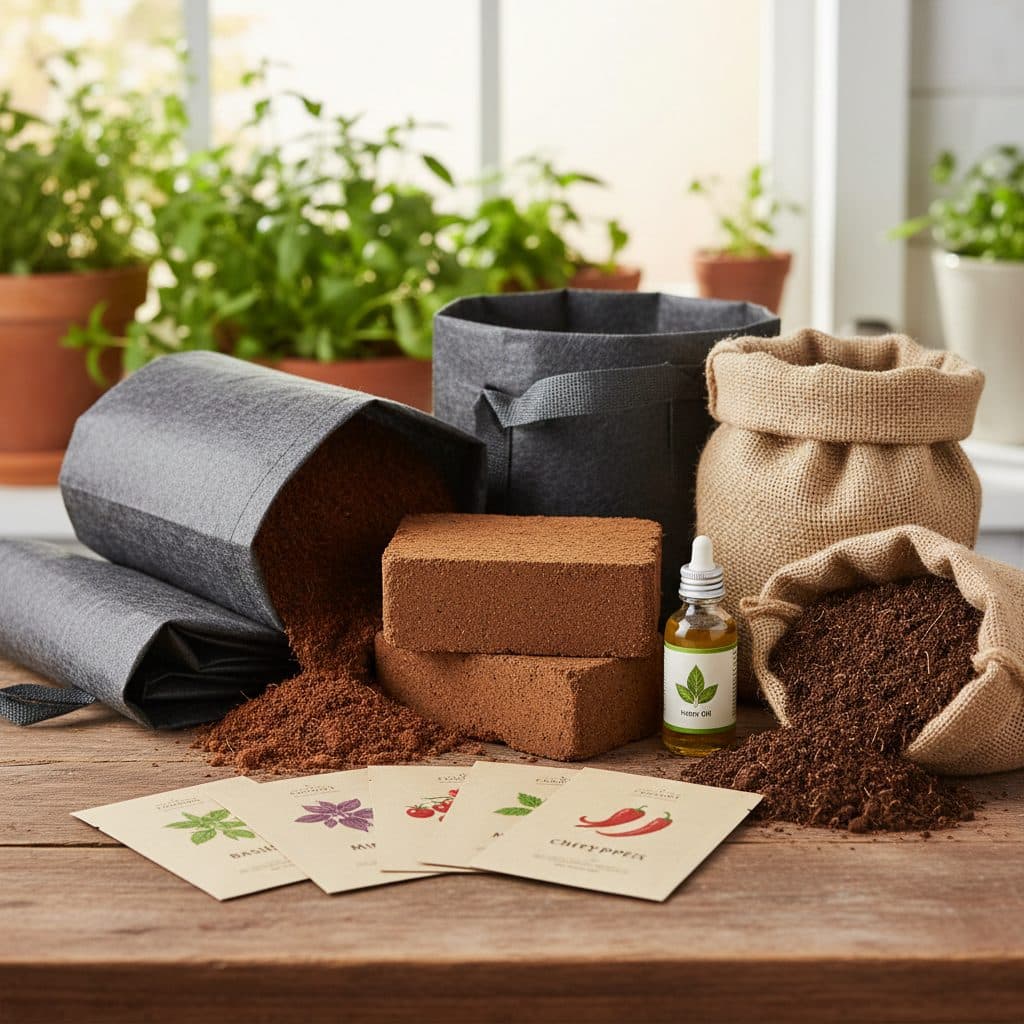
Quick answer: A kitchen garden kit is an all-in-one starter package containing grow bags, compressed cocopeat, organic bio-fertilizers, seasonal seeds, and basic tools. It allows beginners to establish an urban kitchen garden on balconies or terraces without sourcing individual materials from separate agricultural nurseries.
Starting a vegetable garden in an Indian apartment or urban home can feel overwhelming when sourcing components separately. Beginners often struggle to find quality seeds, lightweight growing media, non-toxic pest sprays, and durable containers across multiple vendors.
A kitchen garden kit solves this logistical hurdle by bundling balanced growing materials into a single package. Whether you intend to grow fresh coriander and methi on a windowsill or establish a productive vegetable terrace in Chennai, Bengaluru, or Delhi, a well-designed starter kit provides a reliable foundation.
Understanding what materials a quality kit should contain, how government horticulture kit schemes operate, and how to assemble your first planting containers ensures a smooth transition from unboxing to your first fresh harvest.
What is included inside a quality kitchen garden kit?
Starter kits vary in scale from compact four-pot balcony sets to comprehensive twenty-bag rooftop configurations. High-quality kits contain four core categories of materials.
+-------------------------------------------------------------+
|              STANDARD KITCHEN GARDEN KIT MODULES            |
+-------------------------------------------------------------+
|1. GROW CONTAINERS   | UV-Stabilized HDPE Grow Bags (200 GSM)|
|2. GROWING MEDIA     | Compressed Low-EC Cocopeat Bricks    |
|3. PLANT NUTRITION   | Vermicompost & Organic Neem Khali    |
|4. SEED SELECTION    | Heirloom/Desi Vegetable Seed Packets |
|5. CROP CARE & TOOLS | Cold-Pressed Neem Oil & Hand Trowel  |
+-------------------------------------------------------------+
1. Growing containers
- Grow bags: either UV-stabilised woven HDPE bags (durable, drains through base eyelets) or non-woven geotextile fabric bags (breathable through the wall, air-prunes circling roots). Both should be UV-treated for tropical sun.
- Size variety: Kits typically include small bags (24x24 cm) for shallow-rooted greens, medium bags (30x30 cm) for bush vegetables like chillies and brinjal, and deep containers for root crops.
2. Growing media and soil conditioners
- Compressed cocopeat blocks: Washed, low-salinity coconut coir pith that expands up to five to six times its dry volume when soaked in water. Cocopeat provides aeration and water retention without adding excessive roof weight.
- Vermicompost or microbial bio-fertilizers: Enriched worm castings that deliver essential plant nutrients and beneficial soil biology.
- Neem cake powder (neem khali): Organic residue from neem seed pressing that enriches the medium with slow-release nitrogen while deterring soil nematodes.
3. Seasonal seed packets
Reputable kits provide open-pollinated, non-GMO seeds suited to Indian growing seasons:
- Leafy greens: Palak (spinach), methi (fenugreek), coriander (kothimbir/dhania), and amaranth (chaulai).
- Fruiting vegetables: Bhindi (okra/ladies finger), brinjal (eggplant), tomato, and green chillies.
- Climbers: Ridge gourd (turai), bottle gourd (lauki), and pole beans.
4. Basic crop protection and tools
- Cold-pressed neem oil: Botanical bio-pesticide for managing aphids, whiteflies, and mites.
- Hand tools: Metal or composite hand trowel, mini cultivator, and hand pressure sprayer.
Government horticulture kits vs commercial starter boxes
In India, home growers can acquire kitchen garden kits through two main routes: state government agricultural initiatives or private commercial brands.
       Kitchen Garden Kit Sourcing Channels

 [Urban Home Gardener]
          |
     +----+----+
     |         |
     v         v
 [State Horticulture Dept]     [Commercial Agro Brands]
 (e.g. Tamil Nadu DoH Scheme)  (Online & Local Nurseries)
 (Subsidized Seasonal Quotas)  (Year-Round Availability)
State government horticulture kit schemes
Several state governments operate urban horticulture initiatives to encourage home food production. A prominent example is the terrace gardening kit initiative run by the Department of Horticulture and Plantation Crops in Tamil Nadu. Several other states have at various times run comparable urban or terrace horticulture kit schemes. Because these open, close and change contents by budget cycle, check your own state's horticulture portal or district office for what is currently running.
- What schemes provide: Government kits typically include subsidized grow bags, compressed coir blocks, seed packets, bio-fertilizers (such as Azospirillum and Phosphobacteria), and bio-control inputs (the fungus Trichoderma viride as a soil and seed bio-fungicide, plus neem-based sprays).
- Variability of terms: Scheme availability, subsidy percentages, application windows, kit contents, and delivery mechanisms vary by state, municipal corporation, and district. Quotas are often released seasonally ahead of monsoon rains.
- How to apply: Applications are generally submitted through state horticulture web portals, citizen service centers, or directly at district horticulture offices and Krishi Vigyan Kendras (KVK).
- Important guidance: Because government subsidy guidelines change frequently, contact your local district horticulture officer or visit the official state agricultural portal to confirm current eligibility, documentation requirements, and distribution dates.
Commercial starter kits
Commercial kits are readily available online and at urban garden centers year-round. While they do not carry government subsidies, they offer standardized packaging, detailed multi-lingual growing instructions, and specialized variations (such as salad garden kits, exotic herb boxes, or microgreen trays).
Step-by-step setup: from box to first sowing
Proper assembly of your kit materials ensures rapid seed germination and healthy root development.
Step 1: Hydrate and wash the cocopeat block
- Place the compressed cocopeat brick into a large tub or clean bucket.
- Add roughly 4 to 5 litres of water per kilogram of dry compressed coir — about 3 litres for a 650 g brick, 15 to 20 litres for a 5 kg block. Allow 30 to 60 minutes for full expansion.
- Fluff the expanded coir by hand, checking that no dry compressed cores remain.
- If the kit does not specify that the cocopeat is pre-washed, rinse the expanded pith with clean water and squeeze out excess moisture to drain any residual salts.
Step 2: Blend the potting media
In a broad mixing tray or on a clean tarp, blend your growing medium:
- Combine expanded cocopeat with vermicompost and neem cake powder in the proportions recommended in your kit (typically two parts cocopeat to one part compost, with a handful of neem cake per container).
- If you have access to local garden soil, adding one part clean soil provides structural minerals and beneficial local microbes.
Step 3: Fill grow bags and prepare drainage
- Unfold each grow bag and gently shape the base flat.
- Check that bottom drainage eyelets are open and unobstructed.
- Fill the grow bag with the potting blend up to 3 to 4 cm below the top rim, tapping the sides gently to settle air pockets without packing the media tightly.
       Grow Bag Potting & Sowing Profile

       +---------------------------------------+
 ===== | 3-4 cm Freeboard Rim                  | =====
 ----- +---------------------------------------+ -----
       | Topdressing: Thin Sifted Compost      |
       | (.) Seeds Sown at 2-3x Diameter Depth |
       |                                       |
       | Aerated Mix: Cocopeat + Vermicompost  |
       |                                       |
 ~~~~~ +~~~~~~~~~~~+ ~~~~~
       | Bottom Drainage Eyelets & Air Base    |
Step 4: Sowing seeds at the correct depth
Beginners often bury seeds too deeply, preventing emerging sprouts from reaching the surface.
- Small seeds (coriander, methi, palak): Scatter thinly across the surface and cover with a light 0.5 cm dusting of fine compost.
- Bhindi (okra): press in about 1.5 to 2 cm deep. Brinjal and chillies: cover with only about 0.5 cm of fine sifted mix — roughly two to three times the seed's own thickness.
- Reviewing seedling care and direct sowing spacing ensures you thin crowded sprouts early to avoid weak, spindly stems.
Ongoing care and scaling your garden
Once seeds germinate, consistent observation and maintenance keep your kitchen garden productive:
- Sunlight transition: Keep newly seeded containers in bright, indirect light until green cotyledon leaves emerge, then transition them into at least four to six hours of direct morning sun.
- Gentle watering: Use a fine rose watering can or hand spray bottle during the first two weeks to avoid dislodging delicate rootlets.
- Vertical support: As climbing vegetables (ridge gourd, bottle gourd) develop true leaves, install bamboo stakes or string trellises; explore vertical vining crops in pots for space-efficient trellising.
- Balcony management: If growing in apartment spaces, consulting balcony container vegetable gardening helps manage restricted sunlight angles and wind exposure.
- Preventative pest care: Spray diluted neem oil spray (5 ml per litre of water) every fourteen days to deter whiteflies, thrips, and mites before populations build up. For leaf-chewing caterpillars, explore organic caterpillar and beetle control for non-toxic management.
A well-chosen kitchen garden kit removes the complexity of starting from scratch, providing beginners with the practical tools and media needed for a bountiful harvest.