Key takeaways
- High tunnels can increase internal temperatures by 10-20°F, requiring specific management for summer production.
- Select heat-tolerant crop varieties like heat-set tomatoes, okra, and sweet potatoes to thrive in temperatures over 90°F.
- Implement passive cooling strategies such as roll-up sides, endwall vents, and 30-50% shade cloth to manage heat.
- Utilize off-grid solar power for essential high-tunnel systems like ventilation fans and drip irrigation pumps.
- Consistent irrigation, often via drip systems, helps prevent plant stress and support yields in hot conditions.
- Careful planning and environmental control can extend the high-tunnel growing season by several weeks into late summer.
Quick answer: High tunnels can extend summer harvests in USDA Zone 6 by using heat-tolerant crops and passive cooling methods like shade cloth. Consistent drip irrigation, often powered by off-grid solar, also matters.
For homesteaders in regions like the Midwest, where summer temperatures can regularly climb above 90°F, extending the growing season into the hotter months presents a unique challenge. While high tunnels are often used mainly for early spring and late fall production, they can also be useful tools for growing heat-tolerant crops during the summer shoulder season, defined as periods just before and after the main growing season. This strategy allows for a more consistent harvest, providing fresh produce when open-field gardens might struggle.
However, the enclosed environment of a high tunnel can intensify summer heat, sometimes reaching 110°F or more on a 90°F day without proper management. Successfully growing in these conditions requires a clear understanding of crop selection, environmental control, and often, off-grid power solutions for cooling and irrigation. By focusing on specific plant varieties and implementing smart cooling techniques, growers can increase yields compared to traditional outdoor methods for certain crops.
Managing the summer shoulder season in a high tunnel
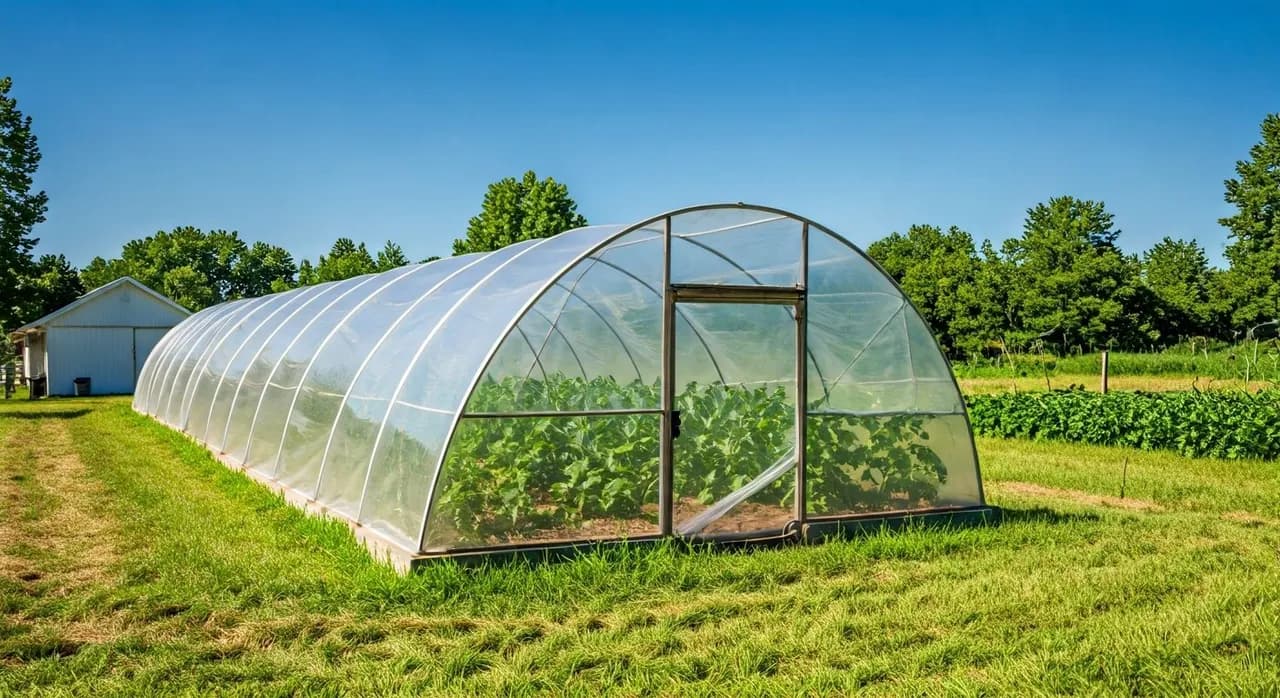
A high tunnel, essentially a large unheated greenhouse, acts as a solar collector, significantly raising internal air and soil temperatures. In regions like USDA zone 6, a sunny 85°F day can easily push the interior of a closed high tunnel past 100°F, creating a challenging environment for most plants. Understanding this heat dynamic is the first step in successful summer shoulder-season cultivation, allowing growers to plan for mitigation strategies that keep plants productive when outdoor conditions are less favorable [3].
The greenhouse effect in practice
The primary driver of heat buildup within a high tunnel is solar radiation, which passes through the plastic covering and warms the interior surfaces and air. Without adequate passive ventilation, this heat becomes trapped, leading to a rapid increase in air temperature. Soil temperatures can also rise dramatically, sometimes reaching 95°F at a 6-inch depth, which can stress root systems and impact nutrient uptake. For example, a study on aerobic rice found that irrigation regimes significantly affected growth and yield during the summer season [1].
- Internal temperatures can be 10-20°F higher than outside.
- Still air pockets can create localized hot spots exceeding 110°F.
- Soil temperatures at a 4-inch depth can reach 90-95°F on sunny days.
- High humidity often accompanies high temperatures, increasing disease pressure.
- Reduced air movement can hinder plant transpiration and cooling.
Choosing crops that thrive in intense summer conditions
Not all crops are created equal when it comes to heat tolerance. For successful summer production in a high tunnel, selecting varieties specifically bred for hot conditions is paramount. While many common garden vegetables struggle with blossom drop or poor fruit set when temperatures consistently exceed 90°F, certain cultivars are designed to continue producing, even when the mercury climbs toward 100°F. This careful selection can mean the difference between a sparse harvest and a bountiful one, potentially increasing yields for specific crops.
Beyond the usual suspects
For tomatoes, look for heat-set varieties like ‘Florida 91’ or ‘Solar Fire’, which can set fruit at temperatures up to 95°F. Peppers, especially certain chili types, also tolerate heat well; ‘Jalapeño M’ and ‘Habanero’ are good choices that continue producing in hot conditions. Okra is a true heat lover, thriving when temperatures are consistently above 80°F, with varieties like ‘Clemson Spineless’ yielding pods up to 6 inches long every few days. Sweet potato slips, planted in late spring, will flourish through the summer, producing large tubers by fall. Even some greens, like amaranth, New Zealand spinach, and Malabar spinach, are surprisingly heat-tolerant, providing fresh leaves when lettuce would bolt at 80°F. Consider planting long-day onions in late winter for a summer harvest, as they tolerate warm soil conditions [2].
- Heat-set tomatoes: ‘Florida 91’, ‘Solar Fire’, ‘Phoenix’.
- Heat-tolerant peppers: ‘Jalapeño M’, ‘Habanero’, ‘Bell Star’.
- Okra varieties: ‘Clemson Spineless’, ‘Cajun Delight’.
- Summer greens: Amaranth, New Zealand spinach, Malabar spinach.
- Other options: Sweet potatoes, yardlong beans, certain eggplant varieties.
Cooling strategies for extended summer production
Effective cooling is non-negotiable for summer high-tunnel success. Without it, even the most heat-tolerant plants will suffer, leading to reduced yields and increased disease susceptibility. The goal is to lower the internal temperature by at least 10-15°F on hot days, bringing it closer to the optimal range for plant growth. Many of these strategies can be implemented without relying on grid power, making them ideal for off-grid homesteads, which can also benefit from resources like solar for tiny homes or off-grid and hybrid solar systems for other homestead needs.
Passive and active cooling methods
The simplest and most effective cooling method is passive ventilation. This involves maximizing airflow by rolling up the sides of the high tunnel, often by 4-6 feet, and opening endwall vents. For larger tunnels, a 30-50% shade cloth density draped over the structure can reduce solar gain by a significant margin, sometimes lowering internal temperatures by 10-15°F on a 95°F day. This simple addition can extend the productive life of many crops by several weeks. Drip irrigation also delivers water directly to the root zone, cutting evaporative loss and helping cool the soil. Consider a small 12V DC fan, powered by a dedicated solar panel, for increased air circulation when passive methods aren’t enough.
- Roll-up sides: Open 4-6 feet high for maximum cross-ventilation.
- Endwall vents: Ensure large, unobstructed openings at both ends.
- Shade cloth: Use 30-50% density, deployed when temperatures exceed 85°F.
- Drip irrigation: Delivers water efficiently, reducing water usage.
- Evaporative cooling: Misting systems or wet pads can further lower temperatures, especially in arid climates.
Off-grid power for high-tunnel systems
For many homesteaders, the ability to operate a high tunnel independently of the grid is a core principle. While passive cooling goes a long way, small electrical loads for ventilation fans, irrigation pumps, or even automated vent openers can significantly improve summer performance. Fortunately, modern solar technology makes powering these essential systems entirely feasible. Understanding how to size and implement these systems is key to reliable operation, and resources like solar panels for off-grid living can provide detailed guidance.
Sizing your solar setup
A typical small high tunnel might require a 20-watt DC ventilation fan for air circulation and a 30-watt irrigation pump for a drip system. To power these for 6-8 hours a day, you’d need a modest solar panel array. A single 100-watt solar panel, combined with a 100Ah 12V battery bank capacity, can provide sufficient power for these loads, even with a few days of cloudy weather. The system would also require a charge controller to protect the battery and an inverter if any AC appliances are used, though DC components are generally more efficient. For more comprehensive off-grid power needs, exploring an off-grid solar kit explained can be beneficial.
- Solar panel: 100-200 watts for basic ventilation and irrigation.
- Battery bank: 50-100Ah 12V deep cycle battery for energy storage.
- Charge controller: 10-20 amp MPPT or PWM controller to manage charging.
- DC fan: 10-30 watt 12V fan for air circulation.
- DC pump: 20-50 watt 12V pump for drip irrigation systems.
Heat-tolerant crop comparison for high tunnels
Crop | Optimal Temp (°F) | Heat Tolerance (°F) | Notes |
|---|---|---|---|
Tomato (Heat-set) | 70-85 | 90-95 | Requires consistent water and good ventilation for fruit set. |
Pepper (Hot varieties) | 70-85 | 90-95 | Some varieties tolerate heat well, but fruit may be smaller. |
Okra | 80-95 | 100+ | Thrives in high heat and humidity, very productive. |
Sweet Potato | 75-95 | 100+ | Grows vigorously in summer, tubers mature in 90-120 days. |
Amaranth | 70-90 | 95+ | Leafy green that tolerates heat and drought better than lettuce. |
Shade cloth benefit: A 40% shade cloth can reduce internal high-tunnel temperatures by 10-15°F on a 95°F day, improving plant comfort and yield.
Water efficiency: Drip irrigation systems can significantly reduce water usage compared to overhead watering in a high tunnel, conserving useful resources.
References
- Response of aerobic rice to irrigation regimes and method of zinc application on growth and yield during summer season in lateritic soil (2020).
- Zea mays (2013).
- The effects of early season soil temperatures on emergence of summer crops on the north-western plains of NSW (1971).
- USDA Natural Resources Conservation Service (2024).